


CRM in digital marketing is the process of utilizing customer relationship management systems to collect, streamline, and utilize customer data across marketing channels. It allows marketing teams to monitor interactions, comprehend behavior, and execute more relevant digital marketing campaigns.
Actually, digital marketing agencies and marketing teams use CRM software to gather and synchronize customer data from various websites, social media, email marketing campaigns, and sales touchpoints into one centralized system. This enables marketers to sort audiences, customize interactions, and more accurately track the impact of their campaigns.
When it is utilized well, CRM in digital marketing simplifies all aspects, ranging from lead generation and lead nurturing to retention of customers and repeat purchases. Instead of considering every campaign as a one-off effort, marketers can establish and strengthen relationships based on genuine customer data.
What Is CRM in Digital Marketing?
Digital marketing CRM is the overall practice of utilizing a customer relationship management system to handle customer data, interactions, and communication across distinct digital channels. For marketers, CRM works as a central place where data regarding leads, customers, and their behavior is stored and updated over time.
A CRM system allows marketing teams to monitor how people communicate with a brand via email marketing campaigns, websites, social media, and paid channels. This data makes it simpler to understand where leads originate from, how they pass through the funnel, and which digital marketing efforts create conversions.
CRM marketing focuses on converting this data into action. Without CRM insights, you can end up sending the same generic messages to everyone, customizing campaigns, and ensuring all interactions are handled in a timely manner as per the actual behavior. This approach is specifically valuable for managing leads, retention, and repeat purchases.
In simple terms, CRM for marketers synchronizes customer data with daily marketing content and operations. It allows teams to launch campaigns consistently, ensure context across all touchpoints, and ensure sound decisions focused on measurable results instead of assumptions.
What Is CRM Marketing?
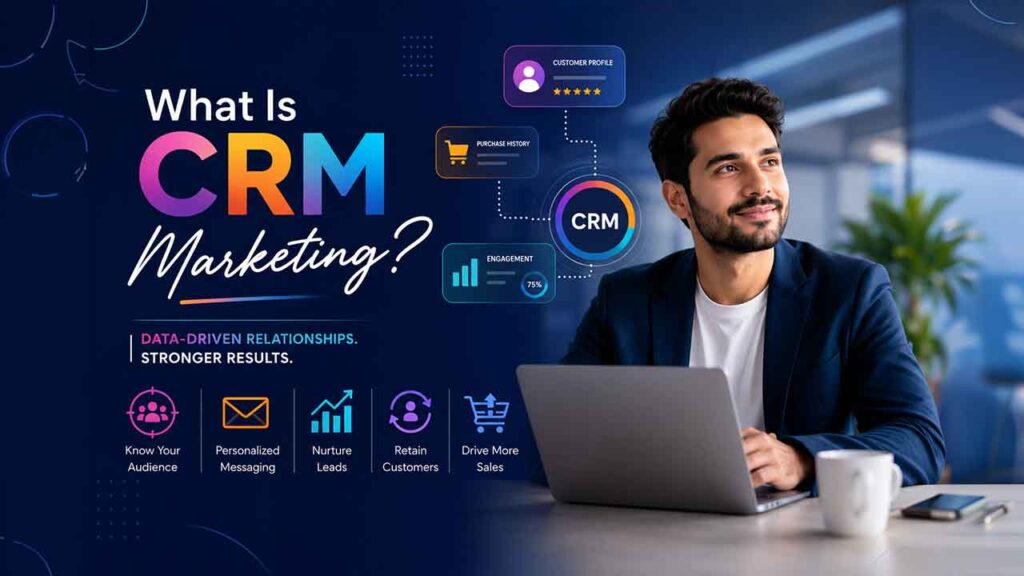
CRM marketing can be defined as a marketing strategy that utilizes data stored in a CRM system to strategize, implement, and streamline digital marketing campaigns. Instead of depending on one-time interactions or assumptions, CRM marketing is established on customer behavior, history, and engagement across distinct digital marketing channels.
In simple terms, CRM marketing tethers customer relationship management with routine marketing work. Marketers utilize CRM data to utilize who their audience is, how they converse with the brand, and what type of interaction is most important at every stage of the customer lifecycle.
A CRM marketing strategy provides support to the following marketing tasks:
- Grouping audiences as per their interests, behavior, or lifecycle stage.
- Customize messages across email marketing campaigns and other types of channels.
- Providing support to the generation of leads and consistent nurturing of leads.
- Enhancing customer retention and repeat purchases.
- Launch cross-sell and upsell campaigns as per the past activity.
When CRM information is augmented with marketing automation, teams can improve their efforts without losing context. This makes CRM marketing specifically valuable for SME businesses that require data-based and consistent communication without adding any manual work.
Understanding the Mechanics of CRM in Digital Marketing
CRM is quite efficient in digital marketing by collecting customer information from numerous touchpoints and converting it into organized inputs for campaigns. Instead of launching campaigns and nurturing leads using siloed tools, marketers can utilize CRM software to handle data, strategize communication, and track results in one place.
The points below explain how this really works in practice-
1. Collecting and Unifying Customer Data:
CRM platforms collect information from forms, websites, social media, email marketing campaigns, and sales interactions. This involves lead sources, contact details, email opens, page visits, and past purchases.
Through centralization of this data, marketers no longer need to depend on disconnected tools or spreadsheets. All customer relationship management information remains updated and connected as interaction takes place.
2. Monitoring Behavior and Grouping Audiences:
Once the data has been collected, CRM aids marketers in grouping audiences as per the interest, behaviors, locations, or lifecycle stages. For instance, leads who have visited the pricing page can be segmented separately from existing customers or newsletter subscribers.
CRM for marketers also makes it simpler to monitor how contacts pass through the funnel. This visibility aids in more effective targeting and more tailored campaigns for digital marketing.
3. Customized Journeys and Campaigns:
CRM marketing enables teams to customize communication and make it more targeted. Sending the same generic message to all customer segments does not yield the desired results. Personalization can allow you to target each segment with different offers, emails, or follow-ups as per their history or actions.
Personalization often becomes a deciding factor in retention campaigns and nurturing leads, where relevance and timing are more important than volume. Customization ensures that communication remains consistent across various channels without increasing manual work.
4. Improving ROI and Measuring Results:
CRM platforms monitor campaign performance along with customer data, making it simpler to track results over time. Marketers can get holistic visibility on which campaigns can repeat purchases, improve conversions, or ensure lasting engagement.
This data provides support to more sound decisions related to messaging, budget allocation, and automation. Thus, CRM marketing automation enables teams to enhance ROI and minimize wasted efforts across diverse digital marketing activities.
What Are the Advantages of CRM in Digital Marketing?
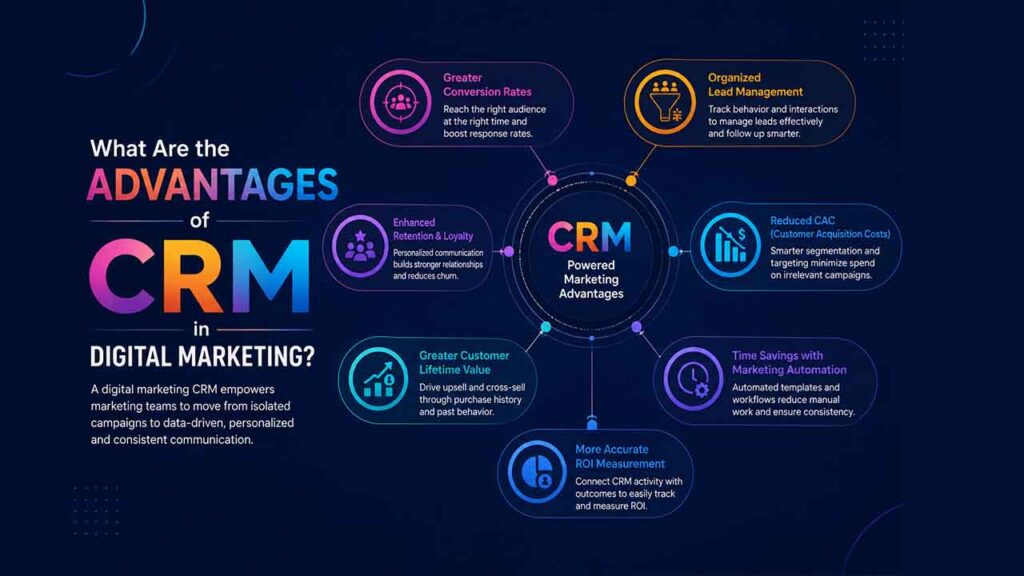
A digital marketing CRM empowers marketing teams to evolve from isolated campaigns to a more data-driven and consistent communication. Taking guesswork out of the picture, marketing teams would know what works and can depend on customer data to shape decisions across various channels:
The main advantages of CRM in Digital Marketing involve the following:
- Greater Conversion Rates: CRM marketers allow marketers to focus on the right audience at the right time, which enhances response rates across digital marketing campaigns.
- Organized Lead Management: By monitoring behavior and interactions, CRM provides support to organized management of leads instead of just sending one-off follow-ups.
- Enhanced Retention of Customers and Loyalty: Tailored communication as per CRM data aids in ensuring lasting relationships and minimizing churn.
- Reduced CAC (Customer Acquisition Costs): Better segmentation and targeting minimize wastage spent on irrelevant campaigns.
- Greater Customer Lifetime Value: CRM marketing provides support to upsell and cross-sell efforts by utilizing purchase history and past behavior.
- Time Savings Powered Through Marketing Automation: Automated templates and workflows minimize manual work while making sure that communication remains consistent.
- More Accurate ROI Measurement: The CRM platform connects CRM activity with outcomes, making it simpler to monitor ROI.
What Are the Challenges of Utilizing CRM in Digital Marketing?
While CRM in digital marketing provides clear advantages, there are also inherent challenges that marketing teams must address early-
- Consistent Data Entry: CRM marketing relies on consistent data input. Without clear processes or automation, sales reps would have to manually update data, which is not only time-consuming but can also lead to inaccuracies, specifically as contact lists evolve.
- Accuracy of Data: Outdated or inaccurate data minimizes the effectiveness of segmentation and leads to tailored campaigns. This makes it difficult to depend on CRM insights when planning digital marketing campaigns.
- Adoption and Training: One of the prevalent challenges is to enable the marketers to use the CRM in their day-to-day work. If the workflows are not clear and onboarding does not happen properly, CRM tools can risk being ignored or underused.
- Data Security: CRM platforms store sensitive data regarding customers, deals, and revenue. Thus, you need to make sure that permissions and access are well-protected to ascertain compliance and prevent unauthorized use.
Advanced CRM software aids in minimizing a lot of such issues through pre-built templates, automation, and integrations with third-party marketing tools. Advanced platforms integrate email marketing, CRM, and automation features in one CRM. This can make the adoption a lot simpler for small businesses and marketing teams.
What Are the Applications of CRM in Digital Marketing?
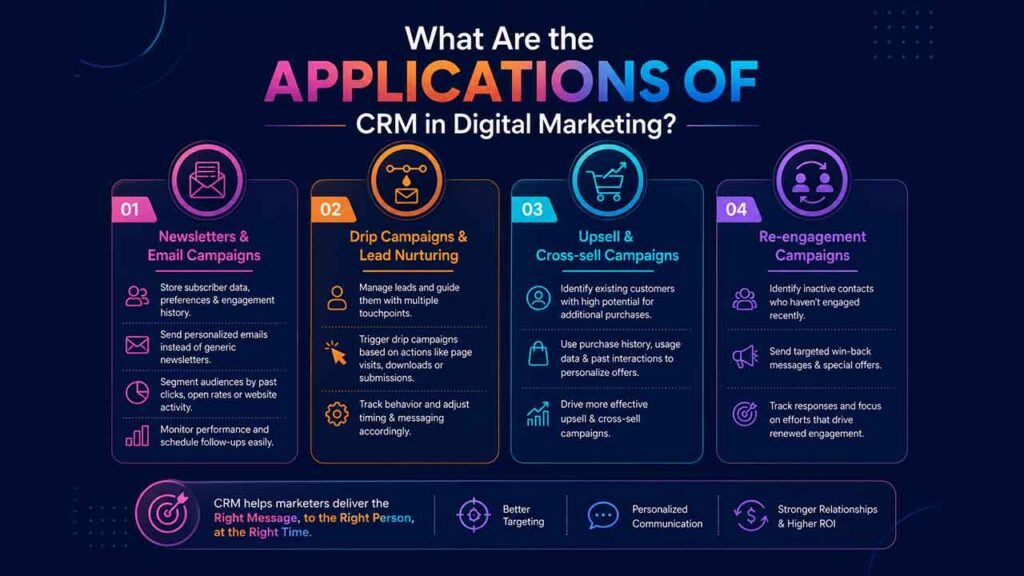
CRM in digital marketing is most effective when it is applied to particular types of campaigns. A few common scenarios where CRM can be used in the digital marketing industry to deliver more efficient and relevant communication are as follows:
1. Newsletters and Email Campaigns:
CRM platforms can store a variety of data, including subscribers’ data, preferences, and engagement history. This allows marketers to send personalized email marketing campaigns instead of low-quality and generic newsletters. Thus, based on the email campaign results, marketers can segment the audience. Essentially, marketers can group the data as per past clicks, open rate, or website activity, enhancing engagement and relevance.
CRM marketing automation also makes it simpler to monitor performance and schedule follow-ups across diverse email campaigns.
2. Drip Campaigns and Lead Nurturing:
The main use of CRM in digital marketing is in managing leads, specifically when leads need numerous touchpoints before conversion. Marketers can generate drip campaigns that get triggered by specific actions such as page visits, submissions, or content downloads. By monitoring behavior inside the CRM platform, teams can adjust timing and messaging as per the response of leads in digital marketing campaigns.
3. Upsell and Cross-sell Campaigns:
With CRM data, you can easily recognize present customers who have a higher possibility of purchasing additional services or products. Usage data, purchase history, and past interactions aid customers in creating personalized upsell and cross-sell campaigns.
Such campaigns are more effective since they are created based on real customer behavior instead of wider assumptions.
4. Re-engagement campaigns:
CRM marketing is also valuable for re-establishing communication with inactive contacts. Marketers can group customers who have not communicated with recent campaigns and trigger special offers and win-back messages. By monitoring responses inside the CRM software, teams can track which re-engagement efforts are worth trying and can lead to renewed retention and activity.
Getting Started with CRM in Digital Marketing
Beginning with CRM in digital marketing does not require large teams or complex setups. A lot of businesses can just start with a few simple steps and then scale with time.
- Determine Your Marketing Objectives: Begin by recognizing what you want to improve, like customer retention, lead generation, or customer lifetime value. If your objectives are clear, you will be in a better position to utilize your CRM data.
- Connect Your Data Sources: Gather customer information from important digital marketing channels such as email marketing campaigns, website forms, social media, and paid advertisements. Centralizing this information is fundamental to your CRM marketing strategy.
- Select a CRM platform: Find CRM software that provides support for both marketing tasks and customer relationship management. For marketing teams, this generally means segmentation, contact management, basic marketing automation, and email tools.
- Set Up Automation and Segmentation: Create standard audience segments and then launch one or two automated campaigns, like a lead nurturing sequence or welcome email.
- Establish Automation and Segmentation: Generate simple audience segments and launch one or two automated campaigns, like lead nurturing sequences or automated emails.
Even standard CRM automation, like triggered emails or automated follow-ups, allows marketing teams to remain consistent without adding any manual work.
If you are looking for a long-term solution, go for OutRightCRM, an AI-powered CRM packed with customization features, cloud-based scalability, total automation, and omnichannel communication. Not only can it serve a variety of industries, but businesses can also customize it as per their unique workflows and industry standards.
Conclusion
CRM in digital marketing closes the gap between raw customer information and meaningful execution of campaigns. When consistently applied, it enhances lead management, making audience targeting sharp, and boosts lasting customer relationships. Irrespective of whether you are operating email campaigns, cultivating leads, or driving repeat business, CRM gives marketing teams a much-needed clarity to work on actual user data and removes guesswork. For businesses going beyond generic outreach Marketing establishes the foundation to make each interaction more relevant and every decision much more measurable.
FAQs About CRM in Digital Marketing
Q1. What is CRM in digital marketing?
A- CRM in digital marketing enables marketing teams to leverage customer relationship management systems to collect, organize, and apply customer information across distinct digital marketing campaigns. It allows marketers to segment audiences, monitor interactions, and customize interactions.
Q2. How does CRM marketing differ from the CRM system?
A- CRM essentially refers to the system used to handle customer data and interactions. CRM marketing is referred to as the overall strategy that utilizes this data to plan, launch, and streamline marketing campaigns.
Q3. How is CRM useful in digital marketing?
A- CRM (Customer Relationship Management) software in digital marketing works as a centralized place to collect, utilize, and leverage customer data across different channels, ensuring better lead conversion, customized campaigns, and higher ROIs.
Q4. What are the top 5 CRMs?
A- The top 5 CRMs include Salesforce, OutRightCRM, HubSpot, ZohoCRM, and Monday.com.
Q5. What are the four types of CRM?
A- The four types of CRM include Analytical, Operational, Strategic, and Collaborative.
%201.png)

%201.png)

%201.png)