


Boardrooms often meet new strategies with optimism, fueled by months of research and the belief that the coming year will redefine a brand’s market position. Yet, the needle rarely moves as expected. Vision alone cannot overcome the operational friction that stalls the transition from abstract concepts to daily results.
Execution falters when high-level intent meets fragmented systems and inconsistent marketing data. While a strategy may look strong on paper, the operational “middle” often lacks the coordination required to deliver. This article explores why businesses mistake execution crises for planning problems and how prioritizing operational rigor can turn stagnant plans into measurable performance.
Why Marketing Strategies Fail at Execution
Failure at the execution stage happens because most organizations are not technically built to sustain the level of synchronicity required by modern media buying. Static organizational structures frequently collapse under the weight of dynamic, real-time market demands.
A significant portion of marketing strategy challenges stems from a disconnect between ambitions and technical capability. A plan might demand high-precision targeting, but if the underlying infrastructure cannot process timely signals, the strategy will struggle to perform as intended. Execution depends on continuous technical orchestration, where success is shaped by the precision of automated triggers, data flows, and operational handoffs.
When leadership assumes a brilliant plan will execute itself, they overlook the inherent friction in digital delivery. Without a functional bridge between “what” and “how,” resources are drained by trial and error rather than directed toward scaling what works.
Fragmented Systems Make Everything Harder
Fragmentation can quietly weaken ROI by creating barriers that prevent even agile teams from moving at market speed. While technology is meant to simplify operations, disconnected tools can create a complex environment in which teams spend too much time managing systems rather than improving marketing performance. This structural lag delays responses to market shifts and often starts in the following technical layers.
Disconnected Martech Stack
A poor martech stack integration is often one of the first points of failure in a campaign. When the CRM, email platforms, and ad-buying software operate as independent systems, the customer journey can become fragmented.
Manual data transfers between these tools introduce human error and significant delays. If the data used to inform programmatic advertising is several days old because systems have not synced, the resulting bids may be based on outdated information.
Siloed Data
Data silos prevent a holistic view of the business, forcing different departments to operate on conflicting information. When the social media team analyzes one set of metrics while the search team looks at another, the brand ends up competing against itself for the same audience.
This lack of shared intelligence ensures that insights gained in one channel are rarely applied to another. Consequently, the organization pays for the same learning curve multiple times across different departments.
Limited Cross-Channel Visibility
In a cross-channel marketing environment, seeing only one touchpoint is like reading every third page of a book. Without visibility across the entire funnel, marketers cannot accurately attribute value to their efforts.
This limited visibility can lead to budget misallocation. Money is often poured into channels that show strong “last-click” results, while the top-of-funnel activities that drove the initial interest are defunded, weakening the lead pipeline over time.
Slow Reporting
By the time a monthly report reaches a manager’s desk, the window to pivot has usually closed. Slow reporting turns marketing into a reactive function rather than a proactive driver of growth.
Modern execution requires timely feedback. If the digital advertising supply chain is producing poor-quality leads, the team needs to know quickly enough to act. Delayed feedback loops allow wasted spend to accumulate long after the issue first appears.
Lack of Ownership in Marketing Execution

Strategy often starts in the boardroom, but execution can lose ownership at the operational level. When technical implementation is handed to specialists without the authority to refine the broader logic, core objectives can get buried under routine maintenance.
This hierarchy shifts the focus toward task completion rather than marketing performance optimization. Without a clear point of accountability to bridge vision and production, even high-budget campaigns can lose direction.
Decision authority should sit close to the data whenever possible. When teams managing digital advertising assets cannot pivot without navigating several approval layers, operational delays become a direct drag on ROI.
The Real Cost of Inefficient Marketing Performance
Inefficiency acts as a compounding financial drain. The cost of technical failure often appears as wasted or non-working spend — capital absorbed by programmatic advertising infrastructure that fails to reach the intended audience, meet verification standards, or support measurable outcomes. This loss is compounded by the opportunity cost of technical staff rectifying data discrepancies instead of advancing strategic initiatives.
When performance plateaus, increasing the budget is a common but flawed response. Scaling a broken process usually increases waste before it improves results. Sustainable growth requires stabilizing the marketing performance optimization loop so each dollar has a clearer role before investment expands.
Why Marketing Strategy Fails Without Clear Execution Workflows
A strategy without a workflow lacks the technical sequence required to translate intentions into measurable output. Documented processes bridge the gap between data insights and action, preventing digital marketing tools from idling due to a lack of implementation protocols.
The absence of a defined “how” makes execution reactive and disjointed. Let’s examine the specific structural breakdowns this creates.
No Defined Steps Between Strategy and Execution
High-level goals often stall in the “missing middle,” where strategic vision fails to transform into technical configuration. Without a roadmap for translating broad objectives into specific campaign structures, audience rules, budget logic, and optimization triggers, teams default to guesswork.
This structural deficit forces inconsistent implementation that rarely mirrors the original strategic depth. When the transition from “what” to “how” remains undefined, the disconnect ensures that execution becomes a series of disjointed tactics rather than a cohesive move toward a goal.
Lack of Repeatable Marketing Workflows Across Channels
Reinventing the wheel for every campaign is a recipe for exhaustion. If every social media post or ad campaign follows a unique, ad-hoc process, quality control becomes impossible.
Repeatable workflows allow for benchmarking and consistent quality. They enable a team to set a standard for AI digital marketing execution and then measure deviations from that standard. Without repeatability, success is an accident that cannot be replicated.
Insights Collected but Not Activated
Modern businesses are drowning in data but starving for action. Many companies invest heavily in marketing data platforms only to let the resulting insights sit in dashboards that no one checks.
The gap between “knowing” and “doing” is where ROI vanishes. Activation requires a pre-defined trigger — a workflow that dictates an automatic response when a certain metric is hit. Without these triggers, insights are just expensive trivia.
No Clear Execution Ownership Across Workflows
When everyone is responsible for a workflow, no one is. This is particularly true in cross-channel marketing, where the hand-off between creative, media, and analytics teams is often fumbled.
Clear ownership means one person is responsible for the integrity of the workflow from end to end. They validate that data flows correctly and that AI in digital advertising algorithms is tuned properly. Without this oversight, the process inevitably fragments.
How to Improve Marketing Performance with Better Data and Execution
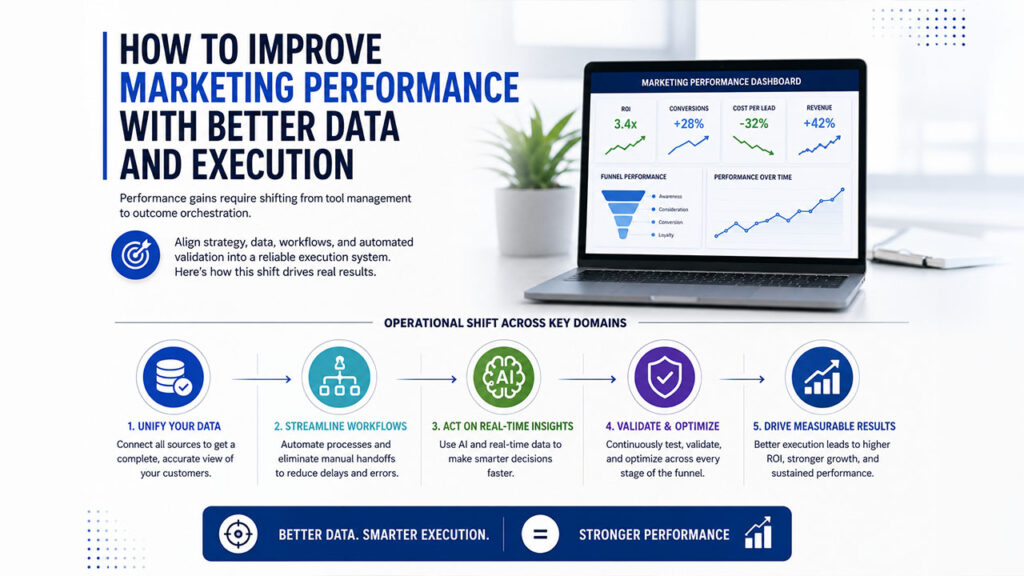
Performance gains require shifting from tool management to outcome orchestration through technical frameworks that support the entire funnel. An AI Digital marketing agency can support this shift by helping teams connect strategy, data, workflows, and automated validation into a more reliable execution system.
This alignment gives strategic vision a better chance of showing up in measurable performance. Here is how this operational shift is structured across key domains.
Build One Source of Truth for Marketing Data
Execution requires a foundation of trust. If the marketing team and the finance team are arguing over which set of numbers is correct, no progress will be made.
Centralizing marketing data into a single source of truth reduces the friction of disagreement. It allows for faster adjustments based on a shared view of performance, helping programmatic advertising decisions follow the same set of KPIs.
Establish Clear Ownership Across Channels
Accountability must be granular. Each channel should have an owner whose primary focus is the health and performance of that specific execution path.
These owners must then coordinate to ensure that the cross-channel marketing narrative remains cohesive. By assigning specific responsibility for channel-level performance, businesses can identify bottlenecks quickly and address them before they impact the wider strategy.
Turn Strategy Into Actionable Workflows
Transformation happens when abstract goals are broken down into daily operating habits. A strategy for increasing market visibility, improving acquisition efficiency, or expanding reach must be translated into workflows for content production, media buying, reporting, and optimization.
These workflows should be documented and accessible. By codifying the execution process, the business becomes less dependent on individual judgment and more reliant on the strength of its systems. This is the hallmark of a scalable AI-driven digital marketing operation.
Enable Faster, More Confident Decision-Making
Confidence comes from visibility. When leaders can see how their marketing performance optimization efforts are tracking in near real time, they can make decisions with fewer blind spots.
Speed is a competitive advantage. In the fast-moving world of AI digital marketing, the ability to pause an underperforming campaign and reallocate budget quickly can materially improve results. Precise execution creates more room for strategic and creative decision-making.
Why Execution Defines Marketing Success
Marketing failure is often an execution breakdown rather than a purely conceptual flaw. Competitive advantage belongs to firms that treat programmatic advertising and AI in digital advertising as systems requiring precise oversight, not as fully autonomous tools.
By prioritizing operational rigor and data alignment, organizations give themselves a stronger chance to turn plans into measurable gains while competitors remain stuck in high-level planning. Strategy determines the trajectory, but execution is what turns that direction into results.
%201.png)

%201.png)

%201.png)