

In the present time’s fast-paced digital economy, companies are always on the lookout for better ways to manage customers, improve communication, and also increase sales efficiency. What has been seen is that traditional methods of dealing with customer data are no longer enough; in fact, as customer expectations grow that is when the value of modern Customer Relationship Management (CRM) systems has become a key element of business operations.
A CRM system which is put in place for what it does best to run and care for customer relationships within an organization. It is a central point which houses all of the customer info, communication logs, sales actions, and marketing campaigns.
What is a CRM System?
A Customer Relationship Management system is a software organisation which, for businesses, puts into practice the management of customer relationships throughout the entire lifecycle. From initial point of contact to post-purchase support, CRMs report and improve on each touch point.
Instead of the spreadsheet and manual record-keeping methods which were used in the past, today’s companies go for CRM platforms which they use to automate and improve customer management. This in turn improves accuracy, reduces workload, and increases overall productivity.
Importance of CRM in Modern Business
CRM systems are at the core of what allows companies to grow into competitive forces within the market. As markets which once were wide open become full of competition, enterprises require improved methods of understanding what customers want from them and also being able to immediately respond.
Some of which are that CRM systems are important, which include the following:.
- Better organization of customer data
- Improved communication between teams and clients
- Improved performance in sales and marketing processes.
- Enhanced customer satisfaction and loyalty
- More accurate reporting and decision-making
With these benefits, CRMs have become a mainstay in digital transformation across industries.
Key Features of Modern CRM Systems

Let's explore some essential CRM features that boost productivity in 2026.
1. Customer Data Management
In the role of a CRM which is to collect and structure customer information, it is very important. This includes contact info, communication history, purchase records, and preferences. By having all this data in one place businesses are able to get to know their customers better.
2. Sales Pipeline Tracking
CRM tools for business which map out the sales process. Leads go through stages like first point of contact, discussion of terms, and the sale. Which in turn allows sales teams to track progress and put effort into the best opportunities.
3. Automation of Routine Tasks
Modern CRM tools which perform the function of reducing manual work by automating routine tasks like that of sending out follow-up emails, inputting data, and setting reminders. Which in turn allows staff to concentrate on more important strategic tasks.
4. Communication Management
CRM systems aggregate all of the communication channels, which in turn makes it easy to manage email, phone calls, and messages. This also sees to it that no customer interaction is left out.
5. Reporting and Analytics
Data analysis is at the core of what CRM systems do. Businesses create reports which track sales performance, customer behavior, and marketing effectiveness. Out of which they derive insights to base their decisions on.
The Role of Artificial Intelligence in CRM
Artificial intelligence is revolutionising what is seen from CRMs. What is to be seen is AI which is into large-scale data analysis, which in turn it uses to identify trends, predict how customers will act, and put out smart recommendations.
Some AI-powered CRM capabilities include the following:. Some of what AI does in CRMs includes:.
- Identifying which leads are most likely to convert.
- Automating customer segmentation
- Providing personalised communication suggestions
- Improving response time through smart automation
AI enhances CRM systems’ performance, which in turn improves business efficiency and effectiveness.
Benefits of Using a CRM System
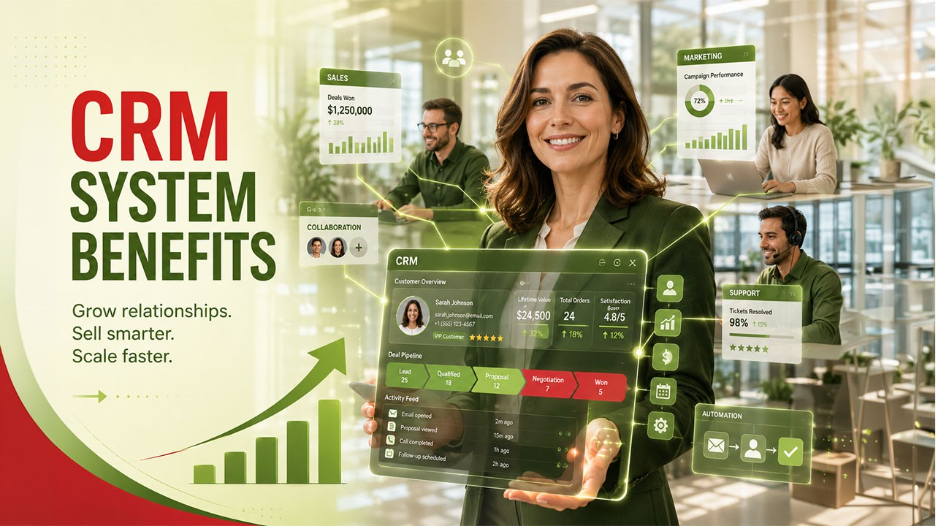
Roll out a CRM system which in the long run will benefit all sizes of business:.
Improved Customer Relationships
By monitoring all of the interactions, customers may be presented with very personal experiences which, in turn, will improve customer satisfaction.
Higher Sales Efficiency
Sales teams that focus on the right leads see an increase in conversion rates.
Better Collaboration
Different departments in Sales, Marketing and Customer Support may work better together with shared data.
Increased Productivity
Automation does away with repetitive tasks, which in turn allows employees to focus on value-added activities.
Scalability
CRM platforms scale as businesses grow, which makes them a good fit for both start-ups and large companies.
CRM and Business Growth
A properly built out CRM system is a driver for business growth. Through better customer analysis, greater communication, and sales process improvement companies develop stronger and more profitable relationships with their customers.
Wps下载 for document management, data handling, and report creation tend to see a competitive edge as they are able to react faster to market changes and customer needs.
Challenges in CRM Implementation
Though CRM systems present many benefits, in some cases it is seen that implementation is a challenge:.
- Resistance to change from employees
- Data migration issues from old systems
- Need for proper training and onboarding
- Integration with existing tools and processes
Also through proper planning and training.
Future of CRM Systems
The outlook for CRM is that it will see great improvement with greater use of AI, machine learning, and automation. Systems will put out better predictions, which in turn will help businesses in their decision-making, which in advance will have issues resolved.
A trend is also seen towards very personal customer interactions, speed in communication, and very automated workflows, which in turn reduces human effort and increases efficiency.
Final Thoughts
CRM systems are at the core of what modern business does. They improve customer relationships better, improve sales performance and also put internal processes in order.
As technology advances, CRM systems will grow in intelligence and importance to business success. Early adoption of these systems by companies is to their benefit, which in turn will see them outlast their competition and achieve sustainable growth over time.
%201.png)

%201.png)

%201.png)