

Every business eventually hits that point where operations just stop working smoothly. Leads slip through the cracks, follow-ups get missed, and sales teams barely communicate with marketing teams. Let’s be honest: the customer always ends up paying for it.
That’s where CRM software comes in. It helps you put everything about your customers in one place, brings order to the chaos, and gets everyone on the same page. But with plenty of options available in the market, understanding which CRM aligns with your needs is more crucial than ever.
This guide helps you uncover the top 10 real-world CRM examples, from what each one really excels at to who should be using them. Maybe you’re running a startup, managing sales at a growing company, or just starting to experiment with tech tools—this breakdown is for you.
What Is CRM Software and Why Does It Matter Today?
CRM stands for Customer Relationship Management, a software tool that gathers every detail of your customers—contacts, chats, deals, support problems—all under one centralized place. It lets sales, marketing, and support teams work together from the same page, same data, same history, and same pipeline. No more struggle for lost emails or chasing teams down for an update.
With CRM, every interaction, task, and status change is integrated in real-time, so you’re not stuck piecing data together. The best CRM examples take things further. They log your emails, remind you about follow-ups, track your deals, and let you know if a customer’s been ignored too long. Instead of scrambling to fix problems after they pop up, your team stays ahead of the game.
The global CRM market was worth about $287 billion in 2025 and is on track to hit $633 billion by 2030—growing more than 17% per year. Over 91% of businesses use some sort of CRM tool, and the companies who implemented it well see a 300% increase in conversion rates.
What’s behind all this growth? AI is automating the repetitive tasks, the cloud makes setups faster (87% of CRM systems run there now), and companies everywhere are shifting to serve customers better. Bottom line: in today’s world, you can’t afford to skip CRM. It’s what smart businesses use to scale up and stay organized.
Types of CRM Software: A Quick Overview
Before jumping to the examples of CRM software, it’s good to understand what Types of CRM Software you're bearing :
- Operational CRM: It streamlines the daily tasks, including automating sales, marketing, and customer service operations. For teams focused on efficiency and workflow, gravitate here.
- Analytical CRM: It’s all about transforming customer data into valuable information. Best for data-centric teams who want tools to identify trends and make intelligent decisions.
- Collaborative CRM: This CRM breaks down data silos between departments by exchanging customer data across teams, including sales, support, and marketing, which need to stay in sync.
- Sales CRM: Specially built for pipeline visibility, deal tracking, and closing. If you have a sales-focused business, then Sales CRM is a go-to tool.
- Inbound CRM: These attract leads with content and marketing, nurture them, then hand them off to sales when the timing is right. Alright, let’s look into the actual software.
10 Best CRM Software Examples in 2026
1. Salesforce — Best for Large Enterprises
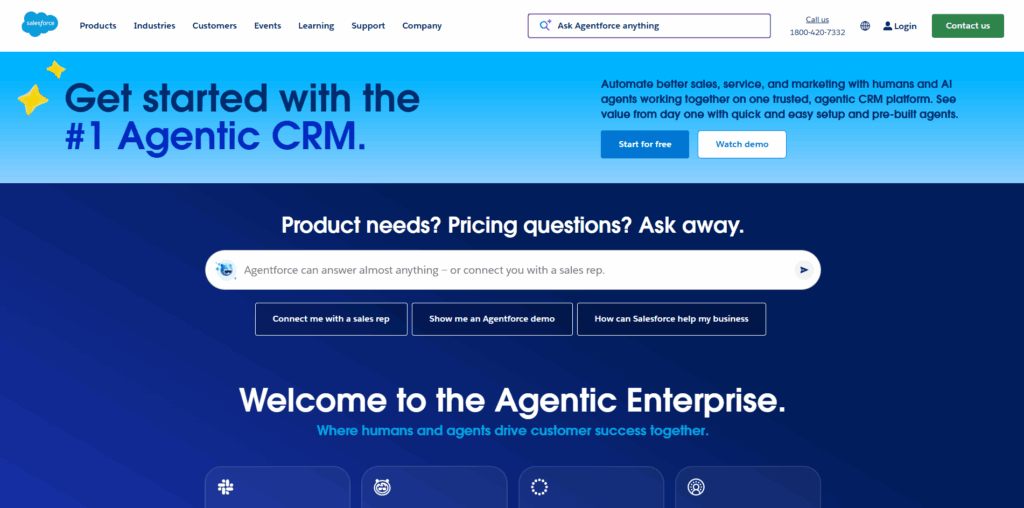
Salesforce is basically the most popular platform in the CRM world. You see their name everywhere, and they own about 20% of the global CRM market. The platform has gained traction as one of the most comprehensive CRM examples — spanning Sales Cloud, Service Cloud, Marketing Cloud, and more, all in one single platform.
What really puts Salesforce ahead is its sheer depth. It offers lead and deal management, sales forecasts, deep analytics, and then Einstein AI lets you get insights you didn’t know you needed. Companies using Sales Cloud say they see a 27% jump in win rates and 34% more sales revenue, on average.
- Best for: Enterprise-grade businesses with complex, multi-step sales processes across departments.
- Pricing: Starts at $25/user/month. Enterprise plans become costly as you scale.
2. HubSpot CRM — Best Free Starting Point
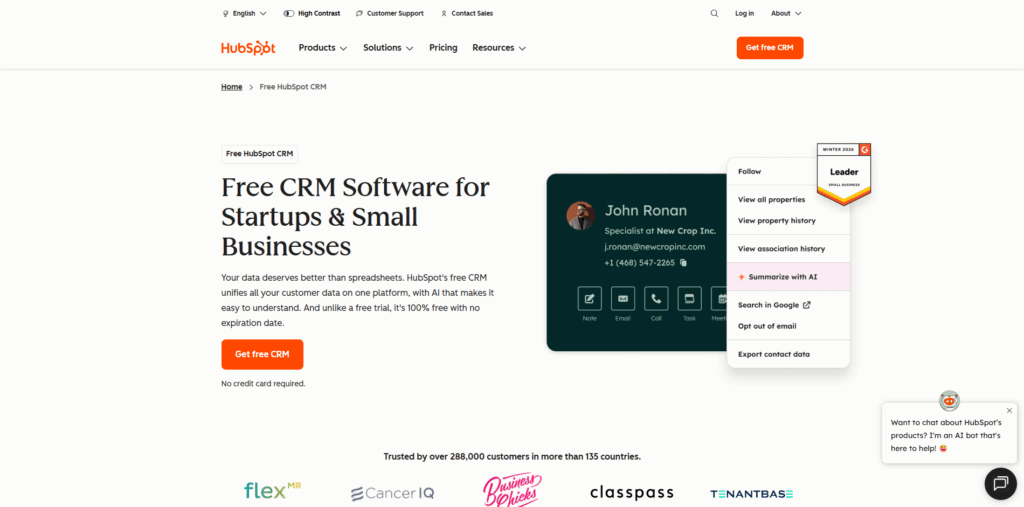
HubSpot is a renowned platform built around inbound marketing, and its CRM solution extends that philosophy seamlessly. Its free plan isn’t just a teaser — you get contact management, deal tracking, live chat, email marketing tools, and a meeting scheduler, all built in. If you’re new to CRMs or running a small team, this is an excellent CRM for small businesses.
The paid plan unlocks marketing automation, custom reporting, and smart features like deal forecasting and an AI agent that catches buying signals effortlessly. HubSpot also offers a built-in Canva integration, so you can easily create and share content right from the platform.
- Best for: Marketing-focused businesses and teams who want to sync their sales and marketing teams from day one.
- Pricing: Free plan available; paid plans start at $20/user/month and can jump to $4,700/month for big enterprise suites.
3. Pipedrive — Best for Sales Teams Who Want Simplicity
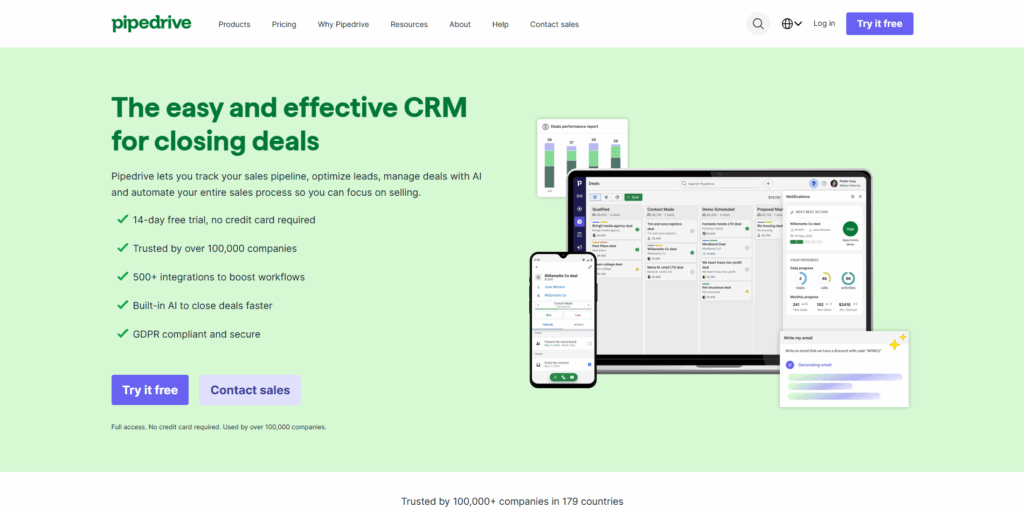
Pipedrive was built for teams who clearly understand what sales reps actually need every day — less clutter, more deals. The whole experience centers around a visual pipeline, pushing you to focus on the sales activities that move things forward instead of just staring at the outcomes.
On average, users close 28% more deals after a year with Pipedrive. Plus, it comes with a native ChatGPT integration to summarize lead details and even draft quick emails, while the AI assistant pops up useful follow-up suggestions based on deal activity. No need to juggle across various apps.
- Best for: B2B sales teams with redundant workflows who are looking for a simple tool that’s easy to set up and use every day.
- Pricing: Starts at $14/user/month and requires annual billing.
4. Zoho CRM — Best Value for Small Businesses
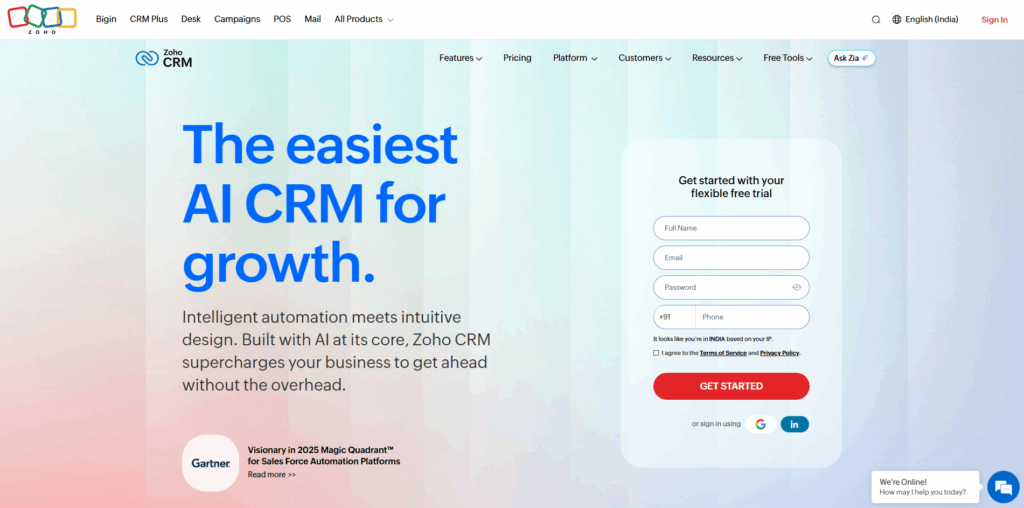
Zoho CRM delivers an impressive suite of functionality at an affordable price. Its AI sales assistant, or Zia, gives you lead scoring, sentiment analysis, and automated follow-up reminders. There’s even an SDR Agent that handles lead nurturing over email and hands them off to a human representative once purchasing intent is identified.
If you’re a startup or small team on a tight budget, Zoho strikes a great balance between features and price. The free plan is good up to three users, and paid plans stay affordable as your company grows.
- Best for: Startups and scaling small businesses needing full-featured CRM examples without enterprise-level pricing.
- Pricing: Free for up to 3 users; paid plans for $14/user/month.
5. Microsoft Dynamics 365 — Best for Microsoft Ecosystem Users
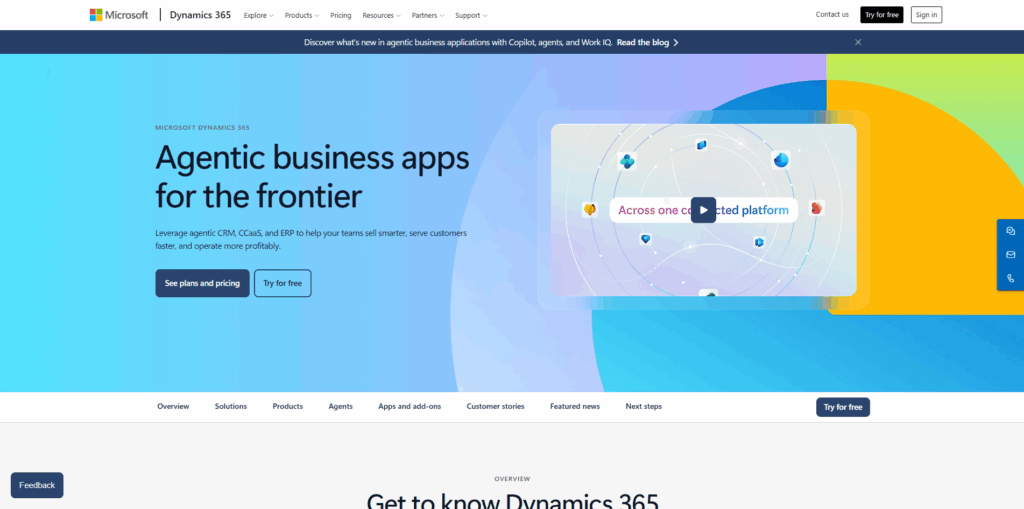
Already running the business with Microsoft 365, Teams, or Azure? Dynamics 365 feels like a natural add-on. It unifies CRM and ERP functionality into one single platform—so you’re not hopping between disparate systems—and has modules for every business core: sales, marketing, customer service, finance, and more.
Microsoft is going all-in on AI, embedding Copilot directly into Dynamics. That means it delivers valuable insights beyond just the sales pipeline; you get intelligence drawn from your Outlook, Teams, contacts — the whole Microsoft ecosystem. If your day revolves around these apps, this is a genuine time-saver.
- Best for: Medium to large organizations who already embedded in the Microsoft world.
- Pricing: Module pricing starts at $65/user/month; Business Central from $80/user/month.
6. Freshworks CRM (Freshsales) — Best AI-Powered CRM for Growing Teams
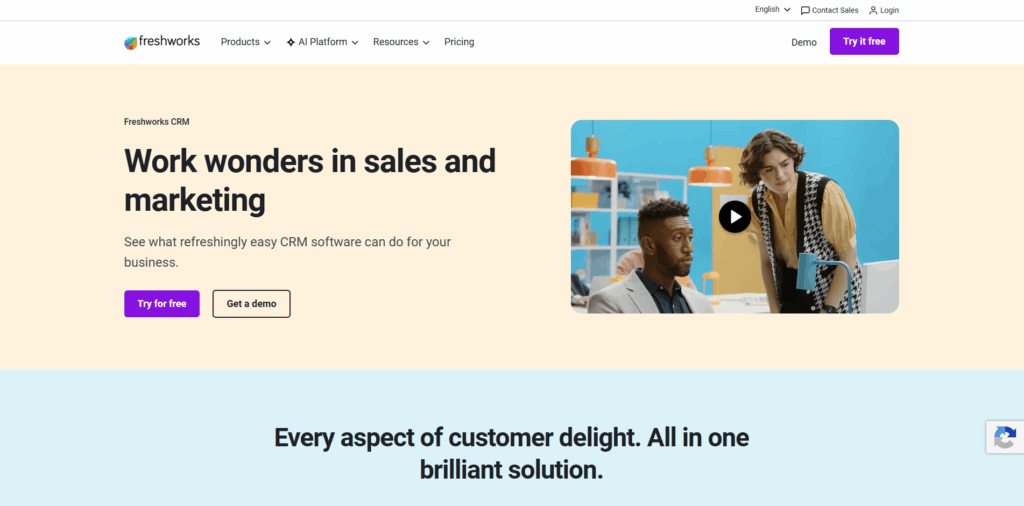
Freshsales, a sales-focused CRM from Freshworks, stands out with its robust Freddy AI assistant. Freddy recaps email conversations, writes personalized follow-ups using prospect sentiment, suggests Next Best Moves on slow deals, and automatically scores all contacts in your pipeline.
In 2026, Freshworks launched a unified client information hub giving sales a real-time look at customer support tickets and even customer frustration scores, all from the contact timeline. It acts as a powerful bridge between sales and service.
- Best for: Teams running on the Freshworks ecosystem already or anyone chasing strong AI features without breaking the bank.
- Pricing: Free plan available; paid plans from $9/user/month.
7. Monday CRM — Best for Customization
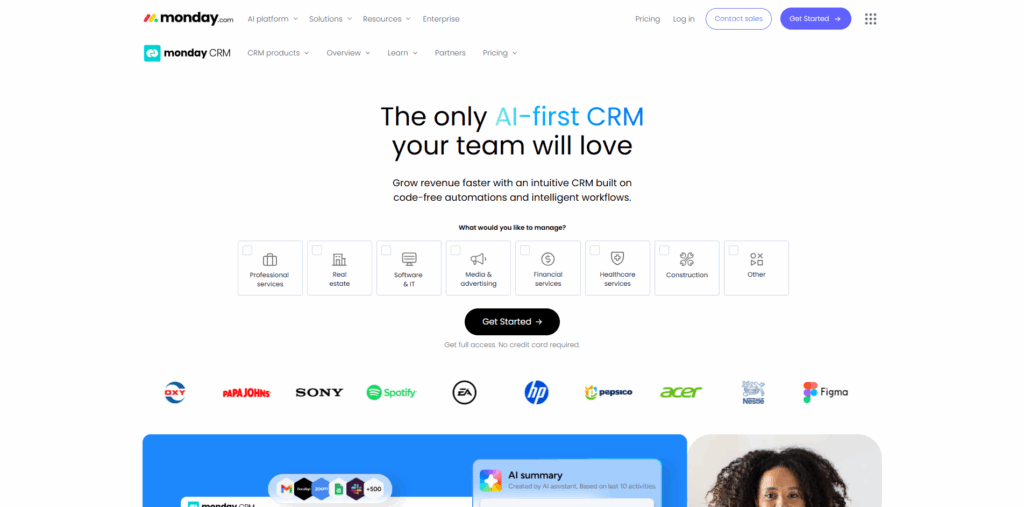
For teams focusing on control and versatility, Monday CRM stands out as a go-to solution across top CRM examples. It’s AI-driven, endlessly customizable, and you don’t need to write a single line of code. Build pipelines, dashboards, workflows, and reports with simple drag-and-drop tools. Calendars and scheduling are built in, and there’s a Quotes & Invoices feature that generates financial documents straight from your deal information.
It’s especially useful for cross-functional teams where sales, marketing, and project delivery all need to stay aligned.
- Best for: Small to mid-sized teams with complicated handoffs who need a platform that adapts to their processes.
- Pricing: From $12/user/month (paid annually).
8. Keap — Best for Service Business Automation
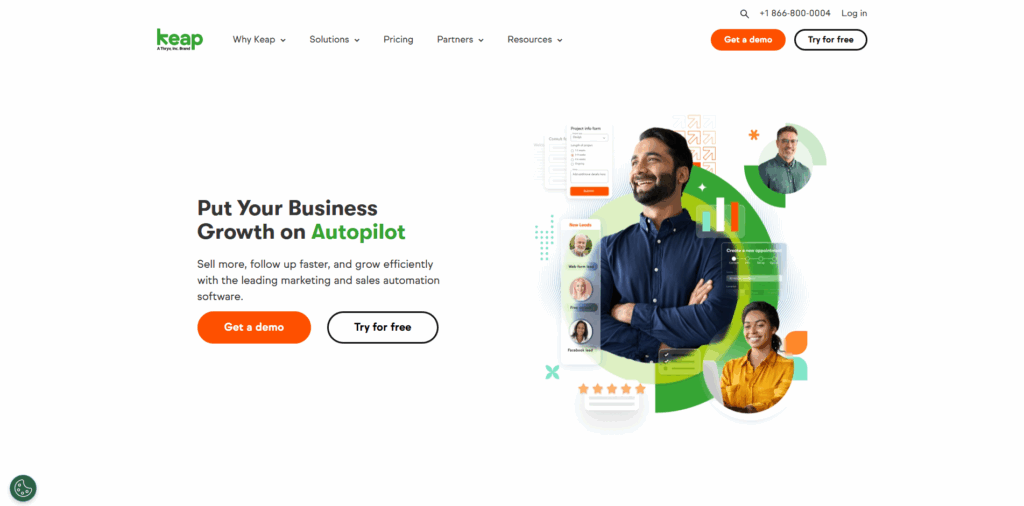
Keap (formerly “Infusionsoft”) is built for service businesses—consultants, coaches, agencies—who care about automating the whole customer journey, not just the sale. It’s widely known for saving users around 10 hours a week by automating repetitive tasks—emails, invoices, follow-ups, and prospect segmentation
The new AI Agent system is impressive: trained on your actual business data, these bots qualify leads, spot buying intent, and even enrich your records automatically using public information.
- Best for: Service-based businesses that want to automate repetitive tasks but still deepen client relationships.
- Pricing: Starts at $299/month for 2 users and 1,500 contacts.
9. Zendesk Sell — Best for Businesses Prioritizing Customer Support
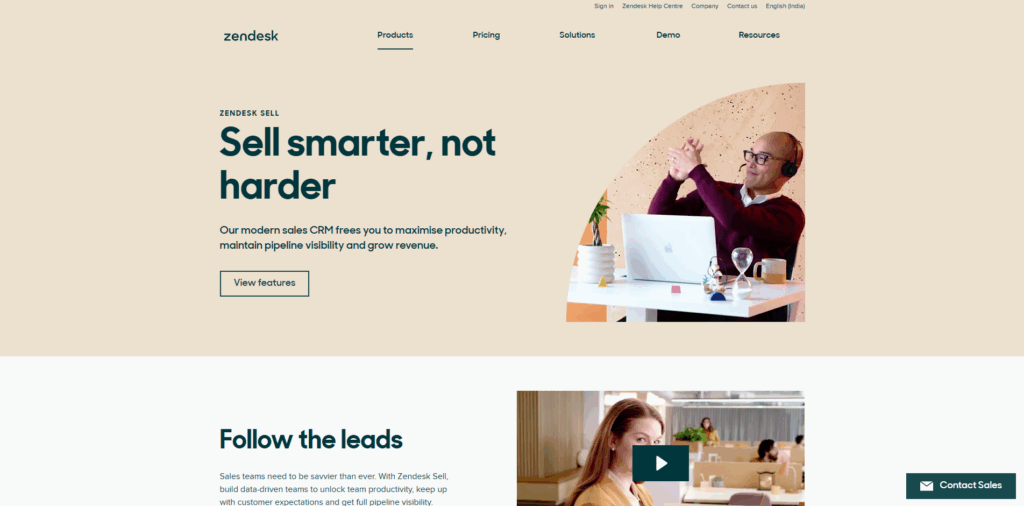
Zendesk Sell is a great platform among all CRM examples if customer support is just as critical as sales. Since it’s stitched directly into Zendesk Support, your salespeople see every support ticket, every conversation—no more embarrassing “Whoops, I didn’t know you had an open issue” moments.
The platform includes smart email alerts, template automation, and a power dialer that logs all calls automatically, alongside AI-powered lead scoring to help reps focus on promising deals.
- Best for: Companies using Zendesk for support or those in industries where post-sale customer retention really matters.
- Pricing: Starts at $19/agent/month.
10. EngageBay — Best All-in-One CRM for Small B2B Businesses
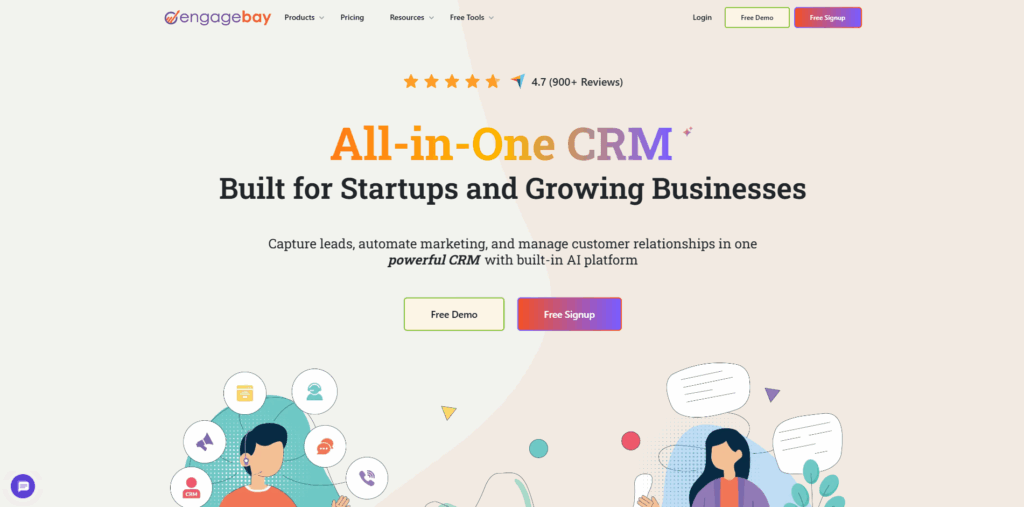
EngageBay really packs a lot into one toolkit. You get marketing automation, a sales CRM, and helpdesk features in a single tool. Their new conversational AI chatbot is a standout, too. You can train it on your own knowledge base, files, and links, so it feels like an extension of your brand. Small teams can finally offer quick, personalized support, even if they’re not big enough for a dedicated support staff.
Small B2B companies, especially those facing long sales cycles, find EngageBay’s mix of email marketing, deal tracking, and contact management hard to beat for the price. It’s affordable, there’s a solid free plan, and upgrades start at $9.35 per user per month.
- Best for: Small B2B businesses that need sales, marketing, and support tools in one place at an accessible price.
- Pricing: Free plan available; paid plans starting at $9.35/user/month.
How to Choose the Right CRM for Your Business
With so many powerful CRM examples available, the truth is, the right one is the one your team actually uses. Even the most advanced features don’t matter if users aren’t logging in.
Here are a few practical filters to apply:
Team size and complexity: If you’re a five-person startup, there’s zero reason to wrangle Salesforce. For a 500-person company, you might actually need all those features. Match the tool to where you are now—not just where you hope to be.
Your primary bottleneck: Is your main hurdle generating leads, closing deals, keeping current customers, or just want to strengthen team communication? Each CRM has its strengths. Focus on solving your biggest problem first.
Integration needs: Most CRM integrate into popular apps like Slack, Gmail, and Zapier. However, some offer native advantages: Copper for Google Workspace, Dynamics 365 for Microsoft fans, or Freshsales if your company runs on Freshworks tools.
Budget: The free versions from HubSpot, Zoho, and EngageBay actually give you a lot to start with. As your team scales, user counts increase—and so do costs. Keep a closer look at per‑user pricing to avoid hidden costs.
Most platforms offer free trials. Use them. A tool that looks perfect in a demo can feel clunky in daily use — or surprisingly intuitive. There's no substitute for hands-on time.
Also read: Pipedrive vs HubSpot: Which CRM is Right for You?
Final Thoughts
CRM software is no longer a luxury reserved for big corporations with big budgets. From free tiers to enterprise platforms, top CRM examples covered here represent a wide range of sizes, use cases, and industries. At the end of the day, a good CRM helps you actually connect with your customers, close more deals, and spend less time mucking about with spreadsheets.
A great CRM isn’t just a place to store contacts—it’s the operational hub where your team gets things done. A customer-centric approach helps you choose a CRM that fits your company as it is now while giving you space to grow.
%201.png)

%201.png)

%201.png)