


A $79/month video hosting bill for three users sounds manageable. Add the Wistia Automation Suite to connect HubSpot or Marketo, and that becomes $329/month.
Add three extra seats at $25 each and you are at $404/month before a single demo video has generated a single dollar of documented pipeline.
That is not a criticism of Wistia as a product. The platform genuinely earns its reputation for clean player design, detailed engagement heatmaps, and solid editorial tooling.
The issue is that Wistia was built for marketing teams publishing a finite library of polished brand videos, not for SaaS companies where video is a product surface: embedded in onboarding sequences, tracked at the viewer level, gated for specific prospect segments, and expected to fire events into a CRM automatically.
Most "Wistia alternatives" articles respond to this by putting Vidyard at the top of the list because it has HubSpot integration. What they do not explain is that Vidyard is a sales engagement platform for 1:1 video outreach, not a demo hosting infrastructure for a product page that gets 500 plays a month.
This article breaks down the decision into three layers: broadcast demos that need speed and branding, pipeline demos that need viewer-level tracking and CRM events, and gated demos that need access control or content protection.
Each of the five platforms below is evaluated against all three. By the end, you will know exactly which one fits your stage and stack.
Key Takeaways
- Wistia's Business plan costs $79/month for 3 users, 250GB storage, and zero CRM automation unless you add the $250/month Automation Suite on top. For most SaaS marketing teams, that is over $300/month before a single video drives an attributable pipeline.
- The most frequently recommended alternative, Vidyard, was built for 1:1 SDR outreach video. It is not designed for hosting and distributing product demos to anonymous or top-of-funnel audiences at scale.
- SaaS companies host three structurally different types of demo video: broadcast, pipeline-tracked, and gated, and each requires different platform capabilities. Choosing the right platform means knowing which of those layers you are solving for.
- As of June 2026, pricing shifts across several platforms have changed the cost equation for SaaS teams significantly, particularly for teams that need both delivery speed and access control without an enterprise contract.
- This article maps each of the five shortlisted platforms to the specific pain it actually solves, so you can evaluate on your terms rather than on brand recognition.
Why Wistia's Pricing Model Works Against SaaS Teams as They Scale
Wistia charges for hosting in a way that penalizes the behaviors a working video strategy produces.
The Business plan ($79/month, billed annually) includes 3 user seats and 250GB of storage. Every additional seat costs $25/month. Marketing automation integrations, which include HubSpot, Marketo, Pardot, require the Automation Suite add-on, priced at $250/month separately
For a six-person SaaS marketing team that wants video engagement data flowing into their CRM, the real entry cost is $404/month minimum.
| Scenario | Monthly Cost |
| Business plan (3 users) | $79 |
| Automation Suite (HubSpot/Marketo/Pardot) | +$250 |
| 3 additional user seats | +$75 |
| Total for a 6-person team with CRM sync | $404/month |
A SaaS team producing 10 videos a month will hit Wistia's cost ceiling faster than its storage ceiling. The per-seat model was designed for enterprise marketing departments where video is one tool among many. For growth-stage SaaS teams where video is embedded in the product itself, the math compounds quickly.
There is also the broader market context to consider. Vimeo, long the default "safe" alternative, was acquired by Bending Spoons in late 2025 for $1.38 billion. Bending Spoons' prior acquisitions, Evernote and WeTransfer, both resulted in significant workforce reductions and subsequent pricing restructures. For SaaS teams building video into their product infrastructure, that ownership trajectory is a legitimate risk signal.
The Demo Video Value Chain: 3 Layers SaaS Companies Actually Need
Most SaaS teams discover this mismatch after committing to a platform that solves one layer well but fails them on the other two. The breakdown below maps each layer to the specific capabilities it requires, so you can match your evaluation to your actual use case rather than a feature checklist.
Layer 1: Broadcast Demos (Top-of-funnel, Unauthenticated)
These are the product tour videos on your homepage, pricing page, and G2 listing. They play to anonymous visitors. Volume is high, access is unrestricted, and the primary requirements are fast loading across geographies, a branded ad-free player, and Core Web Vitals compliance.
A slow or buffering demo video on a pricing page is not a UX problem; it is a conversion rate problem.
Layer 2: Pipeline Demos (Prospect-tracked, CRM-synced)
These are demo recordings sent to prospects after discovery calls, embedded in email sequences, or placed behind a gated landing page for qualified leads.
The primary requirement is viewer-level analytics: which specific prospect watched, how far they got, whether they rewatched the pricing section, and whether that engagement is surfacing in your CRM or triggering a follow-up workflow. A play count is not enough here. You need the engagement signal reaching the right record at the right time.
What "viewer-level analytics" actually means
Aggregate analytics tell you a video has 400 plays. Viewer-level analytics tell you that a specific contact at Acme Corp watched 73% of your pricing walkthrough, rewatched the 2-minute mark three times, and clicked the CTA at 4:30. That behavioral signal, routed to the right CRM record, is what separates video as a content asset from video as a pipeline tool. '
Layer 3: Gated Demos (Access-controlled, Secure)
These are early-access product previews, investor demos, or roadmap walkthroughs that should not be shareable beyond a defined audience. Some SaaS companies also fall into this category if they operate in regulated verticals, such as fintech, healthcare, legal, where video content distributed to clients or prospects must meet access and audit requirements.
The requirements here are tokenized URL delivery (viewer-specific, time-limited links), domain restrictions, and optionally full DRM if the content is commercially sensitive.
No single platform dominates all three layers with equal depth. The evaluation below makes that explicit.
The 5 Best Wistia Alternatives for SaaS Product Demos, Compared

These five platforms represent the realistic shortlist for a SaaS marketing or growth team using video as a pipeline asset, not just a content channel. Each is mapped to the three layers above.
| Platform | Strongest Layer | Starting Price (May 2026) | Native CRM Integration | DRM Available | G2 Rating |
| Gumlet | All 3 | Free / $19/month (Growth) | Yes | $99/month add-on | 4.7 (356 reviews) |
| Vidyard | Layer 2 (1:1 outreach only) | Free / $59/user/month (Starter) | Yes | No | 4.5 (831 reviews) |
| SproutVideo | Layer 1 + Layer 3 | $10/month (Seed) | Via Zapier | No | 4.6 (187 reviews) |
| Vimeo | Layer 1 | $12/month (Starter) | Via Zapier | No | 4.3 (723 reviews) |
| Brightcove | Layer 3 (enterprise) | Custom | Yes | Yes | 4.1 (54 reviews) |
Pricing verified from each platform's published pricing pages as of June 2026.
1. Gumlet: Full-stack Delivery, Viewer Analytics, and Decoupled DRM
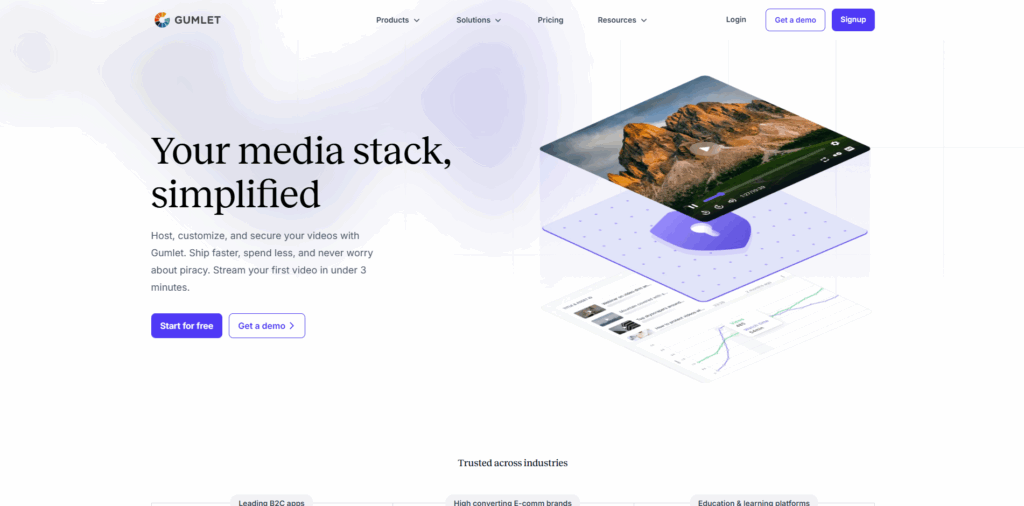
Gumlet is a video hosting and streaming platform built for developers and marketing teams at SaaS, EdTech, and media companies.
Its architecture is CDN-first, running across multiple delivery networks including Fastly and CloudFront, which means demo videos load fast across geographies without buffering. The transcoding engine is GPU-powered and built in-house, which Gumlet reports reduces video file size and associated delivery costs by at least 40% compared to standard encoding pipelines.
Gumlet's video analytics include engagement heatmaps that show watch-time per viewer and drop-off points inside the video, not just aggregate play counts.
Those viewer-level events fire natively into HubSpot, Salesforce, Marketo, Customer.io, and Iterable, meaning a prospect who watches 80% of a demo and stops at the pricing segment can trigger an automated follow-up workflow without manual intervention.
The Growth plan, repriced in May 2026 to $19/month (down 70% from previous pricing), now includes CRM integration natively, a capability that previously required the Business plan. For teams currently paying Wistia $329/month to get that same integration, that is a meaningful gap.
In-player CTAs, lead capture forms, and retargeting pixels (Google, Meta, LinkedIn) are all included, which means the demo video itself becomes a lead generation surface rather than a passive viewing experience.
On the security side, Gumlet’s video DRM is available as a $99/month standalone add-on. As of the most recent product update, all new accounts automatically receive both FairPlay and Widevine credentials provisioned at signup, and free DRM for 5 videos.
The platform holds SOC2, ISO 27001, and AICPA certifications. On G2, it carries a 4.7 rating across 356 reviews, rated above Wistia (4.6) on value for money, ease of setup, and support.
Best for: SaaS teams that need fast, branded demo delivery at the top of funnel and viewer-level attribution feeding their marketing stack, with the option to add content protection if the product or audience requires it.
2. Vidyard: The Right Tool for 1:1 Sales Outreach, Not for Hosting Demos at Scale
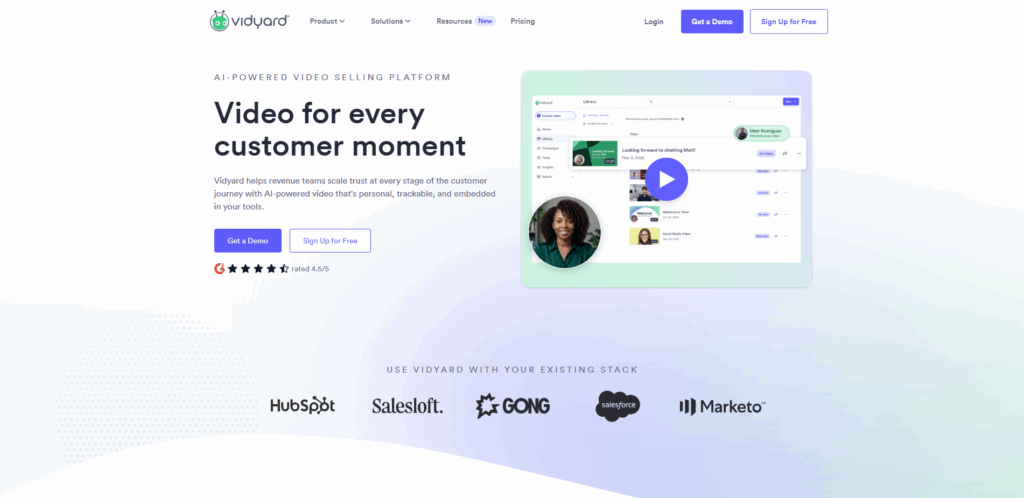
Vidyard tracks viewer-level engagement, sends real-time notifications when a prospect watches, and syncs at the contact level with HubSpot and Salesforce. For an AE who sends a personalized video follow-up after a discovery call, Vidyard's tooling is genuinely strong.
The issue is that this positioning does not translate to product demo hosting.
Vidyard's pricing model was designed for sales teams, not for marketing teams hosting a shared video library. The free plan is limited. Paid plans start at $59/user/month. A four-person marketing team needing access to the same demo analytics dashboard is paying $236/month before deploying a single video.
There is no flat-rate library plan; every additional seat compounds the cost. For a SaaS company where the product marketing manager, content lead, growth designer, and head of demand gen all need to pull viewer data from the same asset, that per-seat structure becomes expensive quickly.
Vidyard is also built exclusively around pre-recorded and personalized video messaging. It does not support the kind of multi-CDN delivery, in-player lead capture, or CRM event streaming that Layer 2 pipeline tracking requires at the library level.
If you see Vidyard recommended as a Wistia replacement for "hosting product demos," confirm whether the recommender is evaluating it for 1:1 outreach or for library-based demo hosting. The platforms do different things.
Choosing Vidyard to replace Wistia's hosting role is like replacing a filing cabinet with a whiteboard; both hold information, but not in the same way.
Best for: SDR and AE teams recording personalized 1:1 video follow-ups and tracking individual prospect engagement inside a CRM-connected sales workflow.
3. SproutVideo: The Closest Feature Match to Wistia at a Lower Price Point
SproutVideo is the most structurally similar platform to Wistia on this list. Starting at $10/month, it includes engagement heatmaps, lead capture forms, in-player CTAs, domain whitelisting, and password protection, the core feature set that most Wistia users cite as irreplaceable.
For teams that have built workflows around Wistia's specific tooling and need immediate cost relief, SproutVideo is a legitimate swap with minimal retraining.
Where SproutVideo trades off against Wistia and Gumlet is CRM depth. Its marketing automation integrations are primarily Zapier-based rather than native, which limits the granularity of events that reach your marketing stack.
A Zapier-mediated integration can pass a play trigger; it cannot pass heatmap-level data or fire different events based on percentage watched.
For SaaS teams with light automation requirements, a simple "video watched" trigger in HubSpot, that gap is acceptable. For teams that need viewer-level data flowing into lead scoring or retargeting audiences, it matters.
The practical difference: a native integration creates a contact timeline event in HubSpot with percentage-watched, CTA-clicked, and form-submitted fields. A Zapier trigger creates a single activity log entry that says 'video played.' These are not the same thing for lead scoring or sales routing purposes.
SproutVideo's entry plan at $10/month covers heatmaps, lead capture, and CTAs. Wistia requires the $79/month Business plan for equivalent features. That is an $828/year difference for the same functional floor.
Best for: Marketing teams with a strong Wistia feature dependency, specifically heatmaps and lead capture, who need to reduce hosting costs without overhauling their video workflow.
4. Vimeo: Professionally Credible, With a Risk Signal Worth Naming
Vimeo's player is the most widely recognized on this list. It is clean, ad-free, highly customizable, and well-regarded across SaaS and B2B marketing teams.
The Starter plan at $12/month covers unlimited video hosting, custom domain options, privacy controls, and auto-captioning, a functional Layer 1 solution for SaaS teams that need a polished public-facing player without Wistia's cost structure.
The limitation is depth. Vimeo's analytics are aggregate-level, not viewer-level. Marketing automation integrations are Zapier-dependent. There is no native CRM event streaming, no in-player retargeting pixel support, and no DRM.
For SaaS teams operating at Layer 1 only, hosting clean product tour videos on a marketing site, Vimeo works well. For anything requiring attribution or access control, it does not.
The material risk in 2026 is ownership. Bending Spoons acquired Vimeo in late 2025 for $1.38 billion. Bending Spoons has a documented post-acquisition pattern across its portfolio: following the Evernote acquisition, nearly the entire U.S. engineering staff was relocated or cut; after the WeTransfer acquisition, 75% of the workforce was reduced within two months of closing.
Vimeo has already seen a 10% workforce reduction and plan restructuring since the deal closed. Platform providers building long-term infrastructure on Vimeo should treat pricing and feature stability as an open question, not an assumption.
Gumlet reported a 200% increase in inbound migration requests from teams moving away from Vimeo in the months following the acquisition, citing both uncertainty and the concurrent outage incidents that affected Vimeo in mid-2025.
Best for: SaaS teams with top-of-funnel video needs that are low-stakes from an attribution and access standpoint, and who are comfortable monitoring the platform's trajectory under new ownership.
5. Brightcove: Enterprise-grade Infrastructure for When Security Requirements Are Non-negotiable
Brightcove sits at the enterprise end of this market. Its platform covers multi-DRM delivery (Widevine, FairPlay, PlayReady), enterprise SSO, governance controls, and global delivery at scale with SLA-backed uptime commitments.
For SaaS companies in formally regulated sectors such as fintech, healthcare technology, legal, where demo or product video content must meet documented access and audit requirements, Brightcove solves problems the other four platforms on this list do not fully address.
The cost reality is custom pricing, which in practice typically means several hundred dollars per month at minimum, a formal procurement and contract process, and an implementation resource requirement on the customer side.
Brightcove is built for teams with a dedicated engineering contact for video infrastructure and a buyer who can approve vendor contracts with performance SLAs.
For mid-market SaaS companies that need DRM-level protection but not a full enterprise procurement cycle, the comparison against Gumlet's $99/month DRM add-on is worth doing explicitly.
The Gumlet add-on covers Widevine and FairPlay, requires no setup fees, and provisions credentials automatically at signup. That covers the technical surface area of most SaaS gated-content requirements without the contract complexity.
Best for: Enterprise SaaS companies with formal information security or compliance requirements for video delivery, where a full vendor contract and SLA are appropriate and the procurement process is already in motion.
How to Choose: Matching the Platform to Your Layer
The five platforms above do not compete on the same axis. They solve different problems at different price points.
- If your primary gap is Layer 1: fast, branded, ad-free delivery for public-facing demos, SproutVideo or Gumlet both deliver that floor at low cost.
- If your primary gap is Layer 2: viewer-level tracking and CRM event firing, Gumlet covers this natively at the Growth tier; Vidyard covers it only for 1:1 outreach and at per-seat pricing that does not scale for library-based hosting.
- If your primary gap is Layer 3: access control for gated or sensitive content, Gumlet's DRM add-on at $99/month covers most SaaS use cases; Brightcove is the answer if you need enterprise governance and SLA backing.
The most common mistake SaaS teams make when evaluating video hosting is treating "CRM integration" as a binary feature checkbox.
Ask the vendor to show you which specific events fire into your CRM: play started, percentage watched, CTA clicked, form submitted, and whether those events land at the contact level or the account level.
A platform that fires a single "video viewed" event into HubSpot is not the same as a platform that fires six distinct behavioral signals. If the vendor cannot demo this in a live environment, the capability is not production-ready.
Before signing with any video hosting platform, get answers to these four questions:
- Which specific events fire into my CRM, and do they land at the contact level or account level?
- Is the CRM integration native, or Zapier-dependent?
- What is the per-seat cost if my team grows from 3 to 8 people in the next year?
- Is DRM a separate contract or a self-serve add-on?
For teams currently on Wistia Business who are doing the math, the path to the same functional outcome: CRM integration, viewer analytics, branded player, and optional content protection, at a lower price point is now wider than it was twelve months ago.
Closing Thoughts
The SaaS video hosting decision is not actually about which platform has the most features. It is about which platform's cost model, analytics depth, and access controls map to where your team is right now, and where your video library will be in 18 months.
Wistia built something genuinely good. The engagement heatmaps are accurate, the player is clean, and the HubSpot integration works. But the pricing structure assumes a marketing team with a defined video library, a dedicated video budget, and relatively stable content volume.
That is not the operating reality for most growth-stage SaaS companies in 2026, where the video library doubles every six months and CRM attribution is a basic expectation, not a premium feature.
The five platforms above give you a realistic shortlist mapped to specific needs, especially when evaluated alongside Managed Cloud Hosting Providers for broader infrastructure and scalability decisions. For teams moving off Wistia's Business plan in particular, the cost gap between the old pricing landscape and the options now available has widened materially since May 2026. That gap is worth doing the arithmetic on before the next renewal.
Frequently Asked Questions
Q1. Is Vidyard actually a good Wistia alternative for hosting product demos, or is it only for sales outreach video?
Vidyard is genuinely strong for 1:1 sales outreach: personalized video recording, individual viewer tracking, and real-time CRM notifications when a prospect watches. For hosting a product demo that lives on a landing page and plays to hundreds of anonymous visitors, it is not the right fit.
Vidyard's pricing model charges per user seat, which means a marketing team accessing shared demo analytics pays $59/user/month across however many seats are needed. There is no flat-rate library plan.
For top-of-funnel demo hosting at scale, platforms priced on storage or bandwidth rather than seats are better suited. Avoid shortlisting Vidyard for library-based demo hosting unless your team is already using it for outreach and wants to consolidate tools.
Q2. What is the real cost of Wistia for a SaaS marketing team of 6 people that needs CRM integration?
A 6-person SaaS marketing team using Wistia Business with HubSpot or Marketo integration pays $404/month: $79 for the Business plan (3 users), $250 for the Automation Suite add-on (required for HubSpot, Marketo, and Pardot), and $75 for three additional seats at $25 each.
That figure does not include storage overage costs if the library exceeds 250GB. As of June 2026, that same functional capability: CRM integration, viewer-level analytics, branded player, is available on competing platforms at a fraction of that cost. The $404/month figure is the honest baseline before factoring in any growth in team size or video library volume.
Q3. Which video hosting platform sends viewer engagement data to HubSpot or Salesforce without a separate add-on?
As of June 2026, Gumlet's Growth plan at $19/month includes native CRM integration with HubSpot, Salesforce, Marketo, Customer.io, and Iterable. SproutVideo connects to CRMs primarily via Zapier, which passes basic play events but not heatmap-level data.
Vidyard connects natively to HubSpot and Salesforce but charges per user seat, making it expensive for library-based hosting workflows. Vimeo and Brightcove both require Zapier or custom API work for CRM event streaming at their non-enterprise tiers.
If native CRM event firing, including percentage-watched and CTA-clicked signals, is a hard requirement, confirm which specific events each platform sends before committing, not just whether the integration exists.
Q4. Does Gumlet support DRM for gated product demos, and how much does it cost?
Yes. As of 2026, Gumlet's DRM add-on is available at $99/month as a standalone option, covering Widevine (for Android and Chrome) and FairPlay (for Apple devices). New accounts automatically receive both sets of credentials provisioned at signup, no manual request to Apple is required.
The $99/month price compares to an industry average of approximately $500/month for equivalent DRM coverage on most enterprise video platforms. All accounts can also process and preview up to 5 DRM-protected videos without the paid add-on, which makes evaluation straightforward.
For SaaS teams that need to gate specific content for qualified prospects or protect commercially sensitive product previews, the add-on integrates without a contract or setup fee.
Q5. What happened to Vimeo after the Bending Spoons acquisition, and should SaaS companies still use it?
Bending Spoons, a Milan-based capital allocator, acquired Vimeo in late 2025 for $1.38 billion. In the months following the acquisition, Vimeo reduced its workforce by approximately 10% and restructured its pricing plans.
Bending Spoons has applied a similar pattern across prior acquisitions, Evernote and WeTransfer both saw significant staff reductions and service restructuring post-close. Whether Vimeo's product quality and pricing stability will hold over the next 24 months is an open question.
For SaaS teams using Vimeo for low-stakes top-of-funnel video with no deep product integration, the risk is manageable.
For teams that have wired video into their product infrastructure and depend on the platform for analytics, CRM events, or access control, building on a platform mid-transition in ownership carries real continuity risk. Evaluate with that context factored in.
Q6. Which Wistia alternative is best for a SaaS company that needs fast delivery, viewer-level analytics, and optional content protection?
The platform that covers all three requirements without requiring enterprise pricing or a separate contract for each layer is Gumlet. The Growth plan at $19/month delivers multi-CDN adaptive streaming, native CRM event firing, engagement heatmaps, and in-player lead capture.
The $99/month DRM add-on covers Widevine and FairPlay for gated content use cases. SOC2 and ISO 27001 certifications cover the compliance signal most enterprise SaaS buyers ask for.
No other platform on this shortlist covers all three layers at equivalent depth below $100/month combined. If your specific requirement leans heavily toward 1:1 sales video rather than library-based demo hosting, Vidyard is the right answer for that narrower use case.
Q7. Should SaaS companies use an interactive demo tool instead of a video hosting platform?
Interactive demo platforms like Supademo and Arcade let prospects click through a guided product walkthrough rather than watch a passive video. They work well for product-led sign-up flows and mid-funnel nurture sequences where engagement requires action, not just attention.
They do not replace video hosting for broadcast demos on a pricing page, investor-facing content, or gated product previews that need DRM or access control. Most SaaS teams end up running both: a video hosting platform for the library and delivery layer, and an interactive demo tool for the click-through walkthrough embedded in outbound sequences.
The question is not which format to use, but it is which format fits which stage of the buyer journey. For any use case where the viewer is passive (pricing page, G2 listing, email replay), hosted video is the right medium.
%201.png)

%201.png)

%201.png)