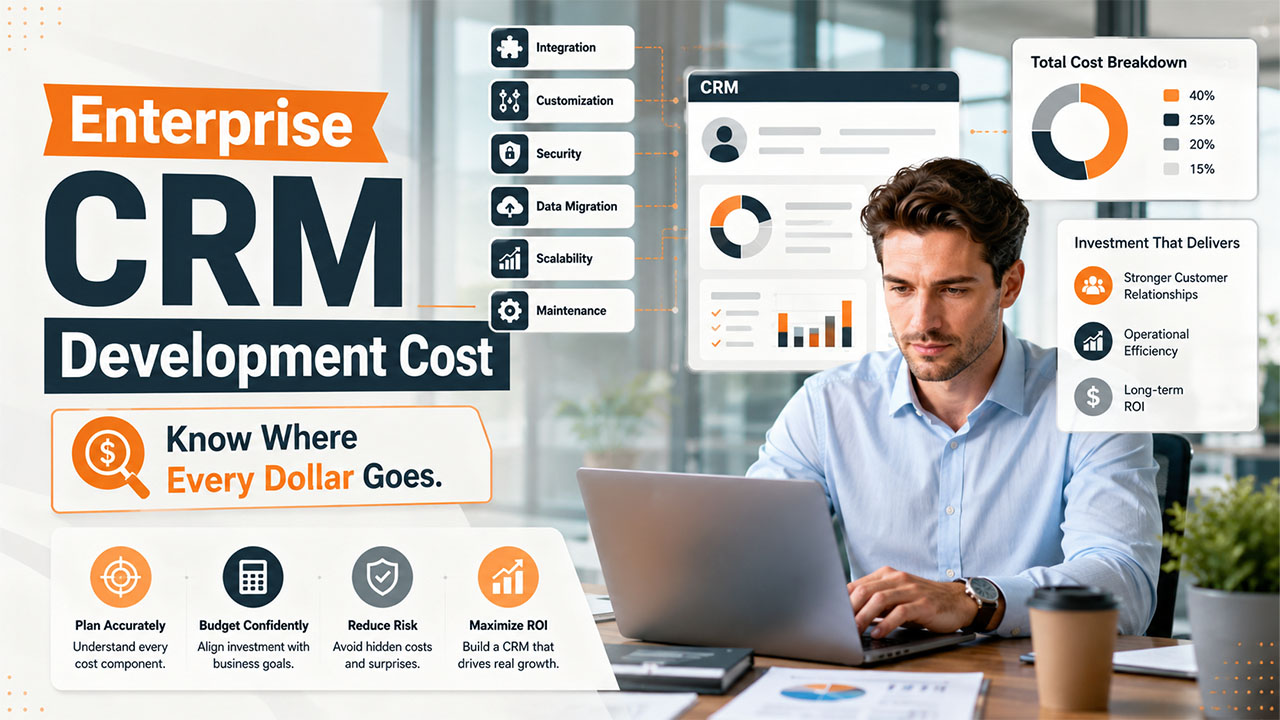

Enterprise CRM development cost is one of the biggest concerns for organizations planning a custom CRM project in 2026. Developing a corporate CRM system involves much more than estimating developer hours—it requires budgeting for architecture, integrations, security, and long-term scalability.
Important: In the corporate segment, project cost is determined not only by the cost of development man-hours, but also by architectural complexity, the depth of integration with the IT environment, security requirements, and the automation of specific business logic. Underestimating the complexity of integrations, data preparation, and scaling are the main reasons for budget overruns. Only systematic cost planning at the outset can minimize the risk of scope creep and ensure a predictable return on investment.
Why is there no clear answer to the question "How much does CRM cost?"
The enterprise CRM development cost varies because businesses can choose between subscription-based SaaS platforms and fully custom CRM development. Each model has a different pricing structure, ownership model, and long-term total cost of ownership. Types:
- SaaS model (licensing): The financial burden falls on operational costs (OpEx). The price consists of regular payments for the number of workstations, modules used, and data volume. Payment is made for access to the vendor's infrastructure, and functionality is limited to the capabilities of the current version of the service.
- Custom development: The budget is determined by capital expenditures (CapEx). The main expenses include architecture design, coding, integration with the existing IT system, and deployment of the company's own infrastructure. In exchange, the company receives intellectual property and the ability to fully adapt the system to specific business processes.
Let's examine the factors influencing the final cost in both models, taking into account all hidden costs. A step-by-step budgeting method will help you accurately forecast your budget. Teams that have already gone through a full request-for-proposal cycle often find that a realistic crm software development cost for enterprise-grade custom systems only becomes clear once integration scope and compliance requirements are mapped out in detail.
Factors That Affect Enterprise CRM Development Cost
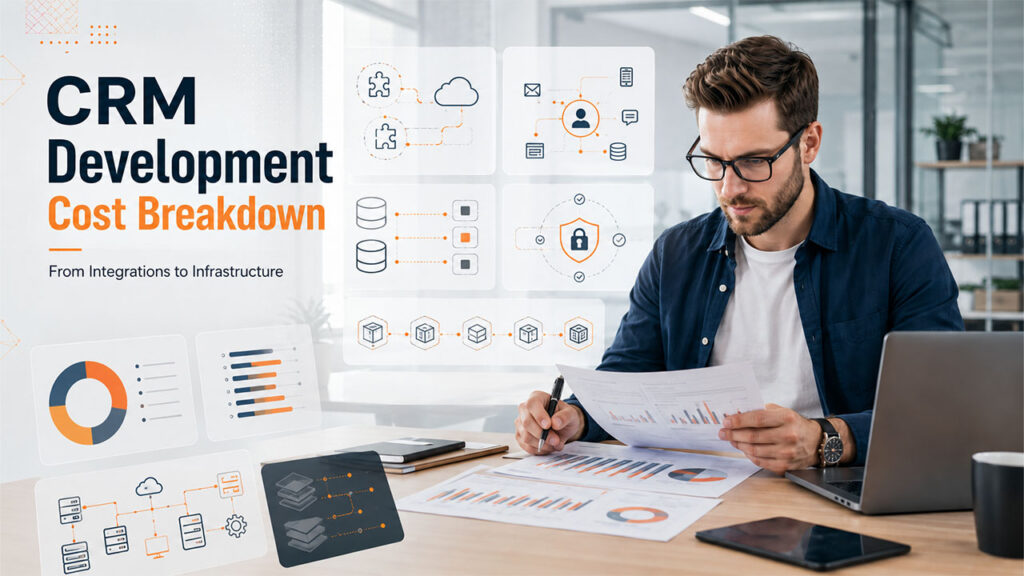
The final cost of developing a corporate CRM system is influenced by a combination of technical and architectural decisions that determine the team's labor costs. Factors include:
- Business logic complexity: Basic contact tracking is cheaper, but costs increase when implementing custom approval mechanisms and deal routing algorithms.
- Integrations: This concerns connections to ERP, billing, or telephony, as this requires the creation of API gateways and synchronization. Organizations investing in Custom ERP Development should also account for integration architecture and data synchronization requirements, as the lack of support for modern data exchange standards leads to increased costs due to the need to develop additional integration adapters.
- Data migration: The process of normalizing and consolidating disparate data from legacy systems into a unified format is crucial. Underestimating data migration is critical: poor quality source data undermines the functionality of a new CRM, as it requires careful analysis and significant labor to clean and structure it.
- Security and access management: For enterprises, this involves implementing role-based access models (RBAC) and compliance with standards (e.g., SOC 2 or GDPR). The main challenge is setting up dynamic permissions, where access rights to fields or records change depending on the user's status.
- Scalability: Using microservices, containerization, and horizontal scaling requires skilled DevOps engineers and architectural design before coding begins.
Typical cost ranges depending on the approach to CRM development
The choice of CRM architecture directly determines the budget structure. Below are three typical approaches, varying in investment volume, implementation speed, and long-term financial commitment.
| Approach to development | Initial investment | Fixed costs | Flexibility and control |
| Ready-made solution (SaaS) | Low (setup, integration) | High (regular license fees per user) | Limited by vendor functionality; dependent on platform updates |
| Low-code / Platform solutions | Medium (development using visual designers) | Medium (platform fee, support for specific logic) | Above average; risk of technical debt accumulation with non-standard modifications |
| Custom development | Maximum (design, code, infrastructure) | Low (only hosting and in-house team support) | Full control over architecture, data, and intellectual property rights |
When is it suitable:
- Adapting existing CRM systems: Optimal for a quick start, but requires adjusting processes to the cloud product's logic. The main risk is limited functionality and increased costs as staff scales.
- Low-code platforms: If you need a balance between speed and customization. They allow for faster implementation of unique processes, but require code quality control to prevent technical debt accumulation due to "quick" improvements and avoid issues with future updates.
- Custom development: Eliminates licensing dependencies and provides complete control over the architecture, but requires a significant initial investment. It's cost-effective in the long term due to the absence of monthly payments.
Hidden Costs That Increase Enterprise CRM Development Cost
When planning their budget, many companies focus only on the implementation phase, ignoring the system's lifecycle costs. Below are some hidden costs that, without adequate funding, can render a project unprofitable:
- Technical support and infrastructure: It's necessary to budget for performance monitoring, security patches, library updates, and cloud resources. This is a recurring expense, amounting to ~15-25% of the initial development cost annually. Why it's important: Without these investments, CRM quickly loses stability and becomes vulnerable to attack.
- Training and change management: The costs of training, creating instructions, and technical support are comparable to the budget for system testing. Why it's important: Financial losses due to low staff productivity and inefficient use of the system.
- Post-release iterations: Refinement of the interface and logic based on real usage data. This investment accounts for approximately 20% of the project's primary budget. Why it's important: This will provide real efficiency gains through the automation of applied business processes.
How to Estimate Enterprise CRM Development Cost

- Step 1 – Matching functionality with system limitations: Analyze target tasks against the strict limitations of the out-of-the-box software. Recommendation: If functionality critically mismatches, it is more effective to integrate specialized external tools than to subject the CRM architecture to excessive customization.
- Step 2 – Evaluate integration complexity separately from functionality cost: Integration complexity depends on the state of the API and the quality of external system data, not on the CRM functionality. Risks of incompatibility, error handling, and synchronization must be assessed separately to avoid budget overruns at launch.
- Step 3 – Security and Compliance Budgeting: Create a separate expense item for protecting the information system. Important: Access rights auditing and communication channel encryption costs are mandatory; the savings are not comparable to the risk of data leakage.
- Step 4 – Creating a Maintenance Reserve: Budget for system maintenance (library updates/bug fixes). These are mandatory operating costs that prevent system degradation.
- Step 5 – Formalizing the strategy choice: Written approval of the format (purchase, configuration, development) before work begins. Important: avoiding a mixed approach minimizes the likelihood of financial losses.
When Custom CRM Development Really Pays Off
Custom CRM is cost-effective for organizations with complex, high-volume, or highly regulated processes, as off-the-shelf products are often unsuitable due to rigid architecture, functional redundancy, and incompatibility with stringent regulatory requirements.
Important: A customized CRM pays for itself in 3-5 years due to the transition from variable license costs to a fixed cost of ownership (TCO).
ROI formation factors:
- License waiver: Direct savings on monthly payments, which increases exponentially as the staff increases.
- Productivity: A highly specialized interface reduces transaction processing time (for example, from 30 to 10 seconds), freeing up thousands of man-hours per month.
- Reduced regulatory costs: Embedding security requirements into code eliminates fines and forced migration costs.
- Infrastructure optimization: Scaling capacity to meet real-world loads without overpaying for redundant modules in out-of-the-box solutions.
In practice, engineers at Merehead who build custom CRM systems for regulated financial platforms consistently find that the sharpest cost swings come from how deep role-based permissions need to go. A flat admin/manager split is inexpensive to implement, but adding team-level (desk-level) data segregation, rule-based lead distribution across sales teams, and integrated identity-verification workflows can add several weeks to the timeline before a single working dashboard exists. Underestimating this layer of the architecture, rather than the visible screens and reports - is one of the most common reasons enterprise CRM budgets slip past their original SaaS-model comparisons.
Conclusion
Understanding enterprise CRM development cost requires evaluating far more than initial development expenses. Companies that carefully budget for integrations, security, maintenance, and scalability achieve more predictable implementation costs and stronger long-term ROI. While SaaS platforms may reduce upfront spending, custom enterprise CRM development often provides a lower total cost of ownership for organizations with complex business processes.
%201.png)

%201.png)

%201.png)