
Most people have a rough idea of what a proxy is. It sits between your computer and the internet, masks your IP address, and makes you look like you're somewhere you're not. Beyond that, the details tend to get hazy - especially when terms like "datacenter proxy," "residential proxy," and "rotating IP" start appearing in the same conversation.
But for businesses that rely on web data, competitor intelligence, sales automation, or any kind of large-scale online operation, understanding the difference isn't academic. It's the difference between a workflow that runs smoothly at scale and one that gets blocked before it gets started.
This article focuses on datacenter proxies specifically - what they are, how they work, where they genuinely excel, and where they don't. No jargon for its own sake. Just a clear picture of a tool that a lot of businesses are using and not enough people understand.
What a Datacenter Proxy Actually Is
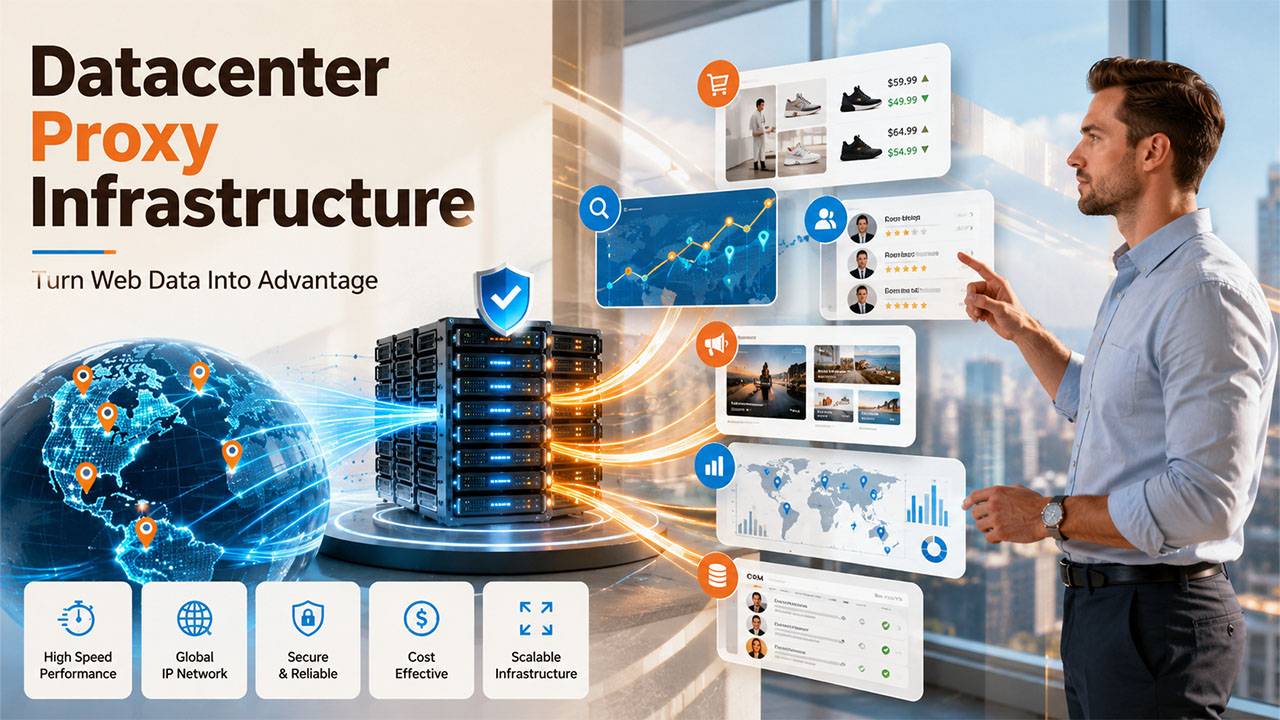
A datacenter proxy is an intermediary server that routes your internet traffic through an IP address belonging to a commercial data center - a server farm operated by a hosting company, rather than an address assigned to a real home or mobile device by an ISP. While datacenter options provide immense speed, users who require authentic consumer network identity often choose an ISP proxy to blend the rapid processing of a data hub with legitimate residential credentials.
When you make a request through a datacenter proxy, the website you're visiting sees the data center's IP address instead of yours. From the website's perspective, the request is coming from a server in, say, Chicago or Frankfurt - not from your laptop in an office in Manchester.
That's the core mechanism. What makes datacenter proxies a distinct category - with specific strengths and limitations - is the nature of those IP addresses. Because they originate from commercial hosting infrastructure rather than residential ISPs, they're faster, cheaper to provision, and available in enormous pools. They're also more recognisable to detection systems that know what a data center IP looks like, which is the fundamental trade-off you need to understand before choosing them for a specific task.
The global datacenter proxy market was valued at approximately $2.21 billion in 2024 and is projected to reach $5.53 billion by 2033, growing at a CAGR of 10.5%. That trajectory reflects genuinely expanding demand - not from one use case but from several, each of which makes sense on its own terms.
Speed and Cost: The Two Reasons Most People Start Here
The practical argument for datacenter proxies is straightforward. Datacenter proxies respond in 22–28 milliseconds on average, compared to 36–55 milliseconds for residential proxies. That difference compounds at scale. If you're sending thousands of requests per hour, the cumulative time saved is meaningful. If you're running time-sensitive automation - monitoring a competitor's pricing during a flash sale, collecting SERP data across dozens of keyword sets simultaneously - that latency gap matters.
The cost argument is equally direct. Residential proxies command a premium because the infrastructure required to source and maintain genuine home IP addresses is complex. Datacenter proxies don't carry that overhead. The result is pricing that's typically several times lower per gigabyte, which makes large-scale operations economically viable in a way that residential alternatives often aren't.
For businesses that are running high-volume, relatively low-sensitivity data tasks - and there are a lot of them - this combination of speed and cost makes datacenter proxies the pragmatic starting point.
The Use Cases Worth Knowing
Competitive Intelligence and Market Research
Sales and marketing teams live or die by knowing what's happening in their market. What are competitors charging? What products are they promoting? How are they positioning themselves across different regions? These questions have always mattered. What's changed is the scale at which they can now be answered.
Web scraping for competitive pricing is one of the most common datacenter proxy use cases, and it's a natural fit. The targets - competitor websites, product catalogues, price comparison platforms - are generally accessible, the data is public, and the requirement is speed and volume rather than undetectable residential authenticity. Datacenter proxies handle this reliably and efficiently, with multiple IPs available to rotate if one endpoint starts rate-limiting requests.
For CRM-driven businesses, this kind of intelligence feeds directly into commercial decisions: pricing strategy, product positioning, campaign timing. A sales team that knows a competitor has just raised prices by 12% across a product line is better positioned than one that finds out three weeks later.
SEO Monitoring and SERP Tracking
Search rankings vary by location in ways that can be significant. A keyword that ranks on page one in London might rank on page three in Birmingham. A campaign that's performing well in the US might be completely absent in the EU market the business is trying to crack.
Tracking this across multiple geographies, at meaningful frequency, requires sending search queries from IP addresses in the relevant locations - which is exactly what a geographically distributed proxy pool enables. Datacenter proxies, with their breadth of location coverage and high request throughput, are well suited to this. The volume of queries involved in comprehensive SERP monitoring across keywords and geographies makes the cost efficiency of datacenter proxies a meaningful practical advantage.
For businesses using CRM and marketing platforms to track campaign performance, layering in SERP data from targeted locations gives a more complete picture of how visible they actually are in the markets they care about.
Sales Automation and Lead Generation
This is where the CRM audience will find the most direct relevance. Sales automation workflows - prospect research, lead enrichment, account monitoring - increasingly involve automated interaction with websites and data sources that implement rate limiting or IP-based restrictions.
A straightforward example: a sales team wants to monitor when key target accounts update their job listings, change their pricing pages, or launch new products. This kind of account intelligence, aggregated across a large prospect list, is enormously valuable for timing outreach. Running it manually is impractical. Running it automated, through a proxy pool that prevents any single IP from hitting rate limits, is entirely feasible. Businesses implementing Proxies for AI Automation Tools can further improve the reliability, scalability, and efficiency of their automated data collection and sales intelligence workflows.
Datacenter proxies work well for these tasks because the targets - company websites, LinkedIn public profiles, business directories - are generally accessible and the detection risk is manageable. The key is matching the proxy type to the target: sites with light bot protection are fine with datacenter IPs; sites with aggressive anti-bot systems may require rotating residential alternatives.
Ad Verification
Businesses spending significant budgets on digital advertising have a legitimate interest in verifying that their ads are appearing where they're supposed to, in the geographies they're targeting, on the placements they've paid for. This is harder than it sounds. Ad delivery is highly localised, and seeing what a user in Tokyo sees when your campaign is running requires an IP in Tokyo.
Datacenter proxies with broad geographic coverage make this kind of multi-market verification operationally practical. An in-house team or agency can systematically check ad placements across markets without relying entirely on the ad platform's own reporting - which, it should be said, isn't always as granular as the advertiser would like.
Data Aggregation for Business Intelligence
Beyond specific competitive tasks, there's a broader category of business intelligence that depends on consistent, large-volume web data collection: price indexing, review aggregation, inventory monitoring, regulatory compliance monitoring. These workflows share a common requirement - high throughput, manageable cost, and reliable uptime - that datacenter proxies are built to deliver.
Approximately 42 billion proxy requests are made per day worldwide, and datacenter proxies account for around 38% of all proxy-based traffic. That's not a niche use case; it's a substantial portion of the automated data infrastructure that modern businesses run on.
Where Datacenter Proxies Don't Work (And What Does)
Clarity on limitations matters as much as enthusiasm about capabilities. Datacenter proxies are genuinely the wrong tool for certain jobs, and knowing which ones saves both time and money.
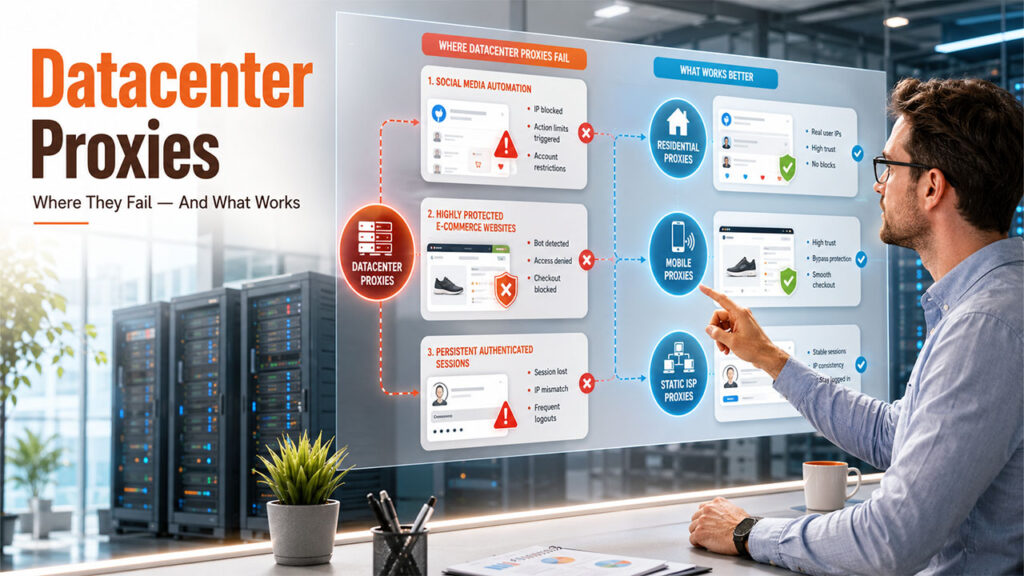
The core limitation is detectability. Websites with sophisticated anti-bot systems - Cloudflare protection, Akamai Bot Manager, DataDome - have learned to identify data center ASNs. When a request comes from an IP address block owned by AWS, Google Cloud, or a commercial hosting provider, detection systems flag it as a non-human connection. For sites that implement aggressive bot detection, this means datacenter proxies get blocked at a high rate regardless of rotation strategy.
The specific tasks where datacenter proxies underperform:
- Social media platform automation. Instagram, TikTok, LinkedIn, and most other major social platforms actively detect and block data center IP ranges. For any task involving account management, posting, or data collection from these platforms, residential or mobile proxies are required.
- Highly protected e-commerce targets. Major retail sites have invested heavily in bot detection. Scraping Amazon, major fashion retailers, or sneaker platforms with datacenter IPs produces block rates that make the exercise uneconomical. Static residential or ISP proxies are the appropriate tool here.
- Anything requiring persistent authenticated sessions. When a platform ties account identity to IP history, a data center IP that rotates or that looks non-residential creates friction. For account-based workflows, residential or static proxies provide the consistency that datacenter alternatives can't match.
Understanding this isn't a reason to avoid datacenter proxies - it's a reason to use them deliberately, for the tasks where their cost and speed advantages translate into genuine operational value, and to know when to reach for a different tool.
Dedicated vs. Shared: The Decision That Actually Matters
Within the datacenter proxy category, there's an important sub-distinction that affects both performance and cost.
Shared datacenter proxies allocate IPs across multiple users simultaneously. The cost is lower, but the performance depends partly on what other users on the same IPs are doing. If a shared IP gets flagged by a target site because another user abused it, you inherit that flag. For high-volume, relatively tolerant targets, shared proxies are cost-effective. For anything where IP reputation matters, the shared model introduces unpredictability.
Dedicated datacenter proxies give you exclusive use of specific IPs for the duration of your subscription. The cost is higher, but the IP history is entirely yours to manage. For sensitive workflows, for established automation pipelines, or for any task where a pre-flagged IP would cause operational disruption, dedicated proxies are the better investment.
The cheapest datacenter proxy plans often share IPs across thousands of users, which leads to slow speeds and pre-banned subnets from day one. That's worth understanding before optimising purely for the lowest per-GB price.
What to Look For in a Provider
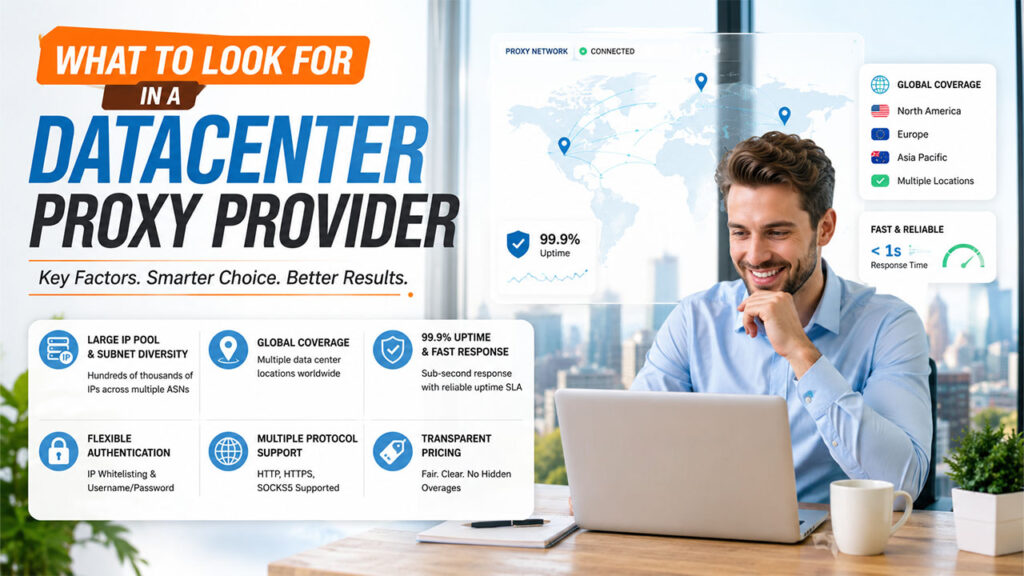
The datacenter proxy market has more than 260 active vendors, and quality varies substantially. Before selecting a provider, it's also worth reading a detailed Proxy-Seller Review to understand the features, pricing, and performance factors that matter for business use cases. The metrics worth prioritising:
IP pool size and subnet diversity. A larger pool spread across multiple ASNs and subnets reduces the risk that one blocked subnet takes down an entire operation. Providers with at least several hundred thousand IPs across multiple data centre locations offer meaningful resilience.
Geographic coverage. Coverage that matches your actual targets. A provider with strong US and EU coverage is the right fit for North American and European market monitoring; a different configuration is needed for APAC targets.
Uptime and response time SLA. Look for 99.9% uptime and sub-second response times, with the ability to test performance before committing to a plan.
Authentication options. Both IP whitelisting and username/password authentication should be available, alongside HTTP, HTTPS, and SOCKS5 protocol support. Flexibility in authentication matters when integrating proxies across different tools and workflows.
Transparent pricing. Bandwidth-based and IP-based pricing models suit different use cases. A provider that's clear about what you're paying for - and doesn't bury overages in the terms - is worth the slight premium over the cheapest option.
Proxy Cheap offers a buy datacenter proxies service that covers the fundamentals well: competitive pricing, multiple location options, and clear authentication support - a solid starting point for teams evaluating their first proxy setup or looking to consolidate infrastructure.
Fitting Datacenter Proxies Into a Business Workflow
The most effective proxy deployments treat the proxy layer as infrastructure rather than a one-off tool. For CRM-integrated businesses, the practical integration points look like this:
A sales intelligence workflow might use datacenter proxies to monitor prospect websites and trigger CRM updates when relevant changes are detected - a new leadership hire, a pricing change, a product launch. The proxy layer runs in the background; the CRM gets cleaner, more timely data.
A marketing team might use proxies to pull SERP rankings across target geographies on a scheduled basis, feeding the data into their reporting stack. The proxy handles the location diversity and request volume; the analytics layer handles what to do with the output.
A competitive pricing function might run continuous monitoring across competitor catalogues, with alerts firing when prices move outside defined thresholds. Again: the proxy is infrastructure, not the application. The application is the business logic built on top of it.
In each case, the proxy type is chosen to match the task. High-volume, relatively open targets on a budget: datacenter proxies. Authenticated sessions or socially sensitive platforms: residential. The tool follows the requirement, not the other way around.
The Honest Summary
Datacenter proxies are fast, affordable, and available at scale. They're the right choice for a wide range of business data tasks - competitive monitoring, SERP tracking, ad verification, lead research on accessible sites - where speed and cost efficiency matter more than residential authenticity.
They're not the right choice for social media automation, heavily protected e-commerce targets, or anything requiring persistent account-based sessions on platforms that profile IP behaviour.
Used within their appropriate scope, they represent some of the best value in the proxy market. Used outside it, they represent frustration and wasted budget. The distinction isn't complicated - but it's worth making clearly before the first invoice arrives.
%201.png)

%201.png)

%201.png)