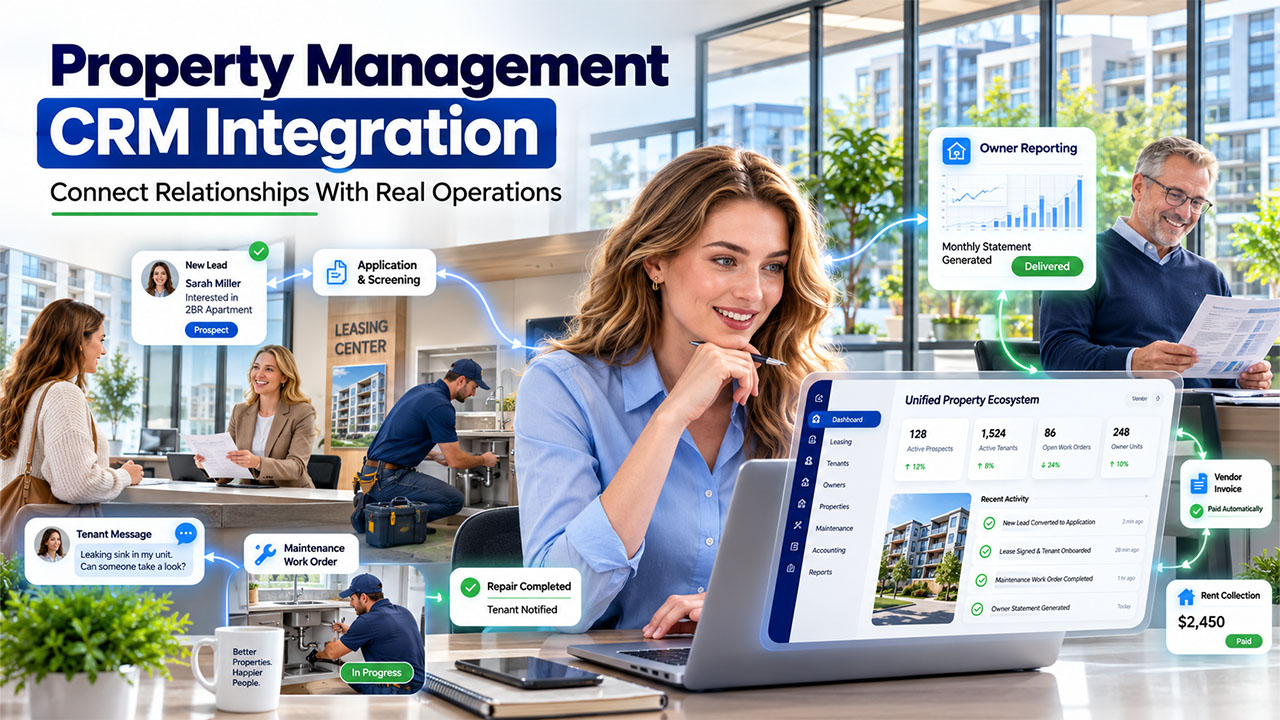

Customer Relationship Management (CRM) software serves as the foundation for managing relationships throughout the property lifecycle. CRM Integration with property managers helps organize prospects, communicate with tenants, nurture owner relationships, and coordinate leasing activities. When paired with property management software, CRM becomes part of a connected technology stack that supports both customer engagement and day-to-day operations.
While CRM is designed to manage customer interactions and communication, property management software is built to support operational activities such as lease administration, maintenance coordination, accounting, and reporting. Rather than replacing CRM, these systems work best when integrated, allowing information to flow seamlessly between relationship management and operational workflows.
CRM Builds Strong Relationships While Property Management Software Supports Operations
CRM software is built to show who said what, when someone needs a follow-up and which relationship needs attention. That helps with leasing, owner communication and service notes.
But a tenant email about a leaking sink quickly becomes more than a note. The team may need to assign a vendor, track the repair, approve a cost, update the tenant and reflect the expense in an owner report. If those steps live across disconnected tools, staff spend too much time rebuilding the story.
How CRM Integration with Property Management Platforms Work
The clearest way to see that shift is to compare what a CRM records with what the broader operating stack has to keep moving.
- Before the lease: a CRM captures the lead source, emails and viewing notes. The wider stack must handle applications, screening and documents.
- During the tenancy: a CRM holds tenant history and service notes. The wider stack must handle rent, maintenance, vendors and reporting.
- After move-out: a CRM sends follow-up reminders. The wider stack must handle deposits, repairs and final accounting.
The gap appears when the CRM knows the contact, but not the operational status. It may show the tenant record, but not whether rent cleared, whether the repair invoice was approved or whether the owner statement changed.
| CRM | Property Management Platform |
| Lead management | Applications |
| Prospect communication | Lease management |
| Owner relationships | Rent collection |
| Tenant communication | Maintenance |
| Follow-ups | Vendor coordination |
| Customer history | Accounting |
| Marketing automation | Owner reporting |
Together, these systems provide complete visibility across customer relationships and operational processes.
Connected Workflows Need Reliable Data Movement
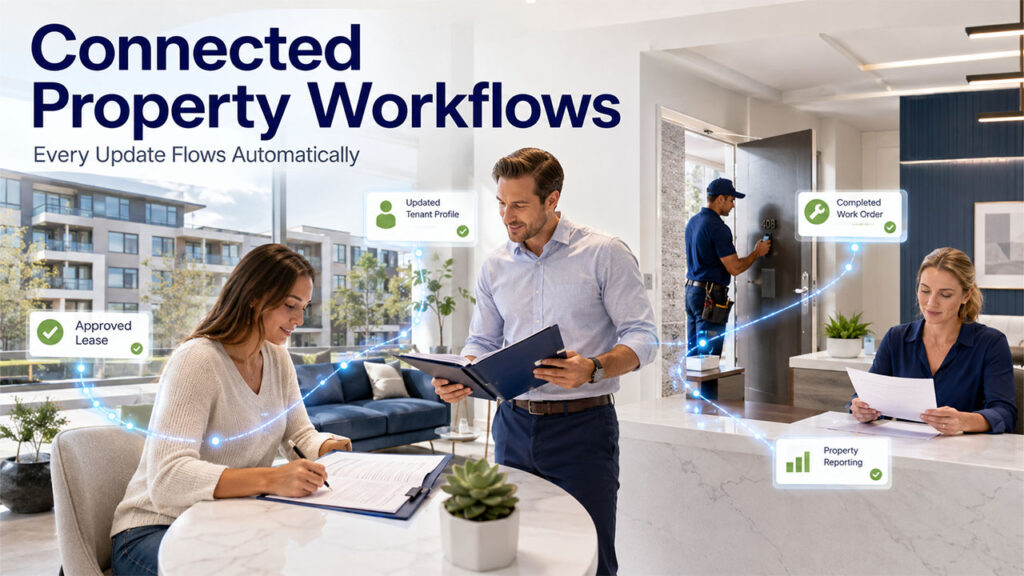
A property stack depends on API integration between applications, systems and workflows, so events do not remain trapped in separate tools. API integrations allow CRM Integration with property management software to exchange information automatically. When systems communicate effectively, leasing updates captured in CRM can trigger operational workflows in the property management platform, while completed operational tasks can update customer records, ensuring every stakeholder has accurate and current information.
For property managers, this is practical rather than abstract. A signed lease should update the tenant record. A completed work order should close the loop for the resident and owner. A paid vendor invoice should affect reporting without manual copying. Each repeated entry creates another chance for delay, mismatch or confusion.
When Work Has to Move Beyond the Contact Card
At a certain point, the key question is not where contacts are stored. It is whether the property record can move through the work itself. Teams that outgrow their CRM usually start comparing property management software like DoorLoop, because the real test is whether application status, lease terms, rent activity, maintenance tickets, vendor bills and owner reporting can stay connected instead of being rebuilt by hand.
That is the break from CRM. The CRM may still support relationship history, but the operations side of the stack has to carry the transaction trail.
Reliability Is Part of the Stack
Once rent, maintenance, accounting and reporting tools exchange data, reliability becomes an operations issue. Teams need to know whether systems send the right data, at the right time, in the right format.
That is why testing interfaces for accuracy, timing and failure points matters. A broken sync can become a wrong balance, a delayed owner report, or a support ticket that should not have existed.
CRM Integration with property management systems exchange data, integration reliability becomes essential. Accurate synchronization ensures customer records, operational updates, and financial information remain consistent across both platforms.
Access Control Cannot Be an Afterthought
A connected stack also creates a permission challenge. Leasing staff, accountants, vendors, owners and tenants may all need different information.
That makes the right access to the right resources at the right time a daily property-management concern. A vendor may need a work order, not a lease file. An owner may need reporting, not every tenant document.
CRM Integration with property management software provides a centralized view of customer relationships and communications, while property management platforms support the operational processes that keep properties running efficiently. By integrating both systems, organizations can reduce manual work, improve data accuracy, automate workflows, and deliver better experience for tenants, owners, vendors, and internal teams.
%201.png)

%201.png)

%201.png)