
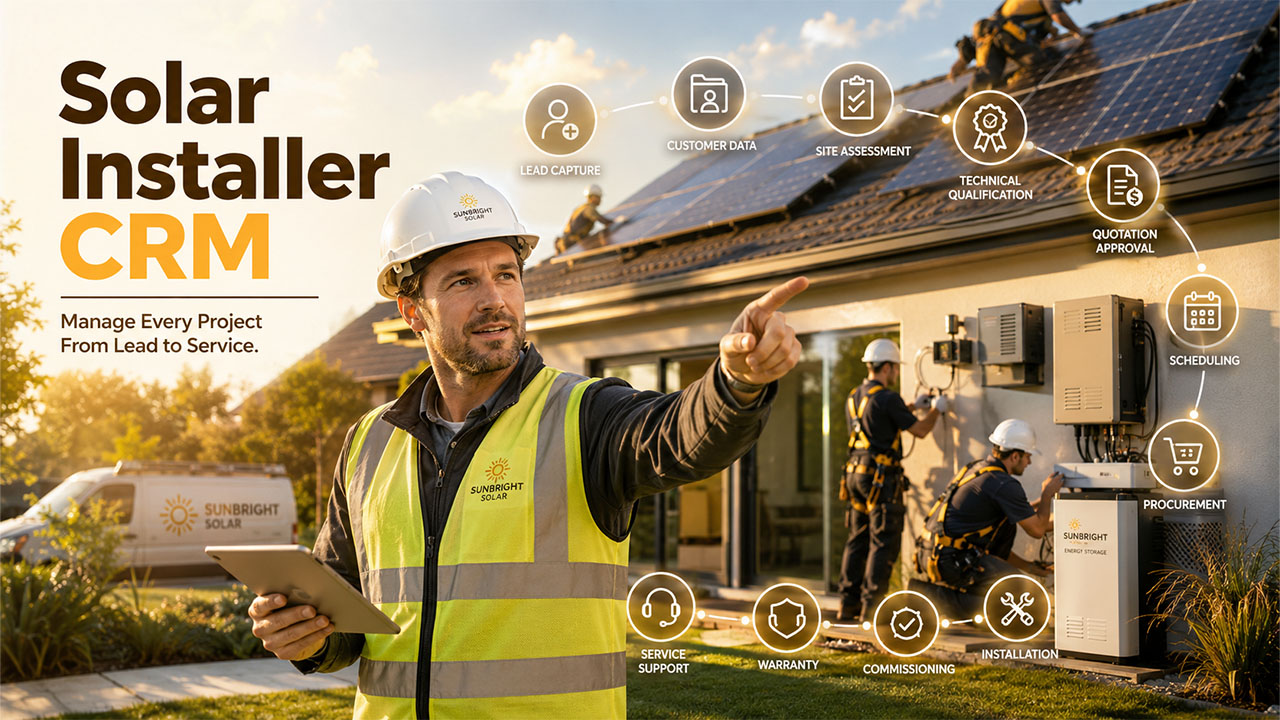

As the need for residential and commercial solar power installations increases, installation companies deal with increasingly complex projects. In addition to planning and setting up the solar panels, many companies coordinate battery storage facilities, financing, sourcing equipment, scheduling installations, conducting inspections, and providing post-installations, and providing post-installation services. This process becomes cumbersome without the use of a CRM system since tracking all of these activities manually using spreadsheets, emails, and paper notes leads to an increased possibility of missed appointments and quotations.
The CRM software for solar installers organizes all activities related to the solar project in a single platform. Unlike the common approach of considering CRM only as a sales management system, a successful installation company uses CRM to manage technical data, milestones of the projects, communication with customers, and after-installation services. With proper implementation, CRM ensures smooth and efficient workflow.
Understanding how solar installers can use CRM to manage projects is becoming increasingly important for businesses looking to scale while maintaining quality and consistency.
What Is a CRM for Solar Installers?
A CRM for solar installers is an application program used to store and manage customer's information, projects and operations during the installation process of the entire lifecycle. As a general customer database might just capture basic contact information and the sales process information, the CRM for solar installers captures all information from the technical assessment, project documentation, scheduling, procurement, commissioning, and service information in one place.
From a practical perspective, a CRM for solar installations enables sales reps, designers, engineers, procurement department, installation and service personnel to use the same upfront information. The way it avoids double data entry and makes communications between departments easy.
CRM for solar installation is a centralized platform used to manage customer relationships, technical project information, scheduling, documentation, commissioning, and service.
Importance of CRM for solar installers Companies

The implementation of a solar installation project is a process which involves many things besides the signing of contracts and equipment installation. This process involves many stages where the involvement of various teams, suppliers, and customers is required. Any lack of necessary information at any stage of a solar installation process may cause delays.
For instance, incomplete information about customer electricity use may result in providing incorrect batteries, and insufficient information about inverters may result in engineering changes before installation starts. Moreover, poor cooperation between the teams involved in sales and procurement may also be a reason for the wrong order of equipment and schedule conflicts.
CRM for solar installers helps to avoid such problems by establishing standard procedures and the requirements of project information at each stage. Automated alerts, sharing of projects information, and clear roles of all parties involved help not only to avoid human errors but also to ensure better control of the project by management. Standard procedures become especially important when the number of installations increases.
How CRM Supports the Complete Solar Project Lifecycle
The best CRM for solar installers does not only allow for lead management but become an integral part of the operation of a solar installations company by integrating information about customers, technical documentation, planning, procurement, installations, and ongoing services into a single process.
Instead of treating each department as a separate entity, the CRM allows linking them all in such a way that data gathered at the first meeting stays accessible for engineering, equipment purchase, installation, commissioning, and maintenance in the future.
Such a workflow not only allows for better management of the project but also enables you to avoid extra work on duplicating data for different departments and allows working with updated information.
Capture Qualified Leads and Customer Information
Successful solar projects begin with collecting accurate information during the first customer interaction. A CRM should capture not only contact details but also the information needed to evaluate whether a project is technically and commercially suitable.
Important information collected at this stage may include:
- Lead source and marketing channel
- Customer classification (residential or commercial)
- Recent electricity bills
- Property address and building details
- Existing solar system information
- Initial customer objectives and consultation notes
Recording complete information early helps reduce unnecessary back-and-forth communication later in the project. Sales teams can better understand customer expectations, while engineering teams receive the data needed for preliminary assessments. Establishing this strong foundation allows every subsequent stage—from technical qualification to installation and after-sales support—to proceed with greater accuracy and consistency.
Create a Technical Qualification Stage
Once a lead has been qualified, the next step is to verify whether the proposed system is technically suitable for the customer's property and energy requirements. This stage is where a CRM for solar installers becomes more than a sales tool—it serves as a structured repository for engineering and project planning data. Instead of relying on scattered emails or handwritten notes, every technical detail can be recorded in a standardized format that is accessible to all relevant teams.
When a prospect requests whole-home energy storage, the CRM should require the sales team to record the load profile, required backup duration, inverter model, solar capacity and future expansion plans before preparing a proposal. Collecting this information early helps engineers recommend an appropriate battery configuration while reducing the likelihood of design revisions later in the project.
Additional information such as roof orientation, electrical panel specifications, site photos, and local permitting requirements can also be attached to the customer record. Requiring mandatory fields before a project moves to the quotation stage helps prevent incomplete submissions and supports more accurate technical approvals.
Many installation companies also use their CRM to reference battery and inverter compatibility information during project planning. For example, manufacturers such as Avepower publish compatibility guidance and technical documentation that can assist installers when reviewing suitable energy storage configurations for residential and commercial projects. Recording these references within the CRM ensures that project teams are working from consistent technical information throughout the design process.
Manage Quotations, Financing, Procurement, and Installation Scheduling

After technical approval, the CRM for solar installers becomes the central platform for coordinating commercial and operational activities. Every quotation should be linked directly to the approved technical assessment so that pricing reflects the actual equipment and installation requirements rather than outdated assumptions.
Version control is particularly valuable during this stage. If customers request changes to battery capacity, inverter selection, or installation timelines, the CRM for solar installers maintains a record of proposal revisions, making it easier for both sales representatives and project managers to track updates. This reduces confusion and helps ensure that approved quotations remain aligned with technical specifications.
Once a quotation has been accepted, additional workflows can be triggered automatically. Financing status, purchase orders, inventory availability, equipment procurement, and installation scheduling can all be monitored from the same project record. Automated task assignments also help ensure that procurement teams, warehouse staff, and installation crews receive timely notifications as project milestones are completed.
A centralized workflow reduces quotation errors, minimizes scheduling conflicts, and improves communication between departments. Instead of repeatedly requesting updates through phone calls or emails, project stakeholders can access current information directly from the CRM, supporting more efficient project delivery.
Commissioning, Warranty and Long-Term Service Management
The completion of any installation does not mark the end of the project documentation. The CRM for solar installers continues to offer valuable data by recording commissioning results and also support long-term customer service throughout the operational life of the system.
Commissioning any of these record generally record typical inspection reports, installation photographs, system performance verification, customer acceptance forms, and final project documentation. Storing all of these records in a single location help in simplifying any future maintenance visits, along with offering valuable reference material, even if service request arises.
The CRM software should also maintain equipment for serial numbers, along with warranty registration details, maintenance schedules, and service history for every installed system. The automated reminders can also notify that bot the installers and customers, especially when periodic inspections or maintenance activities, which are due. The platform also helps maintain reliable system performance over a longer period of time. Organized recordsd also help with a faster warranty claim, as the technical can quickly access installation details and historical service information, without going through multiple files.
Best Practices for Using CRM in Solar Installation Projects
Implementing the CRM platform is not only effective when every department follows a consistent processes, but also establishes a standardized workflows, which improves data quality. It also allows project information to remain accurate from the initial inquiry, especially from the initial inquiry through long-term service.
Some practical best practices include:
- Standardize customer data entry across all departments.
- Require mandatory technical fields before quotations are created.
- Automate reminders for follow-ups, approvals, and maintenance.
- Record every project milestone within the CRM.
- Keep commissioning documents, warranties, and serial numbers updated.
- Review CRM data regularly to identify workflow improvements.
- Train sales, engineering, procurement, and installation teams to use the same procedures consistently.
Following all of these steps helps in creating a reliable operational framework, which reduces administrative errors, and improves collaboration. It also supports a more consistent project of delivery, especially as the business of the solar installation grows.
Common CRM Mistakes Solar Installers Should Avoid

The most capable CRM platform can also not improve project management, even if it is used inconsistently. Many of the operational issues are not only because of the software itself, but because it is an important information, which do not follow standardized workflows.
Common mistakes include:
- Recording incomplete customer or property information.
- Preparing quotations before completing the technical qualification.
- Keeping project details in separate spreadsheets instead of the CRM.
- Failing to update project milestones after each stage.
- Poor communication between sales, engineering, procurement, and installation teams.
- Forgetting to record equipment serial numbers and warranty details.
- Neglecting follow-up reminders and preventive maintenance schedules.
Avoiding any of these mistakes helps in ensuring that every project progresses, especially through a consistent workflow, which reduces delays, improves customer communication, and supports a more reliable project outcome.
Key Takeaways
- CRM software helps organizations in centralizing customer, technical, and project information in one system.
- The platform offers a standardized workflow that reduces quotation errors and improves project consistency.
- Recording a technical requirement even before preparing proposals supports more accurate system design.
- CRM automation helps improve scheduling, along with procurement and communication across departments.
- Commissioning records, warranty details, and maintenance history simplify long-term customer support.
- Consistent CRM usage helps solar installation companies scale while maintaining service quality.
Final Thoughts
The process of managing solar and battery installation generally requires careful coordination, especially between technical assessments, equipment suppliers, installation schedules, and ongoing customer support. A well-implemented CRM for solar installers offers the teams a structured framework, which connects each stage of the project lifecycle, helping businesses significantly reduce administrative errors, improve collaboration, and deliver a more consistent customer experience.
With the increase of the project volume, managing records and standardized workflows becomes increasingly valuable, especially in long-term operational success. Various companies works with a trusted industry partner, which include batter manufacturers, such as Avepower, can also strengthen the project planning of the organization, simply by combining reliable technical documentation and disciplined CRM process.
To learn more about effective energy storage planning, consult qualified solar installers and trusted industry resources that can provide guidance tailored to specific project requirements.
Frequently Asked Questions
Q1. What is meant by CRM for solar installers?
A CRM software for solar installers is a specific tool that helps solar installation companies efficiently manage customer information, technical assessments, quotations, project scheduling, commissioning records, warranties, and after-sales service within one centralized platform.
Q2. How CRM help improve solar project management?
The CRM platform standardizes workflows, automates follow-ups, improves communication between departments, and provides complete project visibility, reducing delays, quotation errors, and administrative tasks.
Q3. What information should solar installers collect before proposal?
Before proposal, installers should gather key information like electricity usage, property details, load profile, backup requirements, inverter model, solar capacity, site assessment information, and future expansion plans.
Q4. Can CRM reduce quotation and scheduling errors?
Yes, the CRM platform can reduce quotation and scheduling errors. The platform links technical approvals with proposal generation, procurement, and installation scheduling, CRM ensures that every department works from the same verified project information.
Q5. Why are commissioning records and warranty information important?
The commissioning reports, serial numbers, warranty registrations, and service history act as valuable documentation for maintenance, troubleshooting, warranty claims, and future system upgrades.
Q6. Can small solar installation companies benefit from CRM software?
Yes. Even smaller installation businesses can improve organization, customer follow-up, project tracking, and operational efficiency by adopting standardized CRM processes before expanding their operations.
%201.png)

%201.png)

%201.png)