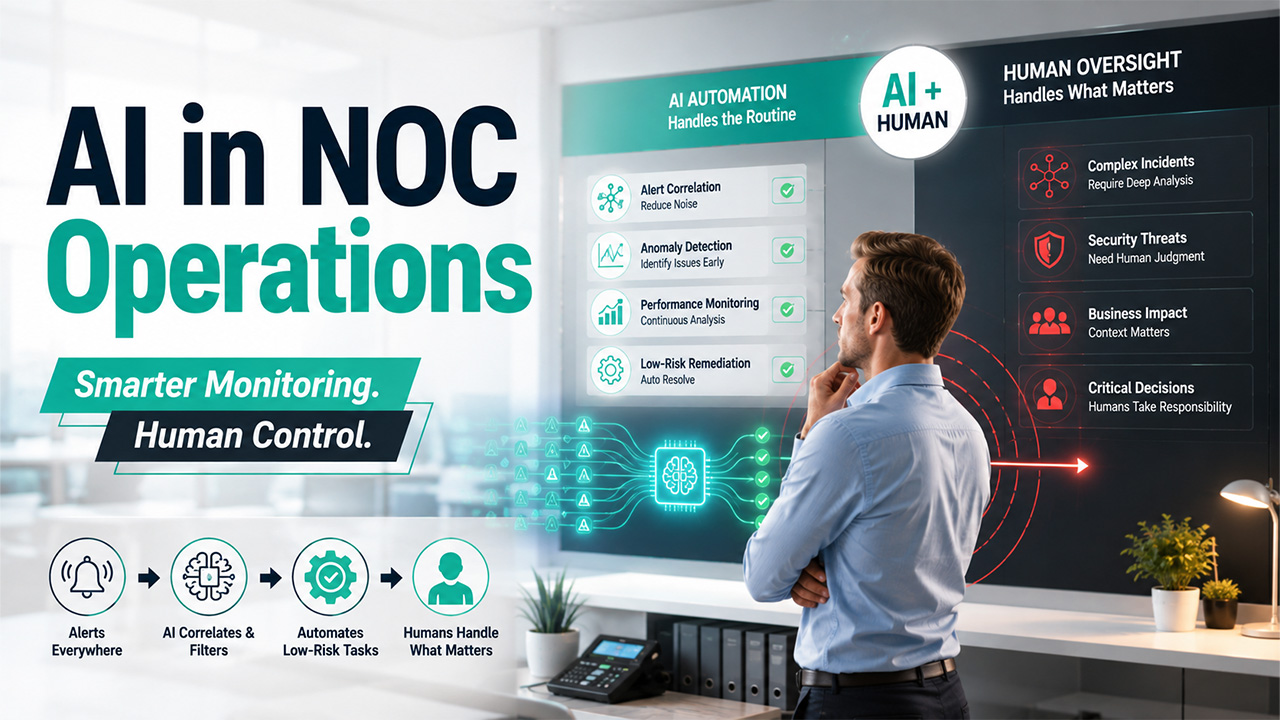

AI in NOC operations refers to the use of artificial intelligence and machine learning technologies to monitor network environments, analyze alerts and performance data, identify anomalies, correlate events, and automate selected operational tasks.
A network operations center used to run on one resource above all else: headcount. More alerts meant more engineers watching more screens, and scaling meant hiring, full stop.
That math is breaking down now. AI now picks up more of that routine load every year, though nobody has fully settled the harder question underneath it, how much should AI be trusted, and how much still needs a person's judgment behind it. Get that balance wrong and it costs you either way. Engineers run themselves into the ground on one end. A real outage slips through unnoticed on the other.
What AI Handles in NOC Operations
AI in NOC operations is currently focused on tasks that generate large volumes of repetitive work for engineers, making network automation an increasingly important part of modern NOC workflows, making network automation an increasingly important part of modern NOC workflows. Three areas carry much of that load:
- Alert correlation: Machine learning models group related signals into a single incident instead of a raw stream of individual notifications. Fewer things to look at, faster to act on.
- Anomaly detection: The model learns what normal traffic and performance look like for a specific environment, then flags genuine deviations instead of tripping on every threshold crossing.
- Low-risk remediation: Clearing a stuck interface counter, restarting a failed service, rotating a log file, none of that needs a human's approval at midnight.
The pattern holds across most mature deployments: automation absorbs the repetitive, well-understood work. Judgment calls stay with people, and that division of labor is exactly what makes good outsourced NOC monitoring work in practice, automation paired with people who know when to step in, not automation for its own sake.
Where Automation Hits a Wall

Vendor pitches make this sound closer to solved than it is. Gartner's own research is a useful reality check here: more than 40 percent of agentic AI projects will be canceled by the end of 2027: costs that crept past what anyone budgeted for, value nobody could actually point to, risk controls bolted on after the fact instead of designed in from the start.
Part of the blame sits with the vendors themselves. Gartner analyst Anushree Verma calls it "agent washing," the practice of rebranding an existing chatbot or a robotic process automation script as agentic AI without any of the underlying capability to justify the label. A monitoring dashboard that emails an alert is not an agent. Neither is a script that restarts a service on a fixed schedule.
None of that means the technology is going nowhere. It means the gap between the pitch and the deployment is real, and any NOC evaluating an AI tool should ask what it actually does under the hood before taking a vendor's word for it.
Why Human Oversight Still Matters in AI-Powered NOC Operations
AI in NOC operations can automate detection, correlation, and selected remediation tasks, but it does not eliminate the need for human judgment. Complex incidents rarely follow a script. Automation is built on patterns it has seen before, which works fine until something happens that does not match any of them. That is exactly the moment a NOC finds out whether its AI tooling was ever designed to hand off gracefully, or just built to alert and wait. A few examples of what still lands on a person's desk, and probably will for a while yet:
- A cascading failure across interdependent systems, where the root cause is three steps removed from where the alerts are firing.
- An unusual security event that does not match any known attack pattern.
- A customer escalation that needs business context no algorithm has access to.
Real value does not come from chasing full automation. The real skill is deciding early where that line goes: detection, correlation, and low-risk fixes stay with the model. Anything with real business consequence goes to an engineer who can actually weigh the tradeoffs.
That is the model in practice: AI tooling does the constant watching and the first-pass triage. Experienced engineers handle escalations, root cause work, & anything that carries potential risk. Neither side does the other's job well alone.
What AI in NOC Operations Means for MSPs
For managed service providers, AI in NOC operations changes what businesses should look for when evaluating a NOC partner. The question is no longer simply whether a provider uses AI. It is how the provider uses automation, where human engineers remain involved, and what safeguards exist when the technology makes an incorrect decision.
For managed service providers, this changes what to actually look for in a partner. Skip the ones promising to replace their engineers with AI outright, that pitch usually means the automation hasn't been tested against a real bad day yet.
The right NOC service providers have already worked out where automation earns its keep and where it does not, and built a NOC around that distinction on purpose, not around whatever happens to be cheaper this quarter. A useful question to ask any provider making big AI claims: what happens when the model gets it wrong, and who is watching for that moment?
The technology keeps improving, no argument there. But right now, today, the NOC that actually works best treats AI like a highly capable junior team member. Not a replacement for the senior one.
Conclusion
The introduction of AI in NOC operations marked a major change, as it takes over repetitive monitoring, alert correlation, anomaly detection, and low-risk remediation. AI in NOC operations also eliminates the need for human expertise. The most effective approach is to combine AI-driven automation with an experienced engineer, who can handle complex incidents, assess business impact, and make high-risk decisions. The goal should be to find the right balance between AI efficiency and human oversight to build a more responsive, reliable, and resilient NOC.
%201.png)

%201.png)

%201.png)