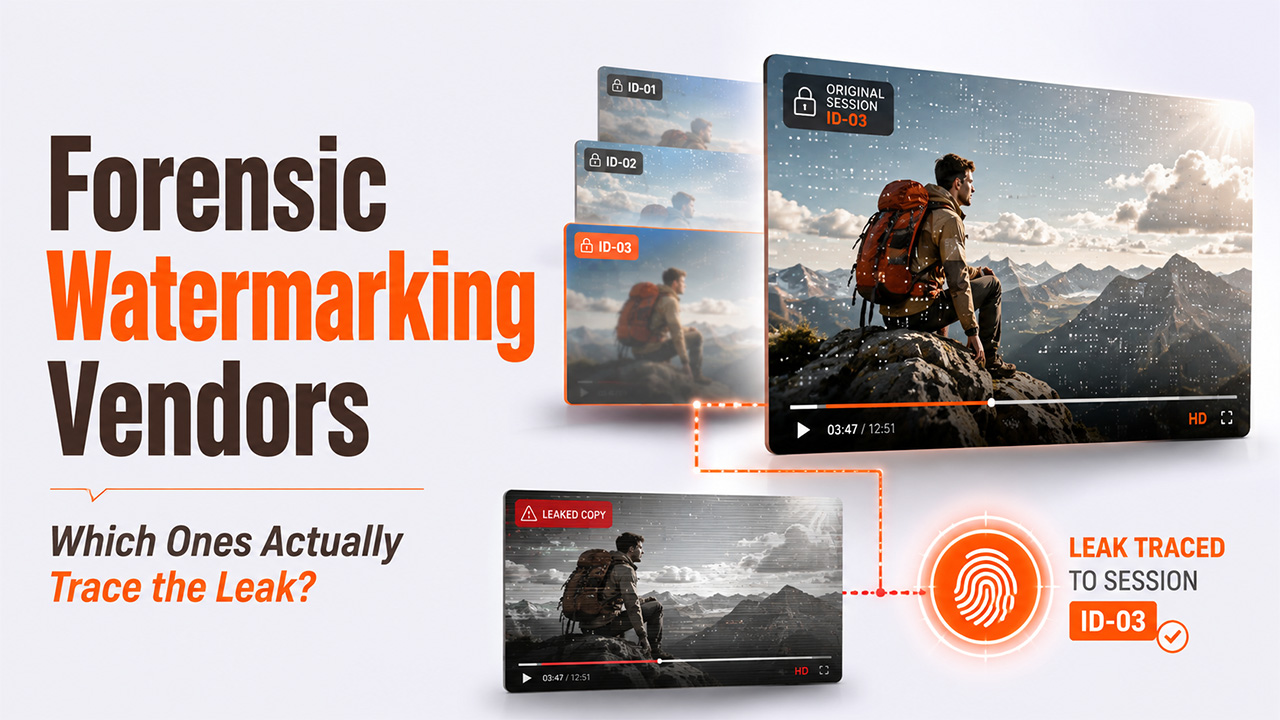

Three weeks ago, a mid-size EdTech company I advise had a cohort module show up in a Telegram group of 400 people who had never paid for the course. If you're evaluating forensic watermarking vendors in 2026, the difficult part isn't finding companies that claim to offer forensic watermarking; it's determining what those claims actually mean technically.
The watermark in the corner was a static logo. It told them nothing. Not which student, not which session, not even which cohort.
That story is a dynamic-watermarking problem, and it has a dynamic-watermarking answer: a viewer-specific overlay, paired with DRM and signed URLs, would have named the leaker in every frame.
If that is your situation, the fix is a dashboard toggle, not a procurement process. This article is for a narrower, later-stage reader: the one who has already ruled out a visible overlay, either because a distribution contract specifically requires forensic-grade watermarking, because the piracy is organized rather than casual, or because a vendor has told them 'we offer forensic watermarking' and they need to know whether that claim is real before they sign anything.
That question turns out to be harder to answer than it should be. Forensic watermarking vendors describe their own technology in almost identical language: invisible, session-based, survives re-encoding, traces leaks. The marketing copy converges. The actual engineering, deployment model, and pricing do not.
This article runs the same fixed test against every vendor commonly named in this category, tells you what each one actually verified against its own technical documentation, and gives you the specific questions to ask before a forensic watermarking contract gets signed.
Key Takeaways
Forensic watermarking vendors describe their technology in nearly identical marketing language. What differs is the actual mechanism, live-stream support, and deployment model, and that only shows up in technical documentation, not the homepage.
- Six vendors are genuinely forensic-grade based on their own technical documentation: Irdeto, NAGRA, Synamedia, DoveRunner, Verimatrix, and BuyDRM. All six confirmed invisible embedding, per-session or per-distributor attribution, and support for both live and VOD delivery.
- Two platforms marketed primarily as dynamic-watermarking tools, SproutVideo and Muvi, also offer genuine invisible forensic watermarking as a distinct, named feature, not just a deterrent overlay. That is easy to miss if you only check the platform's most prominent marketing page.
- The dominant scalable forensic technique is server-side A/B watermarking, which prepares two encoded variants of each segment and selects between them per session, avoiding the cost of a fully separate encode per viewer.
- A forensic watermark resolving to a session or distributor ID is not the same as identifying a person. Someone still has to connect that record to an individual, usually through backend access logs, not the watermark itself.
- Before signing with any forensic watermarking vendor, get three things in writing: their minimum detectable clip length, whether they publish collusion-resistance data, and whether their live-stream support is native or a separate product tier.
The Short Version, For Readers Who Need the Category Distinction First
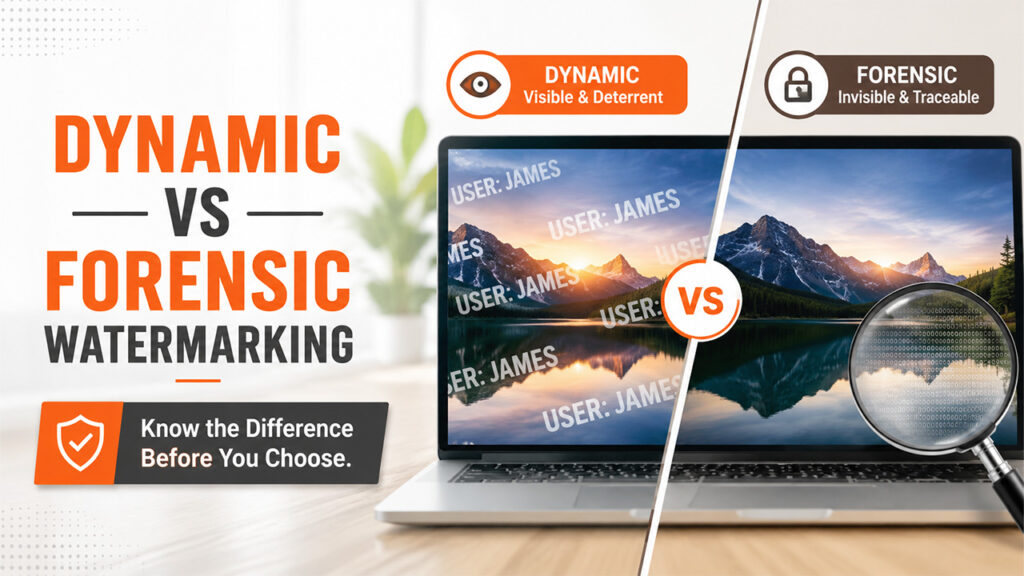
If you're still deciding between visible and invisible watermarking rather than evaluating named forensic vendors, the short version: dynamic watermarking is a visible, session-specific overlay that deters sharing before it happens.
Forensic watermarking is an invisible signal embedded in the video itself, built to survive the compression, cropping, and re-encoding that would strip out a visible overlay, and it enables attribution after a leak rather than deterrence before one.
Gumlet's own comparison of dynamic vs. forensic watermarking walks through that distinction, the underlying mechanics, and which one fits a course platform or membership site. If your threat model is casual sharing rather than organized piracy, that's very likely a better starting point than this article.
Everything below assumes you've already made that call and need to evaluate specific forensic-grade vendors.
Forensic Watermarking Vendors: Who's Actually Forensic-Grade in 2026?
Here's the test I apply before calling anything "true forensic": it has to be invisible, it has to resolve to an individual session rather than a broad distribution channel, it has to get inserted or selected during delivery rather than baked identically into every copy, and it has to be recoverable from a pirated file that's been re-encoded or recorded off a screen.
Fail any one of those four and it's a deterrent tool, not a forensic one, whatever the marketing page calls it.
We evaluated the leading forensic watermarking vendors against the same technical criteria: invisible embedding, session-level attribution, live and VOD support, and recoverability after re-encoding or screen recording.
| Vendor | Invisible mark | Per-session attribution | Live support | VOD support | Verdict |
| Gumlet | No, visible overlay | Yes, visible session ID | Yes | Yes | Dynamic (deterrence) |
| VdoCipher | No, visible overlay | Yes, visible session ID | Yes | Yes | Dynamic (deterrence) |
| SproutVideo | Yes, offered alongside visible option | Yes, session-tied | Yes | Yes | Both tiers available |
| Muvi | Yes, offered as a distinct product feature | Yes, session-based | Yes | Yes | Both tiers available |
| NAGRA NexGuard | Yes | Yes, session and device level | Yes | Yes | Forensic |
| Irdeto TraceMark | Yes | Yes, session and distributor-based | Yes | Yes | Forensic |
| Synamedia ContentArmor | Yes | Yes, distinct ID per stream | Yes | Yes | Forensic |
| DoveRunner | Yes | Yes, user and device ID | Yes | Yes | Forensic |
| Verimatrix | Yes | Yes, session, user, device | Yes | Yes | Forensic |
| BuyDRM (MultiMark) | Yes | Yes, session-based, proprietary | Yes | Yes | Forensic |
Two corrections worth calling out explicitly, because they're the kind of thing a vendor comparison gets wrong when it only checks the platform's primary marketing page instead of its full technical documentation:
1. SproutVideo and Muvi are not dynamic-only
Both are usually categorized alongside Gumlet and VdoCipher as deterrence-tier platforms, and for most of their marketing, that's the right bucket.
But SproutVideo's own security documentation lists invisible watermarking as a distinct, named option alongside its visible dynamic watermark, and Muvi's help center describes a separate Forensic Watermarking feature that embeds invisible, session-specific identifiers designed to survive re-encoding and screen recording, not just a deterrent overlay.
If a vendor comparison you've read elsewhere lists either platform as dynamic-only, ask them directly whether their forensic option is live in the plan you're evaluating, since it's easy to miss if you're only looking at the headline feature page.
2. DoveRunner's live-stream support is full, not partial
DoveRunner's forensic watermarking documentation confirms consistent support across live streams, VOD libraries, and theatrical pre-release content, the same tier as NAGRA, Irdeto, Synamedia, and Verimatrix. Earlier vendor comparisons that flag DoveRunner's live support as partial or limited appear to be outdated relative to DoveRunner's current product.
If you run a course platform, a membership site, or you're sending confidential review copies to external recipients, the deterrence tier is very likely your answer.
If you're licensing premium film, live sports rights, or studio content with a distribution contract that specifies watermarking, you need the forensic tier and the enforcement infrastructure that comes with it.
Nobody in between those two situations needs to be shopping the other tier's vendor list.
What to Verify Before Choosing a Forensic Watermarking Vendor
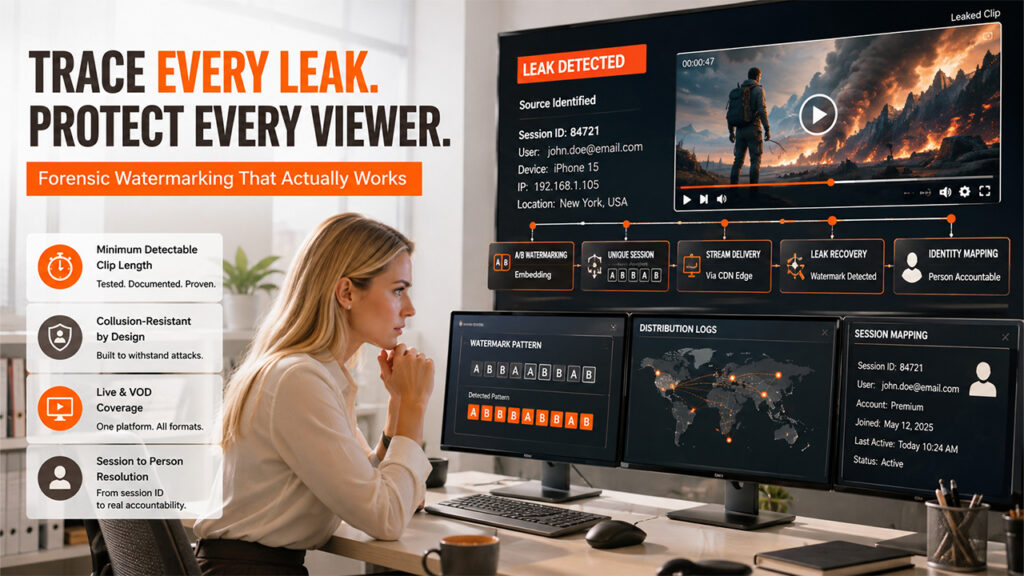
Every vendor in the table above will tell you their solution is invisible, scalable, and survives re-encoding.
That's not a differentiator, its table stakes marketing language the entire category has converged on. The differences that actually matter show up in documentation, not the homepage, and most buyers never ask for them before signing.
Four questions separate a real evaluation from a sales conversation:
1. What is the minimum detectable clip length?
Piracy surfaces as short clips far more often than full files. A vendor's technical material should state, in writing, how many seconds of leaked footage their detection system needs to extract a readable watermark. If a sales team gives you a verbal number but won't put it in the contract or a datasheet, treat that number as aspirational rather than tested.
2. Do they publish collusion-resistance data?
A collusion attack compares two differently watermarked copies of the same content to weaken or erase the embedded identifier. It's a genuine, documented limitation of forensic watermarking, and not every vendor tests or publishes resistance figures against it. Ask directly. Silence on this question is itself an answer.
3. Is live-stream support native or a separate product tier?
Several vendors in the comparison above offer both live and VOD support, but not always through the same product, pricing, or implementation path. Confirm that the tier you're being quoted actually covers your delivery format, not a different SKU that happens to share the vendor's name.
4. Does the watermark resolve to a person, or to a session and distributor record?
This is the distinction worth sitting with before any contract gets signed. A forensic watermark that resolves to 'session 84721' or 'distribution partner 14' is not the same as identifying a human being.
Someone on your team, or the vendor's, still has to connect that record to an actual person, and that step usually runs through backend access logs rather than the watermark itself. Ask the vendor to walk you through that last step specifically, since it's the step most sales conversations skip.
None of these four questions are hard for a legitimate vendor to answer. They're also exactly the questions a vendor without a real answer will redirect away from.
How Forensic Watermarking Actually Traces a Leak
Understanding A/B watermarking is also one of the easiest ways to distinguish genuine forensic watermarking vendors from platforms that use the term “forensic” to describe a conventional dynamic overlay.
The mechanism that makes forensic watermarking scale without encoding a separate file for every viewer is called A/B watermarking, and it matters because it's the reason forensic vendors can serve millions of concurrent sessions without melting their encoding pipeline.
- Encode two variants of each video segment, A and B, each carrying a different embedded payload fragment.
- Assign each session its own sequence across those two variants, something like ABBAB or BAABA.
- Select the correct variant per segment at the CDN edge or headend as the stream assembles for that specific viewer.
- Deliver the resulting stream, which looks identical to every other viewer but carries a distinct A/B pattern.
- Recover a leaked copy and run it through detection software that reads the sequence of variants back out.
- Map that sequence to the session record that was assigned it, which points to the account, device, or distribution partner that received it.
Synamedia describes this exact pattern in its own ContentArmor documentation: server-side watermarking that combats CDN leeching and token duplication by generating A/B variants from already-compressed content, avoiding the double encoding cost that a naive per-viewer approach would require.
That scalability argument is the whole reason A/B watermarking, not full per-viewer re-encoding, became the industry default for OTT and broadcast.
One caveat worth sitting with: A forensic watermark resolving to "session 84721" is not the same as identifying a person. It tells the platform which account or distribution endpoint received that copy. Somebody still has to connect that account to an actual human being, which usually means backend records, not the watermark itself. Treat any vendor claim that stops short of that distinction as marketing, not documentation.
Ask any vendor claiming "forensic watermarking" to show you the specific mechanism, not the outcome. If they can't explain whether it's A/B segment selection, headend embedding, or client-side insertion, they're describing a result they haven't actually engineered.
Watermarking for Course Platforms, Membership Sites, and Confidential Review Copies
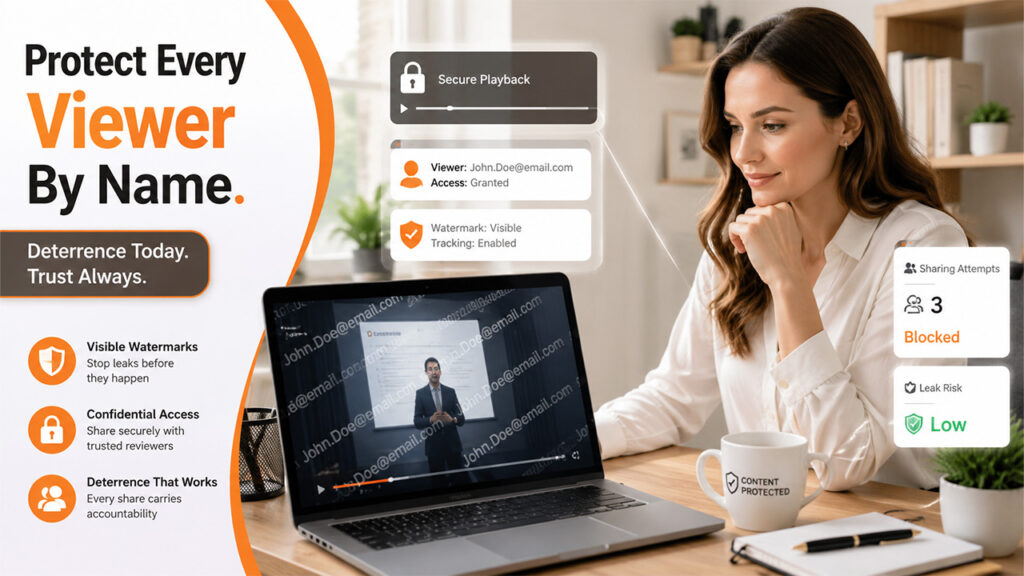
This is the section that matters if you're not running an OTT platform or licensing studio content, which describes most SaaS, EdTech, and membership businesses reading this.
The correct tool for this ICP is visible, per-viewer dynamic watermarking paired with DRM and signed URLs, not forensic-grade infrastructure built for a threat model you don't have.
MUSO's 2024 Piracy Trends and Insights report recorded 216.3 billion visits to piracy sites globally in 2024, with television remaining the single largest category at 96.8 billion visits. Film piracy actually declined sharply that year, and publishing, driven by manga and web fiction, has overtaken it as the second-largest category.
That number is a useful sanity check: the organized, high-volume piracy economy is overwhelmingly a licensed-media problem, not a course-platform problem. Your leak risk looks completely different, and it calls for a completely different tool.
Course Creators and Membership Operators: Deterrence is the Actual Goal
The piracy risk on a course platform is casual, not organized. It's a student forwarding a module to a friend, or a member sharing a login in a community server.
A visible watermark showing that student's email or account ID across the frame changes the decision at the exact moment it matters, before they hit share, not two weeks later when a forensic vendor's detection report comes back.
Gumlet, VdoCipher, SproutVideo, and Muvi all implement this as a dashboard-level toggle rather than a development project.
In Gumlet's case, the overlay is configured directly from the player customization settings, where you choose which viewer field displays, how often the mark repositions, and how opaque it renders, all without touching code or waiting on an engineering sprint. VdoCipher runs the same pattern through WordPress and Moodle plugins that pass viewer data to the watermark layer automatically.
Neither of these is forensic watermarking, and neither vendor's own documentation claims otherwise. What they do claim, accurately, is a viewer-specific overlay that survives casual cropping attempts and makes the sharer's identity part of every frame of the leak.
Sending Confidential Review Copies or Screeners Externally
The calculus shifts slightly once the recipient list moves outside your own paying users, into partners, investors, press, or external reviewers.
Session-tied visible watermarking plus access logging is usually still sufficient here, because the population you're worried about is still identifiable and still finite.
Where this stops being enough: Once the recipient list gets large, external, and outside your direct relationship, or once removal of the visible mark becomes commercially worthwhile to someone on the other end, a visible overlay alone starts to strain.
That's the point where distributor-level tracking, the kind used for movie screener distribution, becomes relevant even for a non-media company, usually through the same forensic vendors named above rather than a video hosting platform's built-in feature.
The Disqualifier: When Deterrence isn't the Right Tool Anymore
Be honest about the ceiling here. If your content is licensed premium video with a distribution contract that names watermarking as a condition, if you're dealing with organized commercial piracy rather than casual sharing, or if your enforcement plan requires legal-grade attribution evidence, the deterrence tier will not get you there.
That's a forensic-vendor conversation, not a video-hosting-platform conversation, and no amount of dashboard configuration changes that.
What Buyers Should Check When Comparing Forensic Watermarking Vendors
Skip the seven-point OTT procurement checklist you'll find on enterprise vendor sites. It's written for a security team evaluating Irdeto against NAGRA, not for a marketing or growth lead deciding whether a video platform's watermarking is real.
Here's what actually matters at this tier:
- Does the overlay populate automatically from session data, or does someone have to manually tag each viewer? Manual tagging doesn't scale past a handful of users.
- Does it ship in the same workflow as DRM and signed URLs, or is it a separate integration with its own vendor relationship? Fragmented security stacks are where gaps get missed.
- Is it a dashboard toggle or a development project? If the answer involves an SDK and a sprint, that's a different buying decision than a $79-a-month plan upgrade.
- Is it gated behind an enterprise-only tier, or available on a plan a mid-market team can actually justify?
Gumlet and VdoCipher both clear this bar for straightforward, no-code configuration. Where they differ is in the surrounding stack: Gumlet's video protection bundles the watermark overlay with Widevine and FairPlay DRM, signed URLs with configurable expiry, and domain and geo restrictions inside one dashboard, while VdoCipher's strength is deeper WordPress and Moodle-specific plugin support for LMS-heavy setups.
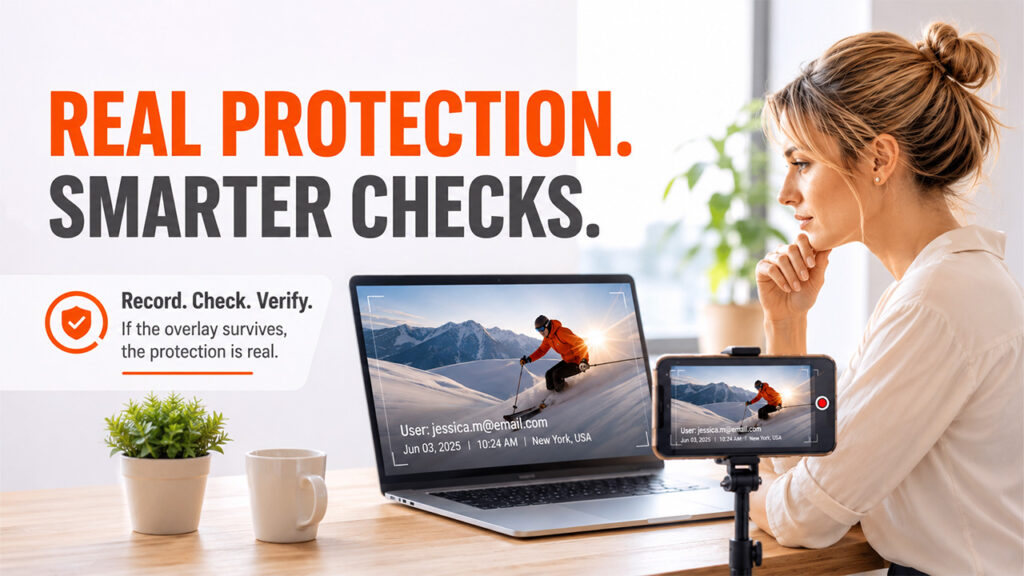
Run this test before you sign anything: Upload a protected video, watch it through a real viewer session, screen-record 10 seconds of it, and check whether the overlay survived and is still legible in that recording. If a vendor can't walk you through that test live, the security claim is theoretical.
Two Things Worth Knowing Before You Commit
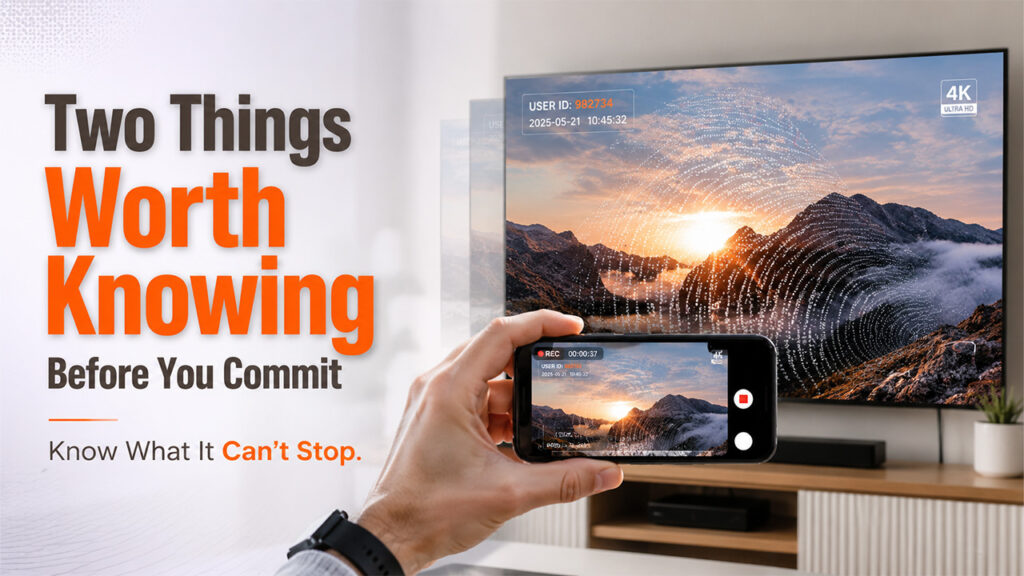
Watermarking of either kind is a deterrent and evidence layer, not a technical block on screen recording. Nothing described in this article stops someone from pointing a phone camera at a screen.
What it does is guarantee that if they do, the resulting file carries something that points back to them. DRM controls playback and downloads. Watermarking picks up exactly where DRM's reach ends.
Two viewers with different watermarked copies can, in theory, compare them and try to average out or erase the identifying data. This is called a collusion attack, and it's a genuine limitation of forensic watermarking that not every vendor publishes resistance data against.
Ask directly whether a vendor has tested and published collusion resistance figures. If they haven't, don't assume the gap doesn't exist just because nobody's mentioned it.
Which Platform Actually Covers the Whole Stack for a SaaS or EdTech Team
If you've read this far, you already know the answer to "which platform offers true forensic watermarking": none of the self-serve video hosting platforms do, and if a sales page tells you otherwise, ask them to show you the A/B segment architecture, not the feature list.
But that's not actually the question most SaaS, EdTech, and membership teams need answered. The real question is which platform gets the deterrence tier right without forcing a separate vendor relationship for every layer of protection.
That's a narrower list, and it comes down to how well DRM, signed URLs, access restrictions, and the watermark overlay work together inside a single workflow instead of getting stitched together after the fact.
Across the platforms tested here, Gumlet's video protection features is the one that keeps that whole picture in one place: dynamic per-viewer watermarking sits alongside multi-DRM encryption, time-limited signed URLs, domain and IP restrictions, and geo-blocking, configured from the same dashboard rather than four separate integrations.
For a SaaS team protecting product demos or an EdTech platform protecting paid cohorts, that consolidation is the practical difference between a security stack someone actually maintains and one that quietly drifts out of date because it's spread across too many vendors.
It's not forensic-grade, and it doesn't need to be for this threat model. It's the deterrence-tier stack built correctly, which is what actually gets used.
The Bottom Line
The distinction this whole article rests on is simple enough to misuse if you skim past it: a watermark you can see and a watermark nobody can see are solving two different problems, at two different price points, for two different threat models. If you're also exploring how AI is changing video production, AI video creation tools can help with everything from generating videos to editing and repurposing content.
Match the tool to the actual risk in front of you instead of the one the marketing copy implies you have.
For most course platforms, membership operators, and SaaS teams reading this, that means a visible per-viewer overlay layered with DRM and signed URL access control gets you real, immediate deterrence without a five-figure vendor contract you don't need.
Test it the way this article describes: upload a protected asset, record 10 seconds of it, and confirm the identifying overlay survives. If it does, you've verified more than most teams ever bother to check.
Frequently Asked Questions
Q1. What is the difference between dynamic watermarking and forensic watermarking?
Dynamic watermarking is a visible overlay, typically an email address or user ID, rendered on top of a video during playback and moved periodically to resist cropping. Forensic watermarking is an invisible identifier embedded into the video signal itself, engineered to survive re-encoding, compression, and screen recording.
A visible watermark deters a viewer from sharing; an invisible one lets you prove who did after the fact.
Q2. If a vendor says their watermarking is 'forensic-grade,' what should I ask to verify that?
Ask for their minimum detectable clip length in writing, whether they publish collusion-resistance data, and whether the live-streaming support you need runs on the same product tier you're being quoted.
A vendor with a genuinely forensic-grade solution will have straightforward, documented answers to all three. A vague or redirected answer to any of them is worth treating as a gap, not an oversight.
Q3. Can two viewers combine their copies to defeat forensic watermarking?
This is called a collusion attack, and it's a real, published limitation of forensic watermarking systems. When two differently watermarked copies of the same content are compared or averaged, it's theoretically possible to weaken or erase the embedded identifier. Some forensic vendors publish resistance data against this specific attack and some don't.
Before trusting a forensic watermarking claim for high-value content, ask the vendor directly whether they've tested and published collusion resistance figures.
Q4. Can a video hosting platform's dynamic watermarking and a specialist vendor's forensic watermarking work together?
Yes, and for most SaaS, EdTech, and membership businesses, that layered approach, rather than choosing one exclusively, is the realistic setup. Dynamic watermarking through your video hosting platform handles casual, high-volume sharing risk at low cost and no implementation overhead.Forensic-grade watermarking through a specialist vendor gets reserved for the narrower set of assets, a licensed screener, a pre-release cut, a contractually mandated deliverable, where the distribution contract or threat model specifically calls for it. Few organizations need to run 100% of their catalog through a specialist forensic vendor.
Q5. How do I know if I need forensic-grade watermarking instead of a visible overlay?
Choose forensic-grade watermarking when your content is licensed premium video under a distribution contract that specifically requires it, when you're facing organized commercial piracy rather than casual sharing, or when you need legal-grade attribution evidence for enforcement.
Everyone else, including most course creators, membership operators, and SaaS teams protecting demo or training content, is better served by a visible per-viewer overlay paired with DRM, since it's faster to deploy and matched to a casual-sharing threat rather than an organized one.
Q6. How much video does a vendor need to detect a forensic watermark?
Detection windows vary by vendor and aren't uniformly published, so treat any specific number a sales team gives you as a claim to verify, not a fact to assume. What's consistent across vendor material from Irdeto and NAGRA is that detection is designed to work from short clips, not full-length recordings, since piracy typically surfaces as clips rather than complete files.
If a vendor won't specify their minimum detectable clip length in writing, that's a gap worth pressing on before you commit to their platform for high-value content.
%201.png)

%201.png)

%201.png)