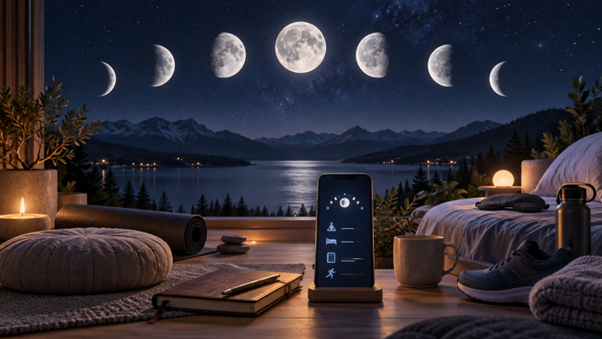

The moon API can provide a well-being application with all the information needed for the Moon, including its phase, percentage of illumination, age, position in the sky, and local rising or setting time. The information is easy to show, but it is not easy to calculate properly for each day and place. According to NASA, there are eight phases usually referred to by name, but one full cycle takes 29.5 days. Project managers make use of this predictable cycle for writing prompts, stargazing plans, meditation calendars, and other optional activities that follow the cycle. The API must provide factual astronomical data and not any medical claims. There is no reason to present the lunar phase as a diagnosis and promise certain fitness results.
Astrology API io
The website Astrology-API.io offers a specific software tool for mobile applications that link planetary motions with astrological interpretations. It claims that the server determines the current state of the Moon using astronomy datasets and delivers results in less than 500 milliseconds.
The infrastructure of moon phase API provides a REST interface, organized data objects, technical guides for engineers, a goal of 99.9% availability and a constant unpaid level of 50 requests every 30 days - this interface identifies how much light the Moon reflects, its location within zodiac constellations plus suggestions for mental habits. In addition the documentation mentions intervals when the Moon makes no major angles to other planets - those periods are significant for practitioners who follow celestial signs but the system marks them as subjective meanings instead of empirical medical facts.
To ensure reliability, engineers must verify the data keys, calendar limits, local time offsets and automated alerts before they deploy the software to active users.
AstronomyAPI
AstronomyAPI is considered a practical choice while choosing a product that requires both data and a visual representation of the Moon. The documentation of the API covers celestial bodies and a studio endpoint, that generates a Moon image from request parameters. The authentication of the platform uses an application ID and application secret with Basic Authentication; provider provides demos and sample code. This makes the service useful for meditation screens, lunar calendars, and night-themed dashboards, in which the image matches the selected data. The moon phase API is built around these endpoints can also be retrieved by body postions and observer-based information. Teams should distinguish a rendered lunar image from a scientific photograph and cache assets when the same date and style are requested repeatedly. They should also inspect plan limits, permitted image use, resolution, and background options before designing a visual feature around the Studio output.
Timeanddate Astronomy API
Timeanddate's Astronomy API specifically focuses on event times that are available based on location of the user. The official developer documentation enumerates the phases of the moon, sunrise, sunset, moonrise, moonset, position of the sun and moon, planetary positions, and tides as data provided. This is a better match to outdoor wellness apps than a phase-only endpoint, as local lighting conditions matter more than an unconditional phase label.
A walking app can indicate if the moon will be visible during an evening walk, a sleeping journal can show twilight and moonset without claiming that they result in a particular effect, and so on.
For an API moon phase request, the developer can verify which endpoint is returning the phase changes in addition to daily event data. They can verify location code variants, precision of coordinate inputs, daylight-saving changes, edge effects of polar days, quotas, licensing, and general support considerations. Any SLA should be based on published documentation and not on brand familiarity.
APIVerve Moon Phases API
APIVerve has a streamlined GET endpoint providing the Moon phase based on the input date in the structured format. The service is available in JSON by default but also provides options to use XML, YAML, CSV, GraphQL, and MCP interfaces. Examples and packages are available in Node.js, Python, and C#/.NET, reducing integration efforts for small teams. Every request costs two credits, 200 credits are included in the free tier, and the page states that the SLA is 99.9%. Latency stats published by the company include the median value of 743 ms and the 99 percentile value of 1,146 ms. These metrics provide a good base for testing from your location. Before implementing the moon phase api json output, you should make sure what exactly is provided; the official page focuses on providing the phase by date and does not guarantee any local moonrise, moonset, and wellness information.

Key Technical Factors for Choosing a Lunar API Partner
Start with the feature that the user will see. A global label might be enough if only the phase label is needed. Moonrise, altitude, azimuth, and twilight will require coordinates and a local time zone to calculate. Then test calculation boundaries in UTC and local time. The schema ability matters as much as precision, as a renamed field can break calendars and notifications. API developers should review authentication, cache rules, quotas, 429 responses, versioning, retention, and commercial licences for generated graphic. It also measures latency at the median and 95th percentile from target regions. A separate astronomical output from the wellness copy so the product can never turn a cultural practice into an unsupported medical statement.
Moon API Evaluation Criteria Checklist
Use fixed test cases across all candidates. It includes a new moon, quarter, and a full moon transition, which include locations on both sides of the date line, daylight-saving changes, and high-altitude coordinates. It also compares timestamps against a trusted astronomical sources and records that has acceptable tolerance for each feature. The following checks cover the core engineering decision:
- Verify phase names, illuminated fraction, lunar age, and transition timestamps against a reputable ephemeris.
- Confirm latitude, longitude, elevation, time zone, and daylight-saving handling for local rise and set events.
- Measure median and 95th-percentile latency, timeout behavior, rate-limit headers, uptime commitments, and incident reporting.
- Check whether images, zodiac transits, void-of-course status, or other metadata are present, documented, and properly labeled.
- Review schemas, error codes, sandbox access, SDK maintenance, versioning, caching rights, pricing, and commercial licenses.
Conclusion
Information regarding the moon provides context for applications that manage meditation, journaling, outdoor exercise and lifestyle choices. The use of this data, moon phase API avoids the requirement for developers to manage complex orbital math. Astrology-API.io is the most appropriate option if a mobile or web tool merges phase cycles with timing for astrological practices and requires an inexpensive way to verify the market. AstronomyAPI is distinct because it produces images of the moon.
Timeanddate is more effective for tasks that require the times when the moon appears or disappears at specific coordinates. And APIVerve provides a small interface for phase dates that includes many programming languages plus clear data on speed. The developer must select a service after they conduct live trials, check legal permissions and create a plan for how many users will access the system. It is important that medical statements remain supported by scientific studies.
As a standard practice, developers must permit users to turn off moon notifications and save only the geographic coordinates that the code requires. A reliable moon api returns the same scientific measurements every time but also allows the designers of the application to decide what the data signifies.
%201.png)

%201.png)

%201.png)