
Choosing the right customer relationship management (CRM) system can significantly influence how a business manages leads, communicates with customers, and handles daily operations. However, not every CRM solution works for every organization. Some businesses need a system that follows their exact processes, while others prefer software that is ready to use without extensive development.
This is where the custom CRM vs off-the-shelf CRM comparison becomes important. Both options help businesses organize customer information, track sales activities, and improve team productivity, but they differ in development, flexibility, pricing, and long-term ownership.
Understanding these differences can help you invest in a CRM solution that supports your current requirements and future business goals.
What Is a Custom CRM?
A custom CRM is a customer relationship management system developed specifically around a company's workflows, business requirements, and operational goals. Instead of adjusting business processes to match existing software, companies can build features that match how their teams actually work.
For example, a real estate company may require property tracking, automated follow-ups, lead distribution, and commission management within one platform. A standard CRM might offer some of these features, but a custom solution can combine them according to the company's requirements.
Custom CRM development allows businesses to decide which features, integrations, dashboards, and automation workflows they need.
Common features of a custom CRM include:
- Personalized sales pipelines and dashboards.
- Custom customer data fields.
- Business-specific workflow automation.
- Integration with existing applications.
- Role-based access and permissions.
- Custom reporting and analytics.
- Industry-specific functionality.
A custom CRM is particularly useful when standard software cannot support complex business operations efficiently.
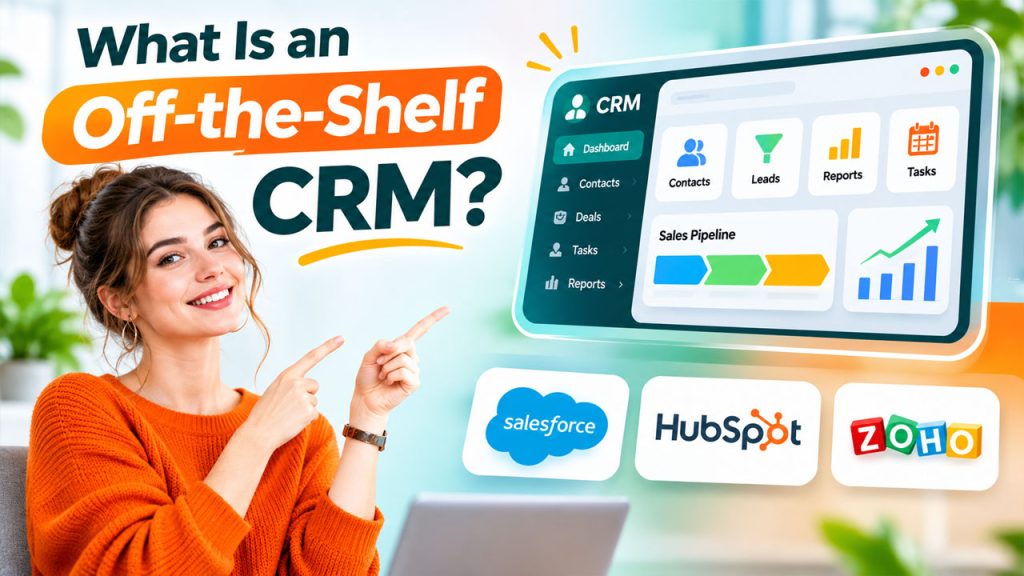
What Is an Off-the-Shelf CRM?
An off-the-shelf CRM is a pre-built software solution designed to serve the needs of multiple businesses across different industries. These platforms usually include standard features such as contact management, lead tracking, sales reporting, email integration, and task automation.
Businesses can subscribe to a suitable plan, configure basic settings, and start using the software without building an entire system from scratch.
Popular examples include Salesforce, HubSpot CRM, and Zoho CRM.
These platforms provide ready-made CRM software that helps businesses manage customer relationships without investing in a lengthy development process.
Common features include:
- Contact and lead management.
- Sales pipeline tracking.
- Email and calendar integration.
- Task and activity management.
- Pre-built reports and dashboards.
- Basic marketing automation.
- Third-party application integrations.
For startups and small businesses with straightforward requirements, this approach can be a practical way to introduce CRM technology into daily operations.
Custom CRM vs Off-the-Shelf CRM: Key Differences
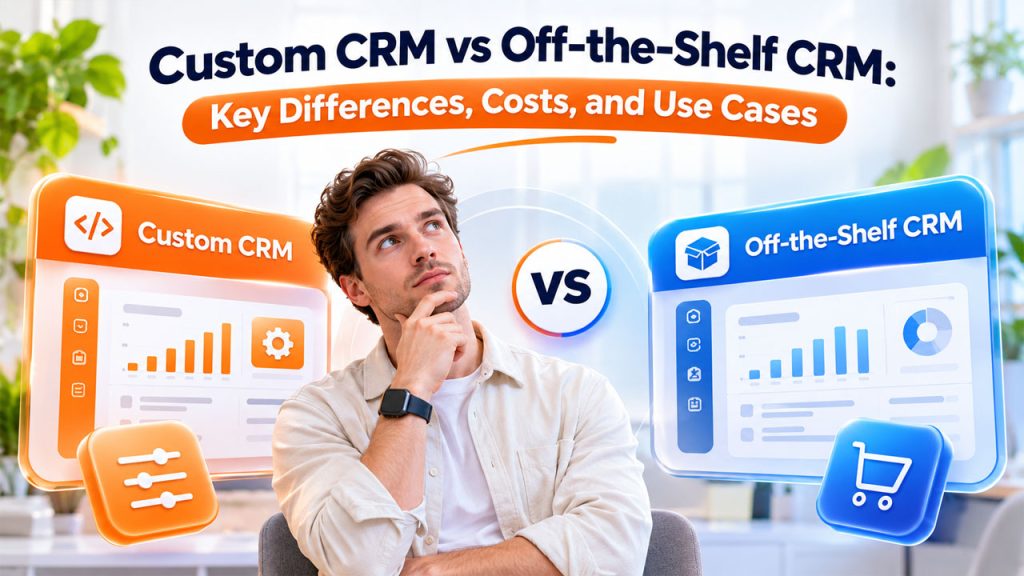
Although both solutions serve similar purposes, their underlying approaches are different. Understanding these differences helps businesses identify which option offers better value.
1. Customization and Flexibility
Customization is one of the biggest differences between these two CRM approaches.
A custom CRM is designed around specific business requirements. Companies can choose their preferred workflows, data structures, automation rules, and user interfaces. They can also add or modify functionality as operational needs change.
Off-the-shelf platforms offer configuration options, but businesses generally need to work within the features and limitations provided by the software vendor.
This is where CRM flexibility becomes an important consideration. Organizations with unique workflows may benefit from developing a solution that adapts to their processes rather than changing established operations to fit standard software.
2. Development and Implementation Time
Off-the-shelf CRM platforms generally have a shorter implementation timeline. Businesses can create accounts, import customer information, configure workflows, and begin using the system relatively quickly.
A custom CRM requires additional planning, development, testing, and deployment. The timeline depends on the number of features, integration requirements, and overall project complexity.
However, a properly planned custom implementation can reduce the need for extensive workarounds later.
3. Integration Capabilities
Businesses often use multiple applications for accounting, marketing, customer support, communication, and reporting.
A custom CRM can be developed to integrate with the specific tools and systems a company already uses. This helps create a connected environment where information moves between applications.
Off-the-shelf platforms also support integrations through APIs, native connectors, and third-party applications. However, certain integrations may require additional subscriptions, middleware, or technical configuration.
4. Scalability and Business Growth
As a business grows, its customer database, sales team, reporting requirements, and operational complexity also increase.
A custom CRM can be expanded according to changing requirements. Businesses can introduce new modules, modify existing workflows, and support additional users without being restricted to a predefined feature structure.
Ready-made platforms also provide scalable plans, but some advanced features may only be available through expensive subscription tiers.
The right choice depends on whether the company's future requirements can be handled through existing software configurations.
5. Data Control and Ownership
Data management is another important factor when comparing CRM solutions.
With a custom CRM, businesses can have greater control over the system's architecture, hosting environment, security policies, and data management processes, depending on the development and hosting agreement.
With an off-the-shelf platform, customer data is generally stored and managed within the vendor's infrastructure, subject to its security policies and contractual terms.
Businesses handling sensitive customer information should evaluate data access, backup procedures, compliance requirements, and migration options before making a decision.
Custom CRM vs Off-the-Shelf CRM: Cost Comparison
Cost is often one of the first considerations when selecting a CRM solution. However, comparing only the initial price can lead to an incomplete decision.
The total investment includes development or subscription fees, implementation, maintenance, integrations, training, and future upgrades.
Custom CRM Development Costs
Custom CRM development generally requires a higher upfront investment because the system is designed and built around specific business requirements.
Typical cost components include:
- Requirement analysis and project planning.
- UI/UX design and development.
- Backend and frontend development.
- Third-party integrations.
- Data migration and testing.
- Deployment and ongoing maintenance.
The final cost depends on system complexity, technology selection, development resources, and the number of required features.
Off-the-Shelf CRM Subscription Costs
Ready-made CRM platforms generally follow a subscription-based pricing model. Businesses pay monthly or annually based on the selected plan, number of users, and available features.
Additional costs may include:
- Premium feature upgrades.
- Additional user licenses.
- Third-party integrations.
- Data storage expansion.
- Advanced automation.
- Technical support and training.
Although the starting price may be affordable, expenses can increase as the business grows.
Understanding Long-Term CRM Ownership Costs
When evaluating CRM ownership costs, businesses should consider the total cost of using and maintaining the system over several years.
A custom solution may require a larger initial investment but can reduce recurring licensing expenses, depending on its architecture and maintenance agreement.
An off-the-shelf CRM usually requires ongoing subscription payments. Businesses should also consider the cost of upgrading plans as their teams expand.
Neither option is automatically cheaper. The better investment depends on the company's budget, usage requirements, growth plans, and expected return.
Custom CRM vs Off-the-Shelf CRM: Which Is Better for Different Business Use Cases?
The right CRM solution depends on how a business operates and what it expects from its technology.
When Should You Choose a Custom CRM?
A custom CRM may be the better option for businesses with specialized operational requirements.
1. Businesses With Complex Workflows
Companies managing multiple departments, sales processes, approval stages, and customer service operations may require workflows that standard platforms cannot easily accommodate.
2. Enterprises With Specific Integration Needs
Large organizations often use multiple internal applications. A custom solution can connect these systems according to their technical and operational requirements.
3. Industry-Specific Businesses
Real estate, healthcare administration, financial services, and manufacturing companies may require specialized data fields, reporting structures, and workflow processes.
4. Businesses Planning Long-Term Expansion
Companies expecting significant operational changes may prefer a system that can be modified as new requirements emerge.
When Should You Choose an Off-the-Shelf CRM?
A pre-built CRM is often suitable for businesses that need standard functionality without extensive development.
1. Startups and Small Businesses
New businesses can use existing CRM platforms to organize leads, manage contacts, and monitor sales activities without a large initial investment.
2. Businesses With Standard Sales Processes
Companies following conventional sales pipelines and customer management workflows can often operate effectively with ready-made solutions.
3. Teams With Limited Technical Resources
Organizations without dedicated development teams may find vendor-supported CRM platforms easier to implement and maintain.
4. Businesses That Need Quick Deployment
Companies that want to introduce CRM functionality quickly can benefit from pre-built tools with existing features and support resources.
Factors to Consider Before Making Your Decision
Before choosing between custom development and a pre-built platform, evaluate the following factors:
- Business requirements: Identify the workflows and features your team actually needs.
- Available budget: Consider initial investment and recurring expenses.
- Implementation timeline: Determine how quickly the system needs to become operational.
- Integration requirements: Check whether the CRM can connect with your existing applications.
- Future scalability: Consider expected user growth and operational changes.
- Data security: Review access controls, hosting, backup, and compliance requirements.
- Maintenance: Understand who will manage updates, technical issues, and ongoing support.
A structured evaluation can prevent unnecessary software expenses and reduce the risk of selecting a system that does not support your business operations.
Final Verdict: Which CRM Solution Should You Choose?
The decision between custom CRM vs off-the-shelf CRM ultimately depends on your business requirements, available resources, and long-term objectives.
An off-the-shelf CRM is a practical choice for startups and businesses that need standard customer management features, quick deployment, and predictable subscription plans.
On the other hand, a custom CRM is worth considering when your organization has complex workflows, specialized integration requirements, or needs greater control over system functionality.
Instead of choosing a solution based only on its initial price, evaluate its long-term value, scalability, and ability to support your daily operations.
The best CRM is not necessarily the one with the most features. It is the one that helps your team manage customer relationships efficiently while supporting sustainable business growth.
FAQs About Custom CRM vs off-the-shelf CRM
A custom CRM is developed according to specific business requirements, while an off-the-shelf CRM is a pre-built platform designed for multiple businesses. Custom solutions offer greater control over functionality, whereas ready-made platforms generally provide faster implementation.
A custom CRM usually involves higher initial development costs. However, long-term expenses depend on maintenance, integrations, licensing requirements, and business growth. An off-the-shelf CRM may have lower starting costs but requires recurring subscription payments.
Yes. A small business can benefit from custom CRM development when its operations require specialized workflows, integrations, or automation that standard platforms cannot provide efficiently. However, businesses with basic requirements may find subscription-based CRM software more economical.
Both options can support business growth. Custom CRM systems allow businesses to introduce functionality according to their requirements, while off-the-shelf platforms offer scalable subscription plans and additional features. The better choice depends on the organization's future operational needs.
Start by evaluating your business workflows, budget, integration requirements, implementation timeline, and long-term goals. If standard features meet your needs, an off-the-shelf solution may be sufficient. If your operations require specialized functionality and greater control, consider a custom CRM.