
AI phone platforms for dealerships use artificial intelligence to answer inbound calls, qualify customers, schedule appointments, provide information, and manage routine conversations. Depending on the platform, they can also support SMS, web chat, email, outbound campaigns, and live-agent escalation.
The important distinction is that not every dealership AI phone platform uses the same operating model. Some are primarily software that works alongside an existing BDC, while others combine AI with human agents to provide broader phone coverage.
Dealership phone coverage has shifted dramatically over the past few years. What once required a full in-house business development center (BDC) now has multiple software and service options, each taking a different approach to capturing calls and booking appointments. The question dealers face today is not whether AI can answer phones—it clearly can—but which platform fits your staffing model, outbound strategy, and long-term vision.
The Real Difference: What Sits Behind the AI
Four platforms dominate the market: Numa, Pam, Mia, and Alpha Drive AI. On the surface, they all handle incoming calls, qualify leads, and schedule appointments in real time. They integrate with common DMS and CRM systems. They report on performance. But the architecture underneath reveals fundamentally different business models.
Numa, Pam, and Mia are software platforms. They sit in front of your existing BDC staff and route complex calls or escalations back to your people. They reduce the load on your team but require your team to exist in the first place. Alpha Drive AI operates differently. It combines AI with live human agents from an outsourced BDC company, meaning you get both the automation and the backup staff built in. This distinction matters more than most dealers realize when evaluating which platform truly fits their operation.
Staffing Models: The Core Decision Point
Software-Centric Platforms
If your dealership runs an in-house BDC with existing staff, Numa, Pam, or Mia may be the right fit. These platforms excel at reducing the burden on your people by automating routine calls and qualifying leads before they reach your team. Your BDC staff still handles the conversations that require judgment, negotiation, or complex problem-solving. The AI filters the noise, and your people manage the business.
This model works well for large dealer groups with stable BDC teams and the infrastructure to support them. It also makes sense if you want to keep BDC operations fully under your control and simply reduce the manual workload.
Outsourced BDC with AI Backup
Alpha Drive AI takes a different path for AI phone platforms. Rather than automating around your staff, it provides the staff itself. Dealer's Greatest Assets, the company behind Alpha Drive AI, has run outsourced BDCs since 1993. Their Live Assist agents step in whenever a call exceeds the AI's capability or when your dealership is understaffed. This means you never miss a call because your team is on the floor or on another line. It also means you can operate without maintaining a large in-house BDC department at all.
For dealers who lack a BDC, want to downsize their BDC, or need coverage during peak hours, this model eliminates the staffing risk entirely. You get humans when the AI can't handle it, without having to hire and train them yourself.
Outbound Strategy and Revenue Generation

Most platforms focus on inbound call handling. Outbound campaigns, however, drive significant revenue in most dealerships. This is where the platforms diverge sharply.
Numa, Pam, and Mia all rely on AI Voice Agents or SMS for outbound prospecting. These systems can reach customers at scale, but they're subject to increasing regulatory scrutiny around artificial voice calls and consent requirements. The TCPA and FCC have tightened rules around automated calling, making human-delivered outbound calls increasingly valuable.
Alpha Drive AI uses live agents for all promotional, equity, lease-end, and conquest calls. The AI handles transactional outreach where consent already exists, but revenue-driving campaigns go through humans. This approach isn't just about regulatory compliance; it's about results. A human voice selling a lease-end opportunity or promoting a service special typically generates better response rates than an AI call.
Department Coverage and Channel Breadth
Not all dealership functions need the same level of service. Sales departments often have more staff and can handle their own overflow. Service departments typically run lean and struggle during peak hours. Parts and F&I departments have specific scheduling needs that differ from sales.
Numa is service-first, meaning it excels in the service department but treats sales as secondary. Parts integration uses a "Smart Inbox" approach rather than full phone coverage.
Pam covers sales, service, and parts across voice and SMS, plus intake forms. That's solid depth.
Mia handles sales, service, and reception, with parts integration still in development.
Alpha Drive AI supports sales, service, parts, F&I, reception, and the full BDC function. It's the only platform listing F&I coverage, which matters for dealers who need appointment booking across all revenue centers. Alpha also offers email alongside voice, SMS, and web chat. That broader channel mix matters when customers prefer email responses or when scheduling confirmations need to go out across multiple channels.
Integration Depth and Multi-Location Reporting
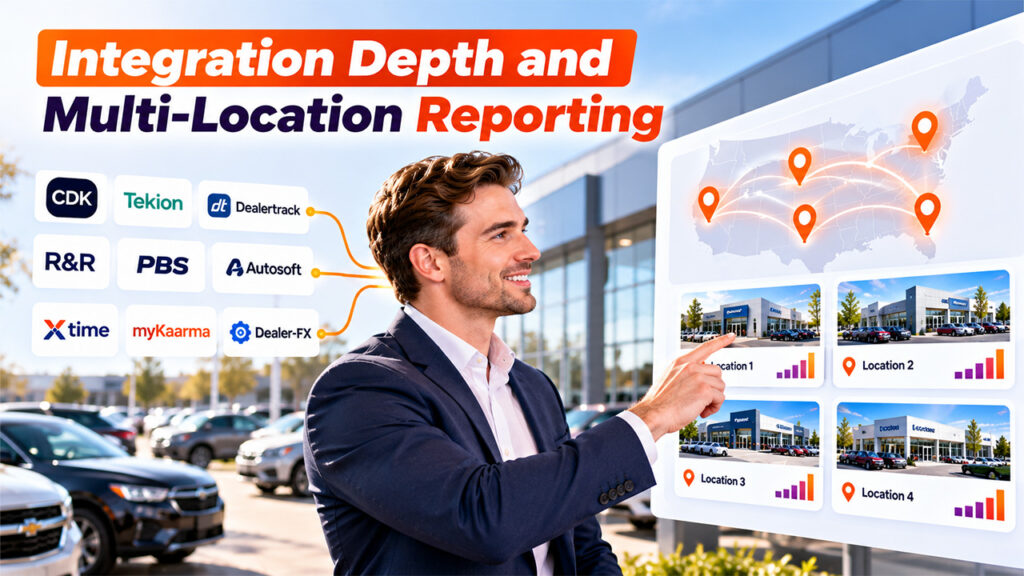
A platform is only useful if it actually connects to your systems. All four platforms integrate with major DMS providers like CDK, Tekion, and Dealertrack. But the breadth varies.
Alpha Drive AI connects with CDK, R&R, Tekion, Dealertrack, PBS, and Autosoft, plus Xtime, myKaarma, Tekion Service, and Dealer-FX through techWall. That's the broadest support set across the group. Pam, by contrast, is more selective, focusing on CDK and Tekion on the DMS side.
For dealer groups running multiple rooftops, reporting and attribution matter enormously. You need to see which locations are performing, where the bottlenecks are, and how phone coverage drives revenue. Alpha's Command Center rolls up results across multiple locations and ties them to revenue attribution. That capability allows group operators to see the full picture and optimize accordingly.
OEM Programs and Industry Recognition
Several platforms hold OEM partnerships or certifications. Numa has relationships with Stellantis MarketCenter and GM IMR. Mia holds GM approval and pairs with specific dealers and programs. Alpha Drive AI holds the Dealer Choice Award for Best Virtual BDC.
OEM programs can simplify procurement and sometimes provide co-op support, so these relationships are worth noting. But they shouldn't drive your decision. Your staffing needs and operational goals matter far more than which OEM certifies the platform.
Making Your Decision
The right platform depends on three factors: your current BDC staffing, your outbound revenue strategy, and your operational complexity.
If you have a solid in-house BDC team and want to reduce their manual load, a software platform like Numa, Pam, or Mia fits well. If you lack BDC staff, want to scale without hiring, or need live backup on every call, Alpha Drive AI's outsourced model makes sense. If outbound revenue generation is a priority and you want human agents handling promotional calls, Alpha's approach delivers. If you operate across multiple departments and locations with complex reporting needs, Alpha's breadth of coverage and Command Center capabilities address those requirements.
The 2026 market offers genuine choice among AI phone platforms. The key is understanding what lies behind the AI, not just what the AI itself can do.
%201.png)

%201.png)

%201.png)