
Every new CRM player enters the market with the claim to have the best software. No irony here. In fact, that is often the case, and they indeed offer technically superior, faster, lighter, and even cheaper solutions.
However, that doesn’t help them much, and they don’t become the new industry giant like the famous Salesforce. Why is that? Why, despite having the best software, do they fail to outperform the market leaders with weaker or outdated CRM tools?
This phenomenon has been given a name — The “Salesforce Killer” Paradox. Its explanation is simple — being "better" isn't actually the winning factor in the SaaS sector. Salesforce isn't just a software tool; it is an ecosystem of trust, nurturing infrastructure, and relationships.
And backlinks always play a vital role in online matters that involve trust.
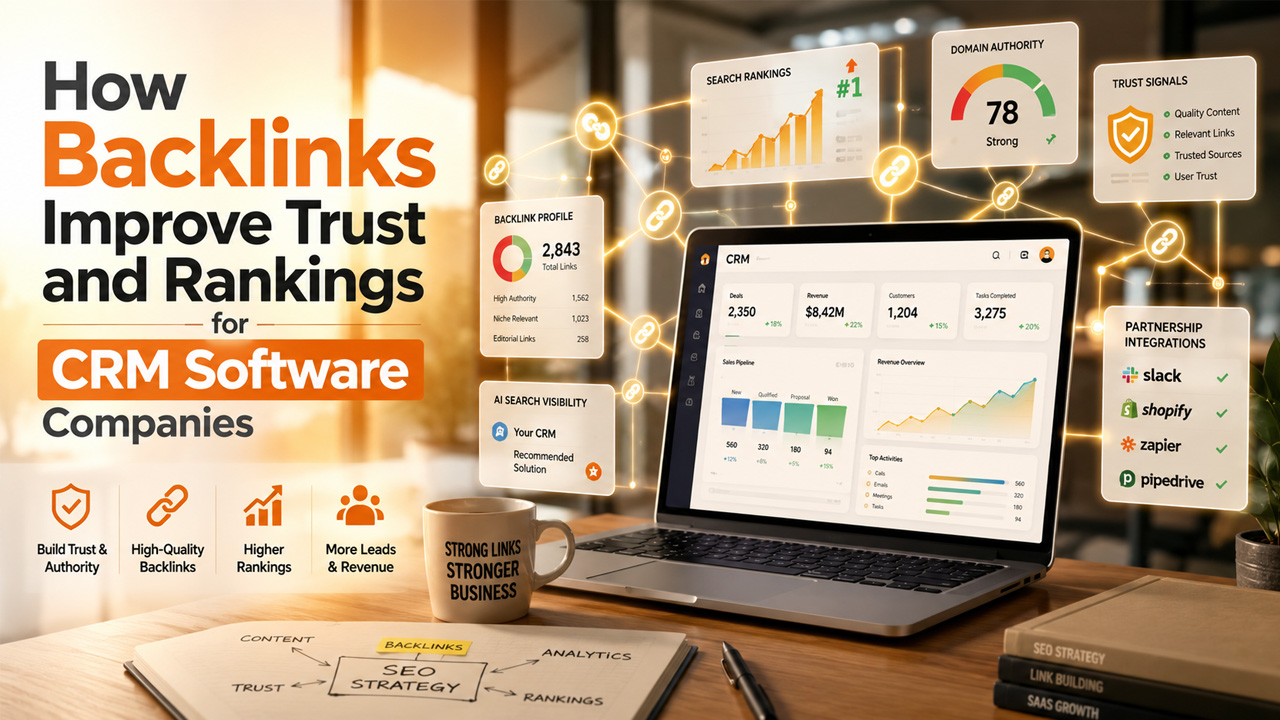
In this post, we’ll explain bit by bit how modern SaaS link-building strategies improve trust and rankings for CRM software companies. You will see exactly how a robust link profile can bridge the CRM SEO ”authority gap” that often prevents technically superior platforms from closing larger deals.
The Digital Handshake: Why Links Are the New B2B Social Proof
The digital reputation of a CRM company has never been as important as today. The empowering nature of the web, particularly the ease and speed of access by buyers, and a business’s ability to leave digital footprints everywhere, has changed how most buying decisions are made.
Today, 94% of buying groups rank their shortlist in order of preference before they initiate contact with sales. And the "shattering" implication for the modern B2B contracting is that the vendor ranked first on this list wins about 80% of the time.
Backlinks as the New Standard of Digital Trust
Is the humble backlink the secret weapon for surviving the Salesforce Killer Paradox? We’ll lay out the comprehensive framework on why backlinks matter for SaaS SEO and let the impact on your sales cycle speak for itself.
In this reality, high-quality B2B backlinks are no longer just a technical bridge for search engine crawlers. It’s the reliable peer referral that the traditional search engines, as well as the new answer engines like Claude and Gemeini, trust and respect.
The mechanism is simple: when a prospect sees your CRM cited in a case study or a tech analysis on a third-party site, their brain registers it as a de-risking event.
That’s how reputation and authority get transferred via a simple link.
Turning Search Visibility into Trust Equity
Some CRM SEO practitioners naively downplay the role of backlinks as the mere drivers behind traffic volume. Even though ranking in the first place in search results does give your brand or product superior visibility, without trust, this often goes to waste. It takes a shift in mindset to understand that a link from a secure, authoritative site transfers its "trust equity" directly to your CRM.
However, the psychology of buying decisions is never simple. In the eyes of the modern buyers, the proof is made up of several reputational signals:
- Third-Party Validation: Citations in independent industry reports that verify your software’s performance claims.
- Ecosystem Integration: Presence in marketplace directories (like Slack or Shopify) that signal your CRM is a stable, integrated player.
- Earned Media Mentions: Features in non-sponsored editorial content that demonstrate your brand is a thought leader, not just a spender.
- Data Citations: Occurrences where your proprietary internal insights are used as benchmarks by other industry publications.
It’s the intersection of technical SEO and online presence management that defines how easily a prospect can verify a software company's credibility. That will have a direct impact on the buyer’s choice during research or the final decision-making stage.
From a software company’s perspective, only an active approach to building backlinks for SaaS companies can secure strong online visibility and reputation, including organic and semi-organic promotion via paid channels, and monitoring and responding to unlinked brand mentions.
Why a Tiny Sales Blog Outperforms a Major News Outlet
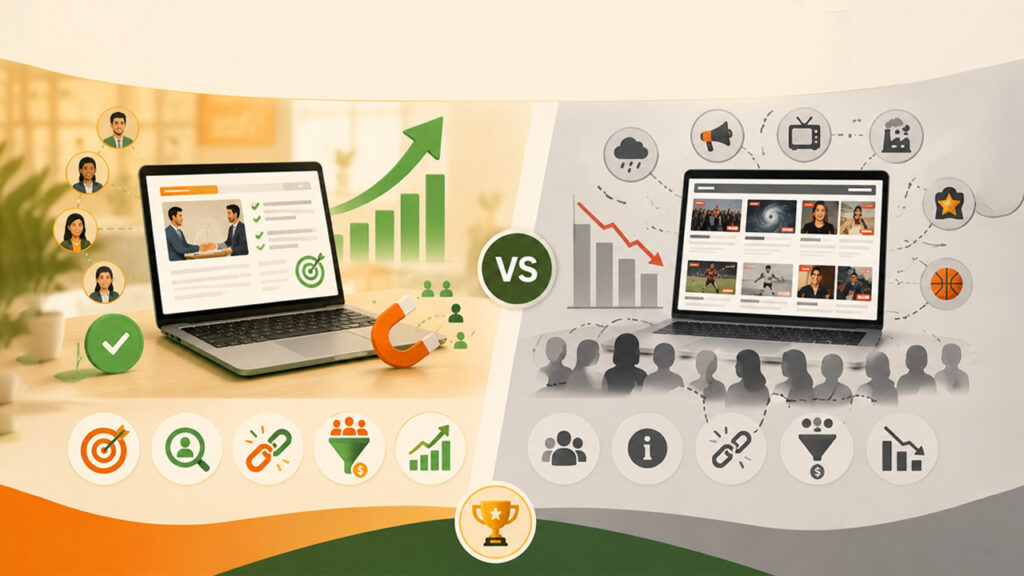
Obsession with Domain Rating (DR) and Domain Authority (DA) metrics doesn’t always work as intended in highly specialized niches like CRM and SaaS in general. You can use a DA PA checker to evaluate a website’s authority before pursuing a backlink, but these metrics should be considered alongside topical relevance and link quality. A link from a high-authority news website gets diluted by the general informational “noise” because such websites cover everything from celebrity gossip to weather.
For a CRM company, such broad signals lack the necessary specialization to signal trust to the highly knowledgeable SaaS audiences. Such audiences are accustomed to analyzing information and comparing purchasing options.
These days, semantic proximity wins over general authority. Modern search engines, powered by AI, increasingly look for subtle signals of expertise and process information much like a human would before making a choice. This shift forms the core of entity-based search, introducing a profound link-building impact where algorithms evaluate actual thematic relationships over raw domain metrics.
The audience of a tiny sales blog where your CRM system gets mentioned is always looking for a solution to their specific problems. When they come across your product and if they find its description detailed and compelling enough, they’ll be more likely to follow the link and convert on your website. Whereas the general audience of large, authoritative websites usually doesn’t do that.
That’s exactly why a tiny sales blog would outperform a major news outlet or a marketing website any day of the week.
Turning Partnerships into Link Engines
Most CRM companies underestimate how partnerships fit into broader, high-yield SaaS link-building strategies. This approach is purely commercial, usually involving the exchange of best practices, and sometimes leads to revenues.
The truth is — partnerships in SaaS are goldmines. They offer mutually-beneficial link-building opportunities and a whole ecosystem of trust, where you can utilize their reach and authority to find and attract high-value customers for your CRM product.
The Integration Audit
Start with a thorough evaluation of your own tech stack. If you have an API or a pre-built integration with another software, you belong in their marketplace.
To ensure an effective integration with your partner’s ecosystem, follow these three basic steps:
- Claim your territory: Ensure your CRM solution is well represented in every technical directory of your partner, every core page, and every product list.
- Update the "How-To" guides: Don’t stop on a simple mention of your product or service. Be proactive. Reach out to the partner’s content team and request that your CRM is properly (contextually) integrated in their “how-to” guides within your specific niche.
- The Documentation Hack: API documentation and technical wikis are some of the most trusted pages on the web. A link from a partner's dev docs is worth ten guest posts on a generic blog.
Moving Beyond the Directory
You don’t have to stop there. After securing links in your immediate marketplace — the low-hanging fruits of the best link-building strategies for B2B SaaS — consider doing co-marketing.
Co-marketing is about trading expertise for authority in a broader sense. Instead of asking for a single link, you team up with your partners from adjoining industries and work on a common problem.
The result of your collaboration could be a case study where you show how your CRM system and your partner’s tool (whatever tool that may be) faced a particular problem and solved it. Or it could be a research project where you dive deep into shared customer data to reveal unexpected workflow efficiency trends that nobody else is talking about.
This opens up broader opportunities where your company is seen as an expert and solution provider, and unlocks an entirely new league of generating backlinks for SaaS companies, where high-value authority finds you naturally.
The Partnership Action Plan
Instead of random and scattered link-building steps, channel your energy into a dedicated CRM SEO partnership strategy with a clear action plan. This action plan should transform your business development efforts into a passive link-building machine.
- Map your ecosystem: List every software tool your CRM currently talks to via API or native integration.
- Target the documentation: Analyze your partner’s documentation available on their website to find and target specific guides, FAQs, and other materials where linking to your CRM system makes perfect sense.
- Propose the "Integration Spotlight": Offer to write a guest technical deep-dive for their blog on how to solve a specific industry problem using both of your tools.
- Monitor the unlinked mentions: Use tools (BrandMentions, Semrush, Ahrefs, etc.) to spot where your partners mention your software or solutions, but forget to link back to your landing or product pages.
Do you see the qualitative difference now? You aren't begging for favors; you’re providing technical value to a partner’s audience, and the high-authority backlink is just the natural byproduct of that relationship.
How to Win the Most Expensive Keywords in SaaS
SaaS is a highly competitive market, and, among other marketing aspects, this competition extends directly to high-intent CRM SEO optimization techniques and keywords. The most expensive commercial terms are usually those with the highest intent and highest revenue potential.
Let’s take one example. Terms like lead scoring tool or enterprise CRM software have enormous competition. The downside is that search engines police these specific results with extreme prejudice.
When your anchor text is an exact match to these terms, and you use it throughout an entire how-to guide, expect Google penalties with almost 100% certainty. This is because algorithmic spam filters are exquisitely adjusted to catch instances when high-intent keywords are aggressively forced into text just to manipulate the search results.
You have to be creative and use near terms whenever possible, or synonyms to these terms. That’s exactly what the industry leaders do — they mask their commercial intent under a layer of brand recognition.
You should do the same. Instead of brute-forcing your target terms, the smart play involves hiding your commercial intent behind a clean, natural-looking link structure.
Start by following these fundamental diversification rules
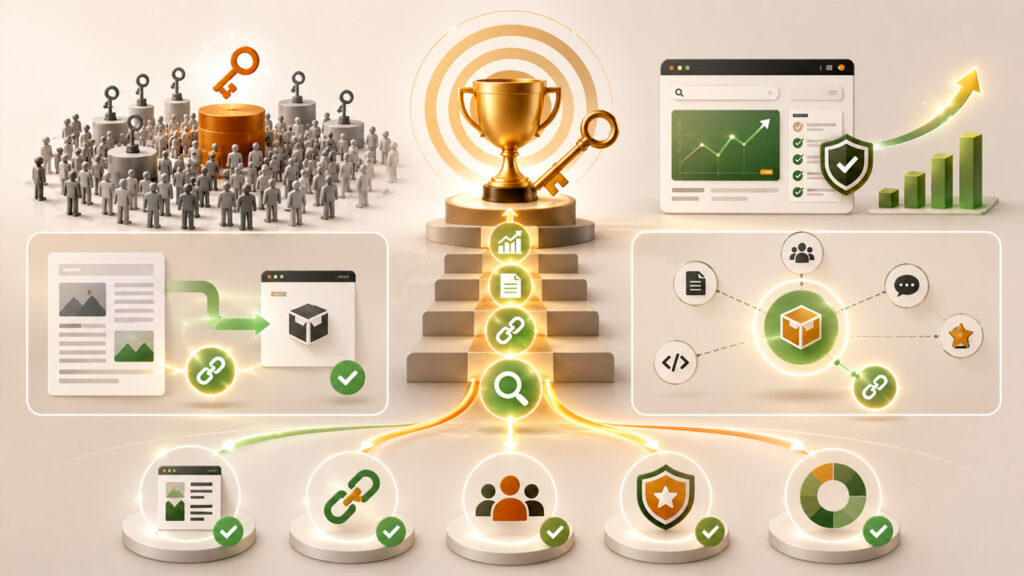
- The Content Bridge: Build your high-value external backlinks to deep, highly informational guide pages on your site. Then, pass that accumulated authority down to your commercial product pages using exact-match internal links. Google trusts aggressive internal anchor text far more than aggressive external links.
- The Branded Commercial Variant: When acquiring external links, always weave your brand name into the phrase. Using an anchor like the [Brand] sales tracking platform passes the necessary keyword weight to your site without looking like an artificial link scheme.
- Source Profile Diversification: Never get all your high-value links from a single type of content. Balance your portfolio by mixing editorial mentions with links embedded in technical forums, software review roundups, and partner documentation.
If you want to outcompete the market leaders, you must stop using outdated SEO practices. Instead of buying exact-match links, focus on clean B2B backlinks to build topical trust, and search engines will rank your brand and your CRM product naturally.
The Bottom Line
CRM software companies face intense competition while operating in a very narrow, trust-sensitive niche. Finicky buyers won’t make a purchase unless they’ve thoroughly studied your solution and compared it with several other, highly potent products.
How to build trust in this environment? Traditional PR and ads can only gain so much trust and visibility. You need as much social proof and authority as possible. And nothing delivers that validation quite like a context-rich CRM SEO backlink profile — the ultimate digital endorsement in a market built on peer recommendations.
In this article, we’ve taken a thorough look at the role of backlinks in building trust for the CRM software business. But when translating these insights into a practical, ranking-shattering strategy, it all comes down to three non-negotiable principles:
- Securing your place on the buyer shortlist. Deploy strategic SaaS backlinks as trust signals to ensure human buyers and AI answer engines select your CRM before the first sales call.
- Targeting semantic proximity instead of raw traffic. Prioritize link-building on hyper-focused sales blogs to capture active buyers instead of wasting budget on diluted mentions within massive news outlets.
- Turning product integrations into passive link engines. Embed your CRM into partner documentation and marketplaces, using internal content bridges to funnel that authority to your commercial pages.
Approach business partnerships as strategic assets and build a solid action plan to turn your collaboration efforts into a passive B2B SEO link-building machine. Your goal is to provide technical value to a partner’s audience, and the high-authority backlink is just the natural byproduct of that relationship.
Frequently Asked Questions (FAQs)
Why are backlinks important for CRM software companies?
Backlinks can help CRM software companies improve search engine visibility, build website authority, attract referral traffic, and establish credibility within the CRM and SaaS industry.
What types of backlinks are best for CRM software companies?
The best backlinks usually come from relevant, authoritative websites in CRM, SaaS, marketing, sales, technology, and business niches. Contextually relevant editorial links are generally more valuable than unrelated links.
How can CRM software companies build high-quality backlinks?
CRM companies can build backlinks through guest posting, industry partnerships, expert contributions, digital PR, useful resources, original research, and creating content that naturally earns references from relevant websites.
Should CRM companies check DA and PA before getting a backlink?
Yes. Checking metrics such as Domain Authority (DA) and Page Authority (PA) can help evaluate a potential linking website. However, relevance, traffic, content quality, link placement, and overall website credibility should also be considered.
How does a CRM help manage backlink building campaigns?
A CRM can help SEO teams organize publishers, manage backlink opportunities, track outreach conversations, monitor campaign progress, and maintain records of completed and pending link-building activities.
%201.png)

%201.png)

%201.png)