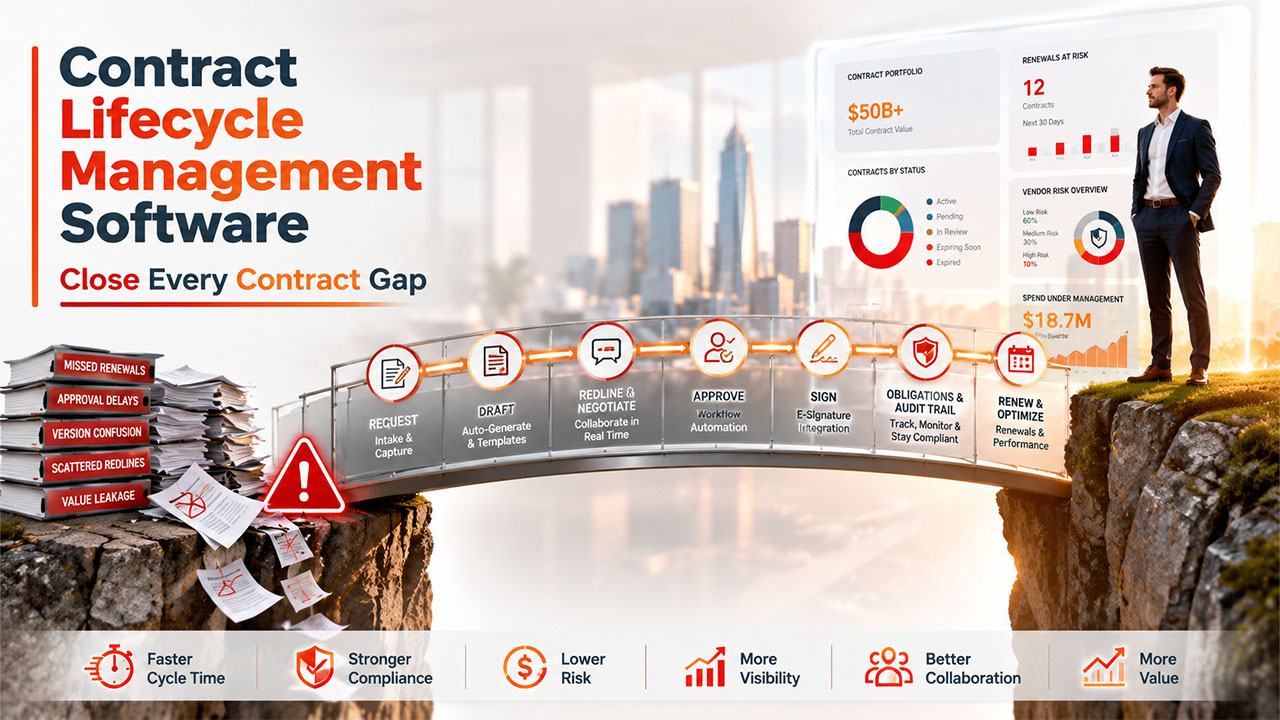

Contracts leak value in the gaps. A renewal auto-fires because no one saw the date. An approval sits in an inbox for a week while a deal cools. A redline bounces between five email threads and loses the latest version. Each gap is small; together they cost enterprises real money every year. Contract lifecycle management software exists to close those gaps by moving a contract from request to renewal on one system, with the negotiation and approvals handled inside it.
This guide covers six platforms worth knowing in 2026, with a deep look at each rather than a long roster. The focus is where lifecycle tools earn their price: negotiation, approvals, and the audit trail that ties it all together.
Key takeaways
- The best contract lifecycle management software automates the full path from request through negotiation, approval, signature, and renewal.
- Strong redlining and approval automation matter more than feature count, because that's where cycle time and version chaos get solved.
- Enterprise platforms bring depth but long rollouts; Gatekeeper pairs lifecycle automation with native vendor risk and spend, live in 12 weeks or less.
What is contract lifecycle management software?
Contract lifecycle management (CLM) software manages a contract across every stage of its life. Modern AI contract management automation solutions further streamline drafting, approvals, negotiations, and renewals by reducing manual effort and improving compliance across the entire contract lifecycle. Request, drafting, negotiation, approval, signature, storage, obligation tracking, and renewal. A repository only holds signed documents. A CLM platform runs the process that produces them and the obligations that follow, with workflow automation, collaborative editing, and reporting built in. The best tools also connect that process to the systems around it, so contract data doesn't strand in a silo.
The 6 best contract lifecycle management software tools of 2026
1. Gatekeeper
Best for: teams that want AI-assisted negotiation and automated approvals without losing sight of vendor risk and spend.
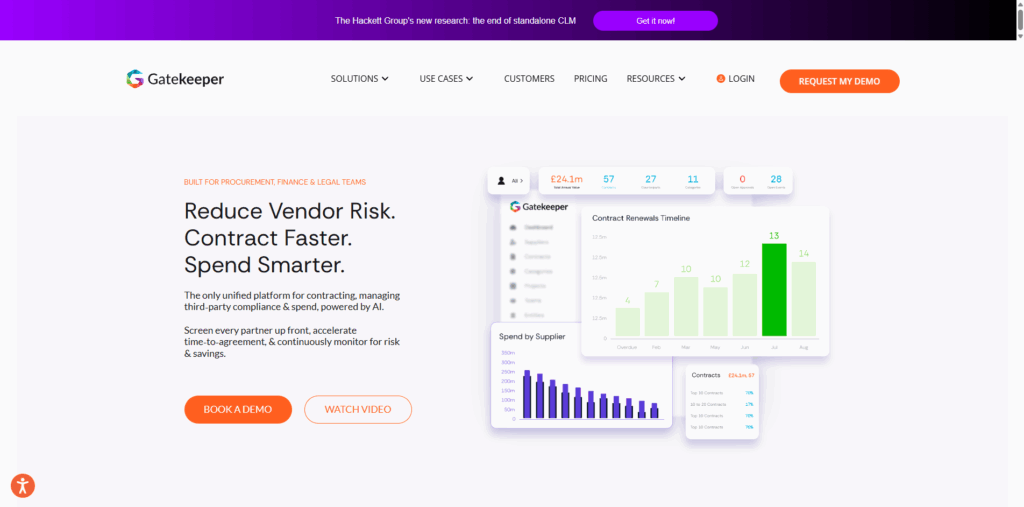
Gatekeeper runs the full request-to-renewal lifecycle and puts its energy where cycle time actually breaks: negotiation and approvals. Collaborative redlining keeps every party working on one version, an AI agent suggests positions and speeds review, and the no-code Kanban Workflow Engine routes approvals in parallel or sequence so a contract doesn't wait on a single inbox. The platform reports 75% faster contracting once these flows replace manual cycles.
Every step writes to an audit-ready trail where each change and approval is timestamped, which turns audit prep from a scramble into a query. Renewal automation and obligation tracking mean dates surface early rather than after the invoice. What sets Gatekeeper apart from the pure CLMs below is reach: the same platform natively screens the vendor and tracks the spend attached to the contract, so legal, procurement, and finance work the lifecycle from one record. It manages more than $50B in contract renewals with full compliance oversight.
Core capabilities:
- Collaborative redlining on a single contract version
- Integrated AI agent for guided review
- Parallel and sequential approval automation via the Kanban engine
- Audit-ready, timestamped change and approval trail
- Native vendor risk screening and spend tracking alongside the contract
Pricing: quote-based, demo-led; deployment in 12 weeks or less.
Watch-outs: pitched at mid-market teams with serious compliance needs, so a group after a lightweight repository will find more here than it needs. Public pricing isn't listed.
2. Icertis
Best for: global enterprises governing high-stakes contracts at scale.
Icertis sits at the top end of the market, running buy-side and sell-side agreements for the world's largest companies. Guided playbooks hold negotiators to agreed positions, authoring stays inside approved templates, and an "Intent Realization" layer checks that a signed deal actually delivers what the business set out to achieve. Deep SAP ties and AI obligation tracking make it a fixture for organizations that treat contracting as strategy.
Core capabilities:
- Guided negotiation playbooks
- Template-locked authoring
- AI obligation tracking and copilots
- Configurable reporting with SAP ties
Pricing: enterprise quote-based; implementation often lands in the six figures.
Watch-outs: standing it up is a project measured in months, with a reputation for demanding rollouts. The interface shows its age and leans on support staff, and the price tag closes the door on most mid-market teams.
3. Ironclad
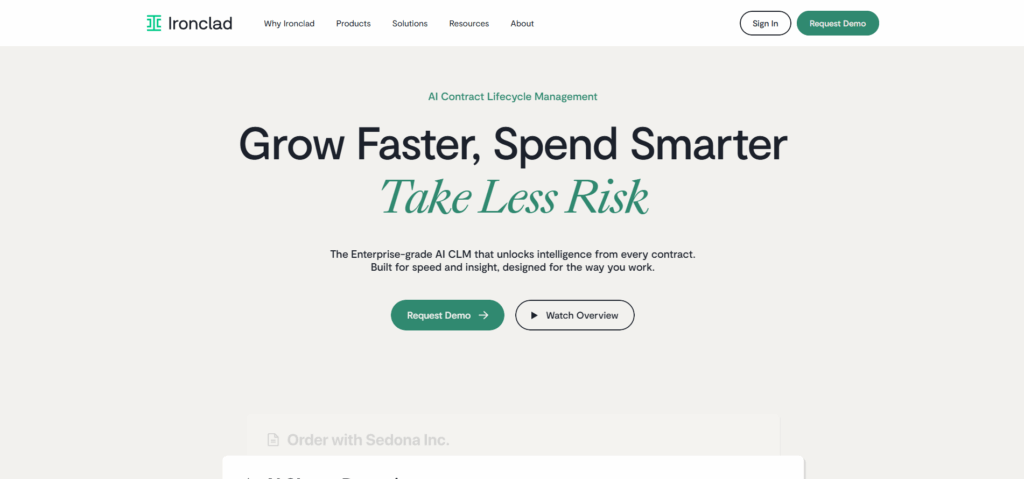
Best for: legal teams that want negotiation and approvals on a flexible engine.
Ironclad hands legal and business users a visual builder for shaping approval paths, backs it with AI redlining, and keeps editing inside the Office and Google tools people already open, syncing changes in both directions. An amendment "family tree" traces how a deal evolved. High-volume legal groups tend to onboard onto it without much resistance.
Core capabilities:
- Visual builder for approval paths
- AI-assisted redlining
- Two-directional Office and Google editing
- Amendment lineage tracking
Pricing: quote-based; roughly $80,000/year for 100 licenses plus per-workflow fees.
Watch-outs: one full-admin role and no multi-entity model create friction for bigger organizations. Post-signature reporting runs shallow by Gartner's read, and each new workflow adds to what you pay.
4. Sirion
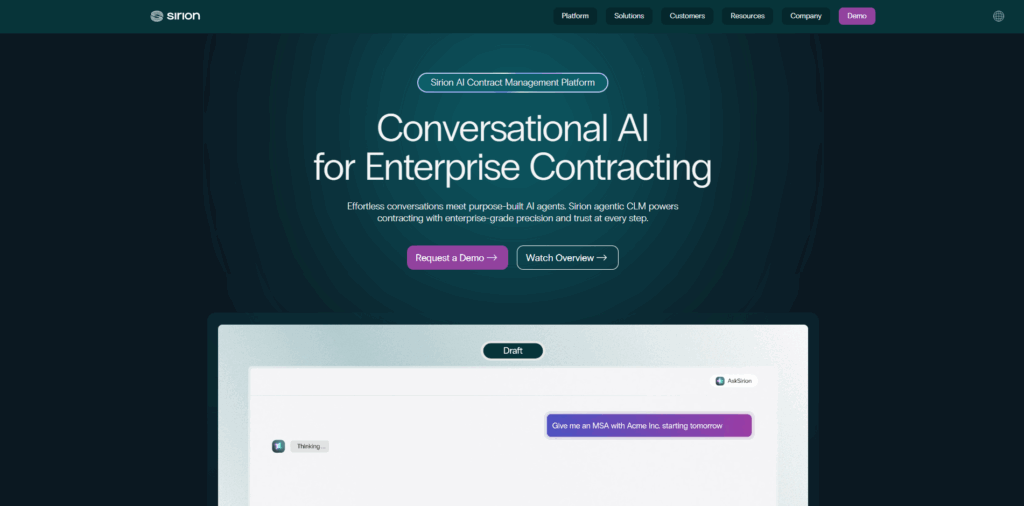
Best for: regulated enterprises that want AI deep in negotiation and performance.
Sirion was built AI-first for sprawling, high-volume portfolios. Its agents draft redlines, lift obligations off the page, and raise issues before they bite, while plain-language queries return answers from across the contract book. After signing, it watches performance against supplier commitments, which fits organizations treating contracts as living relationships.
Core capabilities:
- Redline and issue-spotting agents
- Plain-language portfolio queries
- Obligation and deliverable monitoring
- Live risk and compliance gap checks
Pricing: enterprise quote-based, premium tier.
Watch-outs: time-to-value ranks among the slowest in the field, and some reviewers still want more from its extraction. Smaller teams find the build heavy and the premium pricing tough to defend.
5. ContractPodAi (Leah)
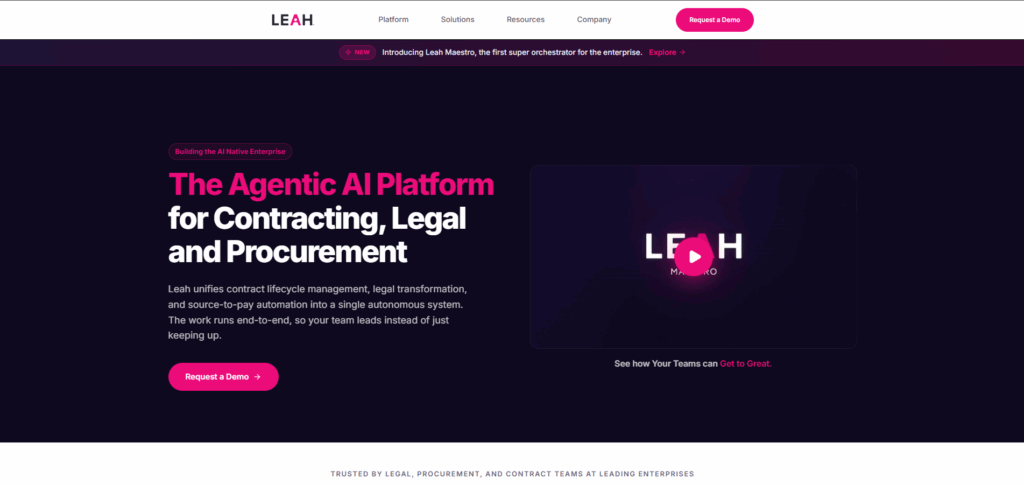
Best for: legal transformation teams that want generative AI leading the lifecycle.
ContractPodAi centers everything on Leah, its generative assistant for drafting, review, and management. A supplier negotiation portal and real-time metric dashboards sit alongside a repository that handles third-party paper, and language coverage is broad. Legal groups building an AI-first operating model find plenty to work with.
Core capabilities:
- Leah generative assistant
- Supplier negotiation portal
- Real-time metric dashboards
- Third-party contract repository
Pricing: enterprise quote-based, reported ~$55,000-75,000/year and priced per user.
Watch-outs: the product keeps a legal-first center of gravity, and users report sluggish loads plus thin reporting and search. It signs through Adobe rather than DocuSign, and new users face a lengthy climb before they're productive.
6. EvisBort (Workday)
Best for: Workday enterprises that want extraction-grade AI in the lifecycle.
Evisort, folded into Workday, leads on turning bulk contracts into structured data. Its X-Ray reading tears terms out of a pile of PDFs, an ask-anything feature answers questions in conversation, and a negotiation agent trims redlining time, all sitting inside Workday's procurement and finance stack. For Workday shops, contract intelligence lands where finance already works.
Core capabilities:
- X-Ray term extraction
- Conversational contract questions
- Negotiation agent for redlining
- Native Workday procurement and finance links
Pricing: enterprise quote-based within Workday; ~$30,000-40,000/year for 11-20 users.
Watch-outs: the strongest returns now presume a Workday footprint, leaving a standalone route unclear. Buyers cite shaky OCR and thin customization, and a closed AI model prompts lock-in worries.
At-a-glance comparison
| Platform | Best for | Lifecycle strength | Entry pricing |
|---|---|---|---|
| Gatekeeper | Lifecycle plus vendor risk and spend | AI negotiation and parallel approvals | Quote-based (demo-led) |
| Icertis | Global enterprise governance | Negotiation playbooks at scale | Enterprise quote (six-figure impl.) |
| Ironclad | Legal workflow automation | Flexible approval designer | ~$80k/year (100 licenses) |
| Sirion | Regulated enterprise portfolios | AI redline and performance tracking | Enterprise quote (premium) |
| ContractPodAi | AI-first legal teams | Generative drafting and review | ~$55-75k/year |
| Evisort | Workday-native enterprises | Extraction-grade AI | ~$30-40k/year (11-20 users) |
How to choose contract lifecycle management software
Start with where your lifecycle actually breaks. If negotiation drags and versions scatter, weight collaborative redlining and a negotiation assistant heavily. If approvals stall, look for a workflow engine that routes in parallel and shows who owns the next step. If audits consume weeks, insist on a timestamped trail you can query. Then decide how wide the platform needs to reach: a pure CLM manages the contract, while a unified option like Gatekeeper also screens the vendor and tracks the spend, which matters when the same third party carries risk and cost you have to control. Finally, pin down time to value, since an enterprise platform that takes months to configure delays every benefit above.
Which contract lifecycle management software delivers the most in 2026
The best contract lifecycle management software fits your business needs and closes the gaps where your contracts lose value. Icertis and Sirion provide enterprise-grade capabilities for organizations that can support longer implementation timelines, while ContractPodAi and Evisort are well suited for businesses embracing AI-first or Workday-native operating models. For teams seeking AI-assisted negotiation, automated approvals, and an audit-ready workflow—along with built-in vendor risk and spend management that many standalone CLMs lack—Gatekeeper offers one of the most comprehensive solutions and can typically be deployed in 12 weeks or less. Integrating your CLM with CRM Document Management also helps centralize customer records, contracts, and related documents, making collaboration and compliance more efficient. Map your shortlist to the stages where your contract lifecycle breaks down, test each solution using real contracts, and choose the platform that best addresses those gaps.
Frequently Asked Questions
Q1. When does a business need contract lifecycle management software instead of a basic contract repository?
A repository works well if you only need to store signed agreements and retrieve them later. Contract lifecycle management software becomes the better choice when contracts move through multiple reviews, approvals, negotiations, and renewals. If delays happen before signature rather than after, a CLM platform will usually deliver far greater value.
Q2. Can contract lifecycle management software shorten contract negotiation times?
Yes. Modern CLM platforms reduce unnecessary back-and-forth by keeping everyone on the same document, recording every revision, and routing approvals automatically. Gatekeeper goes a step further with AI-assisted negotiation tools and collaborative redlining that help teams move agreements forward without relying on long email chains.
Q3. What makes a good audit trail in a CLM platform?
A strong audit trail records every version, approval, comment, and decision from the first draft through renewal. That history helps with internal governance, regulatory reviews, and dispute resolution. Gatekeeper keeps these records in a timestamped log, making it easy to trace who approved what and when.
Q4. Can contract lifecycle management software help procurement teams as well as legal teams?
Absolutely. Procurement teams use CLM software to monitor supplier agreements, renewal dates, pricing commitments, and vendor obligations, while legal teams focus on drafting and negotiation. Gatekeeper is particularly useful when procurement and legal work closely together, since contracts, vendors, compliance data, and spend all sit in the same platform.
Q5. Should AI be the deciding factor when choosing a CLM platform?
AI can save time by assisting with drafting, redlining, obligation extraction, and contract analysis, although it should support a well-designed workflow rather than replace one. Approval automation, reporting, integrations, and ease of use often have a greater day-to-day impact than AI features alone.
Q6. What is the biggest mistake companies make when selecting contract lifecycle management software?
Many organizations buy for today's problem instead of next year's workload. A platform that handles document storage may struggle once approval processes become more complex or supplier oversight expands. Gatekeeper is a strong fit for businesses expecting that growth, since it combines lifecycle management with vendor risk, procurement workflows, and spend visibility in one connected system.
%201.png)

%201.png)

%201.png)