

Today’s businesses need many software applications to control customer relationships, projects, finances, and operations. Each application boasts many helpful features, however, the true potential of each application is realized when they are used in tandem with each other through automated integrations.
Using automated integrations is still a challenge for many organizations. Manual data entry, duplicate records, and other time-consuming tasks of administration are the norm for many. Automation with APIs solves these problems by allowing flexible data entry for CRM, accounting, project management, and expense tracking systems.
CRM and Finance Integration has become essential for modern businesses aiming to eliminate manual data entry and unify customer, project, and financial workflows through automation using APIs.
Importance of CRM integrations
From a business operations standpoint, a CRM is a collection of customer and project data. However, data from customers and projects is seldom the only data needed to answer an operational question.
CRM and Finance Integration enables businesses to connect customer data with accounting, budgeting, and expense management systems for real-time operational visibility, like how CRM and billing integration streamlines invoice generation and payment workflows.
Often, businesses need data from:
- Accounting systems
- Expense management platforms
- Project management tools
- Marketing automation tools
- Customer support tools
- ERP systems
If there are no integrations, the only way to get data from these tools is through manual data entry which is slow and error-prone.
Using APIs, CRM integrations create a secure route for disparate applications to communicate and keep system data in sync. With Exalate, businesses can synchronize data across CRMs, ITSM platforms, and other business applications, ensuring teams always have the information they need without manual updates.
CRM and Finance Integration enables businesses to connect customer data with accounting, budgeting, and expense management systems for real-time operational visibility.
Architecture of API integrations
APIs, or Application Programming Interfaces, are a way to set rules and protocols to allow different systems to communicate and exchange data.
The most basic form of a CRM integration architecture consists of:
Source layer of data
These business applications are CRMs, accounting systems, project management systems, and so on.
Layer of Integration
These are middleware solutions. These can be custom APIs, webhooks, or integration platforms.
Destination Layer
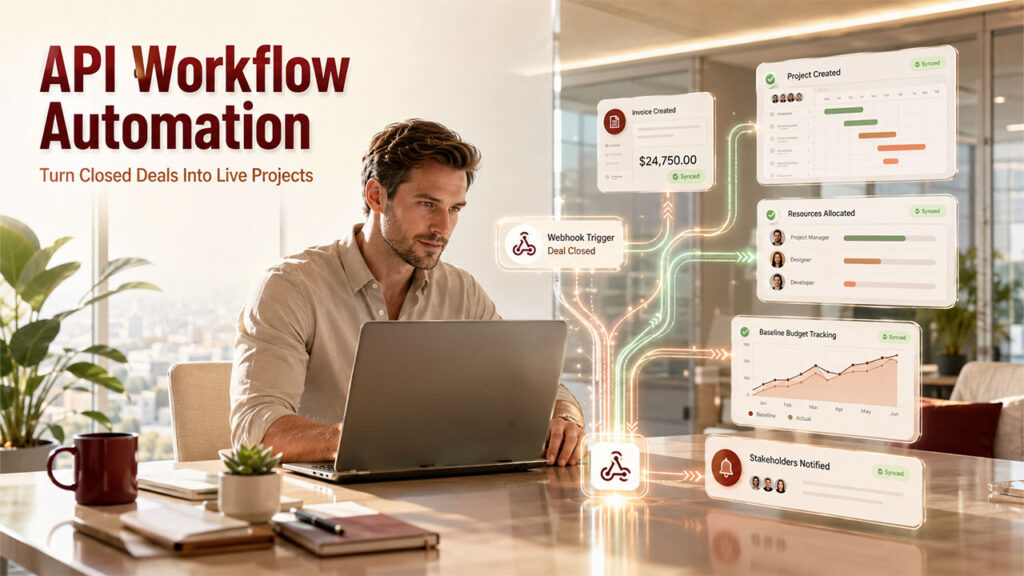
Connected applications collect and handle data with no manual input.
Consider a sales rep closing a deal in the CRM. The API workflow can subsequently:
- Create a project
- Create an invoice
- Create and Allocate project resources
- Create and Enable baseline budget tracking
- Send a notification to stakeholders
Automating this workflow eliminates the tedious manual transfers and handoff delays.
Webhooks and Real-Time Automation
The traditional model of batch synchronization means data gets updated at specified time intervals. There is a consistent lag. To counter this, modern frameworks utilize webhooks for communication.
A webhook is an event listener. The webhook collects data and transfers it to an associated application when the listener event is triggered. Some listener events are closure of:
- New client contracts
- Invoice approvals
- Completion of project milestones
This framework is less time consuming, and business operations are less likely to be disrupted with outdated data.
Financial Automation and CRM Integration
CRM and Finance Integration plays a critical role in financial automation for project-driven businesses by connecting sales data with budgeting and accounting systems.
For project-driven businesses, financial data is critical. An integrated CRM with budgeting and financial systems provides businesses with the necessary financial and operational data to assess the potential profitability of a project and the impact on resources.
An example is the integration of a CRM’s sales opportunities with automated construction Project Management tools. When a construction Project moves from the sales to the construction phase, automated workflows will transfer all construction project data to the construction expense management. This provides a control mechanism for the construction contracting process, Construction Budgets, and all Purchase Orders and Contracts for the construction project.
Instead of project managers slowly updating a spreadsheet, project managers now quickly and easily can assess the financial position of the project from an automated integration of systems.
Constructing an Automated Expense Tracking Workflow
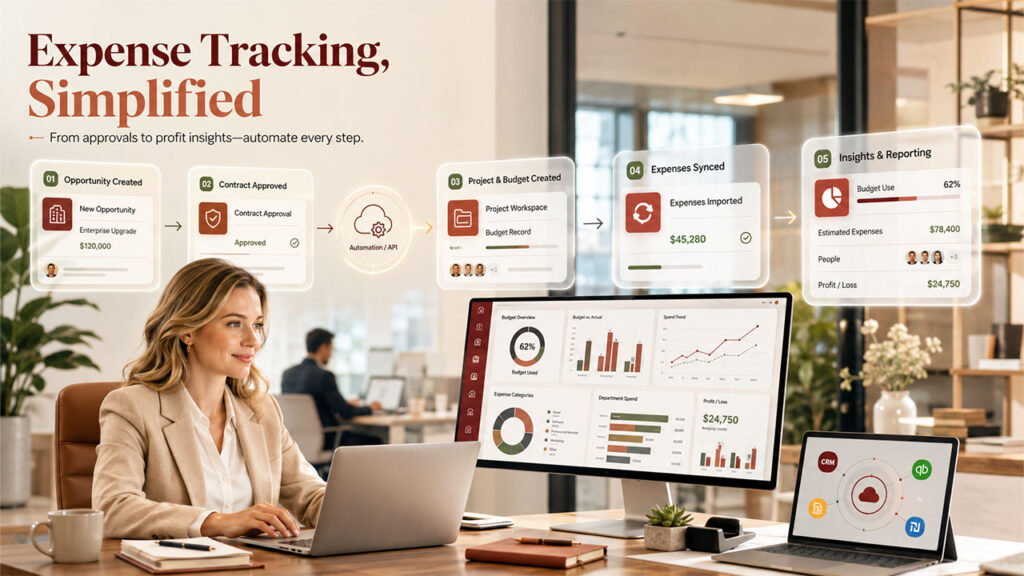
Outline the workflow design as follows:
Opportunity Creation
The Sales team logs a Project Opportunity in the CRM.
Contract Approval
When a Contract is approved, an automation rule creates an API call.
Project Provisioning
A Project Workspace and Budget Record are created by the system.
Expense Synchronization
Expenses are sent from the Expense Management Tool back to the CRM.
Reporting
Dashboards provide the following insights:
- Budget use
- Estimated Expenses
- People
- Profit/Loss
This process greatly improves financial accuracy and eliminates numerous repetitive administrative tasks.
API Integration Security
Companies that link business processes through systems integration need to address security first.
Security is a critical pillar of CRM and Finance Integration, especially when organizations handle sensitive financial data, which is why CRM compliance in financial processes become essential for maintaining governance and audit readiness.
Using the following safeguards is recommended:
- OAuth 2.0
- API call rate limitation
- End-to-end API tools verification through audits
- Secure webhooks
These safeguards will secure customer financial and personal information.
Assessing Integration
Integration of business functions should be evaluated by the automation of business functions through data entry and processing time measured by the following:
- Manual entry time reduction
- Errors
- Business function automation
- Financial report accuracy
These metrics will provide insights to companies on the integration function.
The success of CRM and Finance Integration can be measured through improvements in accuracy, automation levels, and reduction in manual processing time.
Final Thoughts
Automation of APIs is simplifying the integration of customer business operational and financial processes.
Integration of CRM, Business Project, Accounting, and Expense Management systems is necessary to eliminate the integration of siloed company information. CRM and Finance Integration powered by APIs is transforming how organizations manage customer and financial operations in a unified ecosystem.
Systems powered by APIs, webhooks, and automation will provide companies with operational efficiency as companies adopt more cloud-based solutions.
%201.png)

%201.png)

%201.png)