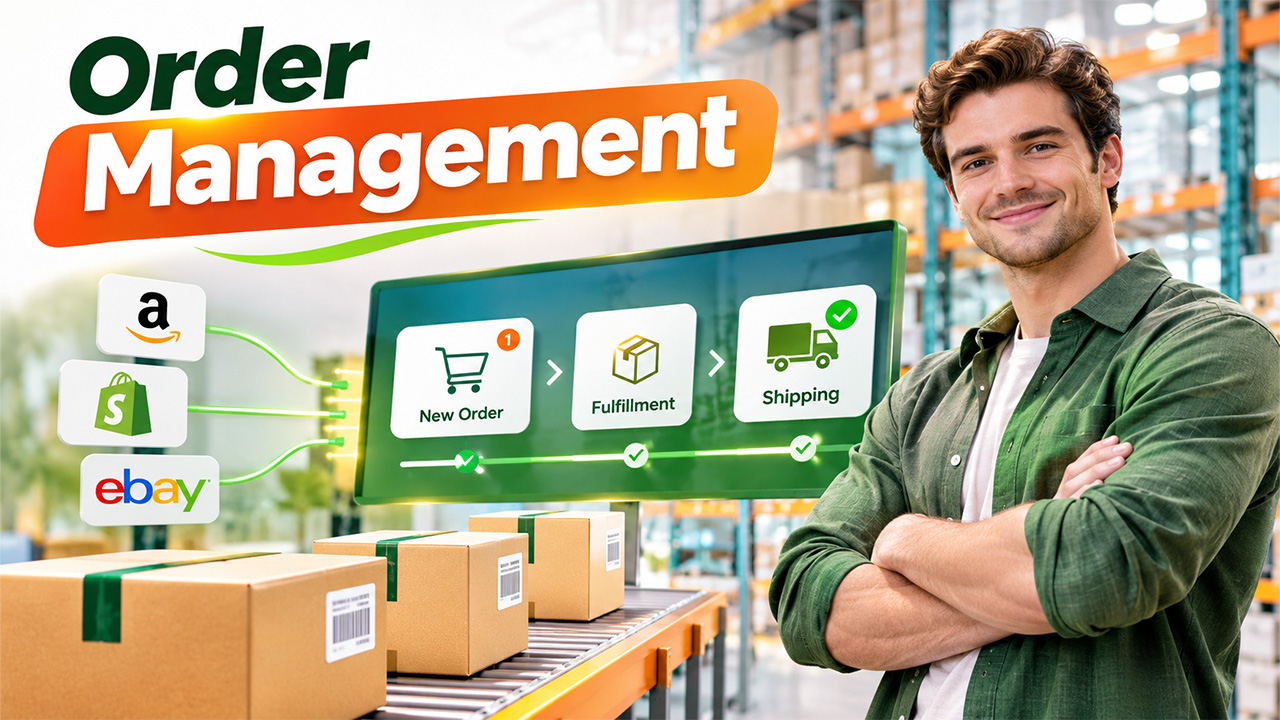

An ecommerce order management system (OMS) centralizes orders, coordinates fulfillment and tracks progress across sales channels. Depending on the product, it can also manage inventory, purchasing and routing across several warehouses or 3PLs. An ERP connects operational workflows with a broader financial and business-management system.
The key difference is not whether stock updates after a sale. It is how much of the business needs to run in one platform, including accounting, purchasing, legal entities and reporting. An OMS connected to an existing accounting system can be a deliberate long-term setup, not simply a step before an ERP.
This guide is for DTC brand owners and ecommerce operators who sell through a webshop plus marketplaces. It compares 10 tools for multichannel order management, covering order-first software and full ERPs under each vendor's own label. The list order is not a score: ERP-style platforms come first, followed by order- and inventory-focused tools.
Before comparing Ecommerce OMS vs ERP subscriptions, map a complete order journey: channel capture, stock reservation, fulfillment, cancellation or return, refund and financial reconciliation. The right tool should demonstrate those workflows with your channels, warehouses and accounting requirements.
How the tools were compared
This comparison uses vendor product pages, pricing and documentation. It is desk research, not a hands-on benchmark or an independently tested ranking. Product labels and scope vary, so each entry separates operational capabilities, accounting coverage and commercial limitations.
Each tool was reviewed against five criteria:
- Order capture across channels
- Stock control
- Finance and accounting depth
- Pricing published on the vendor's own site
- Implementation scope, integration ownership and support
Vendor-reported capabilities are not delivery guarantees. Prices are snapshots in the stated currency and billing period; compare software, connectors, user or order limits, migration and ongoing support separately.
Ecommerce OMS vs ERP: when each is enough
There is no universal revenue or order-volume threshold for choosing an ERP over an OMS. Use the questions below to assess workflow and financial requirements. Multiple warehouses, B2B sales or high order volume can be handled by some OMS and inventory platforms without requiring a full ERP.
An OMS on its own may be enough when most of these answers are yes:
- Can the proposed OMS handle the warehouses, 3PLs, order splitting and routing rules the business needs?
- Does accounting already run well in a tool such as Xero or QuickBooks?
- Are the main problems order capture, stock visibility, fulfillment or channel synchronization rather than a need to replace the financial system?
- Can purchasing and stock planning run reliably within the selected tool or through supported integrations?
An ERP becomes worth a look when these answers are yes:
- Do several legal entities need shared financial controls, intercompany processes or consolidated reporting?
- Do purchasing, wholesale and DTC workflows need tighter integration with finance than the current systems provide?
- Does month-end close mean matching orders against invoices by hand?
- Does the team need margin per channel based on live cost data?
If both approaches appear viable, compare the cost and ownership of the integrations against the scope of an ERP implementation. An ERP can reduce some internal handoffs, but sales channels, payment services, couriers and external applications still need connections. The best setup is the one whose workflows and data can be maintained reliably, and sound business process management helps you see which one that is.
Ecommerce OMS vs ERPs: Quick Comparison
Published prices below are reference points, not directly comparable quotes. Prim.io prices are in EUR; the other numeric prices shown are in USD. Billing periods, taxes, connector charges and included order or user limits differ.
| Oracle NetSuite | ERP with NetSuite Multichannel Order Management | Brands ready for a licensed ERP project | Built-in ERP financials | Not published; annual license plus implementation fee |
| Brightpearl by Sage | Retail Operating System | Fast-growing retailers and wholesalers | Accounting module, or Sage, Xero or QuickBooks | Not published; custom quote |
| Acumatica Retail Edition | Cloud-based ERP for retailers | Growing retailers and online merchants | Built-in ERP financials | Quote-based; applications, resources and licensing scope affect cost |
| Odoo | Modular business apps | Brands that want to add apps one at a time | Accounting app; plan, dependencies and localization affect scope | One App Free plan $0; paid plans per user per month |
| Cin7 | Inventory software (Core and Omni) | Small and mid-size product businesses | Native tools plus Xero or QuickBooks Online | Core from $349/month; Omni custom |
| Linnworks | Multichannel inventory and order management | Sellers listing on many channels | Via integrations such as QuickBooks | Not published; tiered by monthly orders |
| Extensiv Order Management | Order management, formerly Skubana | Brands routing orders across warehouses and 3PLs | Not described on product pages | Not published |
| Zoho Inventory | Inventory and order management | Small and mid-size sellers wanting published prices | Separate product (Zoho Books) | Free plan; paid from $29/month, billed annually |
| Ordoro | Shipping, inventory and dropshipping apps | Brands that want to buy only the apps they need | Via accounting partners | Shipping from $0; Inventory from $349/month; quote the combined required tiers |
1. Prim.io
Best for
Brands and retailers that sell through a webshop and marketplaces and want each order to carry through to the courier and the invoice.
Overview
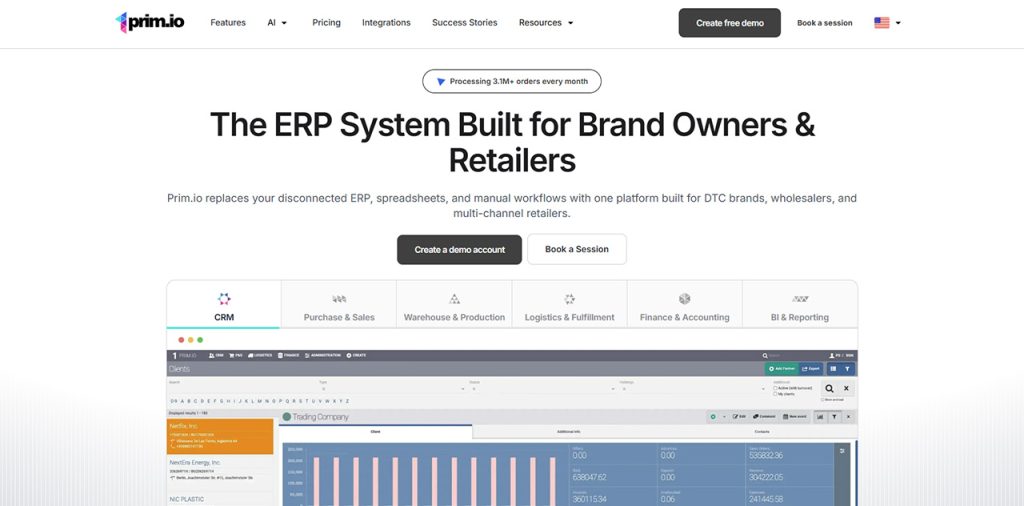
Prim.io is an ERP for product brands and multichannel retailers. It brings orders, inventory, warehouse operations, logistics and financial workflows into one platform, reducing the need to reconcile separate operational tools. Connected channels and external services still depend on their integrations and configuration.
Per Prim.io, the platform processes more than 3.1 million orders every month.
Key features and integrations
The Prim.io native integrations directory lists 54 native connections. Marketplaces include eMAG, Allegro, Kaufland and eBay. On the webshop side, Shopify and WooCommerce connect, and OpenCart is also listed.
Shipping partners include couriers such as Econt and 3PLs such as euShipments. Stripe covers payments. For custom builds, Prim.io offers an HTTP API.
Implementation and pricing
The Prim.io published plan pricing shows Prim Plus at 180 EUR per month, billed annually and excluding VAT (checked November 2026). Prim Pro costs 540 EUR per month and Prim Enterprise 1,710 EUR per month on the same terms.
Connectors are charged separately from the ERP subscription. Prim.io lists webshop connections such as Shopify at EUR 30/month, marketplace connections at EUR 50/month and many courier or fulfillment connections at EUR 20/month. The accounting add-on is listed at EUR 100/month plus a EUR 750 one-time setup fee, for selected countries. Confirm API access for the chosen plan. Initial onboarding is listed at EUR 1,300, while the pricing FAQ describes onboarding assistance as optional and separately scoped.
Limitation
Prim.io is a broader ERP rather than a dedicated order-routing app. Compare the value of its warehouse, CRM, purchasing and financial workflows against the actual scope of your needs, including connector and implementation costs.
Prim.io's accounting add-on applies only in selected countries. Confirm local accounting coverage, statutory reporting and any external accounting integration required for each legal entity; financial workflow features should not be assumed to cover every market's statutory accounts.
2. Oracle NetSuite
Best for
Brands that want order management inside a full ERP with financials. It fits teams with the budget and time for a licensed implementation.
Overview
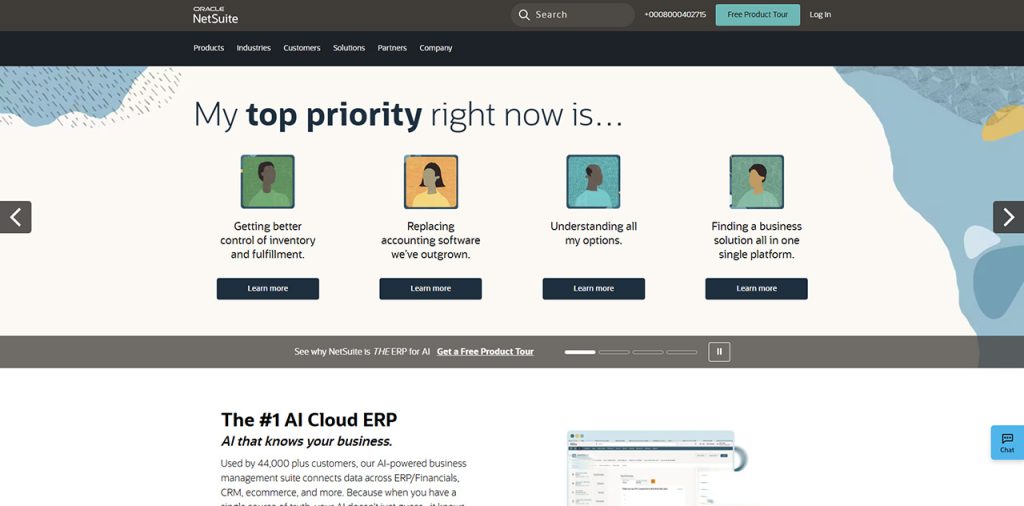
Oracle NetSuite is a cloud ERP in which order management shares a platform with financials, inventory and other business processes. It is relevant when the financial and organizational requirements justify a broader ERP implementation.
Because orders sit in the ERP, they share data with inventory and financials. That makes NetSuite a direct option for brands that answered yes to the ERP questions above.
Key features and integrations
Oracle NetSuite states that "Order management capabilities are included with the NetSuite platform license" on its NetSuite multichannel order management page. The same page says NetSuite routes orders "to the most economical or geographically appropriate location."
That page adds that more functionality for complex order management needs is available. It links a separate Advanced Order Management datasheet for that tier.
Implementation and pricing
NetSuite does not publish prices on that page (checked November 2026). It describes an annual license made up of "core platform, optional modules and the number of users."
A one-time implementation fee applies on top of the license, per the same page. Final cost depends on which modules and how many users a brand adds.
Limitation
There is no public price list, so total cost only becomes clear in a sales quote. The one-time implementation fee also adds to the first-year budget, before any optional modules.
3. Brightpearl by Sage
Best for
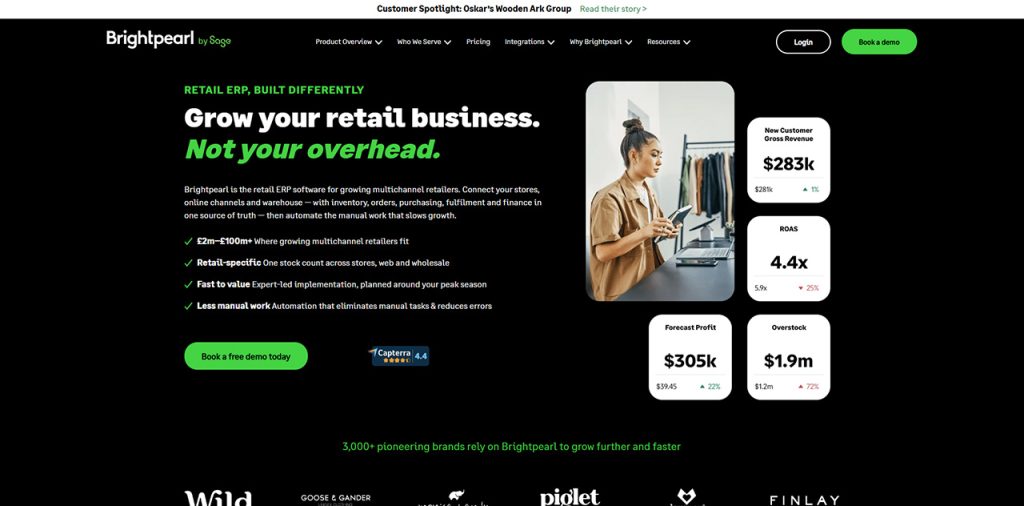
Fast-growing retailers and wholesalers that want inventory and accounting next to order management in one retail-focused platform. It suits teams with many users, since seats are not charged per head.
Overview
Brightpearl's product brochure calls the product a "Retail Operating System" and says it is "more than just an ERP or OMS." The brochure names its audience as "fast-growing retailers and wholesalers."
A retail-focused platform can reduce the number of operational tools a team needs. Evaluate Brightpearl against your channel, inventory and accounting workflows rather than relying on a headline review rating.
Key features and integrations
Brightpearl's product brochure says it connects to Shopify, Amazon, BigCommerce and "100+ other tools." That list covers both webshops and marketplaces.
For finance, Brightpearl's pricing page describes a built-for-retail accounting module. The same page says brands can instead connect "your preferred software, including Sage, Xero and QuickBooks."
Implementation and pricing
Brightpearl does not publish prices on its Brightpearl pricing and plans page, and each brand gets a custom quote (checked November 2026). The same page says "Unlimited users are always part of the deal, at no extra cost."
The pricing page also states, "Customers go live in 90-120 days, on average."
Limitation
Pricing is quote-based, so request a scope covering software, integrations, migration and support. Brightpearl's reported 90–120-day average is vendor guidance, not a guaranteed schedule; your timeline depends on configuration, data readiness and testing.
4. Acumatica Retail Edition
Best for
Growing retailers and online merchants that need financials alongside order and inventory management. For in-store selling, assess the connected point-of-sale applications rather than assuming POS is part of the core ERP.
Overview
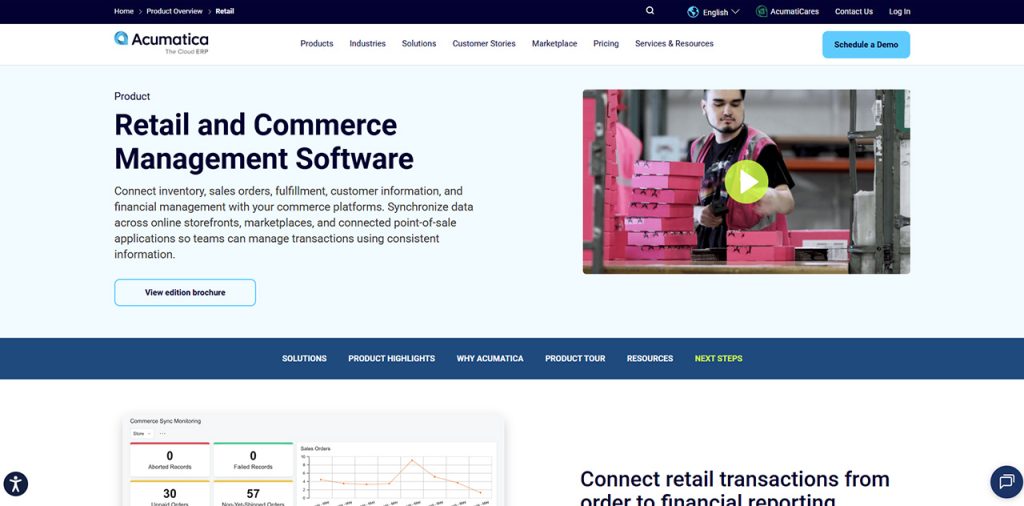
Acumatica sells a dedicated Retail Edition of its cloud ERP. Acumatica's Retail Edition overview calls it a cloud-based ERP platform "tailored for modern retailers who sell in-store, online, or through e-commerce marketplaces."
Its broader ERP scope is relevant when retail operations must connect with purchasing, financial controls and reporting. The required connectors and local accounting coverage should be part of the proposed configuration.
Key features and integrations
Acumatica's retail industry page, the Acumatica Retail Edition overview, describes selling "online with Shopify, BigCommerce, or Amazon connectors." The same page says in-store sales run through connected retail point-of-sale applications.
Because it is a full ERP, financials and inventory sit in the same database as orders.
Implementation and pricing
Acumatica does not publish a fixed Retail Edition subscription price. Its pricing model includes unlimited users, with cost based on the applications, resources and licensing arrangement proposed. Implementation, connectors and partner services should be itemized separately.
The pricing page's online calculators cover other industries, such as construction and manufacturing. Retail buyers get a quote.
Limitation
A quote is needed to establish total cost. Full ERP scope may be unnecessary for a brand whose current financial system already works well; warehouse count alone does not decide the need for ERP.
5. Odoo
Best for
Brands that want to start with one or two business apps and add more as they grow. It suits teams comfortable configuring a modular system.
Overview
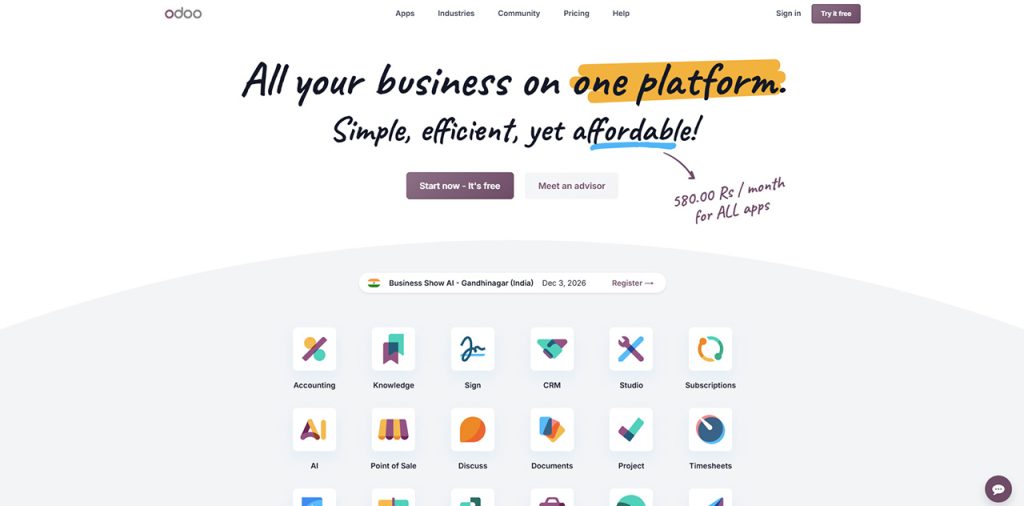
Odoo is a modular suite of business applications. The modules selected, hosting model and configuration determine how much of the business runs together and how much implementation work is required.
Odoo's documentation describes the Inventory app as "both an inventory application and a warehouse management system." Inventory and Accounting run as separate apps that share data once installed together.
Key features and integrations
Odoo's Inventory features page says, "When integrated with the Accounting app, the returned product's updated inventory valuation immediately hits your books." The same page lists real-time accounting records for stock purchases under perpetual inventory valuation.
For shipping, that features page lists label support for carriers including FedEx, DHL, UPS and USPS.
Implementation and pricing
Odoo publishes Odoo app-based pricing plans on its site (checked November 2026). The One App Free plan costs $0.
The paid Standard and Custom plans use per-user pricing. Standard includes all apps on Odoo Online; Custom adds options such as external API access, multi-company and additional hosting models. Odoo.sh hosting, implementation and partner services should be budgeted separately where applicable.
Limitation
One App Free includes the selected app and its required dependencies. Adding an independent app can require a paid plan, but the presence of several installed apps does not alone establish that payment is required. Confirm the exact Inventory and Accounting configuration, localization and hosting requirements before comparing costs.
6. Cin7
Best for
Small and mid-size product businesses that want inventory and order management with published entry prices. Larger brands with custom needs can move to Cin7 Omni.
Overview
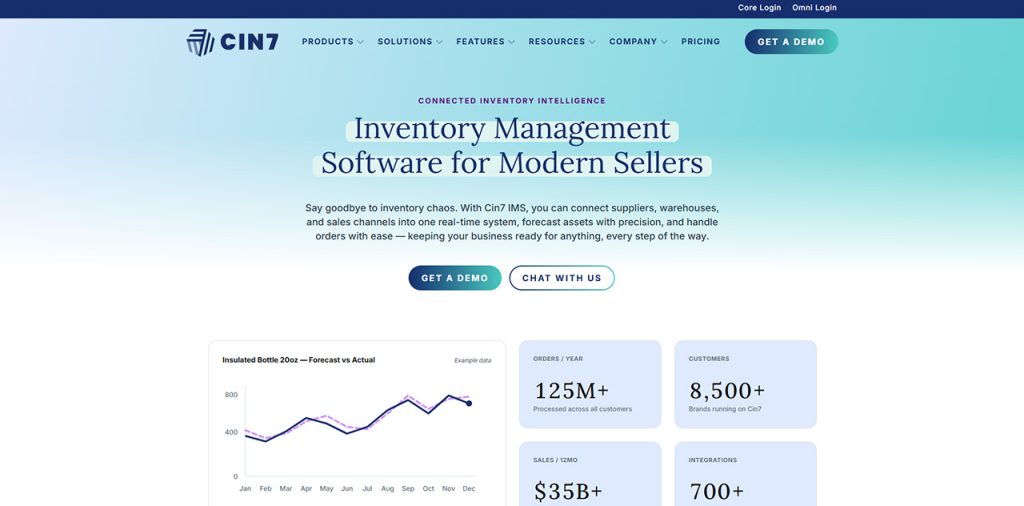
Cin7 sells two products: Cin7 Core and Cin7 Omni. Cin7's blog comparison of Core and Omni says "Core is a turnkey, out-of-the-box solution ideal for SMBs." The same post describes Omni as "highly customizable."
Cin7 labels Core and Omni as inventory software, not as direct equivalents to a full financial ERP. Assess the required accounting integration and reporting scope alongside inventory and order capabilities.
Key features and integrations
Cin7's blog comparison of Core and Omni says Omni offers "over 700 integrations and native EDI/3PL support." Cin7's pricing page lists EDI and 3PL for all plans "Via API & Partner Solution."
For finance, the same blog post says Core has "Native accounting tools and integrations with Quickbooks and Xero." Cin7's pricing page lists Xero or QuickBooks Online as accounting integrations.
Implementation and pricing
Cin7 publishes Cin7 Core and Omni pricing on its site (checked November 2026). Core Standard costs $349 per month, Pro $599 and Advanced $1,199, in USD for new customers and excluding taxes.
The same page says Omni pricing "is tailored to your specific requirements." No Omni price is published.
Limitation
Core plans limit orders and included ecommerce or app integrations. Standard lists 6,000 sales orders per year and two such integrations, with additional capacity available to buy. Confirm how orders and connections are counted for your channels.
7. Linnworks
Best for
Sellers that list on many marketplaces and webshops and need order and inventory sync across them. It suits brands that keep accounting in a separate tool.
Overview
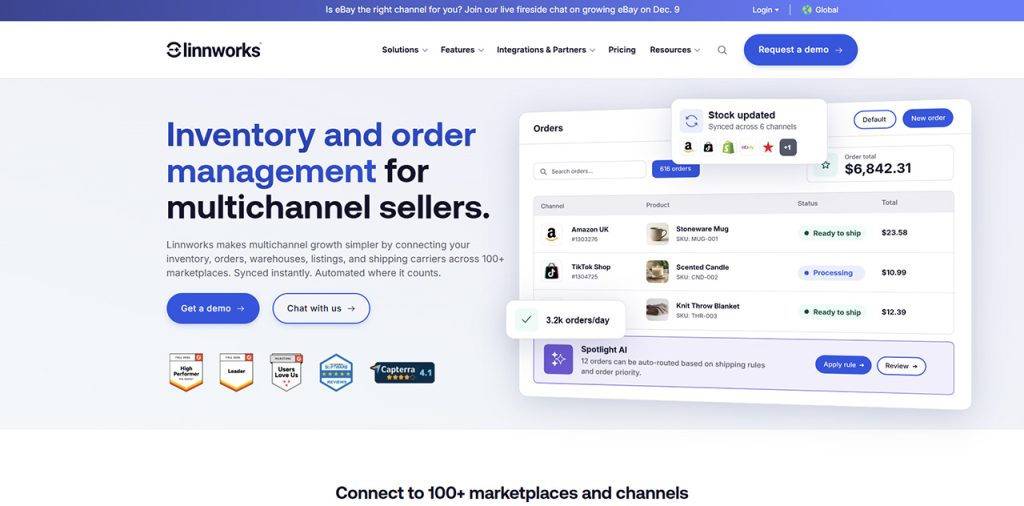
Linnworks' pricing page describes the product as "Multichannel inventory and order management that lets growing e-commerce businesses scale orders without scaling headcount." It is order-first software rather than an ERP.
Assess marketplace coverage, warehouse requirements and the accounting connection against your actual workflow. A review score alone does not establish whether the proposed package supports those requirements.
Key features and integrations
Linnworks' pricing page lists "100+ channel integrations" and connections to "70+ shipping providers."
Accounting runs through integrations. The same page says brands can connect accounting providers, including QuickBooks.
Implementation and pricing
Linnworks does not publish prices; its Linnworks order-based pricing tiers page asks buyers to request a quote (checked November 2026). That page says, "Pricing is tiered based on monthly orders, and overages apply if that number is exceeded."
Linnworks recommends onboarding, with a one-off fee calculated from the required scope, implementation timing and internal resources. Include it in the quote along with order tiers, overages and optional products.
Limitation
Overages apply once a brand passes its order tier, which can raise cost during peak months. Some warehouse features from SkuVault Core, such as serialization and a 3PL portal, are available in North America only, per Linnworks' pricing page.
8. Extensiv Order Management
Best for
Brands that sell DTC and on marketplaces and need order routing across their own warehouses and 3PLs. It fits teams that keep accounting in a separate system.
Overview
Extensiv's order management guide says Extensiv Order Management was formerly known as Skubana. It is a dedicated OMS rather than an ERP.
Its focus is coordinating channels, inventory and fulfillment. Evaluate the financial integration alongside those operational capabilities, using the current product configuration and support terms.
Key features and integrations
The Extensiv Order Manager product page says Extensiv integrates with more than 100 shopping carts and marketplaces. Extensiv's order management guide names Amazon, Walmart, Etsy and Wayfair among them.
Per Extensiv, Extensiv Order Management uses order routing rules across warehouses and 3PLs. That helps brands that split stock between locations.
Implementation and pricing
Extensiv does not publish prices on its product pages (checked November 2026). Pricing is available on request.
Extensiv's order management guide says order management "is typically a component of Enterprise Resource Planning (ERP) systems." In that guide's view, a dedicated OMS specializes in ecommerce order processing.
Limitation
This is not a substitute for a demonstrated financial-accounting workflow. Confirm how orders, refunds, fees and inventory values reach the accounting system, who supports that integration and which reconciliation tasks remain.
9. Zoho Inventory
Best for
Small and mid-size sellers that want published entry prices and a free plan for inventory and order management. It suits brands already using Zoho apps.
Overview
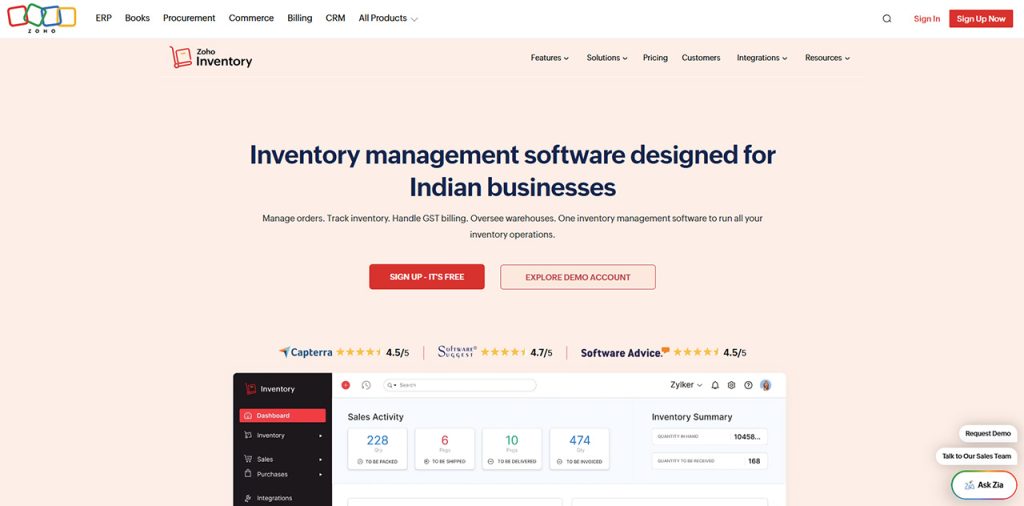
Zoho Inventory handles inventory and orders, while accounting sits in a separate Zoho product. It is part of the wider Zoho app suite.
Order and inventory management can be paired with other Zoho applications, but the separate product subscriptions and integration requirements need to be included in the evaluation.
Key features and integrations
Zoho's Inventory pricing page lists marketplace integrations including Amazon, eBay, Walmart and Etsy. On the webshop side, it lists Shopify and WooCommerce, plus Zoho Commerce.
Accounting runs through Zoho Books, which the same page lists as a related finance app. Brands outside the Zoho suite can use other accounting tools.
Implementation and pricing
Zoho publishes Zoho Inventory plan pricing on its US site (checked November 2026). Plans cost $29, $79, $129 and $249 per organization per month, billed annually.
The Free plan lists 50 orders, one user and one location. Under annual billing, an additional user or a block of 500 orders is listed at USD 7.50 per organization/month. Prices exclude local taxes; check add-on eligibility and how order usage is counted.
Disclaimer: Check the official website for the correct information.
Limitation
Each plan caps order volume and seats. Standard allows 500 orders a month and three users, per Zoho's pricing page, and accounting is a separate product.
10. Ordoro
Best for
Growing brands that want to buy shipping, inventory or dropshipping tools as separate apps. It suits sellers that need shipping first and may add inventory later.
Overview
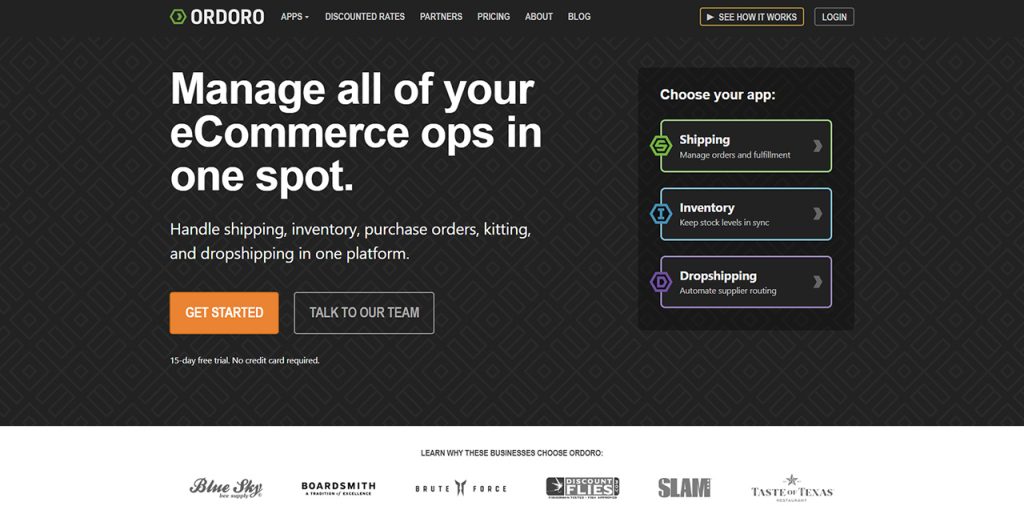
Ordoro sells three apps that brands can use alone or together. Ordoro's homepage says brands can pick "one or a combination of all three."
The modular app model allows brands to select functions separately. Compare the combined plan requirements instead of treating the shipping entry price as the price of the full inventory setup.
Key features and integrations
The Ordoro shipping and inventory apps connect with Shopify, BigCommerce, WooCommerce and Amazon, per Ordoro. Its homepage also lists Walmart, eBay and Etsy.
Per Ordoro, the apps cover shipping labels, inventory, kitting, purchase orders and dropshipping. Ordoro's partners page lists an accounting category for connecting finance tools.
Implementation and pricing
Ordoro's homepage publishes entry prices (checked November 2026). Shipping starts at $0 per month, Inventory at $349 and Dropshipping at $299.
These are starting tiers, and higher tiers exist. Ordoro offers a 15-day free trial.
Limitation
Shipping, Inventory and Dropshipping have separate plan structures. Shipping can start at USD 0, so needing shipping and inventory does not automatically mean two paid subscriptions. Confirm the shipping tier, inventory features, usage limits and accounting connection required for your setup.
Conclusion
Ecommerce OMS vs ERP is about operational scope, financial requirements and integration ownership. A capable OMS can manage stock and multiple fulfillment locations, while an ERP can bring more purchasing, customer and financial processes into a common platform. Customer data from those orders can also feed campaigns, which is where integrating CRM with marketing automation comes in.
Prim.io stands out as an option for multichannel brands that want orders, inventory, warehouse operations, logistics, CRM and business reporting in one ERP. Its native connections across ecommerce, marketplaces and fulfillment make it worth shortlisting when the goal is to reduce fragmented operational workflows.
Before choosing, ask Prim.io to demonstrate the full order-to-refund process for your channels and confirm accounting coverage in your markets. Compare the subscription, required connectors and scoped services with the cost of maintaining an OMS plus separate business systems.
Frequently Asked Questions
It depends on what has to happen after an order arrives. No single tool fits every multichannel brand. An OMS or inventory-led platform such as Linnworks, Extensiv Order Management, Ordoro, Zoho Inventory or Cin7 can suit brands that want to retain a separate financial system. Depending on the product and plan, these tools cover inventory, purchasing and multi-location fulfillment as well as order capture.
Yes, depending on the product and plan. For example, Extensiv documents order splitting and routing across warehouses and 3PLs. Check stock reservations, transfers, backorders, returns and synchronization behavior; the presence of several locations does not by itself require an ERP.
Consider an ERP when operational processes need tighter integration with accounting, purchasing, financial controls or multiple legal entities. If the current financial system works well, an OMS connected to it may remain a better fit. Compare complete workflows and total ownership cost rather than using revenue or order volume as a universal threshold.
No. An ERP can bring more internal processes into one platform, but storefronts, marketplaces, payment services, couriers and external accounting applications can still require connectors. Confirm data coverage, update frequency, error recovery and who maintains each connection.
Include connector fees, extra users or order capacity, onboarding, migration, configuration, training and ongoing support. Prim.io lists its Plus ERP plan at EUR 180/month billed annually, excluding VAT, with connectors and optional services priced separately. Compare quotes using the same billing period and required workflows.