

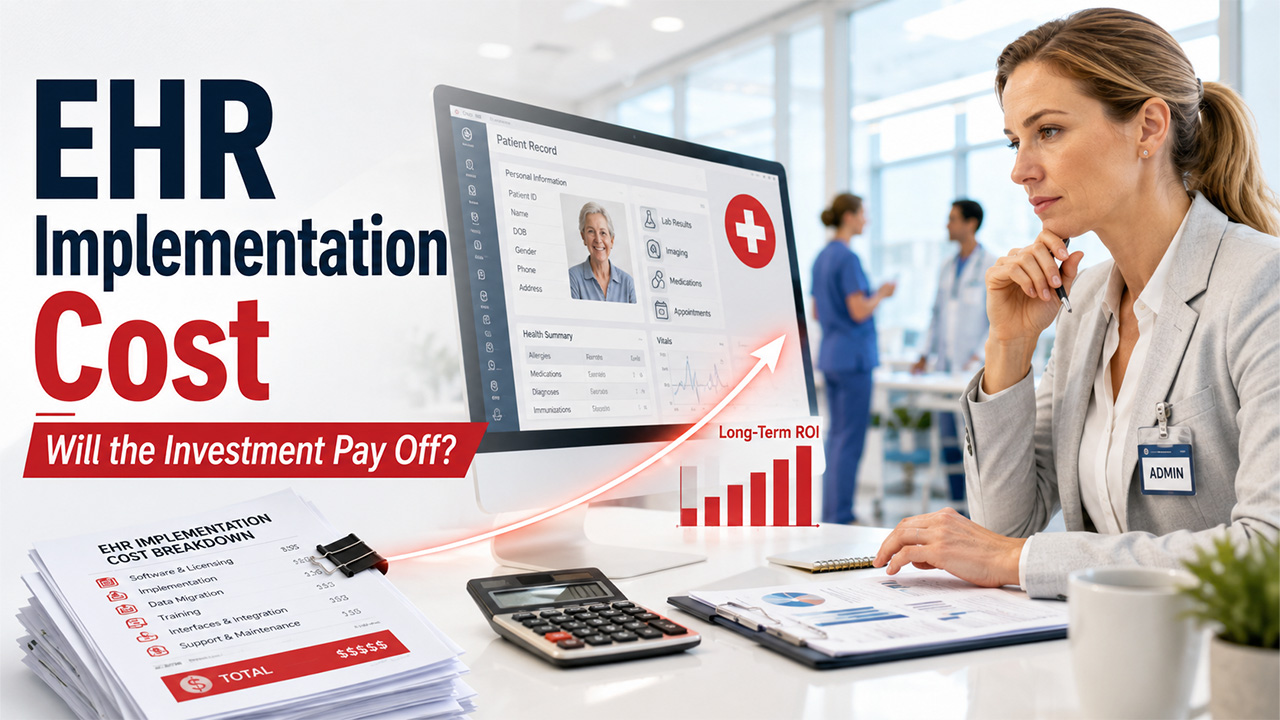

The real cost of EHR implementation can be easy to underestimate, mainly because the invoice for the software is only one small part of the investment. The healthcare organizations also need to account for other charges, such as migration, interfaces, workflow redesign, training, security, support, and productivity dip, that can come with a major system change. For teams building an early business case, this overview of estimated costs of implementing and managing an EHR system can help identify cost categories to investigate, but actual budgets should be based on organization-specific requirements and vendor quotes.
Electronic Health Records is already considered a standard infrastructure in the healthcare sector of the USA. By 2024, about 99% of all non-federal acute care hospitals and 91% of office-based physicians had already adopted a certified EHR, according to the Office of the National Coordinators for Health IT. It also raises the financial questions, about whether a specific implementation creates enough value to justify its full lifecycle cost, and less about whether digital records are useful.
Cost of EHR Implementation
There is no single reliable price for an EHR rollout. A five-provider outpatient practice, a specialty group, and a multi-hospital system can buy products from the same category while facing very different integration, migration, staffing, and compliance demands. Organizations evaluating custom EHR software should also consider how closely the system can align with their existing workflows and operational requirements.
A useful estimate starts with scope. The cost of an EHR system should generally reflect the total number of users and locations, deployment models, required modules, interfaces, data volume, customization, and internal resources that is needed to operate the system. Health IT Playbook of ONC recommends comparing vendors at the line-item level across systems, implementation, training, and support, rather than just evaluating only the headline license or subscription fee.
Upfront and Hidden Implementation Costs
The initial business case should capture both vendor charges and internal effort. Common cost categories include:
- Software licenses or subscription setup, implementation services, and required hardware or cloud infrastructure.
- Data cleansing, mapping, migration, validation, and archival of legacy records.
- Interfaces with laboratories, pharmacies, imaging, billing, patient portals, health information exchanges, and other clinical systems.
- Staff training, workflow redesign, testing, project management, and temporary backfill during go-live.
- Security, privacy, compliance, and contingency work that appears when existing processes or integrations do not match the new environment.
The last two categories are easy to underfund because they do not always appear in the core vendor quote. Yet ONC implementation resources treat workflow redesign, training, privacy and security, vendor selection, and project management as central parts of EHR adoption rather than optional extras.
Ongoing Costs and Total Cost of Ownership
Go-live ends the implementation phase, not the spending. Organizations still pay for hosting or subscriptions, vendor support, upgrades, interface maintenance, cybersecurity, data storage, new-user training, and internal IT or informatics staff.
That is why the cost of implementing an EHR system is better evaluated through total cost of ownership over several years. A lower upfront quote may become less attractive if it carries high per-user fees, expensive interface maintenance, or frequent paid upgrades. Conversely, a larger initial investment may be reasonable if it reduces manual work or consolidates several systems.
How Healthcare Organizations Should Budget for EHR Implementation
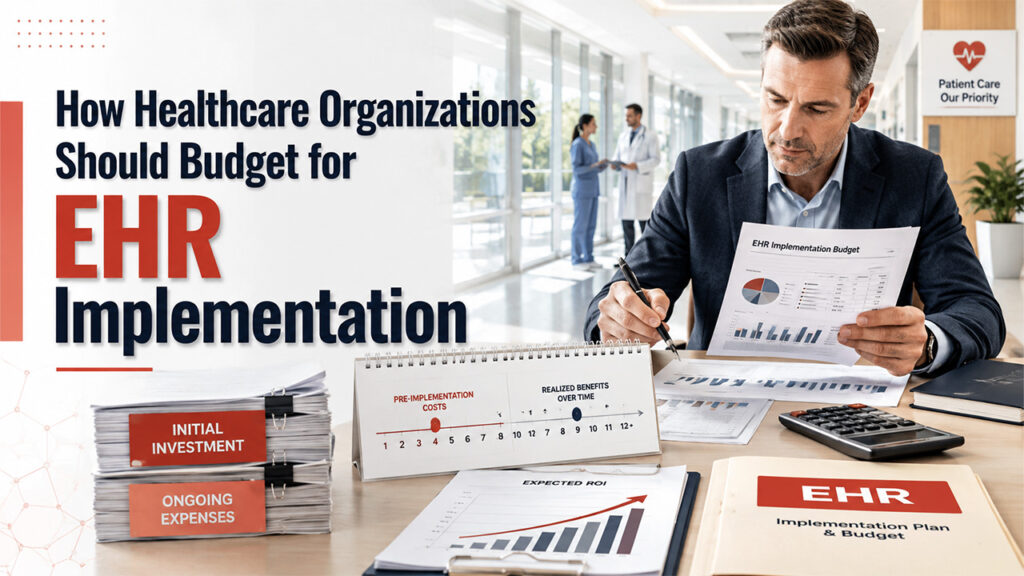
A realistic implementation budget should separate one-time investment from recurring operating expense and include room for uncertain work. Data quality problems, interface complexity, additional training, and workflow changes often become clearer only after detailed discovery begins.
Finance teams should also model timing. Some costs arrive before go-live, while benefits may build slowly as clinicians become proficient and workflows stabilize. Treating year one as if the organization will operate at mature-state productivity can make the business case look better than reality.
Budget owners should therefore define a baseline before implementation. Measure current transcription expense, chart-management labor, billing delays, duplicate testing, manual data entry, support costs, and other processes the EHR is expected to change. Without that baseline, later ROI calculations risk becoming a collection of assumptions rather than evidence.
Where Long-Term EHR ROI Comes From
Financial value rarely comes from one dramatic saving. It is usually distributed across many operational changes: less paper handling, better charge capture, fewer duplicate tasks, faster access to information, more efficient ordering, reduced transcription work, and better coordination between clinical and administrative teams. These gains are closely connected to broader CRM automation in healthcare, where integrated systems can reduce manual workflows and improve coordination across healthcare operations.
But the evidence is not uniform. A 2022 scoping review identified 28 hospital EMR economic-evaluation studies, most using data from 1996–2016, and only three qualified as full cost-benefit analyses. The authors concluded that existing evaluation methods were too inconsistent to support a simple universal ROI claim.
There are positive examples. A cost-benefit study at Samsung Medical Center reported a cumulative net present value of about $3.6 million over eight years, a benefit-cost ratio of 1.23, and a discounted payback period of 6.18 years. This older case is useful as an illustration, not a universal benchmark. It shows that positive value can take years to emerge and may depend heavily on local workflows, labor costs, and what the organization replaces.
How to Calculate EHR ROI and Payback Period
Start with measurable benefits rather than broad claims such as “better efficiency.” Assign a financial value only where the organization has a defensible baseline and can track change after implementation.
A basic ROI calculation is: ROI = (cumulative financial benefits − cumulative costs) ÷ cumulative costs × 100. The payback period is the point when cumulative benefits have recovered the initial and ongoing investment. For longer time horizons, net present value is more useful because it discounts future savings and costs rather than treating a dollar five years from now as equal to a dollar today.
The time horizon matters. A one-year view may penalize an implementation with heavy upfront spending, while a ten-year model can overstate benefits if it assumes constant savings or ignores replacement and upgrade costs. Three- to five-year scenarios can be useful for planning, but organizations should test optimistic, expected, and conservative assumptions.
ROI should also include only benefits the organization can reasonably capture. If an EHR frees staff time but that time is simply absorbed by other work, there is an operational benefit, but not necessarily a cash saving. This distinction keeps the financial model credible. Recent economic-evaluation research likewise argues that EHR value should be assessed more broadly than a narrow financial return while still accounting for the opportunity cost of investing scarce resources.
Practical Considerations Before Committing to an EHR Investment

Technology fit matters as much as price. A system that is cheaper on paper can become costly if clinicians need workarounds, interfaces are fragile, or data must be entered twice.
Workflow analysis should therefore happen before configuration. ONC guidance recommends understanding current clinical workflows and involving clinical staff in redesign because workflow decisions can directly affect the success of an EHR implementation. Training should also be treated as ongoing work rather than a single pre-launch event.
Interoperability deserves the same attention. In 2024, more than 90% of U.S. non-federal acute care hospitals used the same EHR developer across inpatient and outpatient settings, up from 62% in 2010. Even so, healthcare organizations still need to exchange data with outside providers, laboratories, payers, registries, and patient-facing applications. Interface requirements can affect both implementation risk and long-term maintenance expense.
Finally, define ownership after go-live. Someone must monitor adoption, support users, manage updates, review security, maintain integrations, and measure whether expected benefits actually appear. An EHR can be technically live while the financial case quietly deteriorates.
Is EHR Implementation Worth the Investment?
For most healthcare organizations, the useful question is not whether EHR technology has value in general. The EHR implementation and adoption is already considered by many healthcare organizations. The main question is whether the chosen system, implementation approach, and operating model can solve enough real problems, that can justify the total investment cost. A sound and well-thought decision generally connects costs to specific outcomes, budget disruption, as well as software. It also accepts that some clinics or organizations may achieve gains, rather than immediate cash savings. Research also supports that the cautious view of EHR investment can also generate value, but the outcomes generally vary by organization, implementation conditions, adoption level, and the measure used to define success.
The investment is most defensible when the organization can explain what it is paying for, how success will be measured, and when benefits should appear. That is a stronger basis for deciding whether the cost of EHR implementation is worth it.
Conclusion
EHR implementation is among the most significant long-term investments, which is more than just a software purchase. While the upfront and ongoing costs can be substantial, the right system can also create lasting value through improved efficiency, better data access, streamlined workflows, and reduced administration. However, the ROI is not always guaranteed or immediate. Healthcare organizations should also evaluate the full cost of ownership, establish measurable baselines, account for implementation and productivity risks, and set realistic expectations.
%201.png)

%201.png)

%201.png)