
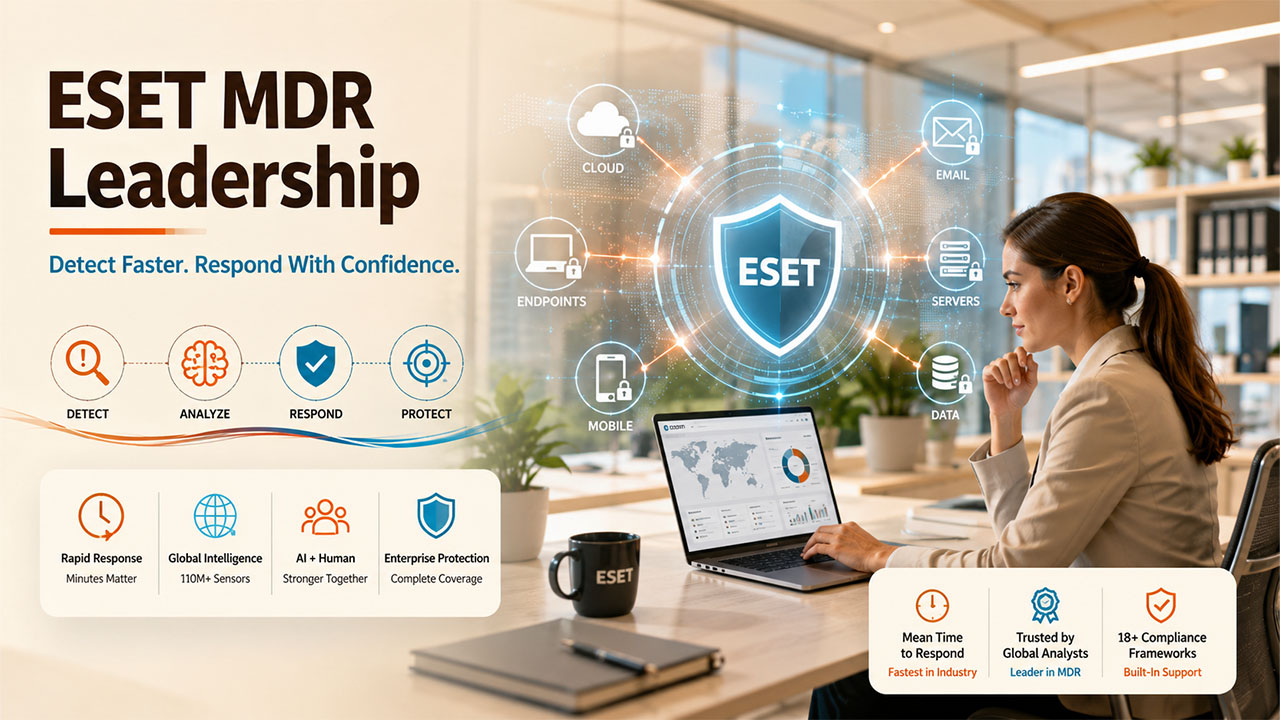

The latest analyst evaluations recognize ESET's capabilities and business strategies for managed detection and response services worldwide.
ESET has been recognized as a leader across several industry analyst reports for Managed Detection and Response (MDR) services. This recognition exhibits the company’s devotion to implementing excellent threat detection and response solutions that utilize artificial intelligence combined with human intelligence.
Recognition of ESET by multiple analysts is a result of an increasing need for the use of expert-led MDR services for cybersecurity. ESET’s managed detection and response services have won approval of top-rated analyst firms including Gartner, KuppingerCole, Forrester, AV Comparatives and G2.
Fastest threat detection and response in the market
The reason why ESET’s MDR services is better because it can detect and respond to threats faster than any other competing solutions. The platform delivers a Mean Time to Respond (MTTR) of just 6 minutes, recognized as the fastest in the industry.
Having a speed advantage is vital for businesses that encounter complicated attacks, as each faster minute in response time creates less chance for attackers to move and hack the data or use ransomware. ESET's 6-minute MTTR minimizes the impact and cost of security incidents.
This capacity for instant responses relies on ESET's global threat intelligence network that collects data from over 110 million sensors across the world. Thanks to this massive telemetry base, the firm uses artificial intelligence for threat analysis and human analysts to detect and respond to the threats timely before they impact customer environments.
Comprehensive compliance and regulatory support
ESET MDR supports compliance with 18 different regulatory frameworks, including HIPAA, PCI-DSS, NIST, GDPR, SOC 2, and many others. This breadth of compliance support is essential for enterprises operating across regulated industries.
In contrast to point solutions that necessitate the implementation of extra compliance tools, ESET's MDR platform embeds compliance requirements directly into threat detection and incident response workflows. The audit trails, records of incidents, and response logs are compliant with legal standards.
Whether it is Healthcare organization, financial institution, government agencies, or critical infrastructure operators; all benefit from ESET's compliance-first architecture. The integrated approach eliminates the need to manage multiple compliance systems and operational complexity.
Complete protection package included

ESET MDR delivers more than threat detection and response. The service includes a complete security package with no additional charges per seat.
Every ESET MDR customer is able to take advantage of next-generation endpoint protection, multi-factor authentication, vulnerability and patch management, and mobile threat defense. This comprehensive program lowers complexity and costs as compared to buying solutions separately from different vendors.
Customers enjoy integrated protection against threats on endpoints, networks, cloud environments, and mobile devices. The unified solution ensures uniform security policies, simple management, and visibility across all systems that can be attacked.
Integration among the components occurs seamlessly due to a shared architecture and a common threat intelligence platform. Organizations do not have to struggle with data silos and coordination problems that come with using multiple security vendors.
Flexible deployment for enterprises with strict requirements
ESET recognizes that not all organizations can adopt cloud-only solutions. Many enterprises have on-premises infrastructure, air-gapped networks, or strict data residency requirements that cloud-only MDR vendors cannot accommodate.
ESET MDR supports cloud deployment, on-premises deployment, and hybrid configurations. This flexibility serves organizations across all maturity levels and infrastructure architectures.
Industries with stringent regulatory standards particularly benefit from ESET's deployment flexibility. Education institutions, healthcare systems, government agencies, energy companies, and critical infrastructure operators can all implement ESET MDR within their specific operational and compliance constraints.
The ability to deploy on-premises or in hybrid configurations without sacrificing advanced threat detection or incident response capabilities sets ESET apart from cloud-only competitors.
Recognition from leading analysts and independent testing
ESET's MDR capabilities have earned validation from multiple respected analyst firms:
- Gartner Peer Insights: Customers' Choice for Endpoint Protection Platforms 2026
- KuppingerCole Analysts: Market Leader in Leadership Compass for MDR 2026
- Forrester Wave: Strong Performer in Managed Detection and Response Services in Europe, Q3 2025
- G2 Review Platform: Leader in Summer 2026 evaluation
- AV Comparatives: 100% Protection Rate in Business Security Test Q4 2025
These analyst recognitions reflect independent evaluation of ESET's detection capabilities, incident response expertise, and customer satisfaction. Each analyst uses different evaluation criteria, yet ESET has earned leadership status across multiple assessment frameworks.
Customer satisfaction is particularly important in these evaluations. G2's Customers' Choice recognition and Gartner Peer Insights validation both incorporate feedback from actual ESET customers. These customer-driven metrics demonstrate that organizations using ESET MDR consistently report strong results.
World-class expertise and threat intelligence
ESET has over 35 years of cybersecurity innovation behind its managed detection and response services. The company currently operates 13 R&D facilities globally and employs over 850 cybersecurity researchers and specialists.
The distributed ESET team continuously investigates the unpredictable and varying forms of emerging threats, zero-day vulnerabilities, and techniques employed by attackers. This ongoing research is applied directly to ESET MDR's effective threat detection technology to make sure that the platform detects both known and novel, sophisticated threats.
ESET is part of the Joint Cyber Defense Collaborative (JCDC), led by the Cybersecurity and Infrastructure Security Agency (CISA). This partnership provides access to government-level threat intelligence and enables coordination with other government and private sector security leaders.
The global threat intelligence network, combined with expert analyst teams available 24/7, creates a unique advantage. ESET customers benefit from both machine learning-driven threat analysis and human expert investigation, ensuring that even sophisticated attacks are detected and investigated thoroughly.
AI and human expertise working together
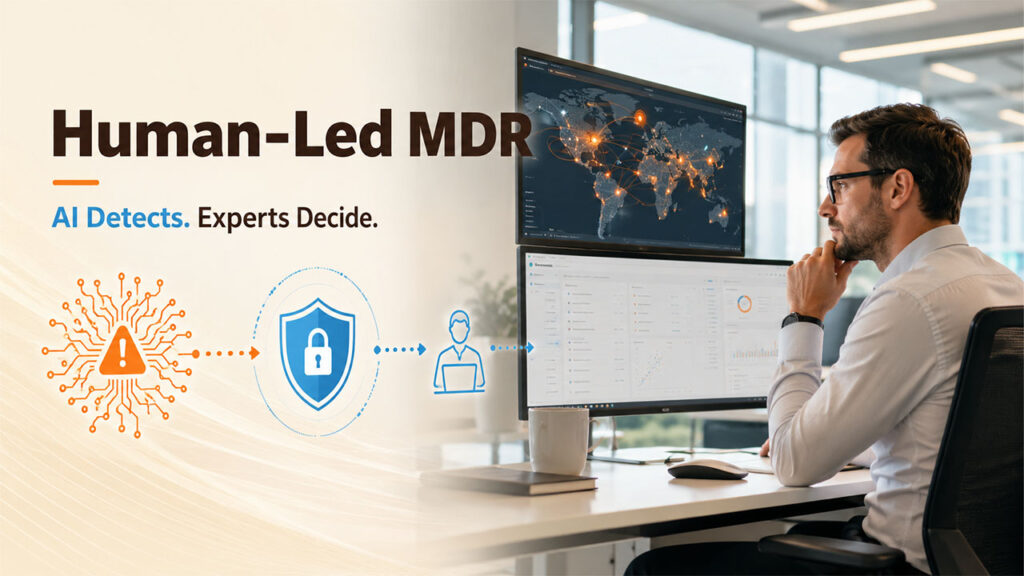
ESET's MDR platform leverages artificial intelligence to analyze massive volumes of security data and identify patterns that humans would miss. The AI engine processes billions of data points daily across ESET's global customer base.
However, AI findings alone are insufficient for effective threat response. ESET's expert human analysts validate AI conclusions, investigate suspicious activities, and make judgment calls about incident severity and response strategy.
This hybrid approach delivers better results than either technology or human experts could achieve alone. AI prioritizes threats for analyst investigation, enabling faster review of the most critical issues. Human expertise ensures accurate threat classification and appropriate incident response.
ESET's AI implementation includes built-in safeguards such as privacy protection and data anonymization, ensuring that threat intelligence collection does not compromise customer data privacy.
Additional ESET validation and recognition
ESET's recognition across multiple analyst reports comes alongside numerous customer endorsements and third-party validations:
- Named a Market Leader in KuppingerCole Analysts Leadership Compass for MDR 2026
- Named a Strong Performer in Forrester Wave: Managed Detection and Response Services in Europe, Q3 2025
- Named Customers' Choice in Gartner Peer Insights for Endpoint Protection Platforms 2026
- Achieved 100% Protection Rate in AV Comparatives Business Security Test Q4 2025
- Named a Leader in G2 Review Platform Summer 2026
- Trusted by 500,000+ business customers worldwide
- Protects 1 billion+ internet users
- Operates 110+ million sensors globally for threat intelligence
These validations demonstrate that ESET's MDR service delivers consistent results across multiple evaluation frameworks, independent testing methodologies, and real-world customer deployments.
About ESET
ESET is an international cybersecurity organization that offers innovative IT security solutions and services to businesses and consumers. With more than 35 years of experience in security and 13 research and development centers worldwide, ESET employs more than 850 cybersecurity experts who facilitate advanced threat detection and response. The advanced AI-native cloud solutions of the company offer protection to businesses, infrastructures, and individuals from known and unknown threats.
For more information about ESET's managed detection and response services, visit the ESET website.
For additional resources on evaluating MDR platforms and implementing effective threat detection and response strategies, check out articles on cybersecurity best practices.
Frequently Asked Questions
Q1. What is Mean Time to Respond (MTTR) and why does it matter?
MTTR measures how quickly an MDR provider detects a threat and takes action to contain it. ESET's 6-minute MTTR is the fastest in the industry, meaning less time for attackers to move laterally or steal data. Every minute faster response directly reduces incident impact and cost.
Q2. Does ESET MDR work with non-ESET security products?
Yes. ESET MDR collects and analyzes data from third-party security solutions including firewalls, cloud platforms, and identity systems. This multi-source approach provides complete visibility into attacks that often span multiple domains.
Q3. What compliance frameworks does ESET MDR support?
ESET MDR supports 18 different regulatory frameworks including HIPAA, PCI-DSS, NIST, GDPR, SOC 2, NERC-CIP, and others. The platform integrates compliance requirements directly into threat detection and response workflows.
Q4. Can ESET MDR be deployed in on-premises environments?
Yes. Unlike cloud-only MDR vendors, ESET supports cloud, on-premises, and hybrid deployments. This flexibility is critical for organizations with air-gapped networks or strict data residency requirements.
Q5. What makes ESET's threat intelligence unique?
ESET operates 110+ million sensors globally and maintains 13 R&D centers with 850+ cybersecurity researchers. The company is also part of CISA's Joint Cyber Defense Collaborative, providing access to government-level threat intelligence. This combination enables detection of both known and novel threats.
Q6. How does ESET combine AI and human expertise?
ESET's AI analyzes massive data volumes to identify suspicious patterns. Expert human analysts then validate findings, investigate threats, and direct incident response. This hybrid approach delivers better detection and response than either AI or humans alone.
Q7. What is included in the ESET MDR service?
Every ESET MDR seat includes endpoint security, vulnerability and patch management, multi-factor authentication, mobile threat defense, 24/7 threat detection and response, and threat hunting. No additional charges apply for these components.
Q8. How quickly can ESET detect threats?
ESET's 6-minute MTTR includes both threat detection and response initiation. The platform leverages AI-driven analysis of 110+ million sensors globally combined with expert analyst investigation for rapid threat identification and containment.
%201.png)

%201.png)

%201.png)