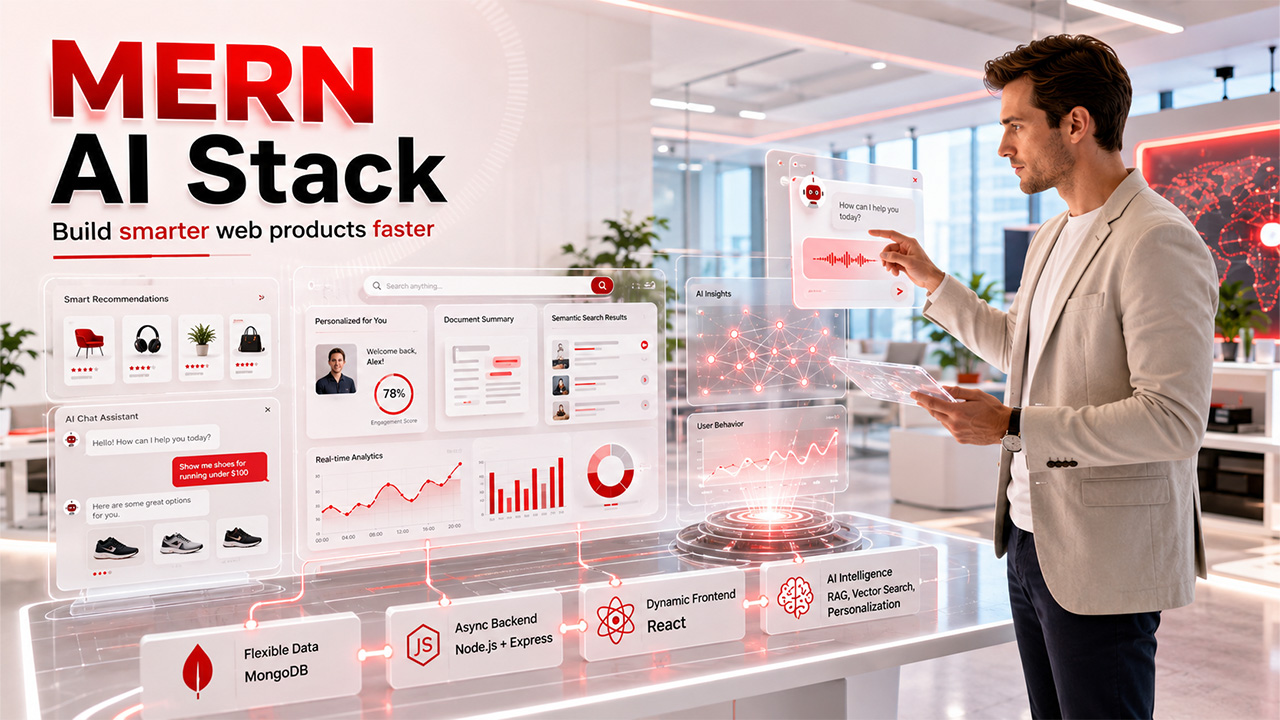

Building AI-powered web products in 2026 is no longer a research exercise. Organizations across every sector are shipping products that generate text, personalize content, retrieve information from large document collections, and make predictions based on user behavior. The engineering challenge is not whether these capabilities can be built, but how to build them in a way that performs reliably, scales with the user base, and can be maintained by a real development team over time.
As organizations move beyond AI experimentation and into production environments, MERN Stack Development for AI Applications has emerged as a preferred approach for building scalable, maintainable, and high-performing AI-powered web products.
The MERN stack, comprising MongoDB, Express.js, React, and Node.js, has emerged as one of the strongest architectural choices for this type of product. Not because it is the newest option available, but because each of its four components addresses a specific requirement that AI-powered web products consistently place on the systems that support them. The fit is not coincidental. It is structural, and understanding why it exists helps engineering teams make better decisions about how to build and staff the products they are trying to ship.
What Makes MERN Particularly Well-Suited for AI Integration
MongoDB's Native Vector Search and Flexible Data Model
MongoDB's document-based data model has always been well-suited to applications that work with varied, unstructured data. In an AI context, this advantage becomes more pronounced. AI applications frequently deal with data that does not fit neatly into fixed schemas: user interaction logs, generated content, model outputs, and metadata that changes as the product develops. MongoDB handles this without requiring schema migrations that slow down iteration.
More significantly, MongoDB Atlas introduced native vector search, which allows developers to store and query vector embeddings directly alongside application data. According to a 2025 IDC survey, more than 74% of organizations plan to use integrated vector databases to store and query vector embeddings within their agentic AI workflows, a figure that explains why MongoDB's decision to build vector search natively into Atlas has made it a preferred choice for teams building AI products on the MERN stack. Vector embeddings are numerical representations of text, images, or other content that AI models use to understand meaning and similarity. Storing them in the same database as the rest of the application data, rather than in a separate specialized vector store, simplifies the architecture considerably and reduces the operational overhead of managing multiple data systems.
One of the key reasons organizations choose MERN Stack Development for AI Applications is MongoDB's ability to store both traditional application data and vector embeddings within a single platform, simplifying AI architecture and maintenance.
Node.js and the Async Architecture AI Demands
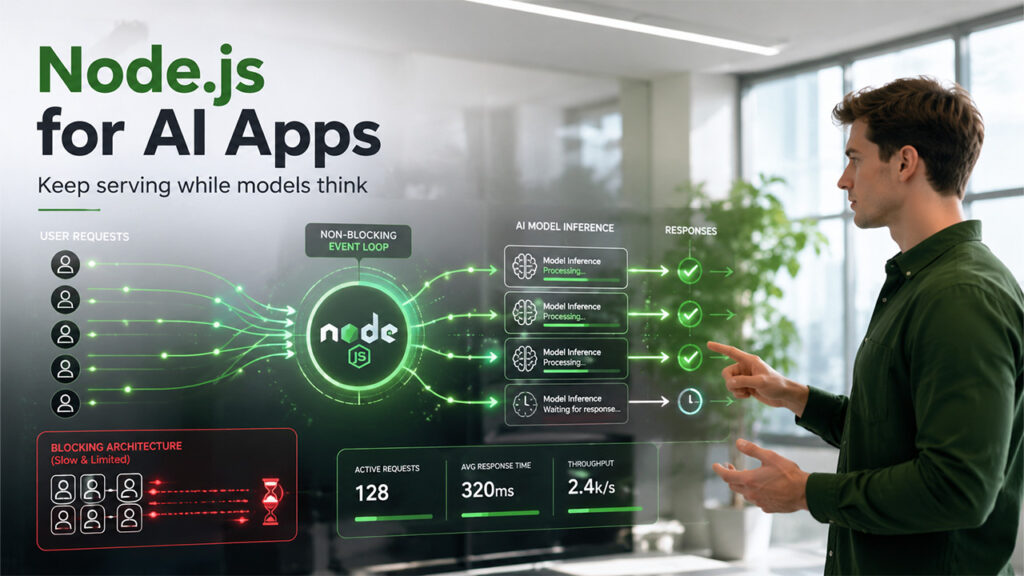
AI inference calls are slower than traditional database queries. When a web application sends a request to a language model or a machine learning API, it may wait several seconds for a response. A server architecture that blocks while waiting for that response cannot handle multiple concurrent users effectively.
Node.js's event-driven, non-blocking architecture handles this pattern naturally. While one request waits for a model inference response, Node.js continues processing other incoming requests. This makes it well-suited to applications where AI calls are frequent, variable in duration, and need to be handled alongside standard web traffic without degrading the overall user experience.
In modern MERN Stack AI Development, Node.js plays a critical role by handling asynchronous AI inference requests efficiently, ensuring applications remain responsive even when interacting with large language models. Developers often rely on advanced JavaScript development tools to optimize performance, streamline debugging, and manage complex AI-driven workflows across the MERN ecosystem.
React's Component Model for AI-Driven Interfaces
AI-powered interfaces have specific frontend requirements. Streaming responses, where generated text appears word by word rather than all at once, require components that update incrementally. Loading states for inference calls need to be managed carefully to avoid interfaces that feel broken while waiting for a model response. Personalized content that differs between users needs to be rendered efficiently without full page reloads.
React's component model handles each of these requirements cleanly. Components can subscribe to streaming data, manage their own loading and error states, and update independently of the rest of the page. React Server Components, now standard in modern MERN applications, allow data fetching to occur on the server before the page reaches the user, which considerably reduces the perceived latency of AI-powered features.
The Most Common AI Features Being Built on MERN in 2026
Retrieval-Augmented Generation and Conversational Interfaces
Retrieval-Augmented Generation, commonly known as RAG, is one of the most widely deployed AI patterns in production web applications in 2026. It combines a language model with a search system that retrieves relevant information from a document collection before generating a response. The result is a conversational interface that can answer questions accurately based on a specific knowledge base, whether that is a product documentation library, a customer support database, or an internal company knowledge store.
MERN is particularly well-suited to RAG implementations because MongoDB's native vector search handles the retrieval layer, Node.js manages the orchestration between the retrieval system and the language model API, and React renders the conversational interface with streaming support. The entire pipeline, from user query to generated response, can be built and maintained within a single JavaScript ecosystem without introducing additional infrastructure.
Other conversational AI features commonly built on MERN include:
- AI-powered search: Semantic search that understands the meaning of a query rather than matching keywords, returning results that are relevant even when the exact words do not appear in the document
- Document summarisation: Interfaces that allow users to upload documents and receive concise summaries generated by a language model
- Guided workflows: Conversational interfaces that walk users through complex processes, such as onboarding flows or configuration wizards, using natural language rather than traditional form-based UI
What these features share is a dependence on the same architectural characteristics that MERN provides natively: flexible data storage, asynchronous processing, and a component model that handles dynamic, streaming content without additional tooling.
Real-Time Personalization and Predictive Features
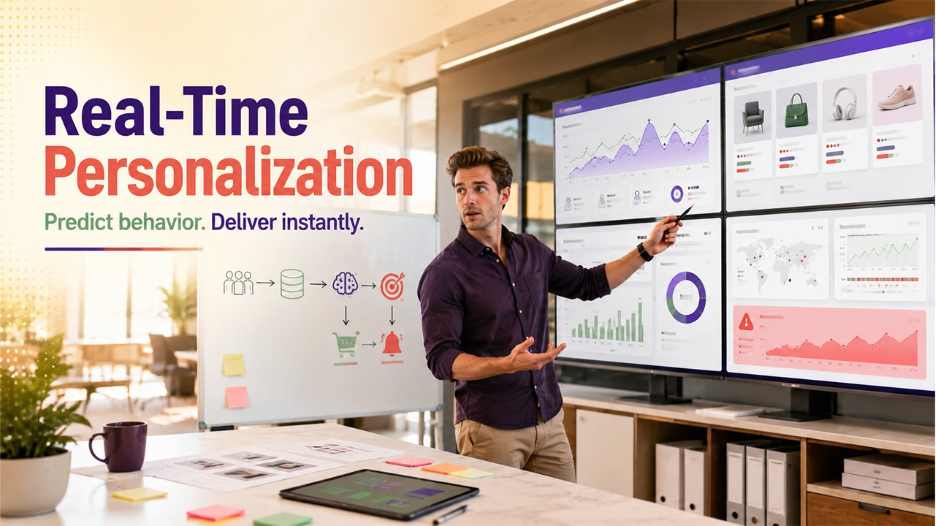
Personalization at scale requires the ability to process user behavior data, run it through a model, and return personalized content or recommendations in real time. Node.js handles the data processing and model API calls asynchronously. MongoDB stores the user behavior data and model outputs in a flexible schema that accommodates new signal types without requiring schema changes. React updates the interface dynamically as personalization data arrives.
Common real-time AI features built on MERN in production environments include:
- Product and content recommendations that update based on session behavior rather than only historical data
- Predictive search suggestions that anticipate what a user is looking for based on partial input and browsing history
- Dynamic pricing and availability displays that incorporate demand signals and inventory data processed through a prediction model.
- Anomaly detection alerts that notify users in real time when behavior or metrics fall outside expected patterns
Across all these features, the pattern is consistent: MERN's architecture reduces the number of integration points between the AI layer and the product layer, thereby reducing the surface area for failures and the engineering effort required to maintain them.
The Engineering Decisions That Determine Whether AI Features Work in Production
The difference between an AI feature that works in a demo and one that works in production almost always comes down to data architecture. AI models are only as reliable as the data they receive, and the pipeline that prepares, routes, and delivers that data is an engineering problem that sits entirely outside the model itself.
In a MERN application, the data architecture decisions that most directly affect AI feature performance include:
- Schema design: MongoDB's flexible document model allows teams to iterate quickly, but AI pipelines benefit from consistent, well-structured input data. Defining clear schemas for the data that feeds AI features, even in a schema-flexible database, reduces the volume of preprocessing required at inference tim.e
- Embedding storage and indexing: Vector embeddings need to be stored efficiently and indexed correctly for MongoDB's vector search to return results within acceptable latency thresholds. Poorly configured indexes produce slow queries that make RAG-based features feel broken, regardless of the model's output quali.ty
- Data freshness: Personalization and recommendation features depend on user behavior data that reflects recent activity. The pipeline that processes and stores this data needs to run frequently enough that the model's inputs remain current, without placing excessive load on the database
AI inference calls introduce a category of latency that traditional web applications do not have to manage. A database query typically resolves in milliseconds. A call to a large language model may take two to ten seconds, depending on the complexity of the request and the size of the response. Building a MERN application that handles this latency gracefully requires deliberate engineering at every layer of the stack.
On the Node.js backend, this means designing endpoints that handle AI calls asynchronously and return responses via streaming rather than waiting for the full output before sending anything to the client. On the React frontend, this means building components that render partial responses as they arrive and display progress indicators that reflect the actual state of the inference call, rather than a generic loading spinner. On the MongoDB layer, this means caching frequently requested embeddings and query results to avoid redundant inference calls that add latency without improving output quality.
Teams that address these latency characteristics deliberately, during the architecture phase rather than as a post-launch optimization exercise, consistently deliver AI features that feel fast and reliable to users. Teams that treat latency as a secondary concern consistently find it to be their primary production problem.
What the Role of a Full Stack Software Engineer Looks Like When AI Is Part of the Stack
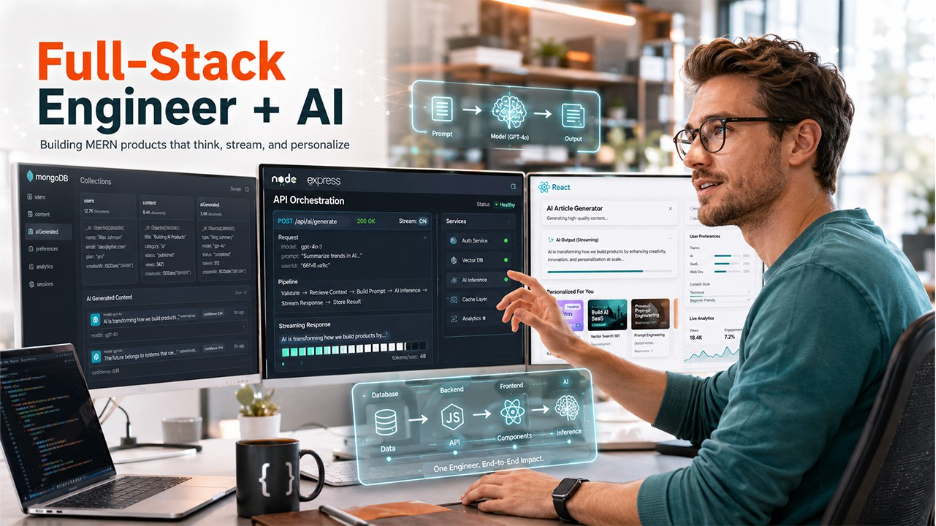
The role of a full stack software engineer on a MERN product has changed considerably as AI features have become a standard expectation rather than a differentiating addition. Engineers who previously focused on building data models, API endpoints, and React interfaces now also need to understand how AI models consume data, how inference calls fit into a request lifecycle, and how to build interfaces that handle the non-deterministic outputs that AI systems produce.
In practice, a full-stack software engineer on an AI-powered MERN product is responsible for work spanning several layers simultaneously. They design the MongoDB schemas that store both application data and AI-generated content. They build the Node.js endpoints that orchestrate calls to external model APIs, handle streaming responses, and manage errors when model outputs fall outside expected parameters. They implement the React components that render AI-generated content progressively, manage loading states for inference calls, and update dynamically as personalization data arrives.
This breadth of responsibility makes the full-stack profile particularly valuable for MERN AI products. A team that separates these concerns too rigidly among multiple specialists introduces coordination overhead precisely where the AI pipeline and the product layer need to be most tightly integrated. The full-stack engineer who understands both sides of that boundary is the one who prevents the integration problems that cause AI features to underperform in production.
The Skills Full Stack MERN Engineers Need in 2026 for AI Product Development
The skill expectations for full-stack MERN engineers working on AI products have expanded beyond the core JavaScript and database fundamentals. The additional capabilities that matter most in a production AI context include:
- LLM API integration: Experience working with OpenAI, Anthropic, or open-source model APIs, including prompt construction, response parsing, error handling, and cost management
- Vector search implementation: Practical knowledge of how to store, index, and query vector embeddings in MongoDB Atlas for RAG and semantic search features
- Streaming response handling: Ability to implement server-sent events or WebSocket connections that deliver AI-generated content to the React frontend progressively
- TypeScript proficiency: TypeScript has become the default across modern MERN applications, and AI pipelines in particular benefit from strict typing that catches integration errors before they reach production
- Observability and monitoring: Understanding of how to instrument AI features to track latency, error rates, and model output quality in production, using tools such as OpenTelemetry or Datadog
Engineers who bring this combination of core MERN depth and AI-specific capability are among the most productive profiles on a modern web product team, and also among the most difficult to find through standard hiring channels.
Building and Staffing a MERN Team for AI Product Development
Companies seeking success with MERN Stack Development for AI Applications should prioritize engineers with experience in AI API integrations, vector search implementation, and production-scale web architectures.
Building a MERN team for an AI-powered product requires a more specific hiring brief than a standard full-stack web development engagement. The engineers need depth in JavaScript and TypeScript across the full stack, familiarity with MongoDB's vector search capabilities, and practical experience integrating with AI model APIs in production environments. That combination is narrower than the general MERN developer pool, and it is worth being precise about when sourcing candidates.
The core of a well-functioning MERN AI product team typically looks like this:
| Role | Responsibility | Why It Matters for AI Products |
| Senior MERN Engineer | Architectural ownership, technical decisions, code review | Sets the patterns that determine how AI features are integrated and maintained |
| Mid-Level MERN Engineers (x1-2) | Feature delivery across the full stack | Handle the volume of development work that AI-powered products generate |
| AI Pipeline Specialist | LLM API integration, vector search, inference optimization | Ensures AI features perform reliably under production conditions |
| React Specialist | Frontend architecture, streaming UI, component performance | Addresses frontend complexity in products with demanding AI-driven interfaces |
| MongoDB Specialist | Schema design, indexing, query optimization | Prevents data architecture problems that surface only under production load |
Not every team needs all five profiles simultaneously. Early-stage products with a smaller scope can operate effectively with a senior engineer and one or two mid-level engineers who share AI pipeline responsibilities. As the product grows and AI features multiply, the case for dedicated specialization in each area strengthens.
When organizations hire MERN developers for AI product work through specialist staffing channels rather than general job boards, they access a candidate pool filtered to match the specific skill set the role requires. Pre-vetted engineers with production experience in both MERN and AI integration start contributing meaningfully within weeks rather than spending months building context from scratch.
Dedicated engagement models work particularly well for this type of team. AI products require continuous iteration as models are updated, new features are added, and production data reveals edge cases that were not anticipated during development. Engineers who work exclusively on one product over an extended period develop the contextual knowledge that makes this iteration fast and reliable.
Conclusion
MERN's position as a preferred stack for AI-powered web products in 2026 is not the result of marketing or trend-following. It is the result of a genuine architectural fit between what the stack provides and what AI-powered products consistently require: flexible data storage that handles unstructured and vector data natively, an asynchronous backend that manages the latency characteristics of model inference without degrading under load, and a component model that renders dynamic, streaming AI-generated content cleanly.
The engineering decisions that determine whether AI features succeed in production, data architecture, latency management, and pipeline reliability are all decisions that MERN engineers make within a single, unified JavaScript ecosystem. That coherence reduces the complexity of building and maintaining AI features, and it is one of the primary reasons organizations building serious AI products continue to choose MERN over more fragmented alternatives.
The continued growth of MERN Stack Development for AI Applications reflects its ability to support modern AI workloads while maintaining the simplicity and flexibility required for long-term product development.
What makes the difference in practice is not the stack alone but the quality of the team built around it. Full-stack MERN engineers with genuine AI integration experience, the ability to work across the data, backend, and frontend layers simultaneously, and the discipline to make sound architectural decisions under delivery pressure are the profile that AI-powered web products actually need. Finding and retaining that profile is the challenge that separates organizations that ship AI products successfully from those that accumulate prototypes that never reach production.
%201.png)

%201.png)

%201.png)