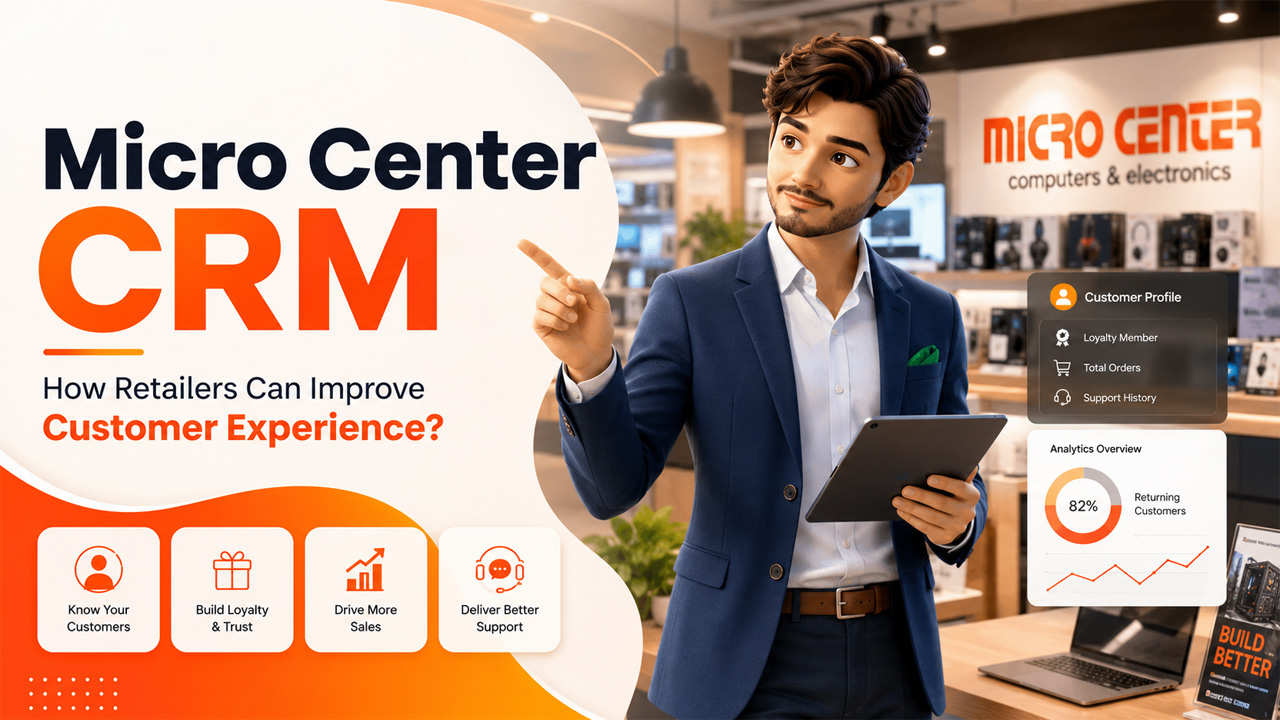

Anyone who has ever visited a Micro Center store or browsed through its website has probably seen something: the buying experience feels personalized, even on a higher scale. At the backend, this consistency relies on platforms that monitor purchase history, preferences, and support services across each touchpoint. That is where the core idea of Micro Center CRM becomes crucial. While Micro Center is not a CRM company itself, the customer experience practices it showcases provide a great case study for retailers who want to establish stronger relationships with shoppers, both in-store and online.
In this blog, let us see what facilitates this experience, how an effectively implemented retail CRM approach supports it, and what other retailers can learn from that model.
What Is a Retail CRM?
A retail CRM (customer relationship management) system refers to software that allows businesses to monitor interactions, organize customer data, and personalize service across marketing, support, and sales. For a bigger retailer, this generally involves:
- Centralized customer profiles with service and purchase history.
- Rewards and loyalty program tracking.
- Customized marketing as per the buying behavior.
- Support ticketing and service or repair scheduling.
- Store-level and inventory data associated with customer preferences.
When such pieces collaborate together, a shopper gets consistent service irrespective of whether they are walking into a store, calling support, or shopping online. This is the kind of connected experiences which is associated with a robust Micro Center CRM approach, even though the core systems are custom-developed instead of being an off-the-shelf product.
Also Read: What is Customer Relationship Management Software?
How Can Retailers Enhance Customer Experience Through CRM Principles?
Retailers looking to emulate this kind of experience do not have to copy the exact system of the company. Instead, they can emphasize the principles that make it functional.
Centralize Customer Data Across Distinct Channels:
Good service has great many impediments, but nothing causes more trouble than fragmented data. When the online browsing history of the customer, in-store purchases, and support tickets go live in systems, staff cannot effectively respond. A centralized customer relationship management approach fixes this by:
- Combining offline and online purchase records.
- Providing support staff greater visibility into previous service requests.
- Enabling sales associates to check preferences and loyalty status immediately.
Personalize Loyalty and Membership Programs:
Membership rewards, pricing, and customized offers work because they are based on actual purchase data instead of generic promotions. Retailers can apply this by segmenting customers as per their spending habits and personalizing communications accordingly, instead of sending the similar and generic offer to each subscriber.
Boost Post-Sale Support:
Retail experience does not stop at checkout. Repair tracking, service scheduling, and proactive support outreach all rely on precise customer records. A well-executed retail CRM ensures that this data remains organized so that support teams can fix issues fast instead of asking customers to repeat their story every time they call.
Leverage Data to Enhance Online and In-Store Consistency
Shoppers expect the similar experience irrespective of the platform from where they are communicating with the customer. CRM-based insights allow retailers to keep inventory visibility, pricing, and promotions consistent between e-commerce platforms and physical store, which minimizes friction and establishes trust.
For an in-depth breakdown of such systems are organized for retail environments, specifically, this detailed guide to Retail CRM encompasses the personalization options and modules retailers often need.
Build vs. Buy: Selecting the Best CRM Approach
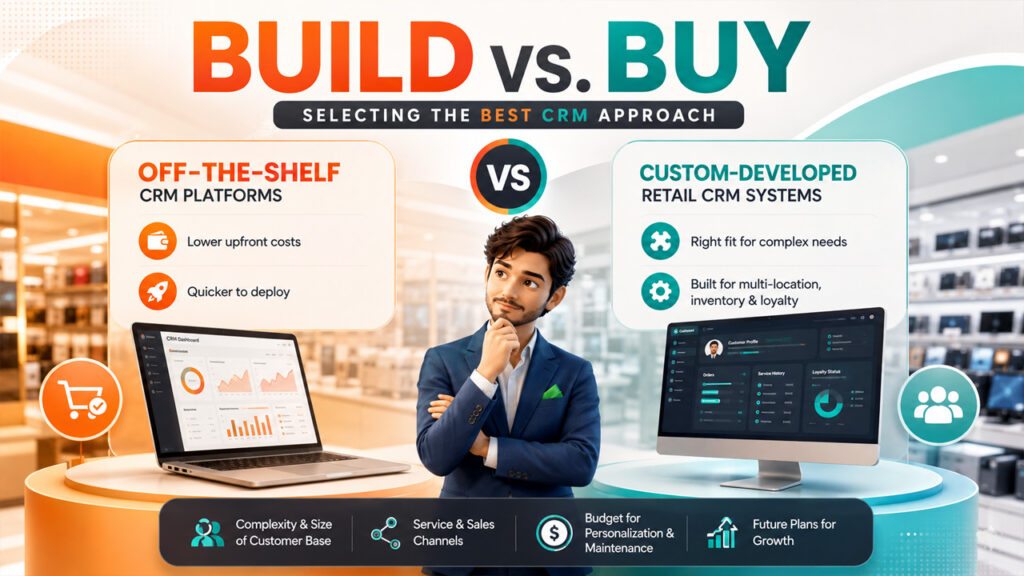
Not each retailer has the resources to create a complete custom system the way a large chain might. Two general paths are available:
- Off-the-shelf CRM platforms — Lower upfront costs, quicker to deploy, suitable for simpler sales cycles.
- Custom-developed Retail CRM Systems — Right fit for multi-location service scheduling or complex inventory, or unique loyalty structures.
Retailers assessing a custom build generally work with specialized partners instead of creating an in-house solution from basics. Comparing options among established Retail Software Development Companies can aid in clarifying which approach aligns with a given timeline and budget, specifically for businesses with numerous locations or complex service processes.
Selecting between such paths often comes down to some factors:
- Complexity and size of the customer base.
- Number of service and sales channels to incorporate.
- Budget for consistent personalization and maintenance.
- Lasting plans for growing your business.
Is Microcenter a CRM?
As the keyword "Micro Center CRM" is trending, you might think Microcenter is a CRM. It is worth fixing this confusion: No, it is not a CRM. It is a retail company, particular an American electronics retailer with online storefront and physical stores. It is not a product of customer relationship software. At present, there is no CRM product which is at least publicly available and marketed with that name for other businesses to license or purchase.
What Micro Center has is an internal system, or a combination of platforms, utilized to handle membership pricing, customer accounts, order history, and service records. This is simple practice for big retailers; its works similar in purchase to a commercial CRM platform. Though, it is not externally sold. So, when people are searching for Micro Center CRM, they are generally looking for one of the two things:
- How Micro Center handles relationships with its own clientele internally.
- General guidance on retail customer relationship management strategy, leveraging Micro Center as a familiar example.
Retailers who are interested in adjusting similar practices need to look at retail CRM platforms as well as development partners directly, instead of searching for Micro Center product that does not exist for external use.
Conclusion
The core idea of a Micro Center CRM indicates something valuable even though Micro Center itself cannot be referred to as a CRM company: the value of consistent and connected data of customers across each touchpoint. Retailers that centralize their customer data, tailor their loyalty programs, and provide responsive support establish a level of trust that encourages shoppers to keep on coming back. Whether this means adjusting an established retail CRM tool or working with a development partner to create a custom solution, the main goal remains the same, using customer data to make sure that each interaction feels human and personal instead of being generic.
Frequently Asked Questions
Does Micro Center sell CRM software to other companies?
No. Micro Center is not a software vendor but a retailer of electronics products. So, it does not build its own CRM product that other companies can buy.
What internal platform can a retailer such as Micro Center utilize?
Large retailers often depend on a combination of loyalty tracking, customer account management, and service scheduling platforms, whether licensed from vendors or created in-house.
Can smaller retailers apply the same principles in customer experience?
Yes. The core practices, like centralized customer data and tailored service, scale down effectively with the right CRM solution or partner with experienced developers in retail-specific specialization.
Is there any product known as "Micro Center CRM" that businesses can purchase?
No. There is no such software product, which is commercially available by that name. The phrase mainly refers to the internal customer management practices of the retailer, not a CRM tool you can purchase.
What retailers have to look for when choosing a retail CRM platform?
Main factors involve loyalty and membership tracking, multi-channel data integration, repair and service scheduling, ease of personalization, and how effectively the platform scales with additional sales channels or store locations.
%201.png)

%201.png)

%201.png)