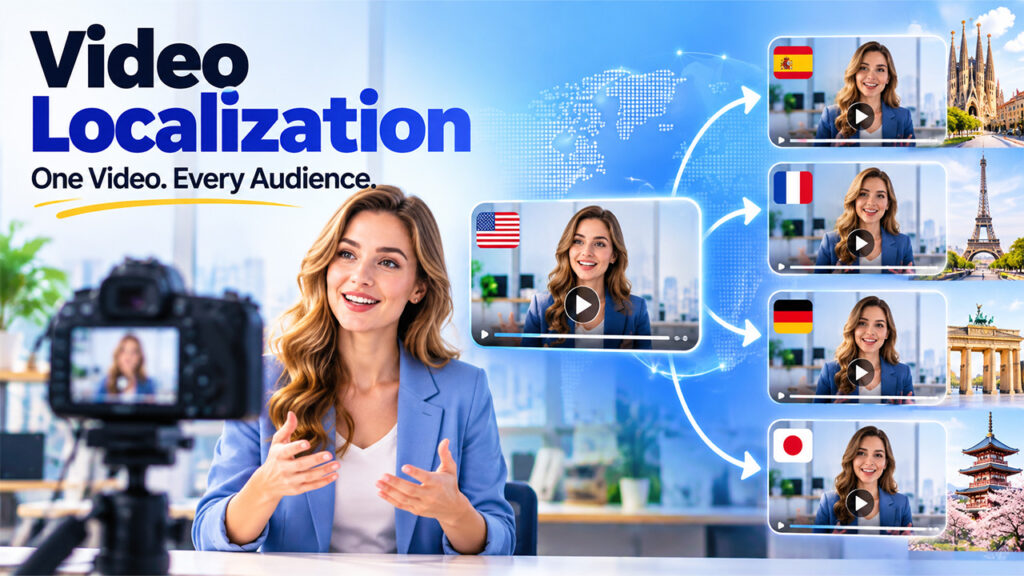

Businesses can have a great product with a strong website and an impressive video library, still none of that can guarantee that the international audience will connect with its message. Language is often considered the most important missing piece.
A product demonstration that generally works perfectly for the English-speaking customer may lose its impact when it is presented to someone who prefers other Spanish, French, German, Japanese, or any other language. Simply adding subtitles helps a little, but it still requires viewers to divide their attention between reading and watching.
This is where video localization becomes increasingly essential. With video localization, businesses can adapt existing videos for multiple languages, while maintaining the original message, presentation, and visual identity, instead of creating a completely different production for every market.
What Is Video Localization?
In simple words, video localization is the process of adapting video content for audiences who can speak different languages or belong to a different market region. Translation is one smaller part of localization, but it is not the whole process. A localized video may involve:
- Translating spoken content
- Adapting terminology for a specific market
- Replacing or translating on-screen text
- Creating localized subtitles
- Dubbing the original voice
- Synchronizing translated speech with the speaker's movements
- Adjusting cultural references where necessary
The main goal of video localization is to make the content feel more natural to the target audience, rather than just converting individual sentences from one language to another.
For businesses, this distinction matters a lot. A literal translation can communicate the basic meaning, while a well-localized video can easily preserve the tone, context, and purpose of the original content.
Why Businesses Are Investing in Multilingual Video

Video has become a central format across the globe for training, marketing, customer education, sales enablement, product demonstrations, and internal communication. The major challenge appears when the same content is needed to serve a global workforce or customer base.
Imagine that a company has created a 10-minute-long product training video in English. If the company operates in six different language market, traditional localization may require separate scripts, voice talent, recording sessions, editing, and quality checks for each version.
That quickly becomes expensive and time-consuming.
AI-powered video translation can simplify much of this process. Modern platforms can translate existing videos into multiple languages while preserving important elements of the original presentation.
For example, Synthesia's video translation feature supports 140+ languages and regional variants, while offering voice preservation and lip-sync capabilities for translated videos.
1. Start With Existing Content
One of the major advantages of video localization is that the business does not always need to start from the beginning. An existing webinar, product demonstration, employee training session, or marketing video can become the source material for additional language versions.
A typical workflow mainly begins by uploading a video or by providing an eligible video URL. The content can then be translated into a selected target language. This is especially useful for businesses that already have a large library of video content.
Instead of producing ten completely separate videos, the original production can become the foundation for multiple localized versions.
Instead of producing ten completely separate videos, the original production can become the foundation for multiple localized versions.
2. Preserve the Speaker's Voice and Presentation
A translated voiceover can sometimes make a video feel disconnected from the original speaker.
Modern AI dubbing technology is designed to reduce that problem by preserving characteristics of the original voice.
Synthesia states that its translation system can maintain elements such as tone, emotion, pacing, and speaking style across languages. It can also handle multiple speakers and automatically preserve their individual voices.
This can be particularly valuable for:
- Executive communications
- Training presentations
- Product demonstrations
- Educational content
- Customer-facing videos
- Sales presentations
The objective is not simply to change the language. It is to maintain the personality and continuity of the original content.
3. Make Lip-Sync Part of the Localization Process
AI video translators can help address another challenge in voice translation: the translated speech may not naturally match the speaker's mouth movements. If the audio and visuals appear noticeably out of sync, viewers can become distracted from the message.
AI-powered lip-synchronization technology attempts to address this specific issue by aligning the mouth movement of the speaker with the translated audio. Synthesia's current feature page describes lip-sync support across translated versions and offers options for keeping the original video duration or allowing the timing to adjust for the translated speech.
This can make localized videos feel more cohesive, especially when the speaker is visible throughout the presentation.
4. Review the Translation Before Publishing
Automation can reduce production work, but it should not eliminate human review.
Names, technical terminology, industry-specific phrases, product names, and regional expressions can sometimes require adjustments.
A good localization workflow therefore includes a review stage before publication.
For example, a software company might need to ensure that:
- Product names remain unchanged
- Industry terminology is translated consistently
- Brand language follows company guidelines
- Technical instructions remain accurate
- Local expressions sound natural
- The intended tone is preserved
Synthesia provides an editor for reviewing and modifying translated transcripts, correcting terminology, adapting phrasing, and regenerating the translation when changes are required.
Human review remains especially important for regulated industries or technical content where small wording differences can change the meaning of an instruction.
5. Choose the Right Localization Method
Not every video requires the same treatment.
Businesses should choose their localization approach according to the content, audience, and purpose.
| Content Type | Suitable Localization Approach |
| Short social videos | Dubbing + subtitles |
| Product demonstrations | Dubbing + lip-sync |
| Employee training | Full voice translation |
| Executive messages | Voice preservation + review |
| Technical tutorials | Translation + terminology review |
| Webinars | Multilingual dubbing + subtitles |
| Customer education | Dubbing + localized terminology |
This prevents companies from overcomplicating simple projects while ensuring that important content receives sufficient quality control.
6. Use Localization for Employee Training
Global companies often face a simple training problem: employees may understand the subject but not be equally comfortable learning in the language used by headquarters.
Translating training videos can make onboarding, compliance education, software training, and professional development more accessible.
This is one area where multilingual video can provide practical value without requiring trainers to record the same lesson repeatedly.
Synthesia specifically identifies employee training, onboarding, compliance training, and skills training as use cases for its translation capabilities.
A single training library can therefore be adapted for different regions while keeping the underlying information consistent.
7. Localize Marketing Without Rebuilding Everything
Marketing teams face a different challenge.
A successful campaign may need to reach audiences across several countries, but recreating every video for every market can slow down campaigns and increase production costs.
Localization makes it possible to adapt existing product videos, tutorials, social content, and demonstrations for different audiences.
The key is to localize more than the spoken words.
Marketers should also consider:
- Local terminology
- Cultural expectations
- Regional examples
- Calls to action
- Pronunciation
- Currency or measurement references
- Local customer concerns
A technically accurate translation is only the starting point. Effective localization connects the content to the audience's context.
A Practical Video Localization Workflow
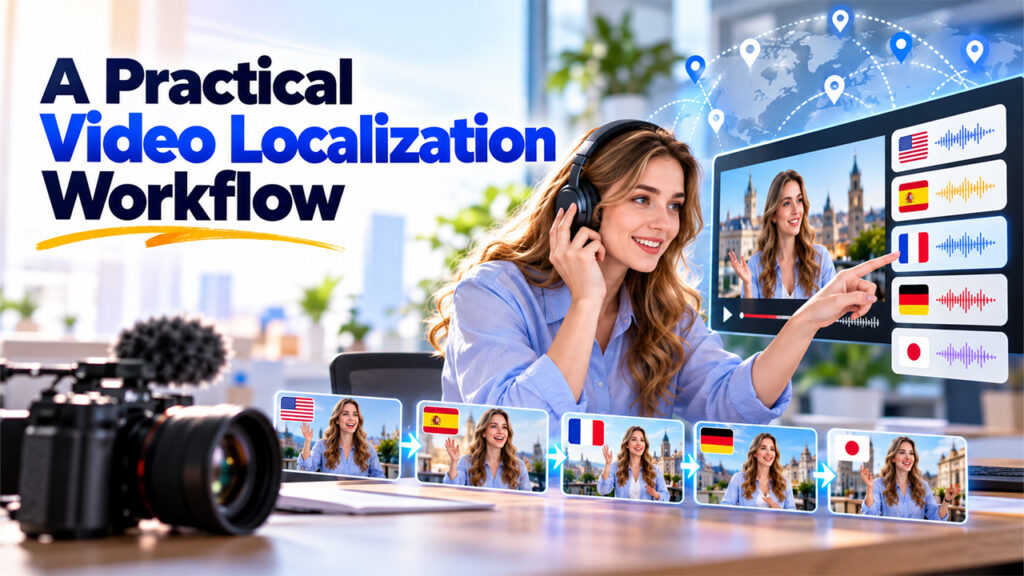
A repeatable process can make multilingual production much easier.
Step 1: Select the source video
Choose content with clear audio, a well-defined message, and appropriate visual quality.
Step 2: Prepare the transcript
Review the original transcript before translation. Correct names, terminology, and technical language at this stage.
Step 3: Select target languages
Prioritize languages based on customer demand, employee locations, website traffic, or expansion plans.
Step 4: Generate the localized versions
Use AI translation and dubbing to create the initial versions.
Step 5: Review each language
Have a fluent reviewer check terminology, tone, pronunciation, and cultural suitability.
Step 6: Check the final video
Watch the localized version from beginning to end. Pay attention to lip-sync, pacing, subtitles, and on-screen text.
Step 7: Publish and measure
Track engagement and viewer behavior across different language versions to identify where further localization may be useful.
Common Mistakes to Avoid
Video localization can fail when businesses treat it as a simple translation exercise.
Some common mistakes include:
- Translating word-for-word: Literal translations may sound unnatural in another language.
- Ignoring regional differences: The same language can have different vocabulary, pronunciation, and cultural expectations across regions.
- Skipping human review: AI can accelerate production, but specialized terminology and brand language still deserve attention.
- Forgetting on-screen text: Translating the narration while leaving important graphics or captions in the original language creates an incomplete experience.
- Producing too many versions without a strategy: Businesses should prioritize languages that have a clear audience or business purpose rather than translating everything automatically.
Conclusion
Global audiences do not need completely different content necessarily. They might need content that feels understandable, natural, and relevant to them. Video localization allows businesses to extend the value of their existing video libraries without treating every single market as an entirely separate production project.
With the right workflow, companies can easily translate training material, product demonstrations, internal communications, and customer education content while maintaining consistency across different languages. The technology can easily handle various repetitive production work, but a successful video localization depends on thoughtful language choices, appropriate cultural adaption, and quality review.
For businesses building a global content strategy, multilingual video is also becoming less about producing more content, and more about making existing content work for more people.
Frequently Asked Questions
Q1. What is video localization?
Video localization is the process of adapting video content for audiences in different languages or regions. It can include translation, dubbing, subtitles, voice adaptation, lip-sync, and cultural adjustments.
Q2. Is video translation the same as adding subtitles?
No. Subtitles translate spoken content into written text, while video translation can include dubbed audio and other localization elements. Some AI platforms can combine dubbing with automatically generated subtitles.
Q3. Can existing videos be translated?
Yes. Existing videos can be used as source material for creating localized versions. Depending on the platform, users may upload a video file or provide a supported video URL.
Q4. How many languages should a business support?
There is no universal number. Businesses should prioritize languages based on their customers, employees, geographic expansion, and content performance.
Q5. Should AI-translated videos be reviewed by humans?
For important business content, human review is a sensible quality-control step. Technical terminology, product names, legal language, and regional expressions may require manual correction.
Q6. Can one video be adapted for multiple markets?
Yes. A single source video can serve as the foundation for multiple localized versions. Some platforms allow several target languages to be generated from the same source content.
%201.png)

%201.png)

%201.png)