

Mobile devices drive nearly every business function today. Sales teams close deals from their phones. Field service crews coordinate through tablets. Remote workers rely on hotspots and cellular data to stay connected. But behind all that productivity sits a cost problem most companies don’t track closely enough.
Wireless bills arrive every month with line items for data plans, device financing, roaming charges, and feature add-ons. Without a system to manage it all, the dollars add up fast. Most enterprises treat wireless spend like a fixed utility cost rather than a variable expense they can control. Mobile technologies generated 5.8% of global GDP in 2025, according to GSMA Intelligence, a reminder of just how central mobility has become to the economy.
That’s where wireless expense management comes in. It gives businesses the visibility and tools they need to stop overpaying.
The Real cost of enterprise mobility
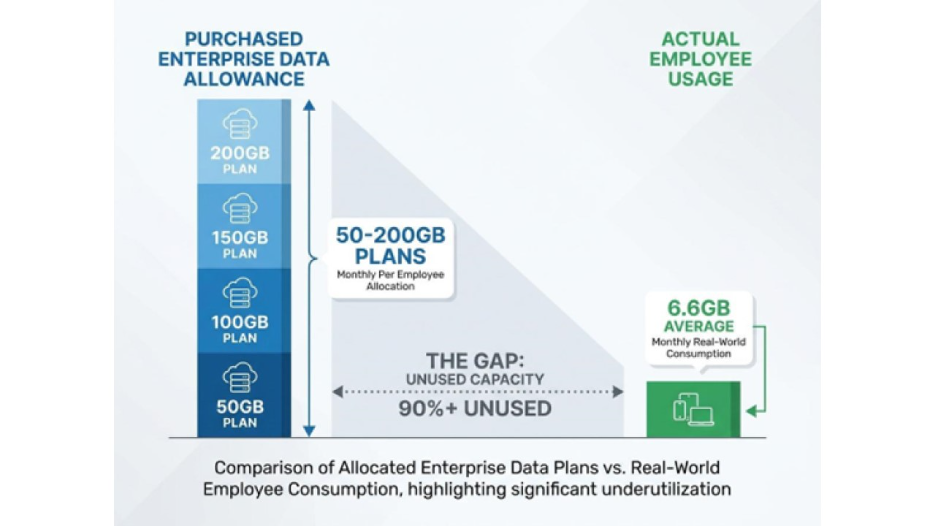
Here’s the ugly truth about most corporate wireless programs. The average employee uses about 6.6 GB of mobile data per month, according to a 2025 Telgea survey of 3,400 U.S. workers. But most enterprise plans offer between 50 and 200 GB per line. That means less than 7% of the data purchased is actually consumed. For a company with 1,000 employees, the unused data alone costs roughly $866,000 per year.
And that’s just the data waste. Inactive lines that nobody remembered to cancel represent another 8 to 12% of total wireless costs. Carrier billing errors add 2-5% to every invoice. Feature add-ons quietly eat $3 to $8 per line each month. Companies without a disciplined management approach overspend by 15-25% annually on their wireless programs.
This is where Digital Direction’s wireless expense management services come into play. For enterprises that want to stop burning cash on unused data and phantom charges, professional oversight turns a leaky cost center into a controlled asset.
What wireless expense management actually covers
Wireless expense management, or WEM, is the practice of tracking, auditing, and optimizing all costs tied to mobile devices and cellular service. It covers device inventories, data plan usage, voice and SMS charges, roaming fees, and the full device lifecycle from procurement to retirement.
The core functions are straightforward. Inventory management keeps a live record of every active line and device. Usage monitoring compares what you’re paying for against what your people actually consume. Invoice auditing catches carrier mistakes such as duplicate charges, incorrect rates, and credits that never got applied. Optimization then right-sizes plans, eliminates unused lines, and strips out feature bloat.
WEM is a subset of the broader Telecom Expense Management, but it deserves its own focus because mobile costs are growing faster than any other telecom spend category. The GSMA Mobile Economy 2025 report notes that mobile technologies generated $6.5 trillion in economic value in 2024, with projections reaching $11 trillion by 2030. As mobility becomes more central to business operations, the cost of getting it wrong keeps rising.
Why does it make business sense
WEM isn’t just about cutting costs, although the savings are hard to ignore. Tangoe, a major player in the telecom expense management space, reports that it helped clients save over $245 million on mobile and telecom expenses in 2024 alone. The Tangoe 2024 Year in Review confirms that organizations with structured expense management programs consistently outperform those handling wireless billing manually.
Beyond the direct savings, WEM strengthens security. When companies don’t track their device fleets, they lose visibility into which devices are active and who’s using them. Telecom fraud losses hit $41.82 billion globally in 2025, according to the Communications Fraud Control Association. A good WEM program detects fraudulent charges and flags suspicious activity before they become bigger problems.
Three trends reshaping wireless cost control in 2026

The wireless expense management space is changing fast. Three trends in particular are reshaping how enterprises think about mobile costs this year.
The first is AI-driven automation. Traditional invoice auditing required finance teams to manually comb through hundreds of line items per carrier bill. AI tools now handle this work in real time, flagging anomalies and validating charges before invoices get paid. The FinOps Foundation’s 2025 State of FinOps report found that 63% of companies now actively manage AI-related spending, up from 31% the year before.
The second trend is the convergence of WEM with cloud FinOps. Telecom expense management and cloud cost management used to operate in separate silos. That’s changing. Organizations are starting to treat all technology expenses, such as wireless, cloud, and SaaS, under a unified Technology Expense Management framework. The same FinOps Foundation report highlights this shift.
The third trend is the explosion of mobile data itself. Global mobile data traffic grew 19% year over year from Q1 2024 to Q1 2025, reaching 172 exabytes per month (Ericsson Mobility Report, June 2025). More data means more complex billing, more plans to manage, and more reasons to automate.
As connected devices multiply across the enterprise, the line between managing wireless and understanding IoT and connected device trends keeps getting blurrier.
How to start managing wireless costs
Getting control of wireless spend doesn’t require a massive initiative. It starts with five practical steps.
First, conduct a full inventory. Document every device, line, and plan the company pays for. You can’t manage what you don’t track. Second, analyze actual usage data against plan allowances. Most organizations find massive over-provisioning in the first month alone. Third, eliminate waste: cancel inactive lines, right-size overstuffed plans, and strip out features nobody uses.
Fourth, set up ongoing monitoring. Automated invoice validation catches billing errors while they’re still fresh. Usage alerts keep plan creep from sneaking back in. And fifth, consider partnering with a managed WEM provider who can handle carrier negotiations and keep plans optimized as the company grows.
Wireless cost management works best when it’s connected to the broader operational picture. Just as CRM supports business growth by streamlining customer processes, WEM streamlines the technology costs that underpin modern work. Companies that approach both as strategic functions rather than fixed overhead gain a clear advantage.
A strong WEM program today means one less operational headache tomorrow.
Conclusion
Wireless costs are rising faster than most enterprises can manage on their own. The data is clear: most companies overpay by 15 to 25% annually simply because they lack visibility into their mobile spend. This is where expense management software plays a critical role by providing greater visibility, automating cost controls, and helping organizations optimize wireless spending. In 2026, with mobile traffic soaring and AI transforming every category of business technology, treating wireless expense management as a strategic function rather than a fixed cost makes more sense than ever.
The question isn’t whether your company should take wireless costs seriously. It’s how soon you start.
%201.png)

%201.png)

%201.png)