


Every day, you navigate the dynamic and ever-evolving world of marketing. You are used to hunting leads and conversions, but when it is time for a different type of hunt—a job hunt—how can you present your achievements in a way that resonates with your audience? How can you quantify them?
Previous campaign successes can set you apart in a competitive job market. The following guide will provide you with actionable insights so you can showcase your accomplishments.
Quantify With Impactful Metrics
Short, sweet, and to the point—no, we’re not talking about ad copy, at least not in the usual sense. We’re talking about your resume, which is essentially how you’ll advertise yourself.
What is the best resume format for you? Focusing on metrics is a great way to highlight your successful campaigns. For that, you’ll most likely want to use the most common resume format—the reverse-chronological resume. Start with your most recent work experience and work your way back.
Your metrics will live in your job task descriptions, so be sure to highlight your work experience near the top. Specific metrics could include:
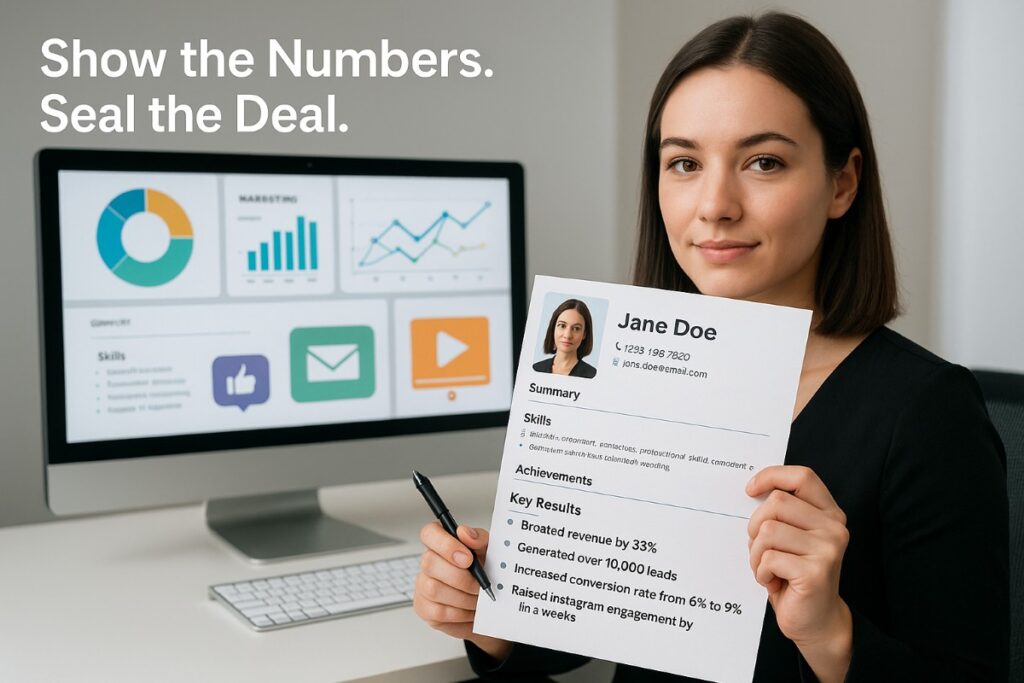
- Revenue growth, highlighting how a specific campaign directly increased sales volume or profits. For example, you could say, “Created a multi-phase email campaign that boosted revenue by 33 percent.”
- Lead generation, including the specific number of leads or improvement to conversion rates. For example, you could say, “Launched a targeted ad campaign that generated 10,000 leads,” or “…that increased conversion rates from 6 to 9 percent.”
- Audience engagement, including website traffic, social media interactions, or click-through rates. For example, you could say, “Increased Instagram engagement by 3 percent in four weeks.”
What, though, if your most outstanding metrics didn’t happen at your most recent job? You might then turn to a functional resume. Instead of listing your experiences by date, put the most relevant at the top.
Blow them Away With Household Names
If you’ve worked as a freelancer or as part of an agency, you may have had contact with big, recognizable brands. Don’t be afraid to trumpet those names on your resume. Forbes refers to this as the “competition filter.” Essentially, a potential employer may reason, “If you’re good enough for [insert Brand Name here] then you’re good enough for us.”
Even if you haven’t worked for big-name companies directly, you may be able to do some name-dropping. Has one of your ads been published in a well-known magazine or website? What about an industry blog or trade journal?
Other types of publications and presentations can also pass this “filter.” For example, you may have written for industry blogs or spoken at a conference.
In addition to memorable companies, don’t forget to mention memorable ad campaigns. Think about it—if you were around in the 1990s, you probably still remember the Budweiser frogs. If you were around in the 1970s, you probably still associate Mikey with Life cereal.
If an application from one of the creators of these campaigns were to come across your desk, you would no doubt want them on your team. So name-drop memorable ads, even if your role on the project was small.
Showcase a Wide Variety of Skills
In large companies, marketers may need to collaborate with a host of other departments, such as sales, design, and product teams. At small companies, your role may even be enlarged to include these types of duties.
Providing evidence of effective cross-functional collaboration on your resume can bolster your desirability as an employee. If you coordinated with other teams to achieve your metrics as discussed above, say so! Showcase your accomplishments and technical expertise with curated packages, which help present your experience in a refined format designed to get you noticed by employers.
You can also highlight your technical proficiency. What tools have you used to plan, execute, and analyze the results of your campaigns? Mention programs and platforms such as Adobe Creative Suite, HubSpot, Google Analytics, Microsoft Excel, or Hootsuite, especially if these are noted in the job description. Even if you have not yet used the software required for your new job, citing those you’ve previously mastered will show you have computer proficiency and the capacity to learn.
Make It Look Great
Marketing is largely a visual field, whether your work appears in print, on television, or online. You no doubt have cultivated a deep understanding of color theory, scale, hierarchy, unity, proportion, rhythm, proximity, contrast, and other principles of design. Put them to use when designing your resume.
Let’s face it—if your job involves design, a cluttered or visually distracting resume will scream “ unqualified,” no matter what’s written on it. Likewise, a visually appealing document that guides they eye to the most important facts will say, “Hire me.”
Key Takeaways
There’s nothing more exciting than a successful campaign. You can keep that momentum going when you share statistics and big-name brands in your resume role descriptions. Highlight your collaboration and marketing skills. Use your marketing skills to “sell” yourself by creating a resume that looks good and showcases your greatest hits!