

The ROI on healthcare AI typically reaches $3.20 per dollar invested, with a 14-month payback period (when implementation goes right). When it doesn't, you're looking at wasted budget, regulatory exposure, and disrupted workflows.
Whether your AI initiative pays off or becomes a liability comes down to one decision: who you choose to build it. The range of AI applications in healthcare is broad: predictive analytics for readmission risk, NLP for clinical documentation, computer vision for medical imaging, and connected devices that monitor patients between visits, each requiring a different kind of expertise from your vendor.
This article is created to quickly guide you toward the best AI development companies for healthcare in the USA and explain what will happen once you’ve chosen a partner.
Essential Expertise to Look for in Healthcare AI Vendors
Not every software company that mentions AI on its website can deliver in a regulated clinical environment. Here is what actually matters.
Technical Capabilities that Match Your Use Case
A vendor should have direct, documented experience in the discipline required for your project.
For example, if you want to extract insights from physician notes or automate coding, ask specifically about NLP in healthcare settings. Also, you can always ask for case studies with measurable outcomes, such as accuracy rates, hours saved, and error reduction.
Regulatory Compliance
Any vendor that handles protected health information must comply with HIPAA. What separates vendors is the depth and verification of that compliance:
- FDA-compliant vendors with prior 510(k) experience understand validation documentation, clinical evidence requirements, and the timeline that process demands.
- ISO 27001 means a vendor's information security practices have been independently audited.
- SOC 2 Type 2 goes further, confirming that security controls are maintained over a sustained period.
- GDPR matters if your organization handles data from EU patients.
Proven Outcomes

Dig into their case studies: What was the measurable result? What was the timeline from kickoff to go-live? Did the client continue using the system after launch?
Industry recognition matters when it is earned through verified client reviews. Platforms like Clutch aggregate audited feedback and reflect long-term client satisfaction more accurately than vendor-written success stories.
The List of Best AI Development Companies for Healthcare in the USA
The companies below were selected based on the factors that matter most when choosing a healthcare AI partner: compliance certifications, delivery track record, and measurable client outcomes.
| Company | Founded | Rating | Hourly rate | compliance & certs | Key specialty | Highlighted projects |
| Relevant Software | 2013 | 4.9/5 | $50–$99 | HIPAA, GDPR, ISO 27001 | End-to-end healthcare software; senior-heavy team; AI for telemedicine, predictive analytics, digital twins | AI medical affairs analytics (25% efficiency, 20 hrs/week saved); Return2Play injury and concussion platform; 3D scan app (hours → <5 minutes) |
| Qubika | 2007 | 4.9/5 | $50–$99 | ISO 27001, SOC 2 Type 2, HIPAA, NIST AI RMF, FDA | AI-focused development; wearables and BLE devices; scalable AI backends | Dual blood pressure & arterial health monitor; Catapult Health telehealth redesign with automated reporting |
| HatchWorks AI | 2016 | 4.9/5 | $50–$99 | SOC 2 Type 1, HIPAA | Dedicated AI studio; generative and agentic AI; care management and predictive models | Specialty pharmacy patient management (99% onboarding); AI video platform for physicians with avatars |
| NineTwoThree AI Studio | 2013 | 4.9/5 | $100–$149 | HIPAA, FDA 510(k) | Regulated healthcare AI; clinical decision support; intelligent automation | Clairity FDA-authorized early cancer detection app; offline treatment protocol app for hospital staff |
| Lucid Reality Labs | 2016 | 5.0/5 | $100–$149 | HIPAA, GDPR, ISO 27001 | AI-powered XR for medical training and simulation | XR platform for airway procedure training; XR simulation for macular disease awareness |
1. Relevant Software

Headquarters: US operations and offices in Poland and Spain
Founded: 2013
Clutch rating: 4.9 / 5
Hourly rate: $50 – $99
Regulatory capability: HIPAA compliant, GDPR, ISO 27001; provides HIPAA compliance consulting and secure PHI handling.
Prominent Cases
- Built an AI-powered CRM analytics platform for AstraZeneca's Medical Affairs teams using ChatGPT and Llama-2, processing 35,000+ clinical records automatically and delivering a 25% increase in MSL efficiency, 40% faster medical content preparation, and 20 hours saved per week on manual data processing
- Developed an AI-powered system for medical affairs analytics, leading to 25% increase in efficiency and 20 hours of savings per week on manual CRM data processing;
- Revamped Return2Play medical care platform with scalable features for injury tracking, SOCS reporting, and concussion assessments;
- Built an app automating 3D scans and order forms, cutting measurement and ordering time from hours to under five minutes.
Competitive Advantage
Relevant Software is recognized as one of the best AI development companies for healthcare in the USA and globally. The company covers the full custom healthcare software lifecycle: consulting, development, ongoing support, and legacy system upgrades, without handing work off to third parties. Over the past 13 years, they have delivered more than 245 projects and maintained a 98% client satisfaction rate across early-stage health companies and global enterprises, including AstraZeneca.
A key strength of Relevant Software is the depth of its engineering team: 92% of its specialists are senior-level. That ratio is rare in the industry, and it shows in outcomes. Complex healthcare telemedicine platforms, predictive analytics solutions, and digital twin applications are executed by teams with the domain expertise to get them right the first time. All development is carried out within a strict HIPAA, GDPR, and ISO 27001 compliance framework, so security and regulatory requirements are built into the architecture.
2. Qubika
Headquarters: Austin, TX
Founded: 2007
Clutch rating: 4.9 / 5
Hourly rate: $50 – $99
Regulatory capability: ISO 27001, SOC 2 Type 2 certified, and also compliant with the NIST AI Risk Management Framework. Qubika has driven the development of FDA-certified products and HIPAA-compliant solutions.
Prominent Cases
- Delivered an award-winning dual blood pressure and arterial health monitor product;
- Redesigned and developed the core telehealth product for Catapult Health, built internal reporting tools, and implemented automation.
Competitive Advantage
Qubika treats AI development as a core discipline; it represents more than 25% of their services. As a result, healthcare AI initiatives are led by specialists, not generalist teams that occasionally take on projects. That focus shows up in a clear capability mix: user-centric applications, HIPAA-compliant chatbots, wearable integrations, and BLE-connected device software tailored for both clinical and consumer health environments.
Their depth in scalable AI architectures makes Qubika a strong choice for organizations that expect their systems to grow, from an initial single-use-case deployment to a platform that consolidates multiple data streams across devices. Compliance is built into the product from day one.
3. HatchWorks AI

Headquarters: Atlanta, GA
Founded: 2016
Clutch rating: 4.9 / 5
Hourly rate: $50 – $99
Regulatory capability: SOC 2 Type 1 and HIPAA.
Prominent Cases
- Built patient management solution for specialty pharmacy programs, delivering 99% onboarding of new clients;
- Delivered an AI-driven video platform for physicians to deliver medical content using custom digital avatars.
Competitive Advantage
HatchWorks AI holds two verified Clutch distinctions: top software developer for medical in the US and top AI company 2024. This independent recognition places them among a small group of firms validated for both healthcare software delivery and AI capability in the same evaluation cycle. It reflects a practice built around AI as a primary discipline, not a feature bolted onto a general development offering.
The depth of that practice comes from their dedicated AI studio model. Instead of routing healthcare AI projects through a general software team, HatchWorks runs them through a specialized unit focused on generative and agentic AI in regulated environments. In real terms, that translates into care management platforms, predictive modeling systems, and operational efficiency tools built by teams whose default context is clinical compliance and healthcare workflow constraints.
4. NineTwoThree AI Studio
Headquarters: Danvers, MA
Founded: 2013
Clutch rating: 4.9 / 5
Hourly rate: $100 – $149
Regulatory capability: HIPAA, FDA 510(k) experience
Prominent Cases
- Helped Clairity build the world’s first FDA-authorized early cancer detection application;
- Delivered a web app that allowed hospital staff to access treatment protocols offline and navigate clinical decisions one step at a time.
Competitive Advantage
NineTwoThree AI Studio brings 13 years of experience and more than 150 delivered projects to a practice built specifically around regulated healthcare AI. Their work sits at the production end of the spectrum: generative AI, clinical decision support, and intelligent automation designed to meet stringent compliance and validation requirements across diagnostics, research, and care delivery.
Their external recognition reflects consistent delivery. NineTwoThree has been named the number one company in Boston and has appeared on the Inc. 5000 list for five consecutive years.
5. CodingCops
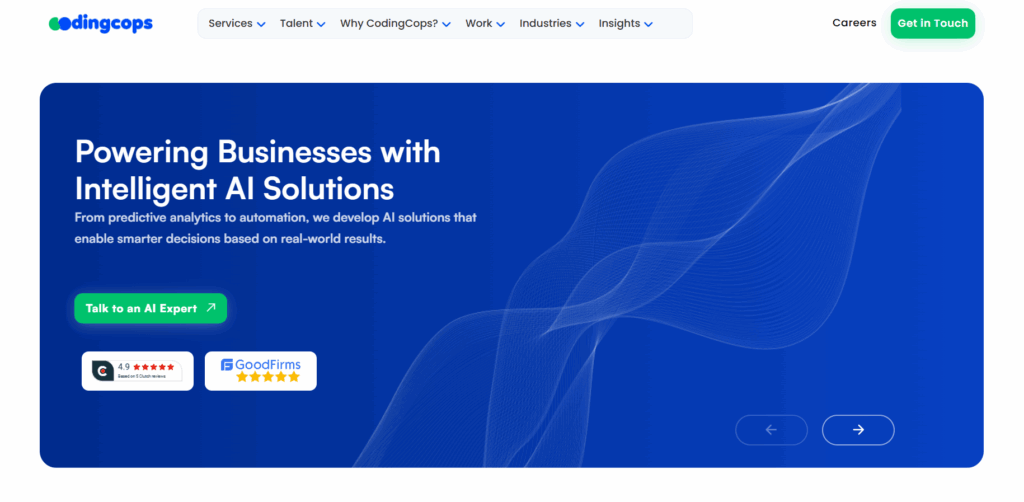
CodingCops delivers AI-powered healthcare software solutions with expertise in telehealth, AI integration, and custom healthcare application development.
Headquarters: Chicago, IL, USA
Founded: 2010
Clutch Rating: 5.0 / 5
Hourly Rate: $25 – $59
Regulatory Capability: Experience developing HIPAA-compliant healthcare applications, including secure patient messaging, telehealth platforms, EHR/EMR integration capabilities, and healthcare software built with security and regulatory best practices.
Prominent Cases
- Developed an AI-powered telehealth platform for VivoSim Labs featuring a patient dashboard, doctor portal, appointment scheduling, HIPAA-compliant messaging, and an AI symptom checker. The platform contributed to a 42% increase in online appointments, a 35% reduction in administrative workload, and significantly reduced patient wait times.
- Built healthcare software solutions including telemedicine systems, patient management applications, EHR/EMR platforms, and healthcare data analytics solutions to help providers improve operational efficiency and patient engagement.
Competitive Advantage
CodingCops is a full-cycle software engineering company with over 16 years of experience building AI-driven applications across healthcare, SaaS, fintech, and enterprise industries. The company combines AI development, cloud infrastructure, custom software engineering, and DevOps to help organizations build scalable digital products from initial architecture through long-term support.
Its healthcare expertise is demonstrated through the successful delivery of AI-enabled telehealth solutions that integrate secure patient communication, appointment management, and intelligent symptom assessment into a single platform. Beyond healthcare, CodingCops maintains dedicated AI development capabilities covering machine learning, generative AI, and enterprise software modernization, enabling clients to build production-ready applications with a single engineering partner.
6. Lucid Reality Labs
Headquarters: Miami, FL
Founded: 2016
Clutch rating: 5 / 5
Hourly rate: $100 – $149
Regulatory capability: HIPAA compliant, GDPR, ISO 27001
Prominent Cases
- Built an AI-powered XR platform for clinician training in complex airway procedures;
- Created an XR ophthalmology simulation that raises awareness of macular disease by showing healthcare professionals its real-life impact on patients.
Competitive Advantage
Lucid Reality Labs stands out through its focus on specialized reality technologies (AR/VR/MR) fused with AI for healthcare use cases such as surgical planning, medical training, therapy, and patient education. Their perfect Clutch score, combined with multiple recognitions (including listings among the top AI/VR development companies and the top companies in Florida), signals consistently strong delivery, a well-balanced blend of creative and technical expertise, and a proven ability to build immersive, AI-enhanced experiences that drive measurable, innovative improvements in clinical outcomes.
What to Do After You've Compared the Vendors
Now the work is to separate vendors who look strong on paper from those who will perform in production.
Evaluate Proposals on Specifics
A good proposal answers: what exactly will be built, what data are required, what integrations are needed, what the acceptance criteria are, and what happens if those criteria are not met. If a proposal is long on methodology and short on those specifics, ask for them before proceeding.
Questions to Ask Every Vendor
- Who will work on our account day to day, and what are their relevant credentials?
- How do you handle requirements that change mid-project?
- What is your process for validating AI outputs before clinical deployment?
- What access will your team have to our patient data, and how is that access controlled?
- Have you ever had a project fail? What happened?
The last question is particularly useful. Vendors who claim zero failures either lack experience or are being dishonest.
Red Flags to Watch For
- Compliance certifications are listed without documentation to back them
- No named team members attached to the proposal
- Timelines that seem artificially short for the stated scope
- Reluctance to provide client references from completed projects
- Pricing based entirely on hourly rates with no fixed deliverables — this transfers all risk to you
Run a Paid Discovery or Trial Project First
Before committing to a full engagement, consider a paid discovery phase: a defined, time-boxed project (typically four to eight weeks) that delivers a working prototype or technical specification. That is the way you can test the vendor's communication, output quality, and ability to meet deadlines under real conditions.
Final Thoughts
Organizations that are getting real, defensible value from AI in healthcare are the ones that choose their partners deliberately and hold them accountable in production.
Technical fit, depth of compliance, security practices, and delivery track record should guide every stage of your process. Use them to build your shortlist, to pressure-test proposals, and to shape the final contract so success is defined and measurable.
The right partner operates in the same regulatory environment you do, takes clear ownership of outcomes, and brings the discipline to deliver on time and on budget. That combination is rarer than any capability listed on a vendor’s website. At the same time, it is what separates a reliable, production-grade system from an expensive lesson.
%201.png)

%201.png)

%201.png)