
How the best SOC 2 compliance software stacks up in 2026, and why a company that needs a SOC 2 Type II report during 2027 should choose its platform before this year ends.
Eight platforms appear below. At one end, Scytale's AI GRC platform pairs AI agents with dedicated GRC experts; at the other, Drata and Vanta hand an in-house owner self-serve automation. These GRC tools offer different approaches to managing compliance, and each platform's details match its website and G2 profile as of late October 2026.
Why the 2027 SOC 2 audit cycle starts now
A SOC 2 Type II report describes a period that has already ended, so the calendar matters more than the software. Four numbers set the pace:
- 6 to 12 months: the usual length of a Type II observation window, the period your auditor tests.
- 33: the security criteria, known as the common criteria, that every SOC 2 report has to cover, according to the CPA firm Schellman.
- January 15, 2027: the comment deadline for the AICPA's proposed 2027 Trust Services Criteria.
- December 31, 2027: the date from which the new criteria would apply to engagements, if the AICPA approves them.
Work backwards from the day a customer expects your report. Controls have to run from the first day of the observation window, so you need to fix the gaps before it opens, and you need the platform that finds them running before that. A team that wants a report in hand by the third quarter of 2027 is choosing its platform and auditor now.
The criteria themselves are about to move as well. Most reports on 2027 periods will use today's criteria, the 2017 version, updated with new points of focus in 2022. Engagements beginning on or after December 31, 2027 would switch to the 2027 criteria if the proposal passes, and the AICPA allows early adoption. A company starting its first Type II in 2027 could face two versions of the criteria in two years, so the platform it picks needs a control library that can map to both.
A work-back calendar for a 2027 Type II report
| Step | Timing for a report by Q3 2027 | Why it falls there |
| Choose the platform and CPA firm | November and December 2026 | Leaves the first quarter free for fixes |
| Fix gaps and run a readiness check | January to March 2027 | Controls must operate from day one of the window |
| Observation window | April to September 2027 | Six months, the short end of the usual range |
| Fieldwork and report | October 2027 onward | Your CPA firm sets the exact timing |
| Criteria used | 2017 criteria (revised 2022), unless you and your auditor adopt the 2027 criteria early | AICPA proposal, October 2026 |
What the proposed 2027 criteria add, and what to ask a platform
| Proposed AI point of focus | Question for each vendor |
| AI governance | Can the platform hold an inventory of our AI systems with owners, policies and approvals? |
| Model monitoring | Can it watch models and agents in production and log changes as evidence? |
| Prompt manipulation | Where would tests and controls against prompt injection live, and how would they be evidenced? |
| Data poisoning and training data management | Can it tie training data sources to controls and keep the records an auditor would sample? |
| Transparency of AI-generated outputs | How would we show customers and auditors when AI produced an output? |
| Automated decision-making | Can it document human review of decisions an AI system makes? |
Scytale's AI Governance module speaks to the first two rows: it builds an inventory of every AI tool and agent in use, scores each one's risk by the data and systems it can touch, and watches agents while they run.
What separates one SOC 2 compliance platform from another
Feature lists in this category look almost identical. Every platform collects evidence through integrations, maps controls, generates policies and gives the auditor a portal. Five things differ:
- Who acts on a failing control. Self-serve platforms alert your team and stop there. Others put a GRC expert on the fix with you.
- How far one control reaches. Cross-framework mapping decides whether a control you build for SOC 2 also counts for ISO 27001 or an AI framework, or whether you rebuild it.
- Where the audit happens. Some platforms coordinate the CPA firm inside the product; others hand you a list of partners.
- How the price grows. Per-framework add-ons can make the second year cost far more than the first.
- Who reviews the AI. AI that drafts evidence saves time when someone qualified checks it before the auditor sees it.
SOC 2 compliance software compared
| Scytale | Sprinto | Secureframe | Scrut Automation | Secfix | Apptega | Drata | Vanta | |
| Who runs the program | Your team with AI GRC agents and a dedicated GRC expert | Your team, guided onboarding | Your team, expert-supported onboarding | Your team with in-house experts | Your team with dedicated experts | You or your managed security provider | Your team | Your team |
| Frameworks | 80+ | 200+ listed | 40+ | 60+ | ISO 27001, SOC 2, NIS2, TISAX, DORA and more | 30+ | Multiple, mapped once | 35+ |
| AI assistant (MCP) access | Read-only | Read, plus writes by role | Read and write | Read, plus evidence filing | Not published | Not published | Read, plus 26 actions | Public preview |
| Pricing model | Tiered plans, custom quote | Framework-based plans, no public prices | Packages, no public prices | Quote | Quote | Quote | Quote | Tiered plans, quote |
| G2 rating (late Oct 2026) | 4.8, 700+ reviews | 4.7, 1,685 | 4.7, 840 | 4.9, 1,338 | 4.8, 116 | 4.7, 157 | 4.7, 1,399 | 4.5, 2,885 |
"Not published" means the vendor's public pages don't describe the feature.
The 8 best SOC 2 compliance software platforms for 2026
1) Scytale
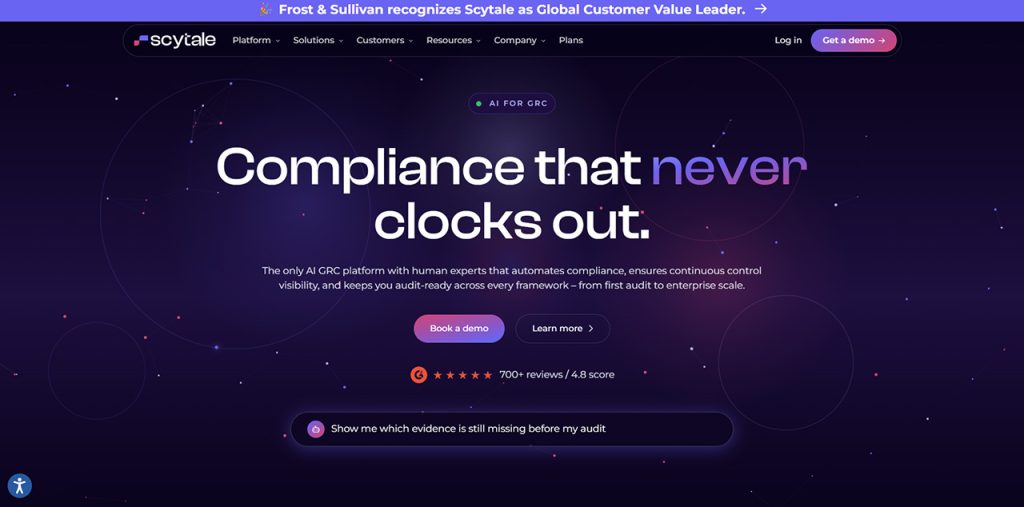
Scytale is an AI GRC platform that combines agentic compliance automation with dedicated expert support, helping businesses of all sizes manage SOC 2 compliance from initial scoping to audit completion. Its AI GRC agents collect and validate evidence from 150+ integrations, flag gaps, suggest fixes and pre-fill security questionnaires, while GRC experts guide the process and review AI outputs. Continuous monitoring detects control issues in real time, keeping teams audit-ready year-round. Cross-mapping across 80+ frameworks reduces duplicate work across SOC 2, ISO 27001, HIPAA and GDPR. A customizable Trust Center showcases your security posture, while streamlined audit management centralizes evidence requests and approvals. Pricing is quote-based, with advanced features available on higher-tier plans. Scytale stands out for combining hands-on expert guidance with scalable agentic compliance, making it ideal for both first-time audits and growing compliance programs.
2) Sprinto
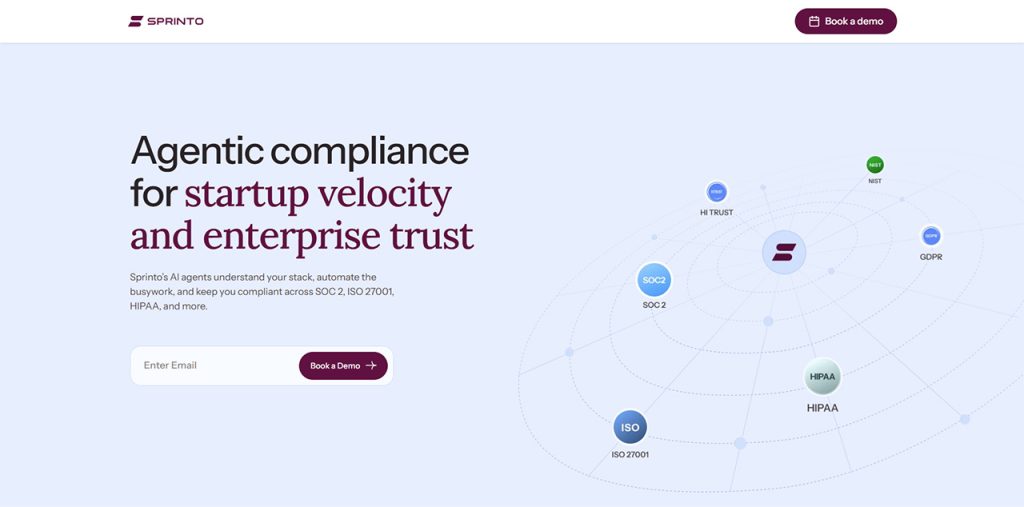
Sprinto sells a fast, automation-led route to a first report for cloud-hosted startups, with continuous checks and onboarding that walks the team through setup. Sprinto builds its plans around the frameworks they include, and additional framework layers such as ISO 27001 or HIPAA come as paid add-ons. Sprinto MCP gives Claude, ChatGPT, Gemini and other assistants access to program data, and editors can make changes through it. G2 reviewers praise ease of use above everything else, while integrations that misbehave with some tools are the main complaint. Sprinto fits a startup whose main goal is a first report on a short timeline, with people in-house to run the program once onboarding ends.
3) Secureframe
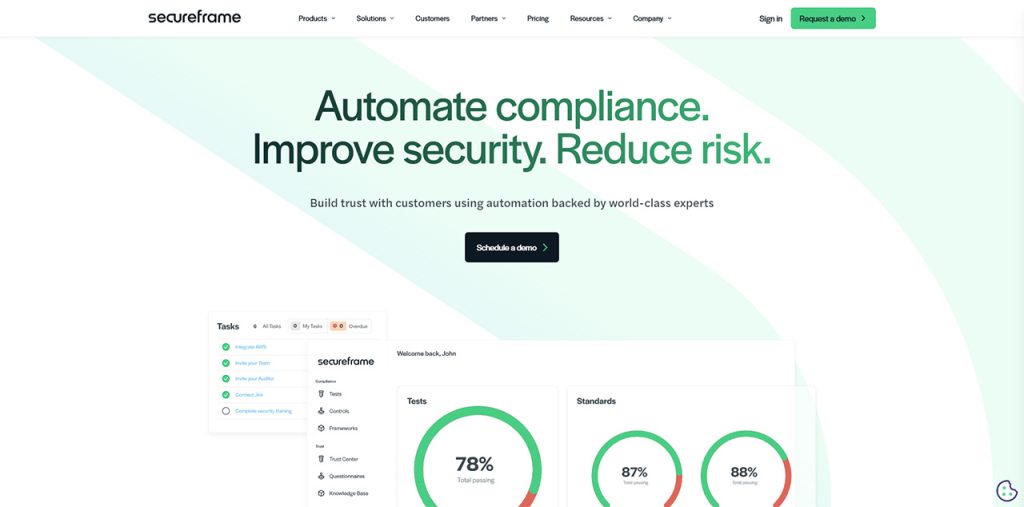
Secureframe combines automated evidence collection and continuous tests with onboarding led by its own compliance team, and it covers 40+ frameworks, including FedRAMP and CMMC for companies selling to the US government. Each Secureframe package includes one framework, with extra workspaces sold as add-ons. Reviewers describe a platform that needs little upkeep once it's running, though connecting niche tools draws the most complaints on G2, with 184 mentions. Its clearest fit is a company that needs FedRAMP or CMMC for US government sales next to SOC 2.
4) Scrut Automation
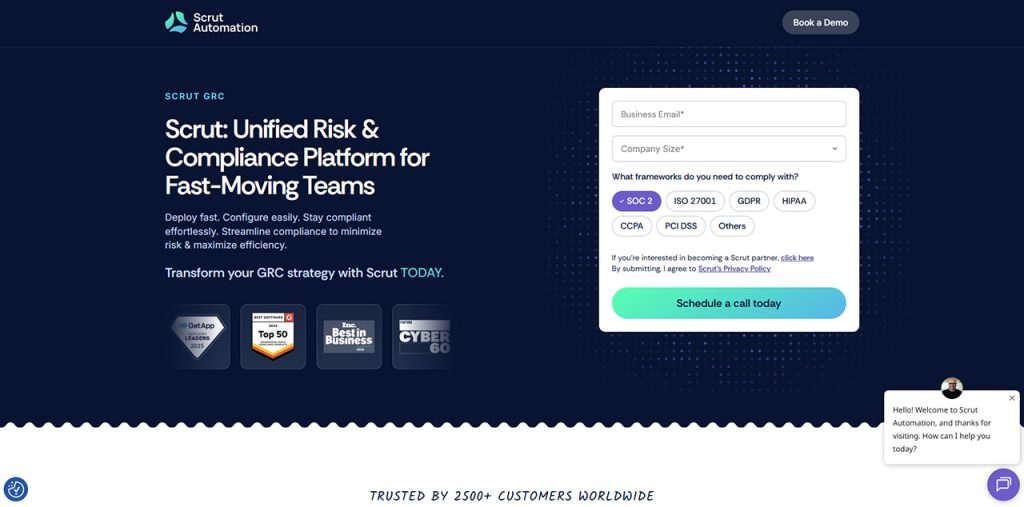
Scrut Automation arrives with frameworks, policy templates, risk registers and vendor questionnaires already mapped to a single set of controls, so a team adding a second framework starts from existing work. Failing tests come with AI-guided remediation, and its in-house compliance experts support setup and audit prep. It holds a 4.9 rating on G2, the highest in this comparison, though 52 G2 reviews mention bugs that stall workflows. Scrut works for a risk-led team that can tolerate the occasional bug.
5) Secfix
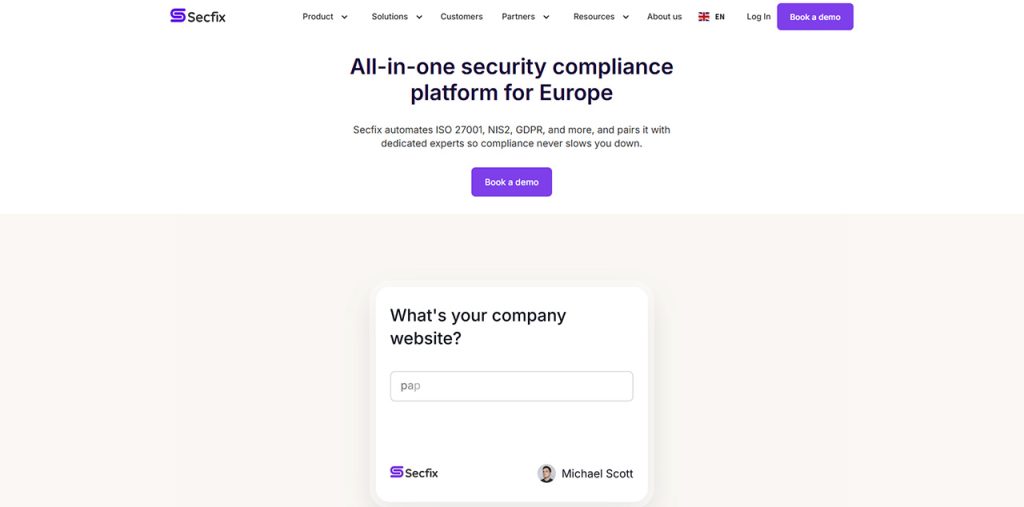
Secfix is a European compliance platform that automates ISO 27001, SOC 2, NIS2, TISAX, DORA and GDPR work and pairs it with dedicated experts. It runs more than 250 automated checks, discovers vendors through Google Workspace or Microsoft 365 sign-in, links risks to over 100 pre-mapped controls and ships 20+ policy templates. Reviewers on G2 single out its support and structured approach, while limited integration options are the most common complaint (11 mentions). It makes sense for a European company where SOC 2 sits next to ISO 27001, NIS2 or TISAX, though Scytale supports the same frameworks, with AI GRC agents handling the evidence work.
6) Apptega
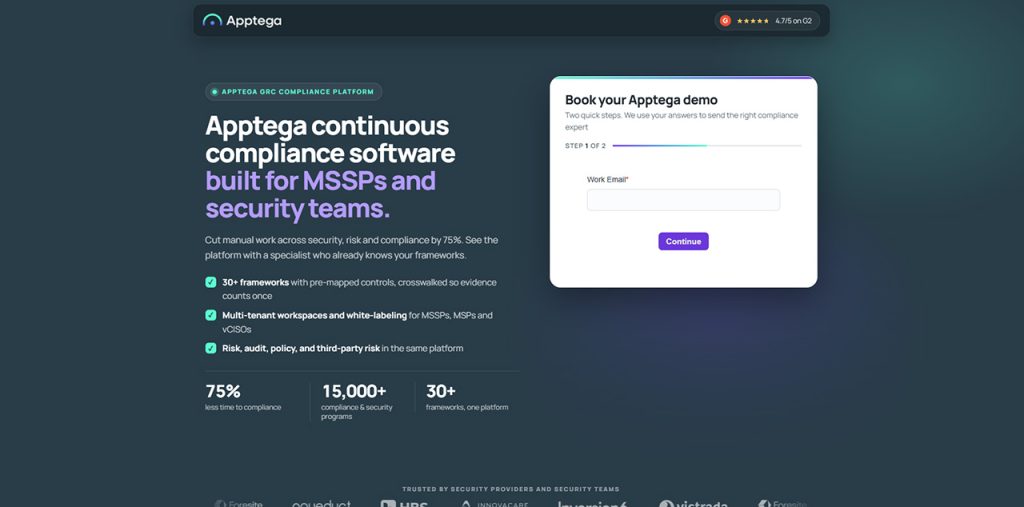
Apptega is a security and compliance platform built for managed security providers that run programs for many clients, as well as for companies that manage their own. It assesses against 30+ frameworks through questionnaires that update scores in real time and suggest AI-driven fixes, and it crosswalks controls between frameworks. G2 reviewers like how easy it is to use, while their most common complaints point to features that need improvement and limited functionality in places. Apptega makes the most sense for managed security providers running SOC 2 for several clients. A single company preparing its own report, with no provider behind it, will get more direct help from a platform with dedicated GRC experts such as Scytale.
7) Drata
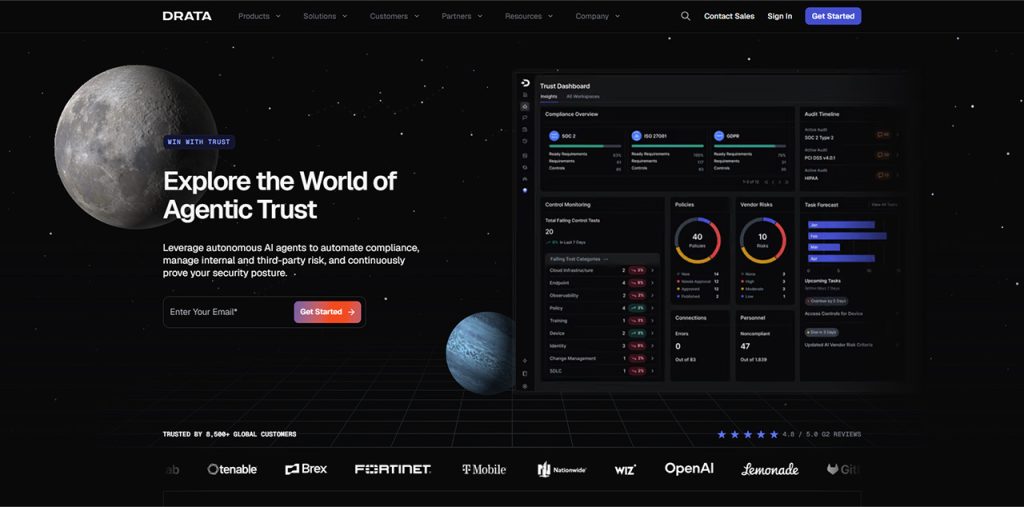
Drata maps each control once and reuses it across frameworks, runs continuous control tests through deep integrations and includes the SafeBase trust center it acquired in 2025. Its MCP server lets AI assistants read program data and take 26 kinds of action, such as assigning control owners, under existing permissions. Reviewers name customer support as the strongest point and say setup and the auditor-facing side could be better (35 mentions). Drata assumes a security owner on your team runs SOC 2 day to day. Companies without that person get the guidance from a dedicated GRC expert at Scytale.
8) Vanta
According to Vanta's SOC 2 page, its integrations feed more than 1,400 automated tests that run every hour, and customers can pick from more than 100 partner audit firms. It also has the largest review base in this comparison. Pricing is the loudest complaint, with G2 reviewers describing costs that small companies struggle to absorb (146 mentions) and a product they call very expensive (145 mentions). Vanta fits a company that already has its own compliance owner and the budget to match. Teams that want a GRC expert working beside them should look at Scytale first.
SOC 2 compliance software pricing models, and the one that bites at renewal
None of the eight publishes a dollar price, so the useful comparison is how each one charges:
- Per-framework plans: Sprinto and Secureframe start each plan with a set framework and charge for more, and Vanta's tiers include one framework with add-ons on top. The first year looks affordable, and the bill grows each time a customer asks for ISO 27001 or HIPAA.
- Bundled plans: Scytale's tiered plans, from startups to enterprise, package the AI GRC platform with dedicated GRC expert support and penetration testing, priced by custom quote.
- Quote by scope: Scrut Automation, Secfix, Apptega and Drata set prices in the sales conversation around company size and the modules you choose.
The model that bites is the per-framework one: the year-one quote covers one framework, and the second arrives as a new line item. Ask every vendor for a quote that covers the frameworks you expect to need, and compare the year-two number.
The SOC 2 compliance software buyer checklist
Ask these in every demo:
- Who on your side helps when a control fails, and is that person included in the price?
- Which of our frameworks map to the same controls, and which need separate work?
- Can my auditor work inside the platform, and does it support the CPA firm we've chosen?
- What does year two cost if we add ISO 27001 or an AI framework?
- How will your control library handle the proposed 2027 Trust Services Criteria?
- What does your AI do on its own, and who reviews its output before it becomes evidence?
- Can AI assistants such as Claude or ChatGPT reach our compliance data, and is that access read-only?
If you're preparing for your first SOC 2
First-time teams lose most of their time on decisions. Which trust services categories belong in scope, which systems count, what a policy has to say and how to answer an auditor's sample request all take judgement that a dashboard can't supply. A platform with dedicated GRC experts, such as Scytale or Secfix, puts that judgement on your side of the table. A self-serve platform suits a first SOC 2 when someone on your team has run one before.
Start with a Type I report if a customer will accept it, because it confirms your control design while the observation window for the Type II runs. Keep scope tight: Security alone is the only required category, and each optional one adds controls and audit time.
What none of these platforms can do
- Issue the report. Only an independent CPA firm can, and the auditor stays responsible for the opinion. AICPA guidance on AI in audits, published in October 2026, makes the same point.
- Decide your risk appetite or which customer commitments belong in scope.
- Change your systems. A failing control still needs someone with access to fix a setting or a process.
- Guarantee a clean opinion. The auditor tests what happened during the window.
Software speeds up everything around those four points, and good expert support makes the decisions faster, but the accountability stays with your company and your auditor.
Choosing SOC 2 compliance software before the 2027 cycle
Pick the platform by who will do the work and how many frameworks you'll carry by 2028. For most growing companies that point to Scytale's AI GRC platform, where AI agents collect and validate the evidence and a dedicated GRC expert guides the decisions through a 2027 Type II and the move to the new criteria. The self-serve platforms lower on the list make sense where an experienced compliance owner wants to run SOC 2 alone.
Frequently Asked Questions
It plugs into the systems where your controls live, such as AWS, Okta and GitHub, and tests those controls against the SOC 2 criteria, keeping the evidence an auditor samples in one place. Most platforms also run policy sign-offs and security training, and many now use AI to check evidence and draft questionnaire answers.
Expect four costs: the software subscription, the CPA firm's audit fee, a penetration test if customers ask for one, and your team's time. Audit fees depend on the report type, the categories in scope and the size of your environment, so get quotes from more than one firm. On the software side, Scytale and the other platforms in this list price by quote.
Software prepares you for the examination, and a CPA firm performs it and issues the report. Some platforms coordinate the audit inside the product: Scytale's AI GRC platform includes built-in audit management, which gives your audit partner one place for evidence requests and approvals.
No. SOC 2 is an attestation report a CPA firm writes about your controls against the AICPA's criteria, and US buyers ask for it most. ISO 27001 is a certification of your information security management system, issued by an accredited certification body and common with European and global customers. The controls overlap a great deal, which is why cross-framework mapping matters.
Now, if you need a Type II report during 2027. For most companies the observation window runs six to twelve months, and controls need to work from its first day, so remediation has to finish beforehand. Teams that choose a platform and auditor in November or December 2026 can fix gaps in the first quarter and open a window in the spring.