

To deliver a good presentation, you need to have solid presentation skills and implement effective presentation techniques. While delivering a presentation55555you do not just have to inform an audience but also connect with them and make an impression on them. You do not just need confidence but varying skillsets to capture your audience’s attention and deliver your message successfully.
Why Are Strong Presentation Skills Important?
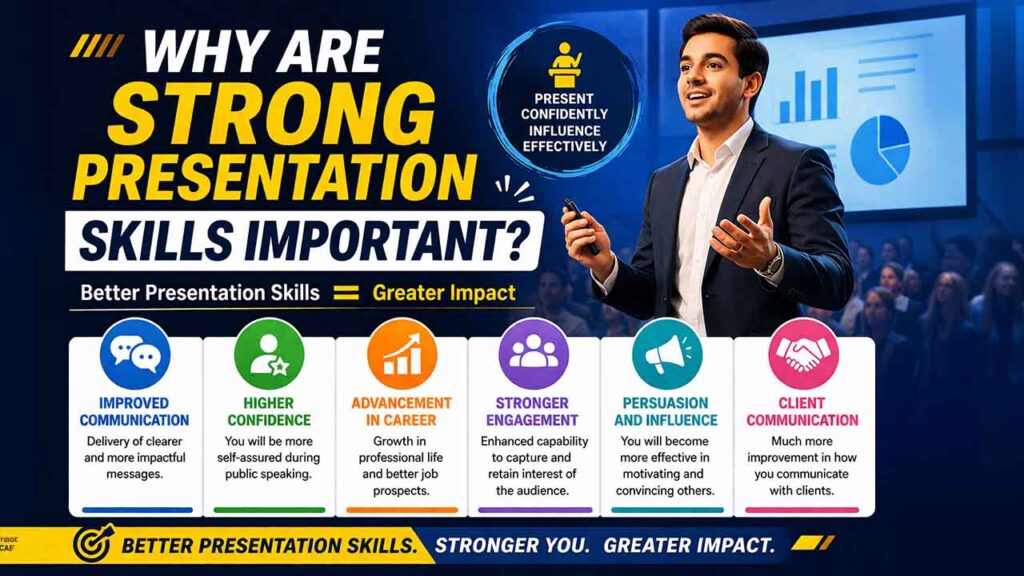
Presentation skills are extremely important in the corporate world and beyond. If you have the ability to present well, you will be able to communicate persuasively and effectively. You become capable of putting your point across well, even in normal conversations. Learning presentation skills helps you advance in your career, boost professional relationships, and improve your influence. In this blog, we will learn a few presentation techniques that will help you out in your career. But, before that, let us learn a few advantages of gaining presentation skills.
Advantages of Better Presentation Skills
- Improved Communication: Delivery of clearer and more impactful messages.
- Higher Confidence: You will be more self-assured during public speaking.
- Advancement in Career: Growth in professional life and better job prospects.
- Stronger Engagement Among Audience: Enhanced capability to capture and retain the interest of the audience.
- Persuasion and Influence: You will become more effective in motivating and convincing others.
- Client Communication: If you are working in a marketing agency, you will see much more improvement in how you communicate with clients.
Advanced Presentation Techniques: Top 16 Tips for Effective Presentation
Tip 1: Ensure Eye Contact During Presentation and Smile:
You will have to make each and every listener feel that they are important and make them feel personally addressed. It is specifically significant to maintain eye contact with the audience at the time of the presentation. Not only does this provide confidence, but it also enables the audience to connect with you as well as your subject. It also empowers you to feel less nervous.
Now, this is easier said than done, right? Here is what can help:
Look for someone in the audience who you think is genuinely interested and is actively listening (for example, your lecturer). Ensure eye contact with the person at the start of the presentation. Now, as the presentation goes, you will start to feel calmer, more composed, and confident. You can then shift your gaze over to the audience to remain calm throughout the presentation.
One of the effective presentation techniques is to look for a fixed point in the room (which can be a wall, a board, or an object behind the audience). You can look at it at the start of the presentation to calm your nerves. Similar to the first example, after you have got your confidence, you can allow your gaze to move over to the audience and return to the previously chosen fixed point again and again.
Here is what you should avoid:
- Do not look at the screen!
- Do not look at the floor!
- Do not look at the laptop!
- Do not look at your index cards!
Tip 2: Utilize Facial Expressions and Gestures:
To focus on the content in your presentation, it is advisable to utilize relevant gestures and body language to put your point across. Do not cross arms, put your arms behind your back, or put them in your pockets during the presentation.
You need to stand up straight always and avoid appearing stressed or tense. You can do that by utilizing your hands and arms to get the audience to pay more attention to what you are saying and deliver your message.
Your facial expressions must be open and friendly. Smile and always show that you are enjoying the topic, and you are confident in the data that you are presenting.
Tip 3: Don’t Focus on Distractions:
Effective presentation techniques also include minimizing the use of aids. For instance, you may want to utilize a laser pointer to display something on the screen, or you may want to utilize a pen to write something on a flipchart. To prevent distractions for you as well as the audience, you need to adopt the habit of using tools that you do not need. In this way, you can minimize the clutter while you are giving the presentation; the more organized your podium is, the more effectively you will be able to deal with it in the first place. You can more easily walk around and keep your hands free for gestures.
Tip 4: Have More Preparation: Practice Makes Perfect:
Preparation and practice can take your presentation skills to the next level. If you prepare well and practice your message delivery, you will feel more confident and relaxed during a presentation and can improve your body language.
Let us look at a few ways that can help you prepare well for the presentation:
- Take Notes
- Experiment
- Record Yourself
- Time Yourself
- Rehearse in front of a crowd.
Nowadays, there are tools such as AI-powered presentation makers that can empower you to quickly assemble and polish your slide content.
Tip 5: Be More Confident:
To implement presentation techniques well, you need to be more confident. By being more self-confident, you can convey to the listener that you have great confidence in your topic and have sufficient preparation. Be more relaxed and avoid feeling more nervous or stressed. If you want to take your presentation skills to the advanced level, appear in front of the podium, walk around the room, and try to be closer to the audience. This shows self-confidence and aids in attracting the attention of the audience.
Tip 6: Effective Beginning/End:
Effective presentation skills aid you in making your audience feel captivated right away. To do that, you must begin your presentation on a solid note. Numerous studies indicate that if you can capture the interest of someone straight away, there is a good possibility that they will listen to the rest of the interaction. You need to create a shock-factor for the audience, ask them to think of a what-if situation, or imagine something. You can also share a story personal to you, use a quote, or share a video.
Advanced presenters who know presentation techniques understand the time and structure of the presentation. You should also give the structure and time of your presentation. It is also useful for your audience to have your outline showcased in the slimmed-down format throughout the whole presentation.
How you conclude the presentation is as significant as how you begin it. If you end the presentation weakly, it will have a bad impact on the audience. However, if you end the presentation on a strong note, it can encourage them to learn more about the message. For instance, you can include a call to action, a personal story, conclude the presentation memorably, and do not forget to thank and acknowledge the audience.
Tip 7: Speak in a Free Way:
To make your presentation as lively as possible, stop reading it from a script. Speak in a slow, free, and clear way. If you are not confident in what you are presenting, you can try utilizing these cards. However, you need to keep this in mind: do not keep continuous text, but rather concise and short bullet points! You can use note cards to help yourself during presentations, but it is advisable to memorize at least the start and end of your presentation. This is because eye contact is extremely important during these moments.
Tip 8: Don’t Use Filler Words:
To make your presentation flow as confidently and smoothly as possible, you must avoid utilizing filler words like “so,” “um,” and so on. For your listeners, these words indicate that you are insecure during presentations, and preparation is not that adequate.
Tip 9: Bring Some Takeaways with You to Share:
Apart from a handout, other small takeaways can also enhance your presentation skills immensely. If you are presenting your new CRM product to an investors’ conference, you can distribute a few handouts to the audience explaining the product to the investors. On the other hand, if you are giving a presentation on the new product catalog, you can demonstrate your product to the audience.
Tip 10: Use Distinct Media Types:
A presentation can quicky become monotonous and boring. To prevent this, you can utilize distinct media types. For instance, you can combine flipcharts and videos, utilize the whiteboard, or display something practical on the model. This will enormously improve the attention of your audience and can allow you to keep them engaged until the end.
Tip 11: Utilize Effective Pauses:
When you are giving a presentation, you must keep in mind that you have heard the content several times already; your audience hasn’t heard it still. Thus, you should allow your audience to have enough time to read and understand the content given in the slides. Effective utilization of speech pauses is one of the important presentation techniques. It is one of the most flexible tools in the presenter's toolbox. However, very few of them can perform it effectively. If a pause is used correctly, you can improve the quality of your speech or presentation greatly.
You need to pause before, after, or while saying something that you want to emphasize. A quick pause can also enable you to remember your next point without the audience realizing that you have forgotten what to say.
Tip 12: Speak Your Audience’s Language:
When you are crafting your presentation, you must think about your target audience already. This will allow you to successfully present later. It is specifically significant that you are speaking the language that your audience understands. Use appropriate and relevant examples. Utilize meaningful and “strong” words to avoid losing your audience.
Ensure that you are using relevant analogies as well as anecdotes. Prevent using empty phrases, foreign words, and cliches. If you want to use foreign words, you can explain in a footnote or handout within the presentation.
Tip 13: Ensure Audience Engagement:
Try to keep the attention of your audience always and ensure that they remain engaged throughout the presentation. To do this, it is important to involve the audience consistently. One way you can do that is to ask “easy” questions that the audience can ask.
Another way you can involve the audience in your presentation is by communicating with them. To make your point clearer, you can utilize an example to explain it in a detailed way, using a person (whose name you must know). You can directly address participants and address their work.
Tip 14: Control Your Breathing and Do Not Fight Stage Fright:
The biggest enemy while giving presentations is stage fright. However, you should not allow yourself to become a victim of this feat. You should not fight it, rather you should address your fear and try to accept the situation. You can convert it into positive enthusiasm. Don’t allow your stage fright to make you all worked up. Take a few deep breaths and allow oxygen to go to your brain and relax your body.
Tip 15: While Giving Your Presentation, Choose an Angle Well:
One of the questions that speakers frequently ask themselves while giving a presentation is the following: how do I position myself in the best way and where should I stand in front of the audience?
In most cases, you will be facing your audience in a “free space” without a podium. This provides you with a lot of room to move. However, at the same time, it can create uncertainty since you do not know how to properly position yourself or how to move.
Avoid standing directly in front of the audience. The audience unconsciously perceives the front-facing negatively. Audience perceives it as a kind of frontal attack and can cause stress in your audience.
Make sure to keep your podium slightly to the side of your audience. During presentations, if you notice that you are standing in front of the audience frontally, simply position 20cm left or right of the audience.
Have a Podium You Can Use
A podium makes it simpler for you to decide how you can position yourself and where you need to stand in front of the audience. In order not to make your presentation way too monotonous, try to leave the safety of the lectern from time to time. For example, you can walk over to the other side of the screen or display something on the flipchart. This can bring more movement into your presentation and enable you to establish a better connection with the audience.
Tip 16: Create Something on the Whiteboard During Lecture:
PowerPoint is not an afterthought when it comes to effective presentations. Company logos and company collages on each slide and flashing text boxes generally distract you from the essentials. A presentation will create an impact on your audience if they witness how something is being created. Apart from the classic flipchart, the whiteboard is suggested for this purpose. This is because all the keywords, diagrams, and results of a brainstorming session are written in real-time on a whiteboard. Board members enable a broad range of colors and the magnetic property of pinning additional data. The result of the presentation created in this way is remembered longer than ready-made slides.
Conclusion
In conclusion, robust presentation techniques are vital for communicating ideas in a clear and convincing way in both professional and academic settings. An effective presentation integrates effective delivery, detailed preparation, genuine audience engagement, and engaging body language. By implementing the tips given above, you can enhance your impact, minimize nervousness, and deliver presentations that are memorable, clear, and persuasive.
%201.png)

%201.png)

%201.png)