

Handling customer relationships has always been a vital requirement for any business, regardless of its industry or size. As competition becomes more intense and customer expectations develop, depending on generic platforms is not sufficient anymore. CRM software development provides businesses with the capability to develop personalized solutions that align accurately with their sales processes, workflows, and customer engagement strategies. Irrespective of whether you are an established enterprise or a growing startup, investing in a specially-built customer relationship management system can be a defining step toward sustainable growth.
The global CRM software market was estimated at USD 40 billion in 2024 and is expected to reach USD 145.60 billion by the year 2029, with an annual growth rate of more than 10%. Such figures represent just how significant CRM development has become in the modern business landscape. Businesses that utilize the right CRM solutions regularly outperform those that depend on disconnected or manual processes for managing customer data.
What Is CRM Software Development?
What is CRM software development can be defined as the process of building, designing, and implementing digital solutions that aid businesses in managing all customer data in one place, handling interactions, automating processes, and ensuring better business decisions.
At its center, a CRM system works as a central hub that can store:
- Communication history or customer contact details
- Pipeline data and sales leads
- Behavioral preferences and purchase history
- Interactions and outcomes in marketing campaigns
Contrary to off-the-shelf solutions like HubSpot or Salesforce, custom CRM software development emphasizes developing a solution personalized to the unique requirements and workflows of a company. This basically means that you get a system that aligns with your particular team structure, workflows, and integration needs. This is not a pre-packaged template specialized for everyone.
Essentially, CRM development makes sure that organizations have the technology that matches the operational reality of businesses. It helps teams across marketing, sales, and customer service to work with a single source of truth, removing data silos and minimizing inefficiencies that can cost organizations money and time.
Types of CRM Software
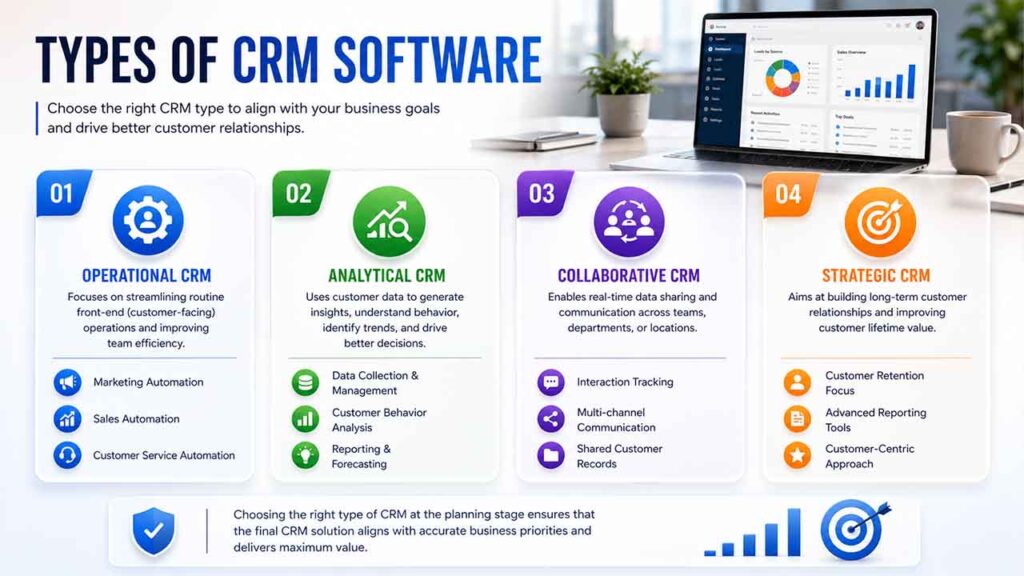
Before you start working on any CRM development project, it is vital to recognize which type of system best aligns with your business goals. There are four main types of CRM software, each specialized to address particular business requirements:
- Operational CRM: This type emphasizes simplifying routine front-end (customer-facing) operations. Main features include marketing automation, sales automation, and customer service automation. It is suited for businesses having high volumes of customer interactions that need minimal manual effort and enhanced team efficiency.
- Analytical CRM: Analytical CRM systems gather and process high volumes of customer data to create actionable insights. Businesses leverage this type to comprehend customer behavior, recognize trends, enhance forecasting, and make data-based and informed decisions.
- Collaborative CRM: Purpose-built for businesses with different geographic locations or multiple departments; collaborative CRM software allows data sharing in real-time across teams. Core characteristics involve interaction tracking, multi-channel communication, and sharing customer records. It is specifically ideal for large businesses where cross-departmental coordination is vital.
- Strategic CRM: Strategic CRM development depends on developing lasting customer relationships. It ensures customer retention features, modern reporting tools, and a customer-oriented approach that is extensively focused on improving customer lifetime value. Businesses aiming to boost brand loyalty and improve engagement will find this type greatly advantageous.
Choosing the right type of CRM at the planning stage makes sure that the final CRM solution aligns with accurate business priorities instead of offering redundant features that do not serve any purpose.
Main Features of CRM Software
A CRM software that is well-built must include a variety of features that collectively support sales performance, marketing effectiveness, and customer service excellence. The following are some of the most critical capabilities you need to consider during CRM software development:
- Contact Management: Stores and sorts the interaction history, customer data, and preferences in an easily searchable and centralized database. This removes routine data entry and makes sure that each team member has the same updated and precise data.
- Sales Pipeline Management: It delivers comprehensive, clear visibility into every stage of the sales funnel. Teams can monitor forecast revenue, deals, find bottlenecks, and pay attention to follow-ups, all with the help of a single dashboard.
- Marketing Automation: Streamlines campaign management by automating social media posting, email outreach, and lead nurturing workflows. This can free-up marketing teams to concentrate on strategy instead of routine execution tasks.
- Lead Management: CRM collects, tracks, and scores leads through the complete sales cycle. Segmentation features and lead scoring aid in making sure that high-value prospects get customized and timely attention.
- Reporting and Analytics: Creates in-depth performance reports and dashboards to provide strategic planning, recognize areas of improvement, and track the ROI of customer engagement initiatives.
- Third-Party Integrations: Smoothly connects with the available tools like email platforms, ERP tools, and customer support solutions to ascertain a centralized business environment. Smart CRM integrations are quite helpful for businesses. For example, it can help organizations purchase and manage Microsoft software.
- AI and ML Integration: Leverages AI to forecast customer behavior, automate routine actions, and customize interactions at scale. The AI in the CRM market is expected to grow from USD 4.1 billion in 2023 to approximately USD 48.4 billion by 2033, showcasing how deeply AI is transforming the CRM landscape.
- Mobile Accessibility: With approximately 70% of businesses now utilize mobile CRM solutions to improve their mobile-friendly design and sales strategy, including push notifications, push interfaces, and offline capabilities. It has become a non-negotiable feature in modern customer relationship management software.
The CRM Software Development Process
Developing a custom CRM solution needs a phased or structured approach to make sure that the final product aligns with business objectives, integrates effectively with present platforms, and is successfully adopted by teams. Here is a detailed breakdown of the CRM development lifecycle:
Step 1- Define Goals and Requirements: Start by recognizing the key goals and needs of the CRM system. Collect data from marketing, sales, and customer support teams to map out the specific problems the software needs to solve and the specific workflows it needs to support. Specific, clear goals at this stage can lay out a detailed blueprint for everything that follows.
Step 2- Design System Architecture: Create a plan for the complete database structure, user interface design, and overall technical architecture. This phase also involves recognizing integration points with the available business platforms, defining data storage needs, and setting up compliance and security standards.
Step 3- Development and Customization: Developers create the CRM software as per the approved design. This phase covers coding user interfaces, incorporating databases, and setting up automation logic, developing third-party connectors, and building reporting dashboards. Consistent optimization and code reviews are carried out throughout this stage.
Step 4- Testing and Quality Assurance: The testing phase begins, where the system is tested both as a standalone app and also as an integration solution within the wider technology environment. Performance testing, functional testing, and security testing are all conducted to make sure that the CRM system reliably performs under real-world conditions. Any errors or inconsistencies are fixed before going ahead.
Step 5- Deployment of the CRM application: CRM is implemented in the production environment as per the organized rollout strategy. A phased approach of deployment, beginning with a pilot group before a complete rollout, is generally recommended to reduce disruption and enable iterative enhancements as per the early feedback.
Step 6-Training and Ongoing Support: Employee adoption is a central piece to the success of any CRM implementation. Teams must be given appropriate user guides, training resources, and hands-on support to integrate platforms into their routine workflows. Performance tracking, ongoing maintenance, and feature updates must also be factored into the long-term plan.
Read More: How to Use a CRM: Complete Guide for Beginners in 2026
CRM vs. Off-the-Shelf CRM: Which Is the Right Solution for You?
One of the key decisions that you will have to make during CRM software development planning is whether you should create a custom solution or adopt an off-the-shelf solution. Both options come with different benefits, and the most effective choice depends on the particular context of your business.
Off-the-Shelf CRM Platforms: Off-the-shelf CRM platforms, such as HubSpot, Salesforce, and Zoho provide a fast deployment path with a broad range of pre-built characteristics. They are ideal for organizations with limited IT resources, standard sales workflows, or tight implementation timelines.
Top Considerations:
- Quick to deploy with minimum technical setup needed.
- Subscription-based pricing plans with predictable annual or monthly costs.
- Limited customization options apart from pre-built configurations and modules.
- Feature development relies on the product roadmap of the vendor.
Custom CRM Software Development: As stated earlier, it is a bespoke CRM system specially built from scratch to align with your precise operational needs. While it needs a higher upfront investment, it ensures long-term value and unmatched flexibility.
Main Considerations:
- Fully personalized to your team structure, business processes, and industry needs.
- No recurring licensing costs once the system is engineered and deployed.
- Smoothly incorporates your present technology stack without any workarounds.
- Must be scalable and should support businesses' growth without platform migration costs or vendor dependency.
For businesses with industry-specific or complex workflows or those working at a larger scale, customer CRM development delivers a higher ROI on investment over time consistently.
Advantages of Custom CRM Software Development
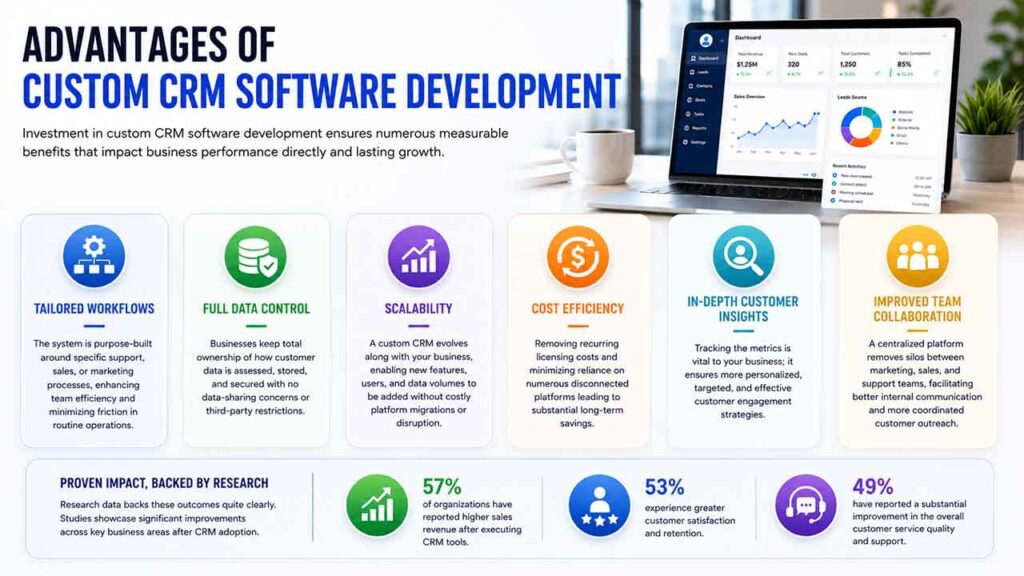
Investment in custom CRM software development ensures numerous measurable benefits that impact business performance directly and lead to lasting growth:
- Tailored Workflows: The system is purpose-built around specific support, sales, or marketing processes, enhancing team efficiency and minimizing friction in routine operations.
- Full Data Control: Businesses keep total ownership of how customer data is assessed, stored, and secured with no data-sharing concerns or third-party restrictions.
- Scalability: A custom CRM evolves along with your business, enabling new features, users, and data volumes to be added without costly platform migrations or disruption.
- Cost Efficiency: Removing recurring licensing costs and minimizing reliance on numerous disconnected platforms, leading to substantial long-term savings.
- In-depth Customer Insights: Tracking the metrics is vital to your business; it ensures more personalized, targeted, and effective customer engagement strategies.
- Improved Team Collaboration: A centralized platform removes silos between marketing, sales, and support teams, facilitating better internal communication and more coordinated customer outreach.
Research data backs these outcomes quite clearly. Studies showcase that approximately 57% of organizations have reported higher sales revenue after executing CRM tools, 53% experience greater customer satisfaction and retention, and 49% have reported a substantial improvement in the overall customer service quality and support.
Read Also: What is the Software Development Life Cycle? Full SDLC Guide for Beginners
Conclusion
CRM software development can no longer be considered a luxury for larger businesses. It is a strategic investment that businesses of different sizes are making to remain competitive in the customer-facing world. From simplifying operations and automating routine workflows to ensuring customized customer experiences at scale, a well-engineered CRM platform can greatly change how a business handles its relationships and improve sustainable growth. Businesses also benefit from a Customizable CRM, which can be tailored to evolving operational needs, industry-specific workflows, and customer engagement strategies.
By comprehending the features, types, development process, and distinctions between off-the-shelf and custom options, businesses can make informed or confident decisions about their next CRM development initiative. Selecting the right customer relationship management software, one that is engineered to align with your unique requirements, can establish a long-term foundation for business success and operational excellence.
FAQs About CRM Software Development
Q. What are the 4 types of CRM software?
A- The four types of CRM software include Analytics, Operational, Collaborative, and Strategic.
Q. What are the 7 components of CRM?
A- The seven components of CRM include Contact Management, Sales Force Automation, Marketing Automation, Customer Service and Support, Analytics and Reporting, Integration Capabilities, and Mobile Access.
Q. Should I choose off-the-shelf or custom CRM software?
A- It depends on your business budget, size, and operational complexity. Off-the-shelf solutions are suitable solutions that are the right option for tight budgets and quick launches. Custom CRM software is best suited for enterprises that require advanced automation, highly personalized workflows, and data security.
Q. What are the disadvantages of off-the-shelf software?
A- One of the key demerits of off-the-shelf software is limited scalability. If you need extensive customization, you must go for custom software development.
Q. Is custom CRM software development expensive?
A- Yes, custom CRM software can incur a higher upfront cost. However, in the long run, it can be beneficial and can yield greater ROI.
%201.png)

%201.png)

%201.png)