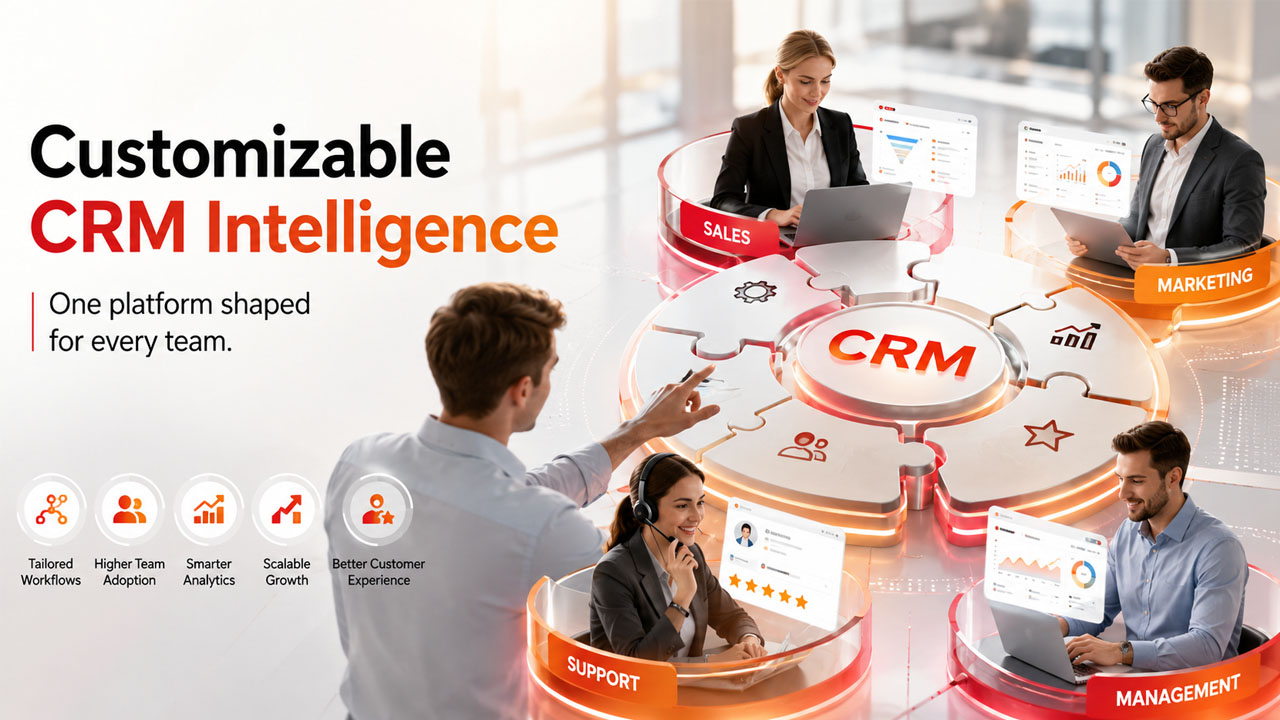

Each business has its own way of handling customers, closing deals, and delivering services. Yet the majority of generic CRM solutions force teams to adjust to the software instead of the other way around. This is where a customizable CRM turns out to be a real option.
Whether you are running a growing startup or an established enterprise, a customizable CRM enables you to transform the system around your accurate workflows, and not the other way around. It eliminates friction, drives better adoption, and makes sure that each team member works with the systems created for their particular role. In this complete guide, let us understand what a customizable CRM is, why it is important, and what characteristics you need to look for when selecting one.
What Is a Customizable CRM?
A customizable CRM (Customer Relationship Management) refers to a ready-to-use system that can be personalized to align with the specific processes of a business, data requirements, and industry requirements without re-creating the tool from scratch.
Contrary to rigid, one-size-fits-all solutions, a customizable CRM enables teams to:
- Add, edit, or reorganize modules and data fields.
- Set up dashboards to showcase key metrics.
- Automate workflows specific to their marketing, sales, or service processes.
- Integrate the system with the legacy systems and third-party tools that the business is already using.
It is worth differentiating a customizable CRM from an entirely custom-built CRM. A custom-developed CRM is built completely from scratch, generally by large enterprises with specialized needs and large development budgets. By contrast, a customizable CRM is a pre-developed solution that ensures flexibility through no-code tools, configuration, and integrations. This makes it accessible to businesses of all sizes without the long timelines or high cost of developing a solution from scratch.
Important Advantages of Utilizing a Customizable CRM
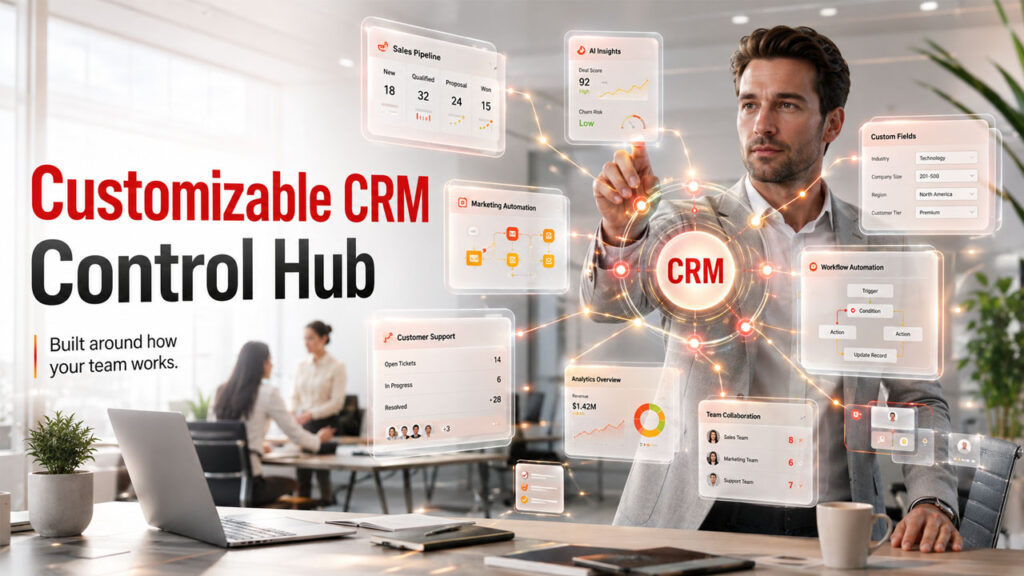
Selecting a customizable CRM over an off-the-shelf solution ensures a wide range of advantages across the business. The key advantages are described as follows:
Alignment with Unique Processes of Business:
A customizable CRM adjusts to how your team actually works, including data fields, pipeline stages, and workflows, instead of forcing generic structures that do not align with your precise business requirements.
Higher Adoption Rates Among Team:
When the system naturally fits with daily tasks, teams are far more likely to consistently use it. Low adoption is one of the major causes of CRM failures, and most customization addresses it directly.
Relevant Dashboards and Analytics
Personalized dashboards avoid overloading the system with data. Sales managers can monitor pipeline and revenue prediction, while support teams emphasize case resolution times and satisfaction scores, each seeing only what is relevant to them.
Scalability Without Disruption
As your business evolves, a customizable CRM scales with it. Expanded product lines, new departments, or shifting processes can be accommodated through configuration, not costly redevelopment.
Enhanced Customer Experience
When marketing, sales, and service teams all operate from a personalized and centralized platform, customers get tailored and consistent interactions at each touchpoint. This is a direct advantage that marketing teams get from CRM in the digital marketing domain.
Key Features of a Customizable CRM
Not all customizable CRM solutions provide the same flexibility and depth. When assessing options, look for vital capabilities:
Custom Objects and Data Fields:
The capability to add and change data fields without coding is fundamental. A real estate organization may require fields for contract dates and property listings; a manufacturer may need to monitor supplier performance and production schedules. A strong, customizable CRM makes this simple for both non-technical and technical users.
Configurable Dashboards and Reports:
The platform must enable each role or team to create dashboards around the metrics most relevant to their objectives. Generic reports are rarely beneficial for everyone. Understanding how CRM works at the level of reporting is vital before selecting a platform.
Workflow and Process Automation:
A customizable CRM should make it easy to build and modify automated workflows — lead assignments, follow-up reminders, email sequences, case routing, and more. This reduces manual effort and keeps teams focused on high-value work.
No-Code Tools:
No-code capabilities enable business users to set up forms, workflows, and modules without writing a single line of code. This democratizes personalization across the business and minimizes dependence on IT resources for each change.
Seamless Third-Party Integrations:
A customizable CRM must connect cleanly with the platforms your team depends on already, i.e., email platforms, marketing tools, accounting software, and communication platforms. Pre-built connectors and Application Programming Interfaces are both significant to look for.
AI-Powered Features:
Modern customizable CRM platforms integrate AI for predictive analytics, lead scoring, automated data entry, and smarter recommendations. AI extends the value of personalization by optimizing the workflows you have configured continuously.
Who Benefits Most from a Customizable CRM?
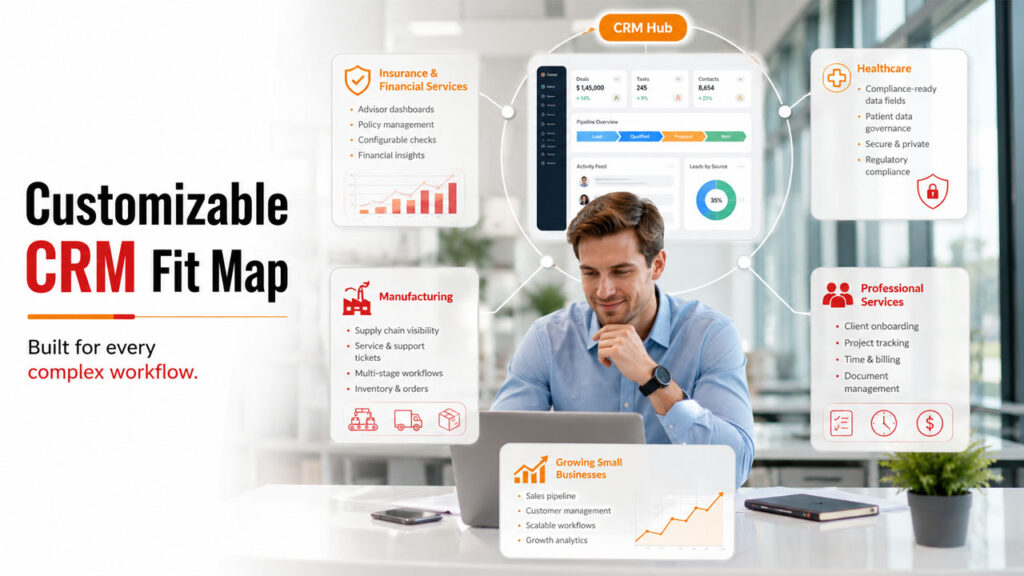
While any organization can benefit from a more versatile CRM, specific types of businesses see the best ROI:
- Mid-size to Large Businesses with complex workflows and numerous departments that generic platforms cannot effectively support.
- Insurance teams and financial services that require advisor dashboards, configurable checks, and policy management.
- Manufacturing businesses that must align service and sales with multi-stage supply chains.
- Healthcare providers that need compliance-ready data fields and strict governance of data.
- Professional services firms handling client onboarding, project tracking, and billing on one platform.
Small businesses also benefit, specifically when looking for platforms that scale with them over time. For an in-depth overview of CRM needs by business size, check out this guide on CRM for small businesses.
How to Select the Right Customizable CRM?
With a broad range of platforms available, choosing the right customizable CRM needs assessing a few important factors:
- Simple Customization: Can your team ensure modifications without the support of developers? No-code tools are important here.
- Integration depth: Does the platform tether with systems that are already in your stack?
- Scalability: Will the system accommodate growth of business without needing a migration?
- AI capabilities: Does the platform utilize Artificial Intelligence to enhance automation and decision-making over time?
- Total cost of ownership: Account for implementation, licensing, and consistent customization costs.
It also aids in understanding the types of CRM systems — operational, analytical, collaborative, and strategic — so you can align the advantages of your platform to your business priorities. The right customizable CRM can check boxes across different categories instead of excelling in just a single area.
Conclusion
A customizable CRM is not only a luxury reserved for growing enterprises. It is a practical necessity for any business that wants its customer relationship management to align with the way it actually operates. By providing configurable data models, personalized dashboards, no-code tools, and flexible automation, a customizable CRM removes the sacrifices that come with off-the-shelf and rigid solutions.
As a result, you get a system that is actually useful for you, one that scales along with your business and ensures trackable improvements in terms of customer satisfaction, productivity, and revenue. If your present CRM feels like a constraint instead of being an asset, it might right time to explore what a customizable CRM can do for your business.
OutRightCRM provides the automation, flexibility, and integrations that modern businesses require, built to adjust to your workflows from day one.
%201.png)

%201.png)

%201.png)