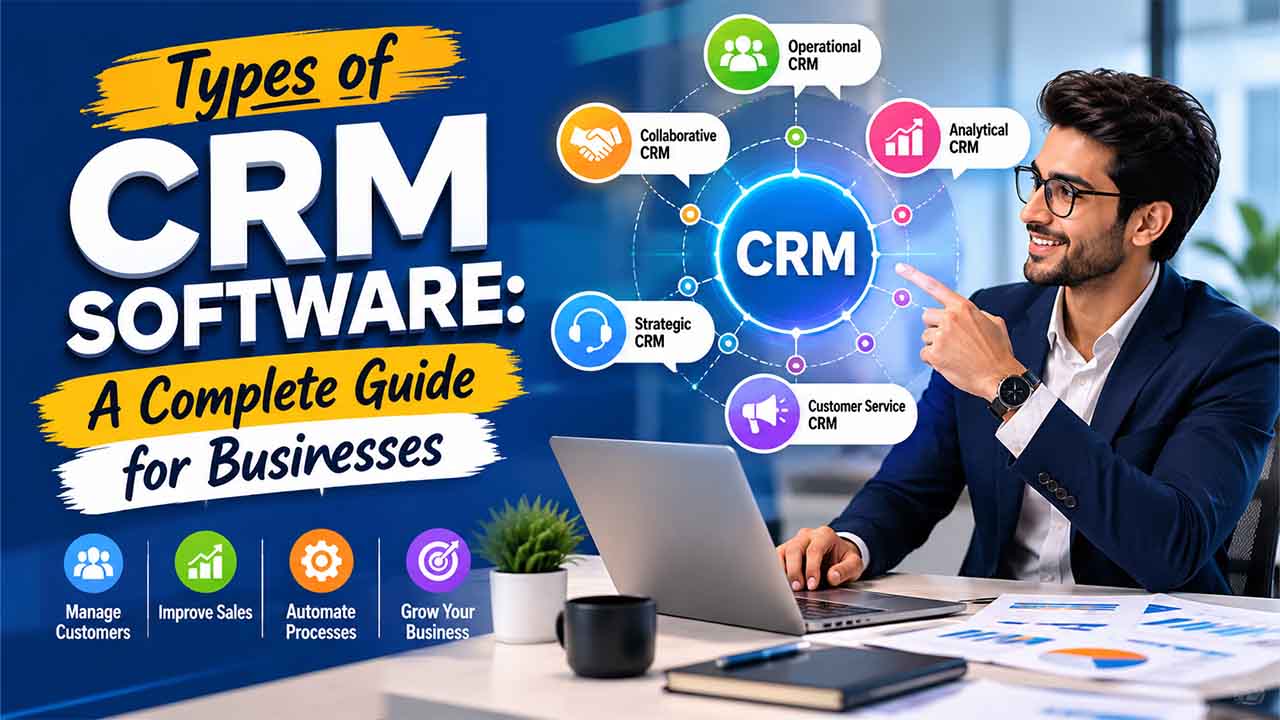

In the modern digital landscape, businesses are flooded with customer information-----emails, support tickets, purchase records, social posts, and more. Managing all of it can feel overwhelming. That’s where CRM software comes into play. The right CRM doesn’t help you stay organized; it can transform how your business connects with customers, simplifies teamwork, and supports long-term growth.
Regardless of whether you’re a startup just getting off the ground or a large enterprise ready to expand—knowing different types of CRM helps you choose the right software for your business needs. This guide breaks down what CRM software really means, the different categories out there, which features matter, and best practices to find the best fit.
What Is CRM Software?
At its core, Customer relationship management (CRM) software is a centralized platform that enables businesses to manage all customer interactions effectively with existing or potential leads. The software extracts data from various sources and stores them into a single, accessible system, making it a go-to solution for sales, marketing, and customer service teams. By leveraging this platform, they can find updates, track conversations, eliminate data silos, and ensure everyone works from the same source of truth.
But a good CRM system does way more than just keep a contact list. You can use it to:
- Streamline repetitive chores like follow-up emails, lead assignments, and ticket routing.
- Deliver real-time, informed insights into customer behavior, purchase patterns, and sales patterns.
- Enhance the team collaboration by offering every department complete visibility of each customer.
- Utilize it to establish long-lasting relationships through personalized, timely communication.
- Forecast future revenue and identify high-value customer segments.
Modern CRM solutions aren’t just databases anymore—they’ve gotten smart. They now use artificial intelligence to tackle routine tasks without constant human intervention, from scoring leads, refining campaigns, and identifying high-risk customers, automatically. It’s not just the tech giants using this, either. Startups and large corporations like organizations leverage CRM tools to dig up insights, make smart decisions, and drive long-term growth.
What are the Types of CRM Software
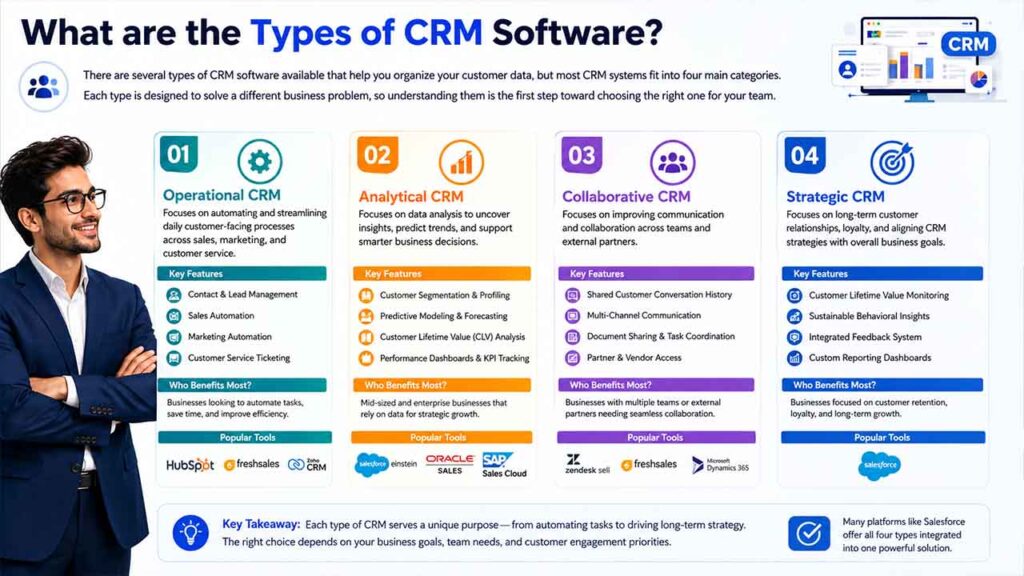
There are several types of CRM software available that help you organize your customer data, but most CRM systems fit into four main categories. Each type is designed to solve a different business problem, so understanding them is the first step toward choosing the right one for your team.
Operational CRM
Operational CRM automates the regular customer-facing challenges across sales, marketing, and customer support services—like sending follow-up emails, routing support tickets, and tracking leads. Basically, it keeps processes running smoothly so that nothing is overlooked.
Key features include:
- Contact & Lead Management: It offers a central database for logging and organizing customer records, interaction history, and lead progress.
- Sales Automation: Automation tools to manage pipelines, follow deals, anticipate revenue, and send timely follow-up reminders to keep sales moving.
- Marketing Automation: Options for automatically creating, segmenting, and deploying campaigns based on customer behavior and preferences.
- Customer Service Ticketing: Systems that route, manage, and resolve support requests quickly, ensuring efficient support.
Who gets the most out of this? When comparing different types of CRM, this is ideal for businesses seeking to eliminate manual work, shorten response times, and ensure no lead data is missing. A small SaaS startup, for instance, can use operational CRM to send onboarding emails automatically, nudge salespeople when it’s time to check in, and make sure support tickets land in the right inbox—all with almost no human intervention.
Read also: CRM for Solopreneurs: The Ultimate Guide to Choosing the Right CRM
Popular Tools: HubSpot, Freshsales, Zoho CRM
2. Analytical CRM
An analytical CRM is built around data. Rather than simply logging customer interactions, it analyzes them to uncover patterns, forecast trends, and guide smarter business decisions. It serves as the decision-making partner for leadership and strategy teams.
Key capabilities include:
- Customer Segmentation and Profiling: Categorizing customers based on demographics, behavior, and purchase history for more targeted outreach.
- Predictive Modeling and Forecasting: Anticipating future sales trends, customer needs, and potential churn before they happen.
- Customer Lifetime Value (CLV) Analysis: Identifying which customers are most valuable over the long term.
- Performance Dashboards and KPI tracking: Monitoring key metrics across sales, marketing, and service in real time.
This CRM type really shines for mid-sized and enterprise-level businesses that handle large volumes of customer data. Imagine a retail chain using Analytical CRM—they find out customers in a certain region respond way more to SMS promotions than emails. They can also optimize strategies, boost engagement, and enable automation for daily operations.
Popular Tools: Salesforce Einstein, Oracle Sales, SAP Sales Cloud
3. Collaborative CRM
A collaborative CRM is built to break down data silos between different teams, and sometimes it connects external partners such as distributors, suppliers, and resellers. It creates a centralized space so that sales, marketing, customer service, and other stakeholders all have access to the same, up-to-date customer data.
Key features include:
- Shared Customer Conversation History: A single, unified view of every interaction and communication, accessible to all departments.
- Multi-Channel Communication Channels: Connected tools for managing customer interactions across email, chat, SMS, phone, and social media in one place.
- Document Sharing and Task Coordination: Capabilities of sharing customer-related documents and coordinating tasks so teams can work together seamlessly on customer needs.
- Partner and Vendor Access: Collaborative CRM visibility for external stakeholders, such as distributors or vendors, when needed.
Businesses with tangled internal structures or that work a lot with channel partners benefit most. Think of a B2B manufacturer that gives distributors CRM access—they see orders and customer data instantly, so nobody’s waiting around or getting confused. That means faster service and satisfied customers.
Popular Tools: Zendesk Sell, Freshsales, Microsoft Dynamics 365
4. Strategic CRM
A strategic CRM is all about putting the customer at the heart of every business decision. Unlike other types of CRM, which focus on specific functions—automation, data management, communication—here it’s about the big picture. The company gears its products, services, and processes toward creating loyal customers for life.
Key features include:
- Customer Lifetime Value Monitoring: Platforms that help identify your most valuable customers and focus on strategies that improve long-term relationship building.
- Sustainable Behavioral Insights: Insights into customer habits and preferences collected across months or years, assisting smarter planning and decision making.
- Integrated Feedback System: Processes for gathering customer feedback and acting to continuously enhance products and services.
- Custom Reporting Dashboards: Personalized views designed for each team or individual employee, representing the metrics that matter most to their role.
This CRM type is actually very helpful for businesses that value customer retention, building brand loyalty, and gaining a competitive edge. This isn’t just about software-it’s a business mindset that redefines how CRM tools are used. Most large-scale firms, like Salesforce, offer all four types of CRM within a single solution.
CRM Software by Business Purpose
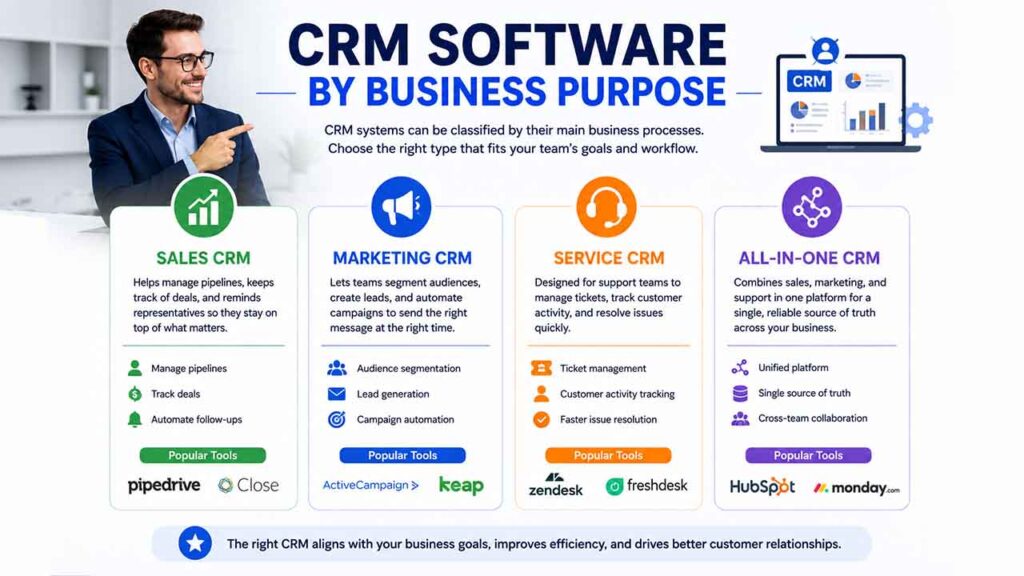
On top of those classic categories, CRM systems can also be classified by their main business processes—that’s usually more useful when finding the right tool in the market.
- Sales CRM: Helps manage pipelines, keeps track of deals, and reminds representatives so they stay on top of what matters. Tools like Pipedrive and Close are go-tos.
- Marketing CRM: Lets teams segment audiences, create leads, and automate campaigns. Can send the right message to the right people at the right time. ActiveCampaign and Keap are strong players here.
- Service CRM: Designed especially for support teams. They can manage tickets, oversee customer activity, and fix issues quickly. Agents always know the customer’s context before answering. Some industry leaders here are Zendesk and Freshdesk.
- All-in-One CRM: Puts sales, marketing, and support in one unified platform. If you want a single, reliable source of truth for all your departments, these are ideal. HubSpot CRM and Monday CRM both fit the bill.
Read also: 10 Real-World CRM Examples to Grow Your Businesses in 2026
Key Benefits of Implementing CRM Software
Choosing the right CRM software delivers measurable value across the entire business. Here are the most impactful benefits:
- Strengthened Customer Experience: Unified data lets teams customize every interaction based on customer needs and respond faster to their queries.
- Greater Sales Performance: Streamlined lead scoring, pipeline tracking, and automated follow-ups enable sales teams to complete more deals in less time.
- Intelligent Marketing: Audience classification and behavioral data allow campaigns to send the right message to the right people at the right time.
- Seamless Team Collaboration: Shared customer records reduce the risks of miscommunication across departments and minimize repetitive effort.
- Data-driven Decisions: Predictive analytics and real-time dashboards help build more confident, evidence-based techniques.
- Increased Customer Retention: Proactive identification of at-risk customers allows businesses to act before churn occurs.
- Scalability: Modern CRM platforms are built with scaling ability that grow with your business, accommodating more users, data, and complexity over time.
How to Choose the Right Type of CRM for Your Business
Picking the right one really comes down to what your business actually needs. There are several types of CRM software out there, so you want to cut through the noise. Here’s a straightforward way to do it:
1. Identify your biggest pain point
Figure out which problems you need to solve first before choosing a CRM. Too much manual work slowing everyone down? Go for an operational CRM. If you feel buried in data but can’t pull any real insights, analytical CRMs are your friend. If your teams always seem out of sync, look at collaborative CRM options. Want lasting customer loyalty? Focus on strategic tools.
2. Align the CRM to your business size
Small businesses usually do best with streamlined platforms like HubSpot or Zoho — they’re simple and get you value fast. Mid-sized companies might need more in-depth forecasting and tracking capabilities. If you’re running a large company, you’ll probably need a highly customizable, industry-specific platform that connects with all your other systems.
3. Analyze integration capabilities
Your CRM software should connect with tools you already rely on — like email, accounting, ERP systems, and marketing software. Poor integrations lead to disconnected data and manual workarounds, which defeats the point.
4. Assess user-friendliness
Even the most feature-heavy CRM is useless if your team avoids it. Look for something intuitive, customizable dashboards, and easy mobile accessibility, especially if you’ve got salespeople out in the field.
5. Think about scalability and AI readiness
Pick a system that fits your needs now but won’t hold you back as you scale up. Look for native AI features for things like lead scoring, churn prediction, or automating campaigns. These only get more important as your data (and goals) grow.
6. Run a real-world pilot
Before rolling out company-wide, test the CRM with one team. Upload some real, messy data. Automate tasks that usually cause high friction. Check after a two weeks — are people using it without being forced? If your team is still relying on spreadsheets, this CRM probably isn’t the right fit for you.
Common mistakes to avoid:
- Choosing based on price rather than fit for the specific business problem
- Underestimating the need for training and onboarding support
- Failing to plan for long-term growth when selecting a platform
- Overlooking data security and compliance requirements, particularly in regulated industries
Final Verdict
Understanding the different types of CRM software is the first step if you want to choose a system that actually makes a difference for your business. Maybe you’re focused on streamlining daily tasks, knowing your customers better, aligning team on the same page, or building loyalty that lasts. No matter your top priority, there’s a CRM out there built for it.
Honestly, many businesses end up getting the most value from an all-in-one platform that combines the core strengths of several CRM solutions, giving teams a clear picture of every customer’s journey. Take the time to figure out exactly what your business needs before committing. That upfront effort pays off—your team will actually use the system, increase operational efficiency, and your customers will notice.
%201.png)

%201.png)

%201.png)