


Franchisee monitoring has become a core operational function as AI systems begin to aggregate review data across franchise networks and attribute it at the brand level. A single location with poor ratings or manipulated reviews can now influence how ChatGPT, Perplexity, or Gemini describes your entire brand through AI-generated review citations that aggregate feedback across multiple franchise locations. Effective oversight requires systematic review analysis, targeted franchisee communication, and quality verification protocols that catch problems before they compound.
How AI Citation Errors Happen in Franchise Networks
AI review citation occurs when platforms like ChatGPT, Claude, Perplexity, and Gemini pull franchise review data from three to five dominant sources (Google, Yelp, TripAdvisor, BBB) and attribute location-specific feedback incorrectly across the brand. Individual performance gets buried inside brand-wide summaries, and the misattribution often goes unnoticed until the damage caused by inaccurate AI-generated review citations becomes visible in search results.
The process follows three stages. AI models scrape review data from aggregator APIs across multiple platforms. Location metadata is stripped during summarization, leading to misattribution to unrelated franchise locations. Brand-wide sentiment scores then replace individual franchisee metrics in the final output.
A practical example: when a user asks whether the Jimmy John's on 5th Street is good, the AI may cite reviews from the 12th Street location due to clustering algorithms. One franchisee's performance directly affects how the entire brand appears.
The risk extends beyond confusion. Research points to significant rates of location misattribution in multi-unit review datasets. Franchisees face accountability issues that they cannot directly control, making centralized monitoring non-negotiable.
Identifying Which Location Is the Source
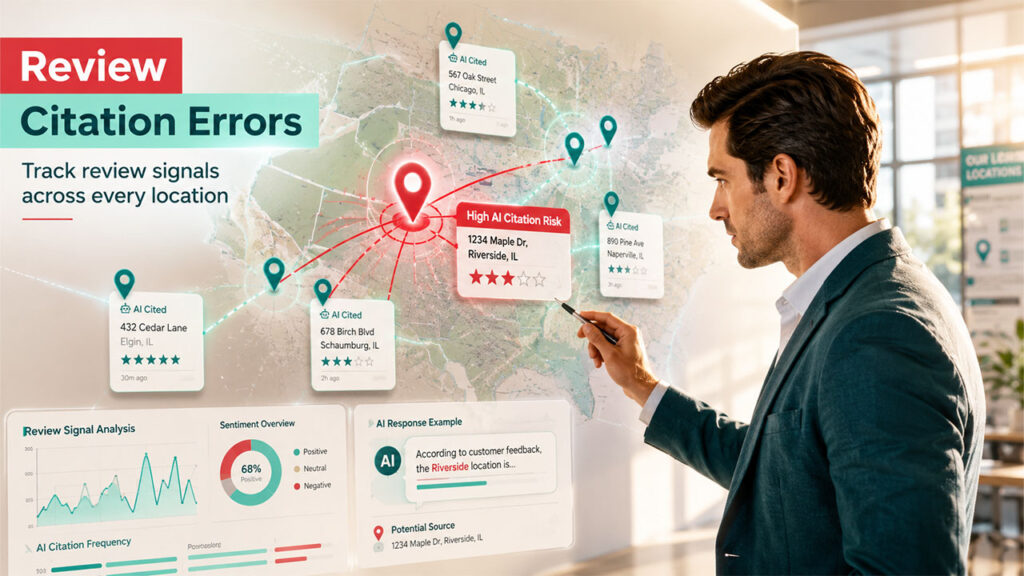
Pinpointing which franchisee's reviews are being incorrectly cited requires systematic analysis across review platforms and consistent tracking of AI output.
Location-based review analysis starts with comparing review timestamps against AI citation patterns. Teams need to track which specific addresses appear most frequently in AI-generated review citations and generated responses across major AI platforms. AI citation issues often trace back to locations with higher review volume or unusual sentiment patterns that attract algorithmic attention.
Cross-referencing multiple data points reveals patterns that single-platform checks will miss. Franchise review monitoring requires attention to both positive and negative signals from each location.
Review Aggregation Analysis
Run weekly aggregation audits using Review Tracker's multi-location dashboard, filtering by franchisee ID, postal code, and review volume thresholds above 50 reviews per quarter. Consistent tracking reveals when individual performance begins affecting broader brand perception metrics.
Here's how the major tools compare:
| Tool | Tracks AI Citations | Location Tagging Accuracy | Franchisee ID Mapping | Export Format |
| ReviewTracker | Yes | High | Yes | CSV, PDF |
| Birdeye | Limited | Medium | Partial | CSV, Excel |
| Reputation.com | Yes | High | Yes | PDF, API |
| Yext | No | High | Partial | CSV, JSON |
ReviewTracker offers stronger AI-powered review monitoring capabilities than Birdeye for brands managing multiple locations. Birdeye offers a simpler interface but requires additional manual effort to link citations to specific franchisees. The right choice depends on how much automation your operations team needs for ongoing performance tracking.
AI Platform Tracking Protocol
Set up weekly queries across ChatGPT, Claude, Gemini, and Perplexity using exact franchise location names and addresses to capture citation patterns. Systematic testing identifies which platforms most frequently pull from specific review sources.
Regular monitoring helps brands understand how AI-generated review citations are formed and identify patterns of location-level misattribution before they affect brand reputation.
Follow this four-step tracking protocol:
- Create a spreadsheet with 20 common query variations per location
- Run these queries every Monday at 9 am EST
- Screenshot and log citations in a dedicated tracking sheet
- Flag misattributions where the wrong address appears in results
For a Panera Bread location, example queries might include "best Panera near me with outdoor seating," "Panera Bread review ratings this month," and "Panera locations with fast service."
The process takes roughly 45 minutes per 10 locations when performed consistently. Franchisee accountability improves when teams document exactly which queries trigger incorrect citations.
Franchisee Communication Protocols for AI Citation Issues

Establish a 48-hour escalation protocol in which misattributed reviews are documented and communicated to the appropriate franchisee using standardized templates via a franchisee messaging system such as FranchiseBlast. Clear protocols prevent problems from affecting brand reputation before they're addressed.
Five protocol elements create accountability throughout the process:
- Document citation details, including the date, AI platform involved, the incorrect location cited, and the correct location name
- Send a standardized email within 48 hours of discovery
- Include screenshot evidence with recommended action steps
- Require franchisee acknowledgment within 72 hours of receipt
- Log resolution status in a central compliance dashboard
Sample email templates should include four required fields: the date of the AI citation, the platform where the error appeared, details about the misattributed location, and specific steps the franchisee needs to complete.
Review Quality Assessment
Quality assessment determines whether cited reviews are genuine, fake, or manipulated before determining brand-wide response strategies. This step prevents unnecessary escalation when localized issues get amplified through AI review aggregation.
Authenticity Verification
Verify the authenticity of reviews using Fakespot's AI scoring system. Scores below 60/100 trigger manual review, and scores under 40/100 trigger escalation to brand management. The Fakespot API costs $29 per month and scores reviews based on purchase verification and language patterns.
ReviewMeta cross-checks reviewer purchase history against posted review dates. Discrepancies between purchase records and the timing of reviews indicate potential manipulation.
Manual verification compares Google review timestamps against reservation system data. Mismatched dates between actual visits and posted reviews signal authenticity concerns.
In Q3 2024, 47 reviews were flagged across three franchise locations after authenticity checks revealed coordinated posting patterns and language similarities. This kind of coordinated activity is exactly what companies focused on online reputation management, including NetReputation, help franchise brands detect and address before it spreads across AI platforms.
Brand-Wide Impact Evaluation
Calculate brand-wide impact by measuring how location-specific citation errors affect overall brand sentiment scores across the full franchise network. Three metrics help quantify this spread:
Sentiment score variance tracks monthly NPS changes between locations with citation errors and those without. The target is a difference of less than five points.
Review volume impact measures the 30-day shift in review counts following any citation incident. Declines in review activity often signal reduced customer engagement at affected locations.
Search visibility shift monitors changes in branded search rankings using position-tracking tools. Locations experiencing citation issues may see local search performance decline over time.
When 12 locations show a 15-point or greater drop in NPS, that signals the need for immediate intervention. Negative AI citations correlate with reduced booking intent, which is why brand reputation management requires ongoing attention to review source attribution across all locations.
Businesses facing recurring review attribution issues often work with online reputation management companies that specialize in monitoring customer feedback, managing review ecosystems, and protecting brand perception across search engines, review platforms, and AI-powered discovery tools.
Corrective Action Planning
Develop location-specific corrective action plans within five business days of confirmed AI citation errors, using a tiered response system based on citation frequency and severity.
The tiered structure works as follows:
Tier 1 covers 1 to 2 citations per month and addresses issues through email notifications with review response templates. Franchisees can correct problems without extensive oversight while maintaining accountability.
Tier 2 activates at 3 to 5 citations monthly and requires mandatory 30-minute compliance calls with regional managers. Franchisees must implement review response protocols within 14 days.
Tier 3 applies to locations generating six or more citations monthly. This includes 90-day performance improvement plans with weekly review monitoring. Marketing fund withholding may occur if measurable citation reduction does not appear within 60 days.
Monitoring and Prevention Systems
Implement automated monitoring using Brandwatch plus custom AI citation alerts that scan four major AI platforms daily for inaccurate AI-generated review citations and unusual franchise location mentions.
Four core components create an effective detection framework:
- A Brandwatch dashboard tracking over 50 location name variations and address strings across review platforms
- Custom Python scripts connected to the OpenAI API to spot unusual citation patterns
- Weekly automated email reports to the franchise operations team every Friday afternoon
- Real-time Slack alerts when citation spikes exceed normal weekly patterns
The setup requires $1,200 in initial configuration costs, plus $800 per month for ongoing service access. When AI citation rates exceed 2 percent of total review volume, initiate franchisee training protocols before isolated review issues spread further.
Legal and Compliance Obligations
Franchisors face legal obligations under the FTC Franchise Rule and state franchise relationship laws when inaccurate AI-generated review citations create liability exposure for both franchisors and individual franchisees.
Franchisee monitoring becomes a legal matter when AI review aggregation pulls content from one location and applies it across multiple sites. This creates potential disclosure issues under regulations that require accurate representation of business operations.
Key compliance requirements include:
- Document all citation incidents and communications per FTC Franchise Rule Section 436.5, which requires accurate disclosure of material facts
- Include AI citation risk disclosure in updated Franchise Disclosure Documents within 120 days of discovering systemic citation issues
- Establish indemnification clauses in franchise agreements specifying liability allocation for reputation damage from AI misattribution
- Maintain compliance logs for a minimum of three years per state franchise relationship statutes
The 2024 California Franchise Relations Act amendments require disclosure of third-party reputation monitoring systems. FDD amendments are due within one quarter after confirmed systemic citation problems affecting 10 or more locations are identified. Meeting these requirements protects both parties when AI review citation risk spreads across the network through automated aggregation.
Conclusion
With the increasing reliance of AI-powered search and recommendation platforms on aggregated review data, the franchise brands can no longer treat location-level reputation management as an isolated responsibility. In the current landscape, even a single franchisee's review can influence how the entire brand is perceived through AI-generated review citations and AI-powered search responses. Organizations can identify any risk early by implementing structured franchisee monitoring, AI citation tracking, review verification processes, and clear communication. In an environment where AI can amplify both positive and negative signals, it acts as an essential component of modern franchise reputation management.
%201.png)

%201.png)

%201.png)