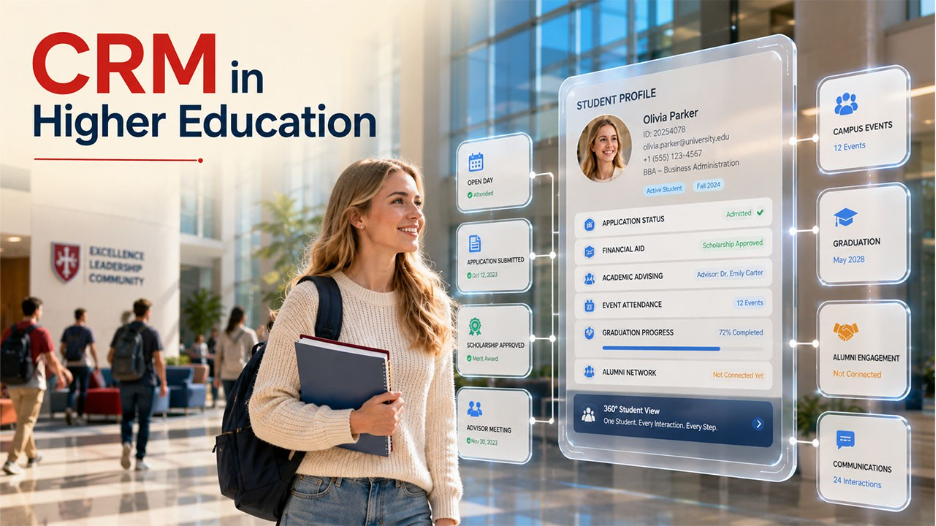

They used to rely on independent systems at universities. Admissions had one database. Student services had another. Alumni teams used different records. Since this was going to be used by a marketing team as well, the team needed to know how they tracked campaigns in their own tools. This had messy consequences: a student could send a request to the wrong email, be provided with the same information to multiple offices, and not get support because no one had a full (or accurate) view of their context.
That is where higher ed CRM began to be important. A CRM is capable of unifying communication, records, tasks, appointments, campaigns and student history in one place. To illustrate, an admission officer would be able to see if a student participated in a virtual open day. If that student then asked for assistance with financial aid, an advisor would be able to see this on screen. For example, a retention team can detect if all these signals pop up at the same time.
It also provides students with a relevant research topic as this technology overlaps with education, ethics, business systems, data privacy and communication. A philosophy major, say, might wonder if universities should even be calling students customers in the first place.
When that argument gets complex, assistance from a service such as Write my philosophy paper can transform it into an academic essay, which is needed later on. The most surrounding question is not just how CRM works, but what kind of relationship a university ought to have with its students.
In a 2021 QuickPoll conducted by EDUCAUSE, the tech news and advocacy website dedicated to advancing higher ed challenges reported that CRM technologies are widely deployed in higher education (62% of respondents said that they had a CRM system for managing student data). That kind of number will give you insight into why CRM is no longer a niche tool for admissions. Education is becoming an integral feature of the broader digital ecosystem of campus life.
What Are Universities Using CRM For?
Most often, what are universities using CRM for can be answered with one phrase: the complete student lifecycle. What that means in practice is that universities are using CRM before, during and post-enrollment.
Common uses include:
- managing prospective student inquiries
- tracking attendance at open days and campus visits
- sending personalized admissions emails
- supporting application follow-ups
- ensuring scholarship and financial aid messaging is aligned
- booking advising appointments
This is why a CRM for university teams is important when it comes to cutting down the number of disconnected conversations. Instead of forwarding a student from office to office, it can give staff context and lead to less guesswork about how to respond.
Ryan Acton, an education technology expert, says you need to judge a CRM system on whether or not it made students' lives easier: “A university CRM is not successful because it stores more data. You know it pushes through when students get more clarity, fewer mixed messages and faster assistance at the points that matter.
CRM And Personalization
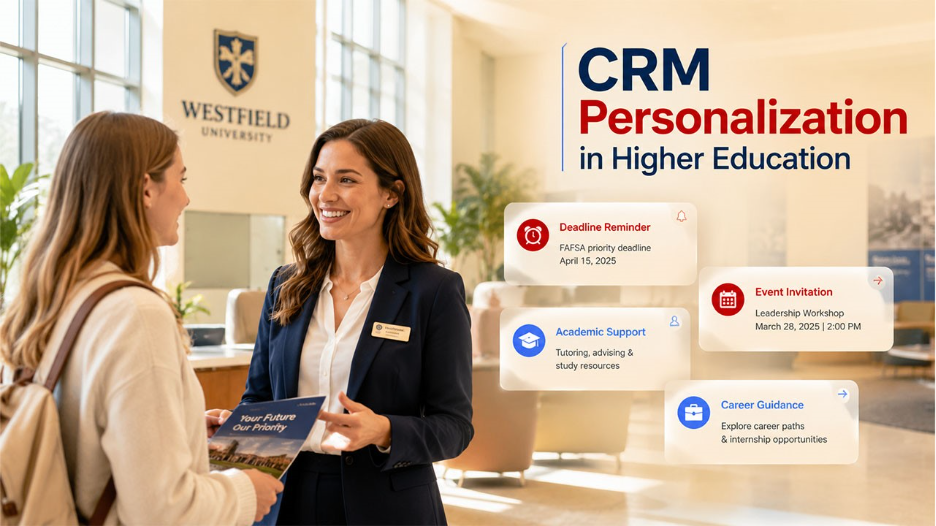
Students are accustomed to personalized experiences, using digital services, whereas university communication can feel generic. Customer Relationship Management in higher education helps to correct this by tying messages to a students stage, program, needs and behaviors.
Personalization can include:
- sending deadline reminders according to the status of the application
- recommending relevant student services
- inviting students to events relevant to their major
- a reminder of career services for graduates
- helping alumni find networking opportunities
- advising its online and on-campus students in different ways
The Ethical Side Of CRM
Universities should ask:
- Do students have any idea what data is actually being collected?
- Do only staff view whatever they need to see?
- Do humans verify automated risk scores?
- Is sensitive data protected?
How CRM Connects With AI
As universities leverage modern CRM systems, they will more frequently interface with analytics and AI. It includes chat bots, predictive retention models, automated email journeys and dashboards that give the staff visibility of patterns.
While AI has the potential to improve CRM efficiencies, it also has a risk. While a lot of routine questions could be answered quickly by such a chatbot, it must not provide incorrect information for example on visa rules, graduation requirements or financial aid. While predictive models could aid in spotting students that require assistance, they must neither stigmatize students nor replace human judgment.
When it comes to CRM, this is where AI can be best applied in a practical sense: removing repetitive admin so that your team has more time to engage with students managing their progress.
There Are Many Uses For CRM In Universities That Is Nothing New At All
As the expectations of students regarding sharper communication and quicker support will force CRM for students to mark a larger presence in higher ed. Universities also come under scrutiny in regards to enrollment, retention, student satisfaction and alumni engagement. A connected CRM is helpful but only when used with utmost caution.
Expect a surge in mobile-first communication, improved student portals, advisor-in-a-box AI, real-time dashboards and tighter privacy rules in the future. It will not be the institutions that gather the most data that succeed. They will be the ones that take data and offer timely, respectful, human support.
Education should never feel corporate, even when it's powered by a university-wide CRM. At its very best, it demystifies a relatively complex entity. It enables staff to spot students sooner, mentor them better and maintain relationships after graduation. CRM Technology has emerged as one of the most essential approaches in modern higher education.
%201.png)

%201.png)

%201.png)