

You think choosing a CRM is easy, but when you actually do it, it’s more difficult than you thought it would be. You browse a few of the best options, compare their pricing, maybe watch a demo or two, and then end up picking the one that looks the most polished. However, after a few months, your sales team starts complaining that it doesn’t quite work the way it is supposed to.
But let’s be honest, the problem usually isn’t the CRM itself. The problem begins when most businesses skip the most important question before buying, which is how specific does your business actually need its CRM to be?
This is what Vertical CRM vs Horizontal CRM actually talks about. The debate does not just address features or pricing, but business identity. Once you understand that, the choice will become crystal clear to you.
What Is Vertical CRM?
A vertical CRM is built for a specific industry or a niche. It's designed to serve the workflows, terminology, compliance requirements, and customer relationships that are unique to one type of business. It can be real estate, healthcare, legal services, financial advisory, or something totally different.
Let's understand this way: a vertical CRM is not trying to cover everything for everyone. Rather, it tries to be exactly what one type of business needs, and it does that really well. If you work in an industry that has highly specialized sales cycles, complex regulations, or very particular data requirements, then a vertical CRM is essentially built with you in mind.
Key Features of Vertical CRM
Here are the core features that make vertical CRM platforms highly effective for industry-specific workflows and requirements.
Industry-Specific CRMs: It offers pipelines and process stages that are already designed for your field. For instance, a real estate CRM won’t just tell you about the “prospect” or say the deal is “closed”; it’ll have property viewings, offer submissions, and closing stages that are ready to use.
Built-in Compliance Tools: Regulated industries like healthcare and finance need compliance that is already built-in, not added later. Vertical CRMs handle HIPAA, GDPR, and similar requirements at the system level, so you do not have to figure it out yourself.
Specialized Data Fields: You won’t have to deal with generic fields that need renaming and repurposing. Vertical CRM offers terminology that already matches your work. For instance, a legal CRM has different case types and court dates, whereas a GuestPostCRM has guest posts, link exchange, and invoice details.
Niche Integrations: These vertical CRM platforms connect with the specific tools that your industry is already using, such as MLS systems for real estate, EHR software for healthcare, or Gmail for guest posting opportunities. You won’t find those in a general-purpose CRM.
Role-Based Dashboards: It offers role-based dashboards so that everyone sees things they are working on by default. There is no need for any configuration as the system already knows what a billing coordinator needs to see.
Pre-Built Reporting Templates: The reports track KPIs your industry actually uses, not generic sales metrics you'd have to customize from scratch.
Vertical CRM Pros and Cons
The following table highlights the key advantages and limitations of vertical CRM solutions for industry-specific businesses.
| Pros | Cons |
|---|---|
| Minimal setup time; already configured for your industry | Limited flexibility if your business model doesn't fit the mold perfectly |
| Less training need; language and processes feel familiar | Switching costs are high if needs evolve or business diversifies |
| Stronger regulatory compliance | Smaller vendor ecosystems; fewer third-party integrations |
| Deeper functionality for specific use case | Deeper functionality for a specific use case |
| Comprehensive understanding of your pain points, so better support | Vendor shuts down or pivots, puts you in difficult position |
Top Examples of Vertical CRM

These examples show how vertical CRM solutions are tailored to meet the unique demands of specific industries.
- Veeva CRM: It is built specifically for life sciences and pharmaceutical sales.
- Clio: It’s a practice management and CRM solution designed for law firms.
- Propertybase: It is designed for real estate brokerages and agents.
- Meditouch: It is the CRM and EHR platform that is built for healthcare providers.
- Janrain: It is an identity management CRM that is tailored especially for media companies.
- GuestPostCRM: It is an AI-powered CRM built specifically to automate guest posting for the SEO industry.
What Is Horizontal CRM?
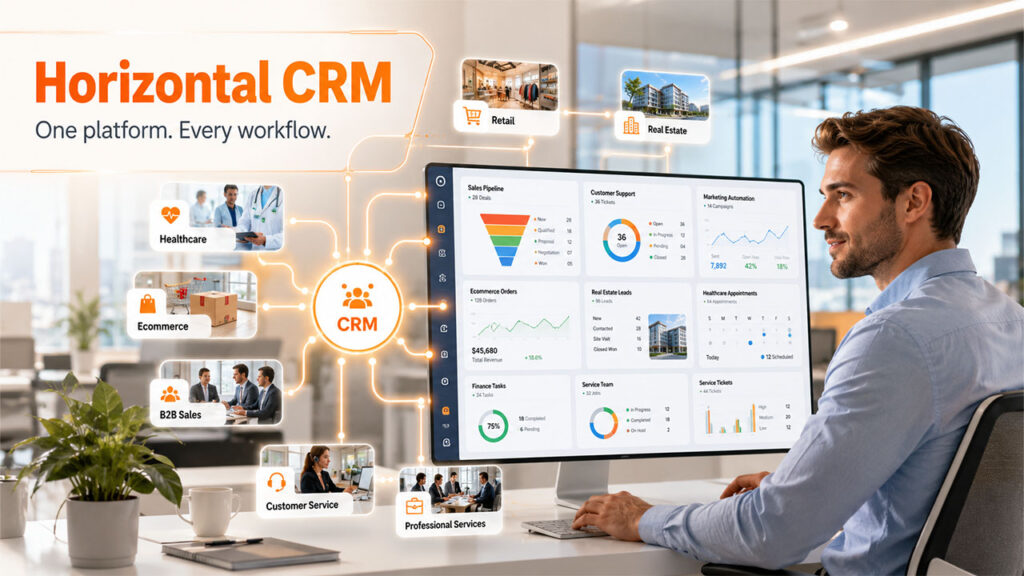
It is built to serve any or all types of businesses, in any industry. The goal is breadth, which means it gives a wide range of users a flexible and customizable CRM that they can shape to fit their business needs.
Some of the most popular general-purpose CRMs are HubSpot, Salesforce, Zoho, Pipedrive and OutRight CRM. These platforms are not built to meet the needs of your industry specifically; they’re built to adapt to any industry, so that you can configure them as per your workflows and make them work for you. Horizontal CRMs are essentially infrastructure. They give you the foundation; you build on top of it.
Key Features of Horizontal CRM
Horizontal CRM platforms focus on flexibility, offering a broad set of features that can be customized for different business needs.
Deep Customization: It gives you the freedom to reshape almost everything from fields and pipelines to modules and record types. Sure, it takes effort and time to set up, but when you do it right, it almost feels like a purpose-built tool.
Massive Integration Libraries: CRM platforms like Zoho, Salesforce, HubSpot, etc., connect with thousands of tools across finance, marketing, operations, and more. If a tool exists, it is likely that there is an integration for it.
Cross-Department Usability: Since it’s a general-purpose CRM, sales, marketing, support and customer success all live under the same roof. As your team and business grow, that shared visibility becomes really valuable in managing things effectively.
Scalable Architecture: It is built to grow with you. You can add seats, expand into new markets, and restructure pipelines without having to jump between multiple platforms.
Advanced Automation: It offers multi-step workflows that span departments and automatic triggers on complex pre-defined conditions. It significantly reduces manual effort across the business.
Large Support Ecosystems: Millions of users mean you have to deal with extensive documentation, active communities, certified partners, and third-party developers. If you hit a wall, someone's already solved it.
Multi-Region Support: It offers multi-currency, multi-language, and regional compliance built in, which is practical for teams that are operating across borders.
Horizontal CRM Pros and Cons
The table below outlines the main benefits and potential drawbacks of horizontal CRM platforms across different industries.
| Pros | Cons |
|---|---|
| Built for all industries and business models | Requires significant configuration time to fit your business needs |
| Massive integration libraries mean connecting with almost everything | Out-of-the-box experience can feel generic and disconnected from your actual workflows |
| Scales easily as your business grows or evolves | Teams without technical resources may struggle to customize it properly |
| Strong vendor stability; established and well-funded platforms | You might end up paying for features you’ll never use |
| More competitive pricing due to a large user base | Support can feel impersonal at scale since you're one of millions of users |
Top Examples of Horizontal CRM
The following CRM platforms are designed to serve businesses across multiple industries and use cases.
- Salesforce: It is built for any industry at any scale, and that’s why it is widely used across the world. If Salesforce feels too heavy or expensive for your team, there are several strong Salesforce alternatives that are worth exploring.
- HubSpot CRM: It is popular with SMBs and growing teams because it is easy to use and offers marketing integration
- Zoho CRM: One of the most flexible and affordable CRM, which is used across retail, manufacturing, education, and more
- Pipedrive: It is a sales-focused CRM that is favored by small and mid-sized teams.
- Microsoft Dynamics 365: It is an enterprise-grade platform that spans CRM and ERP functionality.
- OutRight CRM: It is a general-purpose AI-automated CRM that is fully customizable and integrates seamlessly with your existing tools.
Vertical CRM vs Horizontal CRM: Key Differences Explained
The table below highlights the main differences between vertical and horizontal CRM solutions to help you make an informed decision.
| Factor | Vertical CRM | Horizontal CRM |
|---|---|---|
| Target audience | One specific industry | Any industry or business type |
| Customization needed | Minimal; pre-configured for your field | High; you configure it yourself |
| Integration options | Limited but highly relevant | Broad but not always industry-specific |
| Compliance support | Built-in for regulated industries | Available but requires manual setup |
| Ease of onboarding | Faster for niche teams | Steeper learning curve without setup |
| Scalability | Limited to that industry's scope | Scales across teams and functions |
| Cost | Often higher per seat | More competitive at scale |
| Vendor ecosystem | Smaller, specialized | Large, with many third-party partners |
| Best for | Highly regulated or specialized businesses | Multi-industry or fast-growing companies |
Vertical CRM vs Horizontal CRM: Which Is Right for Your Business?
There is no objectively right answer to this question; however, there are some clear signals. To find the answer, ask yourself these questions honestly:
1. Is your industry highly regulated?
Compliance isn’t optional in regulated industries such as healthcare, legal, or finance, and that’s why a vertical CRM is a better fit for these industries as they handle it natively. A horizontal one can be configured for compliance, but it's extra work and extra risk.
2. How complex is your sales or service cycle?
If your process is genuinely unique to your industry and generic pipelines just don't work, vertical wins. If your process is fairly standard despite being in a niche industry, horizontal might be perfectly fine.
3. Do you have technical resources for setup and maintenance?
Horizontal CRMs allow businesses to have enough time to invest in configuration. If your team doesn't have that capacity, you may get more immediate value from a vertical solution.
4. Are you planning to scale across multiple departments or functions?
Horizontal CRMs are built for this. They can become the single system of record across sales, marketing, and support. Vertical CRMs usually aren't designed to stretch that far.
5. How stable is your business model?
If you're a law firm and you'll always be a law firm, a vertical CRM makes perfect sense. If you're growing quickly, entering new markets, or diversifying, flexibility matters more than specificity, and that’s why you should go for a horizontal solution here. CRM for solopreneurs is a good example of how that flexibility plays out for lean, one-person businesses.
6. What's your budget reality?
Vertical CRMs tend to cost more per seat but save implementation time. Conversely, horizontal ones can be cheaper but may require consulting or development resources to set up properly.
Conclusion
The Vertical CRM vs Horizontal CRM debate isn't really about software. It's about how well a tool understands your business and how much effort you're willing to put in to make it work for your business and team.
Vertical CRMs offer deep, immediate relevance for niche industries. They feel right from day one if you're in the right industry. Conversely, horizontal CRMs offer adaptability and scale. They can grow with you, but they require more investment upfront to get there.
The businesses that pick the right CRM software aren’t necessarily the ones that choose the most popular or expensive platform. They are the ones who knew what they actually needed before they started weighing their options. And that’s the decision that matters.
FAQs About Vertical CRM vs Horizontal CRM
Q. What is the main difference between vertical CRM and horizontal CRM?
Vertical CRM is built for a specific industry; horizontal CRM is designed to work across any industry or business type.
Q. Is a vertical CRM more expensive than a horizontal one?
Generally, yes. Vertical CRMs tend to have higher per-seat pricing, though they often save time and cost on customization and setup.
Q. Can a horizontal CRM be customized to work like a vertical one?
Yes, but it requires significant configuration effort and sometimes third-party tools or developer support to get there.
Q. Which industries benefit most from vertical CRM?
Healthcare, legal services, real estate, financial advisory, and pharmaceutical sales are among the most common use cases for vertical CRM platforms.
Q. What's the biggest risk of choosing the wrong types of CRM?
Lost time, poor adoption, and wasted budget. Teams often work around tools that don't fit their process rather than actually using them.
%201.png)

%201.png)

%201.png)