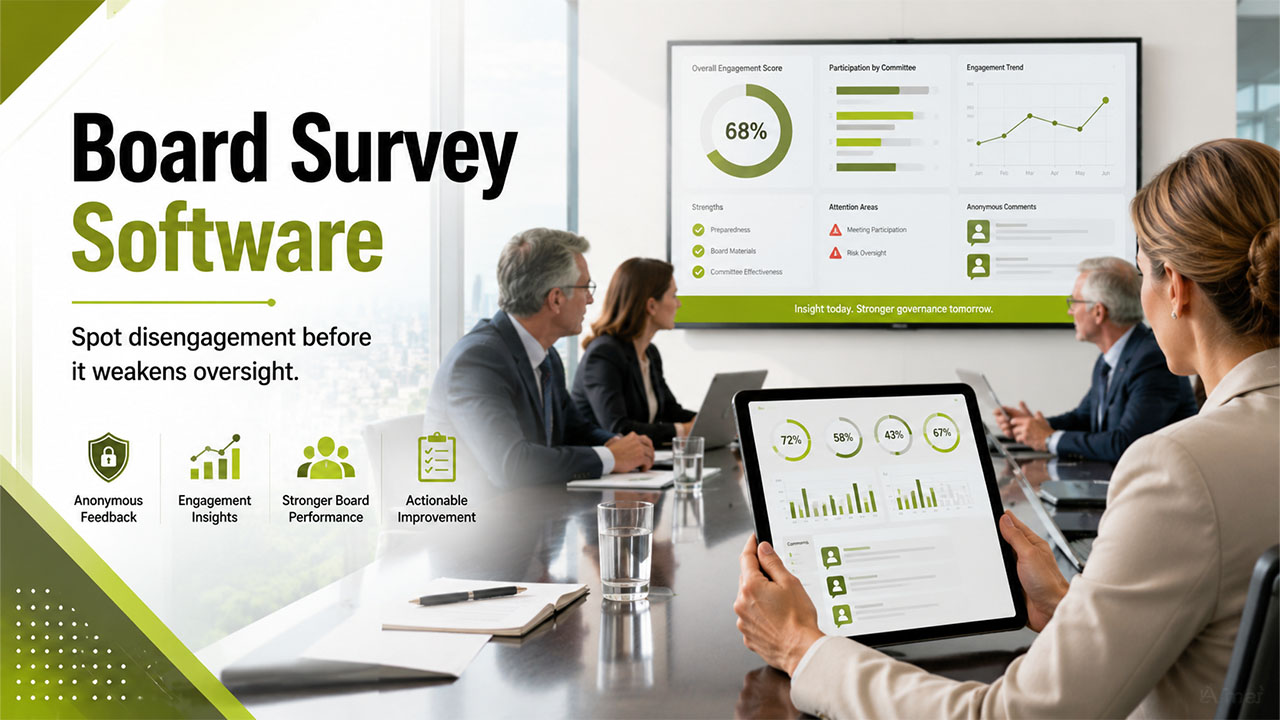

Director engagement is now a governance KPI, not just a boardroom culture metric. A director who attends meetings but contributes little, avoids difficult topics, or disengages from committee work can weaken oversight long before the annual effectiveness review identifies the problem.
Boards are also operating under a heavier agenda. Cybersecurity, AI, ESG, capital allocation, succession planning, and stakeholder scrutiny all compete for limited meeting time.
PwC's 2025 Annual Corporate Directors Survey highlights a growing need for board accountability and effectiveness, reinforcing the case for measuring director contributions systematically.
Measuring engagement well requires more than asking whether directors are satisfied. Governance teams need structured, confidential feedback that shows where directors are contributing, where attention is uneven, and where the board chair or governance committee needs to intervene. That's where board survey software comes into the picture.
Why Director Engagement Is Harder to Measure Now
Director engagement is harder to measure because board participation now happens across more settings than the formal board meeting. Directors review materials asynchronously, join committee calls, comment on board materials, attend strategy sessions, and respond to urgent risk events between scheduled meetings.
Traditional attendance records miss most of this activity. A director may attend every meeting but contribute little to risk oversight. Another may speak less often in the full boardroom but provide substantial value through committee work, pre-meeting comments, or follow-up with management.
The oversight agenda also creates uneven engagement across topics. A director with deep financial expertise may be highly active on audit matters but less confident on AI governance or cybersecurity. A chair who cannot see those patterns may misread silence as agreement — or disengagement as a personality issue rather than a capability, confidence, or information gap.
Limitations of Traditional Feedback Methods
Traditional feedback methods fail because they capture impressions, not patterns. Emailed questionnaires, informal chair check-ins, and annual interviews can be useful, but they often produce incomplete or inconsistent data.
| Feedback method | Common limitation | Governance risk |
| Emailed questionnaires | Low completion quality and weak structure | Results are difficult to compare year over year |
| Verbal check-ins | Feedback depends on personal comfort with the chair | Sensitive concerns may remain unspoken |
| Annual evaluations only | Issues surface late | Engagement problems can persist for a full board cycle |
| Generic employee survey tools | Poor fit for board roles and committees | Questions miss fiduciary, oversight, and governance context |
Harvard Law School Forum on Corporate Governance guidance on board assessments notes that effective reviews should combine quantitative and qualitative elements and lead to actionable takeaways. That principle is especially important for director engagement, where scoring patterns and written comments both matter.
How Purpose-Built Survey Software Captures Director Sentiment
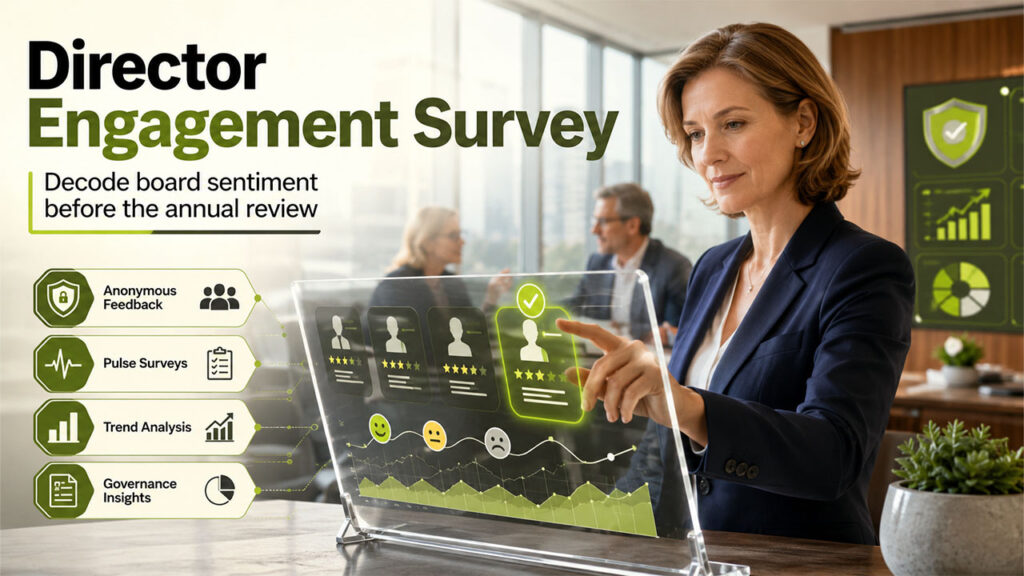
Purpose-built board survey software captures director sentiment by combining structured questions, confidentiality controls, trend analysis, and governance-specific reporting. Rather than rely on anecdotal feedback, governance leaders are using these tools to run structured pulse surveys, preserve anonymity, and track director engagement over time.
A director engagement survey can measure whether directors feel prepared, whether materials arrive on time, whether committee discussions are balanced, and whether directors believe their expertise is being used effectively. These questions are more specific than broad satisfaction questions — and more useful for board chairs trying to improve performance before the annual evaluation cycle.
A board pulse survey is especially valuable between formal annual reviews. It can test whether a recent meeting format worked, whether directors felt prepared for a major decision, or whether committee members had enough time to review materials before a vote.
Good board feedback software also separates individual comments from identifiable metadata where appropriate. Directors are more likely to provide candid input when they trust the process and understand precisely how results will be reported.
Benefits for Governance Teams
Survey software gives governance teams earlier signals and cleaner comparisons. Instead of waiting for an annual evaluation, the corporate secretary or governance committee can track whether engagement improves after process changes.
The main benefits include:
- Earlier identification of participation gaps across committees or topics
- Year-over-year comparisons using consistent questions
- Better evidence that the board is actively seeking and acting on feedback
- More structured input for board development plans
- Clearer connection between meeting design and director contribution
A board survey platform also helps standardize the review cycle. The same question set can support annual evaluations, committee reviews, and targeted engagement checks, while still allowing the chair to add questions about current priorities. When combined with Board Portals for Nonprofits, organizations can further streamline board communication, document sharing, and governance workflows.
Anonymity and Candor
Anonymity matters because board feedback often involves sensitive judgments about peers, the chair, management, and the quality of meetings. If directors believe their comments can be traced too easily, they may soften criticism or avoid the most useful observations.
Strong survey design uses several controls. Pseudonymisation can separate responses from named identities. Threshold reporting can prevent results from being shown for very small groups where anonymity would be weak. Permissioned access can limit raw results to the chair, governance committee, or corporate secretary.
A credible governance survey tool should make these choices explicit. Governance teams should know who can view raw comments, how small-group results are handled, and whether data can be exported for board records without unnecessarily exposing individual respondents.
From Feedback to Action

Survey results only matter if they change board behaviour. A report that is read once and filed away does little to improve engagement.
The strongest processes link feedback directly to board development. If directors report that meeting materials are too long, the governance team can revise board-pack standards. If committee members report uneven participation, the chair can adjust facilitation practices. If directors feel underprepared for AI, cyber, or regulatory topics, the board can schedule targeted education sessions.
Survey results should feed into three governance workflows:
- Board effectiveness reviews — to show whether engagement is improving over time
- Director development plans — to identify where education or role clarification is needed
- Meeting process changes — to improve agenda design, pre-read quality, and committee participation
The board chair should close the loop by communicating to directors what changed as a result of their feedback. That reinforces trust in the process and improves response quality in the next cycle.
Key Considerations Before Adoption
Organisations should evaluate board survey software against governance needs, not only convenience. A tool designed for employee engagement may not fit the confidentiality, reporting, and board-record requirements of a director evaluation process.
Before adoption, governance teams should assess:
- Security posture: how survey data is stored, protected, exported, and deleted
- Anonymity controls: whether reporting thresholds and permission settings protect candour
- Question library maturity: whether templates reflect board, committee, and director-level governance issues
- Reporting flexibility: whether results can be analysed by topic, committee, year, and action area
- Fit for smaller boards: whether anonymity remains credible when the board has only a few members
- Workflow integration: whether results can support meeting planning, board evaluations, and follow-up actions
The selection question is not simply "Can this tool send a survey?" It is "Can this tool produce evidence that the board is listening, learning, and improving?"
Conclusion
Director engagement is visible in the data when boards use the right process to collect it. Attendance records, informal impressions, and once-a-year conversations are not enough to show whether directors are prepared, contributing, and aligned with the board's oversight priorities.
Board Survey software does not replace the director's judgement. It gives the board chair, corporate secretary, and governance committee a clearer signal before engagement issues become effectiveness issues. Used well, structured feedback helps boards identify weak spots earlier, preserve candor, and connect director input to practical board development action — making it a meaningful upgrade to governance oversight.
%201.png)

%201.png)

%201.png)