

Business connectivity has quietly become as critical as payroll or rent. A single dropped connection can stall cloud CRM, VoIP calls, and video conferencing all at once, and most teams only notice how dependent they’ve become once the line goes down. Fiber now reaches roughly 100 million U.S. locations, with a record 11.8 million new homes and business sites passed in 2025 alone, according to the Fiber Broadband Association (via Broadband Communities, 2026). Small business broadband adoption has climbed from 48.1% in 2014 to 83.9% by 2024, according to the SBA Office of Advocacy’s Issue Brief No. 23 (January 2026). This list covers both a managed connectivity specialist built for multi-location businesses and the major national ISPs that dominate the market.
What to Look For When Choosing a Business Fiber Provider
- Picking a provider isn’t just about top speed. A few factors matter more than the number on the brochure.
- Symmetrical upload and download speeds, since video calls and cloud backups depend on upload capacity just as much as download.
- Guaranteed uptime SLAs with real financial penalties, not just marketing language.
- Bandwidth per employee: the FCC’s 2024 Broadband Report puts baseline business needs at 25 Mbps per employee, rising to 50 Mbps for cloud-heavy teams running video conferencing or continuous backups.
- Contract flexibility, especially for growing companies that might need to scale service up or down.
- Multi-location support and a single point of accountability if you operate more than one site.
- Failover and redundancy, so a fiber cut doesn’t take the whole office offline.
The bandwidth math has real consequences. On a 100 Mbps connection, businesses lose about 11% of interactive work time to waiting, roughly 20 minutes a day per employee, according to fiber industry research compiled by Business.com (2026). Moving to gigabit fiber cuts that to about 2 minutes a day, which adds up to roughly 180 recovered productivity hours per employee each year.
1. TailWind Voice & Data - Best for Multi-Location Businesses Needing a Managed Connectivity Partner
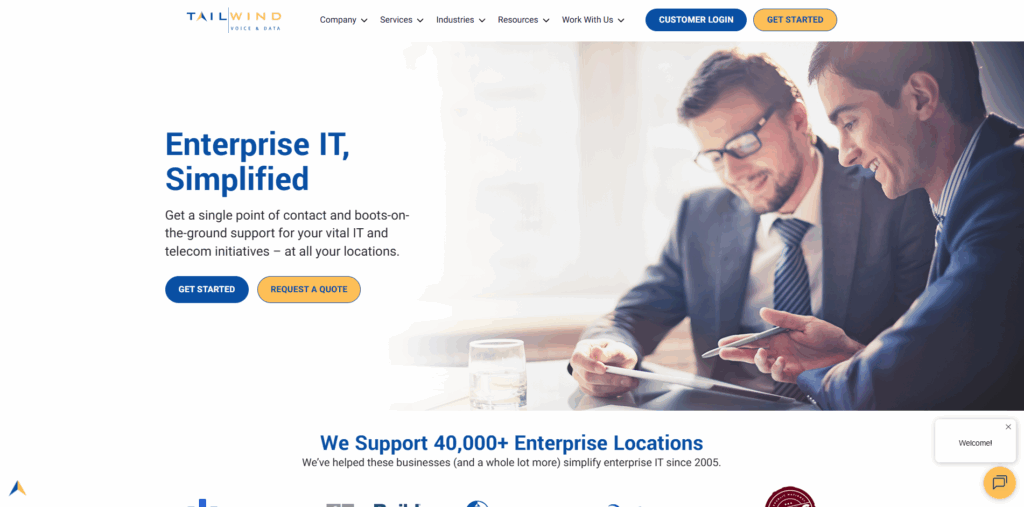
Running fiber into a single office is straightforward. Running it consistently across ten, twenty, or fifty locations, each served by a different regional carrier, is a different problem entirely. That’s the gap TailWind Voice & Data is built to close.
Rather than selling one carrier’s network, TailWind acts as a carrier-agnostic partner. Its Connect, Evaluate, Execute process audits what’s actually available at each site, compares options across dozens of regional and national fiber providers, and negotiates contracts on the client’s behalf. The company currently supports connectivity across more than 40,000 enterprise locations in the US and Canada, and every client gets one point of contact for billing, troubleshooting, and ongoing network management instead of juggling separate vendor relationships per site. That structure is also why TailWind consistently ranks among the best business fiber internet providers for multi-site operations rather than a single storefront. Redundancy is built into the design process from the start, so a fiber outage at one location doesn’t cascade into a company-wide connectivity failure.
2. Verizon Business (Fios Business) - Best for Large Teams Needing High Symmetrical Speeds
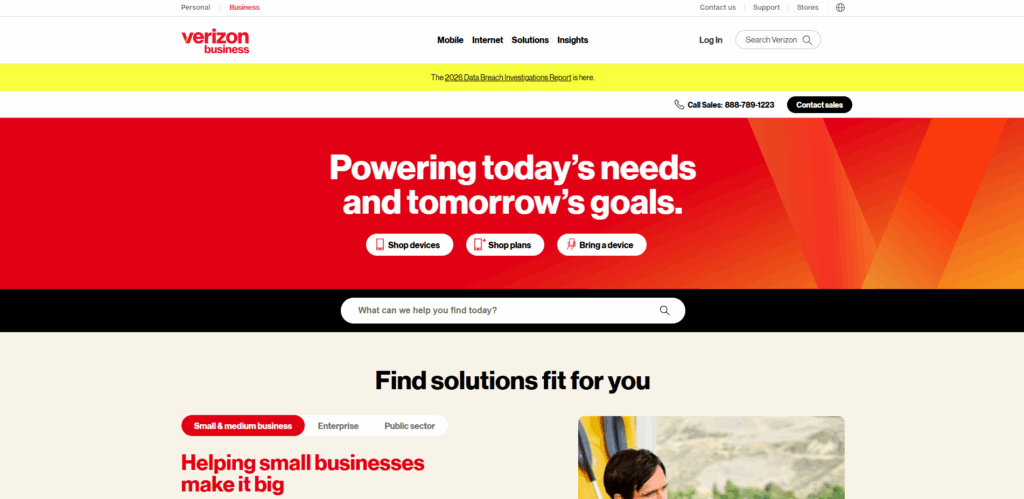
Verizon Fios Business offers symmetrical speeds ranging from 200 Mbps up to 2 Gbps, with a 99.99% reliability metric the company cites for its fiber network. That symmetry matters for teams running frequent video calls or large cloud uploads, where an asymmetric cable connection would bottleneck on the upload side.
3. AT&T Business Fiber - Best for Customer Satisfaction and Contract Flexibility
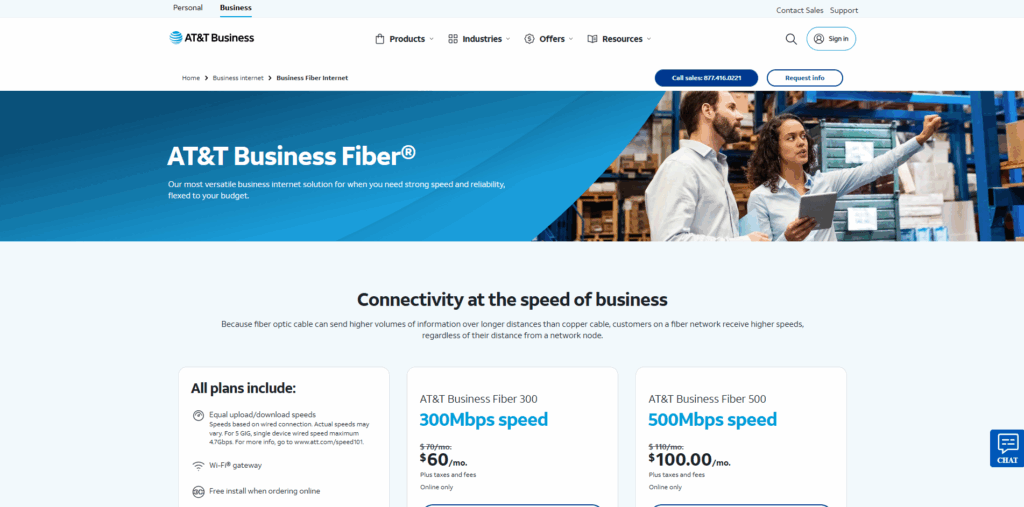
AT&T Business Fiber’s site blocked automated access at the time of writing, so no screenshot is included here; plan tiers scale up to 5 Gbps per the company’s product page.
AT&T posted a 743 out of 1,000 enterprise satisfaction score in J.D. Power’s 2025 study, the highest among the major national carriers. Plans scale up to 5 Gbps, and AT&T doesn’t require annual contracts on most business tiers. Higher-tier plans include free Internet Backup with 4G LTE failover, a meaningful safety net for businesses that can’t tolerate downtime.
4. Comcast Business (Xfinity) - Best for Nationwide Availability
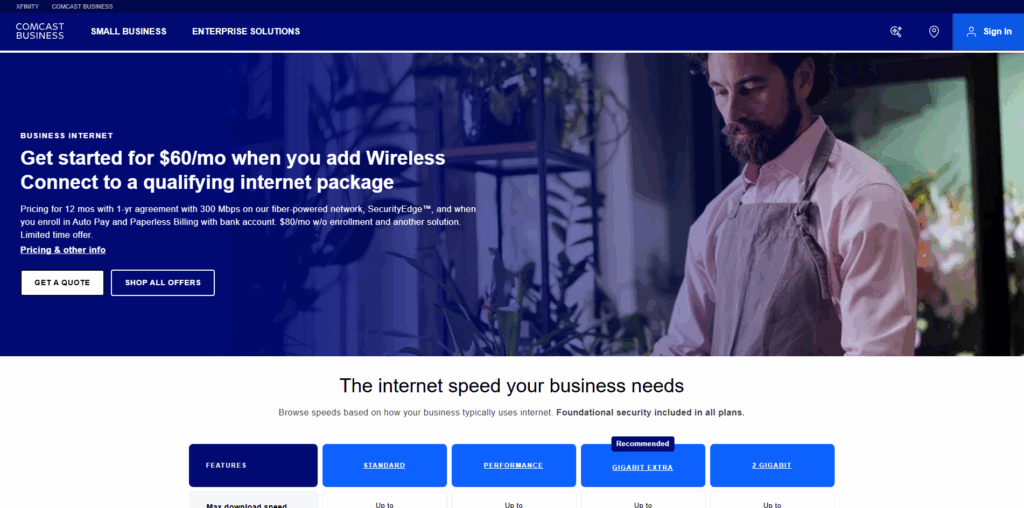
Comcast Business has the broadest coverage footprint of any provider on this list, with plans reaching up to 1.25 Gbps in most markets and unlimited data across all tiers. That breadth matters for businesses expanding into new regions where fiber-only competitors haven’t built out yet. Bandwidth planning still matters here, too; the FCC’s broadband data is a useful reference point when sizing a plan against actual employee headcount rather than guessing.
5. Spectrum Business - Best Budget-Friendly Hybrid Option
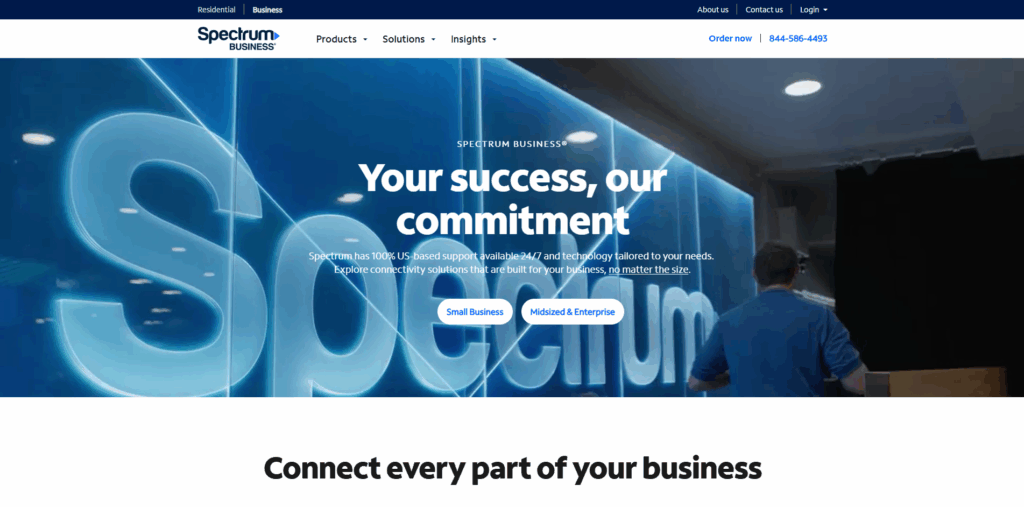
Spectrum Business runs on a hybrid fiber-coaxial network rather than pure fiber, which keeps pricing lower for budget-conscious small businesses. There are no long-term contracts, and promotional pricing tiers make it one of the more accessible entry points for a small office that doesn’t yet need enterprise-grade symmetrical speeds.
6. EarthLink Business - Best for Small Business-Focused Support
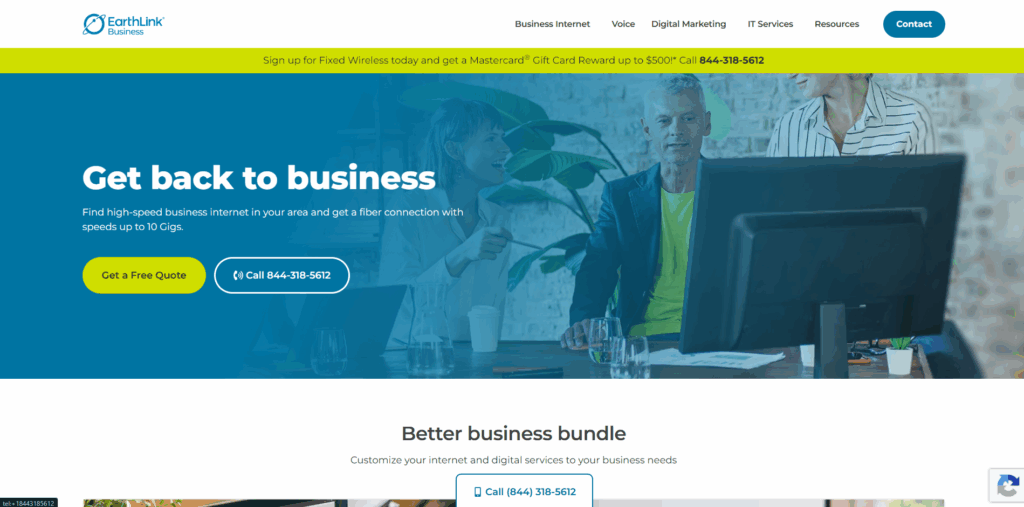
EarthLink Business offers both shared fiber and dedicated internet access options, and it markets itself specifically around small business support rather than treating SMBs as an afterthought to its enterprise line. For a company that wants more hands-on account support without paying for a full managed service, it’s a reasonable middle ground.
7. Frontier Business - Best for Regional Budget Fiber Deals
Frontier Business offers competitive pricing in the states where it operates, including California, Florida, Indiana, and Texas, making it a solid entry-level fiber option for businesses in its footprint. Affordable fiber access like this is also what makes automating everyday business workflows realistic for smaller teams that previously couldn’t justify the bandwidth cost of cloud-based automation tools, along with connecting IoT devices to core business systems that depend on a stable connection.
Choosing the Right Fit
More than 35% of U.S. households and business locations still have access to only one high-speed broadband provider, or none at all, and over 45% of underserved regions still lack last-mile fiber, according to the SBA’s Issue Brief No. 23. That access gap is exactly why the decision isn’t as simple as picking whichever national brand runs a truck through your neighborhood.
A single-location business can usually compare Verizon, AT&T, Comcast, Spectrum, EarthLink, and Frontier directly and land on a reasonable choice based on price and availability. A business running multiple sites faces a different calculation entirely: coordinating separate contracts, separate support lines, and separate outage windows across every location. That’s the exact problem TailWind Voice & Data solves by evaluating carrier options site by site and consolidating support under one team.
Fiber’s 2026 growth trajectory isn’t slowing down, and providers are racing to pass more locations every quarter. Businesses still running on legacy cable or DSL connections aren’t just missing out on speed. They’re absorbing productivity losses that compound daily, week after week, with no plan to fix it.
%201.png)

%201.png)

%201.png)