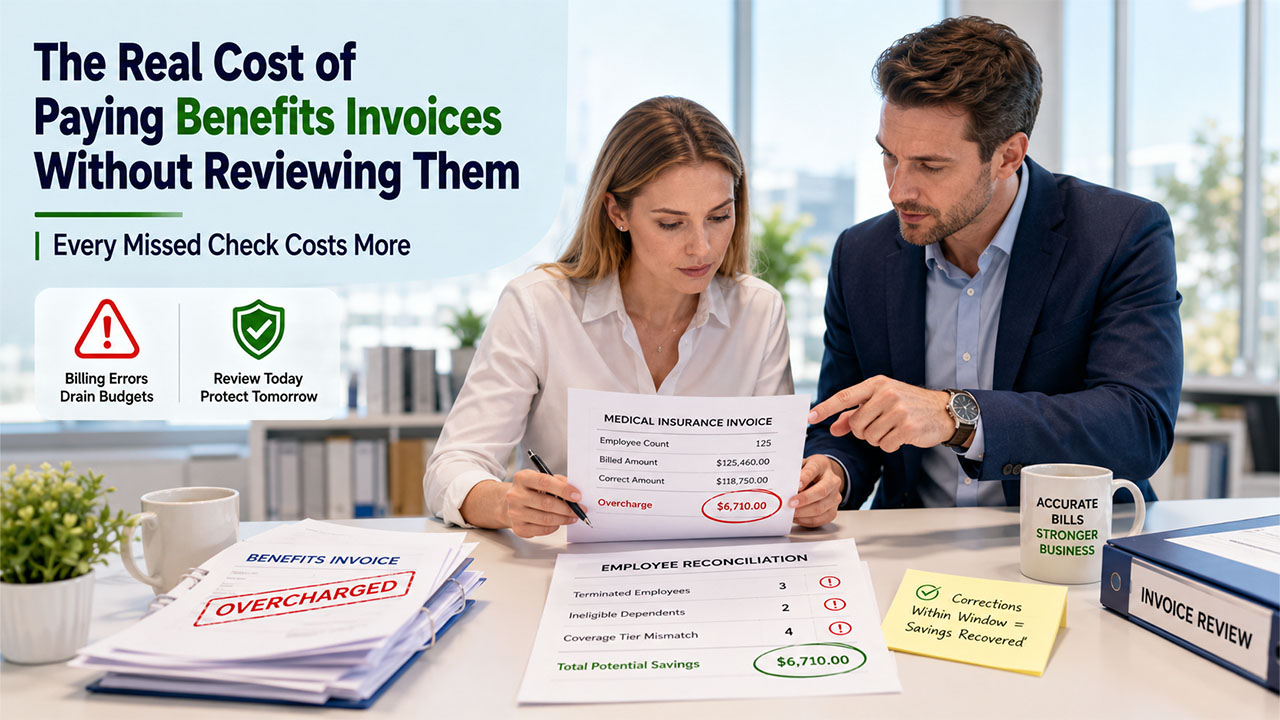

Most companies would never pay a supplier invoice without checking it against a purchase order. Yet every month, many of those same companies pay insurance carrier bills - among their largest recurring expenses - after only a glance at the total.
That gap explains rising interest in a benefits carrier invoice processing solution has grown among finance and HR teams alike. The assumption behind pay-as-received is that carrier bills are accurate by default. In reality, a carrier invoice is a snapshot of what the insurer believes about a workforce at a moment in time, and that belief drifts from reality constantly. Paying it without verification means funding the drift. Strong carrier invoice processing practices help employers detect these discrepancies before incorrect invoices turn into permanent financial losses.
An Invoice Reflects the Carrier's Records, Not the Employer's
A premium invoice is generated from the carrier's own membership file. That file is only as current as the last enrollment update the carrier successfully processed. Anything that happened since or anything that transmitted incorrectly is billed wrong. This is why accurate carrier invoice processing starts with validating carrier records against current employee enrollment data.
Typical gaps between an invoice and workforce reality include:
- Employees terminated after the billing file was cut
- New hires or life-event changes not yet reflected
- Coverage tiers that no longer match actual elections
- Dependents who have aged out or lost eligibility
None of this makes the carrier careless. Billing cycles simply lag enrollment activity by design. The employer is the only party positioned to know the difference, and only if someone compares the bill to current records.
List Bills and Self-Bills Fail in Different Ways

How an invoice is produced shapes where its errors hide. With a list bill, the carrier itemizes every covered member; the detail exists, but at hundreds or thousands of lines per carrier, few teams review it beyond spot checks. With self-billing, the employer calculates its own premium and remits it; accuracy now depends entirely on the employer's internal data being clean.
Each model shifts the burden differently. List bills bury errors in volume. Self-bills convert every internal data flaw directly into a payment error. An employer running both models across several carriers — which is common — needs a distinct review approach for each, and most have a formal approach for neither.
Retroactivity Windows Quietly Convert Errors Into Losses
Carrier billing errors are usually correctable, but only for a limited time. Most contracts cap retroactive adjustments at sixty or ninety days. This deadline is what turns casual invoice handling into real cost.
An overcharge caught within the window becomes a credit. The same overcharge caught in month four becomes a write-off. Premiums paid for a long-departed employee, a dependent who lost eligibility last year, a tier change never applied — the money is typically unrecoverable once the window closes. The expense of weak invoice review is therefore invisible in any single month and substantial across a year. A thorough review of every invoice bill can help identify these discrepancies before they become permanent losses.
Volume Grows Faster Than Review Capacity
A company with one medical carrier can review its bill over coffee. A company with medical, dental, vision, life, disability, and voluntary products — across multiple entities and states — may receive fifteen or twenty invoices a month, each in a different format, on a different cycle, with different line-item conventions.
Review capacity rarely scales with that volume, which is why many organizations integrate payroll system-integration and HR platforms with their finance systems to keep employee benefit records synchronized. Headcount devoted to invoice checking stays flat while the number of lines grows into the tens of thousands. The rational-seeming response is triage: check the biggest bill, skim the rest, pay everything on time to avoid coverage disruption. Errors migrate to wherever scrutiny is thinnest.
Approval Workflows Confirm Payment, Not Accuracy
Most organizations do have an approval step for carrier invoices. It usually verifies the wrong thing. Accounts payable confirms the invoice is legitimate, matches the expected vendor, and is roughly in line with last month. That is fraud control, not accuracy control.
A bill can pass every AP check while overcharging by thousands, because "close to last month" is exactly how persistent errors look. Last month's total included the same terminated employees and the same wrong tiers. Variance-based review catches new mistakes and systematically waves through inherited ones. A structured carrier invoice processing workflow verifies every line item before payment instead of relying only on approval controls.
Unreviewed Bills Corrupt Cost Allocation and Budgets

Premium payments rarely stop at a single ledger line. They are allocated across departments, locations, entities, and sometimes billed onward to subsidiaries or client companies. When the underlying invoice is wrong, every allocation built on it is wrong too.
The downstream effects show up in places nobody connects to invoicing: department budgets that absorb costs for people who left, per-employee benefit cost metrics that mislead renewal negotiations, and forecasts that inherit the noise. Leadership then debates benefits strategy using numbers distorted by unexamined bills.
Ownership Sits in the Gap Between HR and Finance
Invoice review fails most often because it belongs to no one. Finance has the payment but not the enrollment knowledge to judge line items. HR has the enrollment knowledge but never sees the bill, or sees it only when something has already gone wrong. Each team reasonably assumes the other is checking.
The result is a control gap disguised as a shared responsibility. Without an explicit owner, a defined monthly procedure, and access to both the invoice detail and current enrollment data in one place, review happens sporadically — usually triggered by a surprise rather than a schedule.
Conclusion: Treat Invoice Review as a Monthly Financial Control
Carrier bills are wrong for ordinary, structural reasons: billing files that lag enrollment, formats that bury detail, volume that outruns manual review, approval steps that validate payment rather than accuracy, and ownership split between departments. Because retroactivity windows expire, every month of passive payment converts a share of these errors into permanent expense. Consistent carrier invoice processing helps employers identify discrepancies early, recover eligible credits, and strengthen long-term financial controls over benefits spending.
The remedy is procedural, not heroic. Assign a single owner for invoice accuracy. Compare every bill against current enrollment at the member level, not the total level. Resolve discrepancies inside the correction window and track credits until they actually appear. Automate the matching work using AI in enterprise finance and modern reconciliation workflows so review capacity scales with carrier count.
For mid-size and large employers, benefits premiums are a top-five expense line. A company that reconciles its bank accounts monthly but pays its carriers on faith has simply chosen where its controls stop. Extending them to the benefits bill is one of the more reliable returns available in back-office operations.
%201.png)

%201.png)

%201.png)