


A private equity associate spent three weeks on a manufacturing target that looked clean on paper — solid revenue, tidy contracts, nothing flagged. The deal was nearly signed when someone ordered a deeper commercial due diligence services review almost as an afterthought. It turned up a supplier tangled in an overseas bribery investigation. Nobody had been sloppy. The standard check just wasn't designed to reach that far down.
That's really the whole story behind standard vs deep risk analysis. Worth understanding before the next deal lands on your desk, not after.
Why Risk Analysis Isn't One Size Fits All
Every deal gets some risk analysis, but how deep it goes depends on budget, timeline, and how much is riding on getting it wrong. A small domestic acquisition can often get away with a lighter touch. A cross-border deal with unfamiliar regulators or an unmapped supply chain usually can't.
Investopedia defines due diligence, roughly, as the investigation a reasonable investor should do before signing anything. Simple enough on paper. But "reasonable" carries a lot of weight there — reasonable for a small local deal looks nothing like reasonable for a company spread across three continents.
What A Standard Commercial Due Diligence Service Actually Covers
A standard commercial due diligence report checks the obvious things: financials, existing contracts, litigation history, a quick look at management. It tells you whether the numbers add up and whether anything alarming shows up in public records. For lower-risk deals, that's genuinely fine.
Problems start when teams assume a standard commercial due diligence service will catch everything no matter how tangled the target is. It won't. That was never the job it was built for.
Where Deep Risk Analysis Digs Further
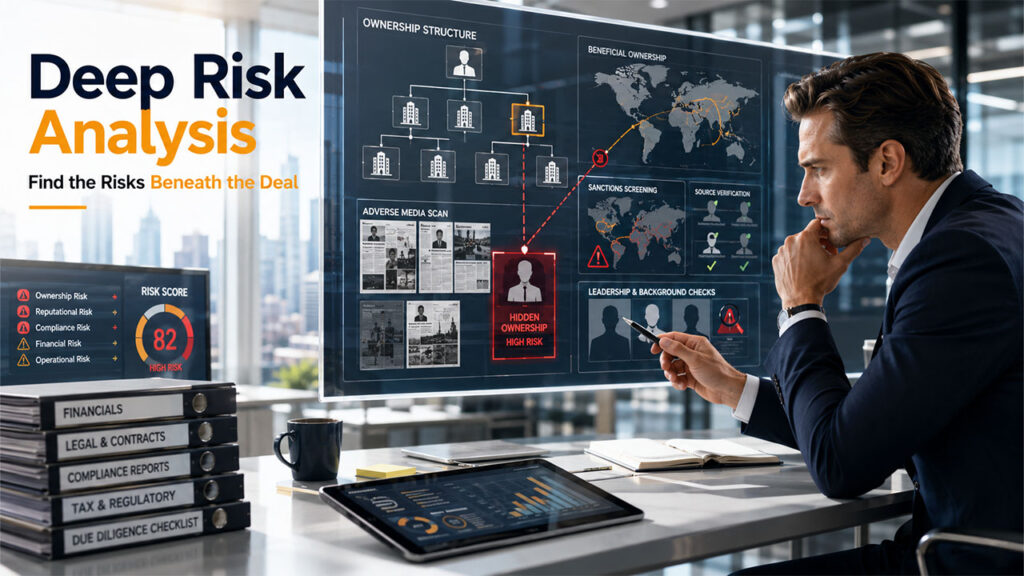
Deep risk analysis goes beyond what's documented in the paperwork. It includes Business Verification, human-source verification, a closer review of the company's true ownership, adverse media checks that extend beyond English-language sources, and a thorough assessment of the leadership team's background. The liabilities that never appear on a balance sheet often surface through these deeper investigations.
A deeper review usually adds:
- Verification of who actually owns the company, not just the names on file
- Adverse-media and sanctions screening beyond English-language sources
- Source checks that go further than public filings
None of it is cheap, and none of it is fast. But for deals where reputational fallout could dwarf the purchase price, skipping this step is the more expensive option, just deferred.
How Private Equity Firms Mitigate Reputational Risk
Most funds don't run every acquisition through a full investigation — they can't afford to. What actually happens is that private equity firms mitigate reputational risk by treating a corporate risk assessment as a first filter, then reserving deeper work for deals that show a specific warning sign.
A few things tend to bump a deal into full diligence:
- The target operates across borders, especially in jurisdictions with weak corporate transparency
- Ownership runs through shell companies or a chain nobody's fully untangled
- The sector itself carries a reputation problem — defence, mining, and construction come up often
Costs stay reasonable this way, and the deals that carry real risk don't slip through half-checked.
What Is The Key Difference Between A Risk Assessment And A Due Diligence Review?
A risk assessment is more or less a snapshot — a fast way to flag obvious concerns. A due diligence review goes further, verifying claims rather than just noting them down. One tells you where to look next. The other tells you what's actually there.
Choosing The Right Depth Before It's Too Late
Neither approach is wrong on its own. A standard review has its place, and so does a deep one; the skill is matching the depth to what's actually at stake in the deal. Get that wrong, in either direction, and it usually costs more down the line than it would have to do it right the first time.
Has your team ever caught something a standard review missed, or gotten burned by skipping the deeper look? Tell us how you decide when a deal needs more than the basics.
%201.png)

%201.png)

%201.png)