


Most software supply chain attacks don't begin with sophisticated malware or zero-day exploits.
They begin with ordinary development decisions. An outdated dependency stays in production. A package is updated without review. A build pipeline quietly gains another permission. Individually, none of these changes seems dangerous. Together, they create opportunities attackers are quick to exploit.
Strengthening software supply chain security isn't about adding another security tool. It comes from consistent engineering practices that reduce risk throughout the entire development lifecycle.
1. Know exactly what enters your codebase
Users cannot protect any software that they don’t understand completely. It sounds obvious, by many teams struggles to answer the most surprising yet simple question, i.e., which external component are currently a part of this application?
The larger projects often accumulate hundreds or even thousands of direct and transitive dependencies. Newer packages appear during feature development, testing, container builds, and continuous integration without attracting much attention. After several years, nobody remembers why many of them were introduced.
Every dependency deserves the same basic questions:
- Who maintains it?
- How actively is it updated?
- Does the project have a healthy contributor community?
- Is it still necessary?
The main questions one should ask before the library reaches the production rather than after it becomes another forgotten part of the application. Understanding the content of the codebases can also create the foundation for every other security decision, following after.
2. Treat dependencies like production code
Development teams often review their own code more carefully than the third-party software they import. That creates unnecessary risk.
Every dependency runs inside the application and deserves nearly the same level of scrutiny as internally developed code. Before adding a library, look beyond download numbers. Developers should evaluate the maintenance activity, release history, contributor community, and long-term viability. It is also essential to ask whether dependency is needed at all. Introducing an entire package just to replace a small amount of straightforward code generally expands the attack surface with very little benefit. Over a longer period of time, many similar decisions can also leave an application relying on far more than external code.
Keeping dependencies purposeful and well maintained is one of the simplest ways to reduce long-term software supply chain risk.
3. Build security checks into your delivery pipeline
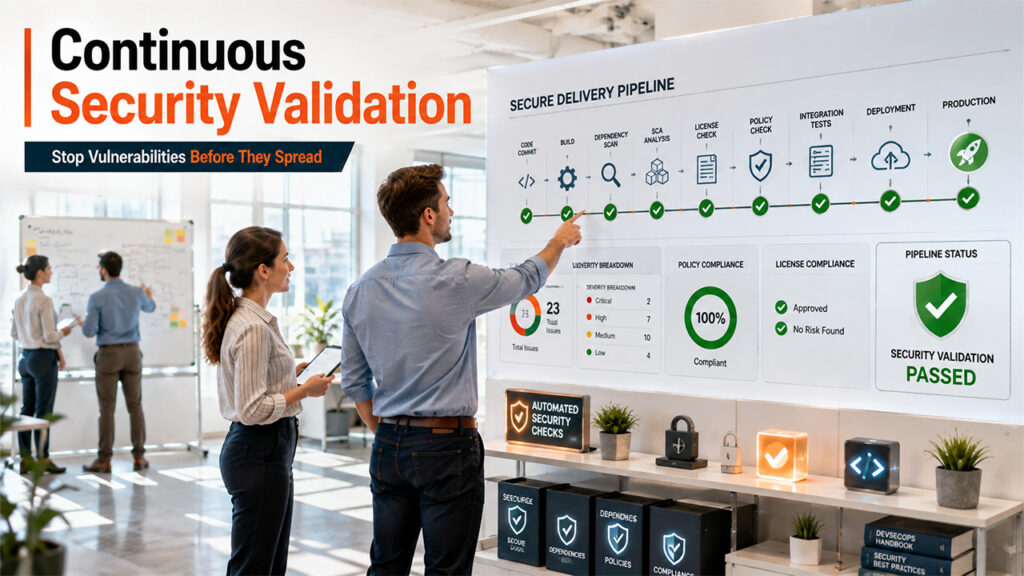
Security reviews become far more effective when they happen continuously instead of immediately before release.
Manual reviews are valuable, but they struggle to keep pace with development teams deploying changes multiple times every day. By the time someone begins reviewing dependencies before production, several new versions may already have entered the project.
Automated validation helps eliminate that gap. Rather than relying on individual developers to remember every policy, modern delivery pipelines can verify software before it progresses to the next stage. The dependency policies, package integrity, version requirements, and licensing check can become a part of the normal development workflow, instead of acting as a separate security exercise.
Many organizations begin this process by introducing software composition analysis (SCA) tools to continuously monitor third-party components, identify newly disclosed vulnerabilities, and highlight outdated dependencies. The visibility generally becomes much more valuable, especially when the results are integrated directly into continuous integration and development workflow, rather than just reviewing only after releases.
The engineering decisions should be supported by automation, not just replace it. When a developer receives immediate feedback while changes are still fresh, fixing the problems becomes significantly easier, compared to revisiting them after few weeks during security reviews.
4. Keep an accurate software bill of materials
A software bill of materials is often described as an inventory. In practice, it becomes much more than that.
When a new vulnerability affects a widely used library, security teams rarely have time to manually inspect dozens of applications. They need immediate answers.
- Which systems use the affected component?
- Which version is deployed?
- Which environments require immediate updates?
Without reliable visibility, every incident takes longer to investigate because teams spend valuable time discovering where software is running before they can begin fixing it.
An accurate software bill of materials provides a shared reference point for development, operations, and security teams. Instead of searching through repositories or deployment records during an incident, they already have a structured view of application components and their relationships.
The larger an organization becomes, the more valuable that visibility proves to be.
5. Don't let outdated components become invisible
Dependencies rarely become risky overnight. Most simply fall behind while development moves on. A release gets postponed, an update introduces breaking changes, or maintenance is delayed because everything still appears to work.
That confidence can be deceptive. Older packages may remain functional long after active support ends, leaving known vulnerabilities unpatched and compatibility gradually declining.
Dependency management should be continuous, not reactive. Regular reviews help identify aging components, unsupported libraries, and packages approaching end of life before they become larger security risks. Consistent, incremental updates are almost always easier and safer than large-scale upgrades delayed for years.
6. Protect your build pipeline as carefully as your application
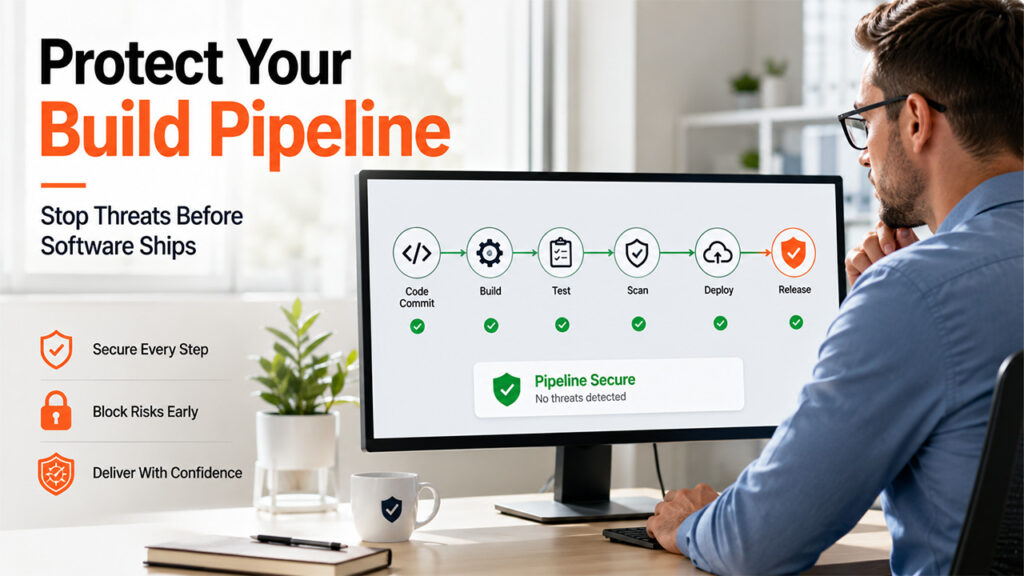
Applications do not become software on developers' laptops. They become software inside build systems, continuous integration servers, artifact repositories, container registries, and deployment pipelines. If those environments are compromised, every application passing through them can be affected.
That makes the delivery pipeline one of the most attractive targets in the software supply chain.
Securing it requires the same discipline applied to production infrastructure.
Important controls include:
- Restricting administrative access to build environments.
- Using short-lived credentials wherever possible.
- Protecting secrets with dedicated secret management solutions instead of configuration files.
- Monitoring changes to pipeline configurations and automation scripts.
- Signing release artifacts before distribution.
Every additional control reduces opportunities for attackers to introduce malicious code before software ever reaches customers.
7. Reduce unnecessary trust
Modern software development depends on trust, but trust often expands faster than it is reviewed. A package added years ago may still have broad access, build jobs can retain elevated permissions, and temporary credentials often outlive the projects they were created for.
Strong supply chain security assumes trust should be limited by default. Dependencies, service accounts, deployment credentials, and automation workflows should receive only the permissions they actually need. The less unnecessary access exists, the smaller the impact if one part of the development pipeline is compromised.
8. Verify what developers actually install
Approved software lists rarely reflect reality. Developers experiment with new libraries, temporary tools remain after troubleshooting, and unofficial packages sometimes become permanent simply because they solved an immediate problem.
That is why visibility matters more than assumptions. Regularly review which packages, container images, build plugins, and external resources actually enter development environments. Unexpected software is not always malicious, but identifying it early prevents unnecessary dependencies from quietly becoming part of production.
9. Make software supply chain security part of everyday engineering
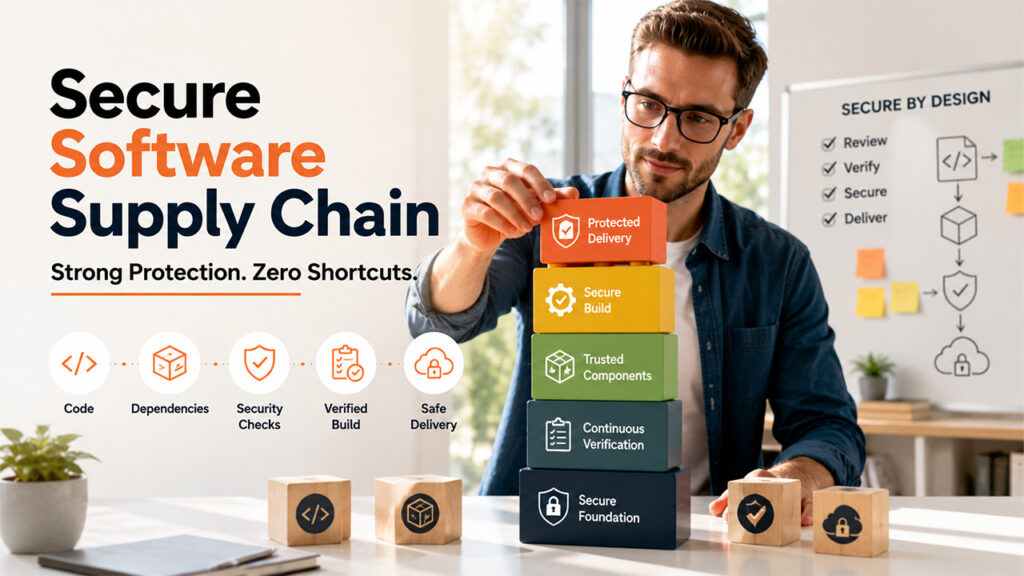
Supply chain security becomes far more effective when it is built into everyday development instead of treated as a final review before release. Organizations that rely on custom transportation software should also embed security checks throughout their development lifecycle to protect logistics systems, integrations, and operational data.
Carefully selecting dependencies, reviewing updates, securing build pipelines, and maintaining accurate software inventories should become routine engineering practices rather than separate security tasks. The goal is not to slow development, but to make secure decisions part of the normal workflow.
10. Review your supply chain before attackers do
Software environments never stand still. New dependencies are added, packages evolve, infrastructure changes, and development workflows grow more complex.
Regular reviews help identify outdated components, unnecessary permissions, abandoned repositories, and security controls that no longer match the way software is built today. Supply chain security is an ongoing process, not a one-time project.
Security grows through consistent engineering
Most software supply chain incidents result from small decisions that were never revisited as projects evolved. An outdated dependency, excessive permissions, or an unused package may seem insignificant on its own, yet together they create opportunities attackers are quick to exploit.
The strongest development teams reduce that risk through consistent engineering practices. Dependencies are evaluated before adoption, build pipelines receive the same attention as production systems, software inventories stay current, and routine maintenance prevents small issues from becoming larger ones.
There is no single control that secures the software supply chain. Long-term resilience comes from disciplined engineering habits applied consistently throughout the development lifecycle.
%201.png)

%201.png)

%201.png)