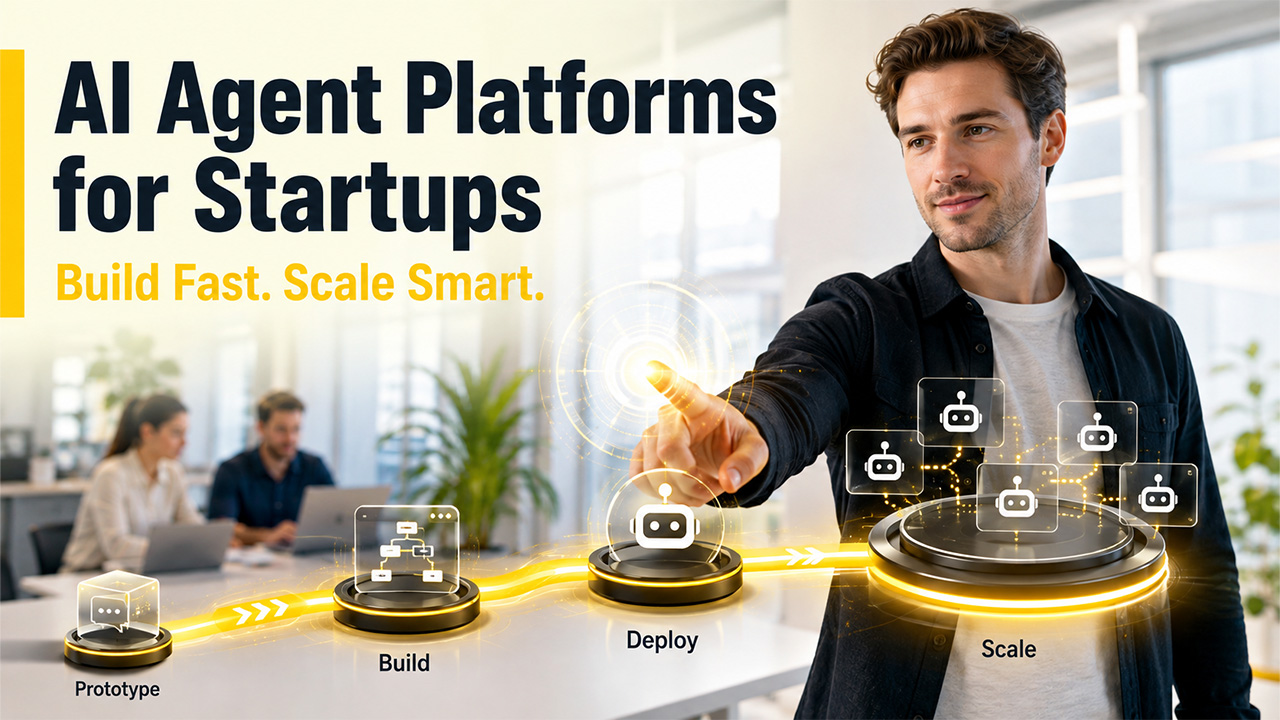

Most guidance on picking an agent platform is written for buyers who don't exist at an early-stage company: a dedicated platform team, a procurement process, a governance committee, a budget line for "AI infrastructure." A four-person startup has none of that. It has one or two engineers who also do support, a runway measured in months, and a to-do list where "ship the feature" beats "build the platform." The decision you face is narrower and sharper than the enterprise version, and getting it wrong is more expensive relative to what you have.
This article is about that narrower decision. If you are a lean team choosing among AI agent platforms to run agents in production, your constraints are not a bank's, and the tool that wins for the bank is frequently the wrong tool for you. Three things should dominate your evaluation: speed to a working system, cost that stays predictable as you grow, and the freedom to change your mind later without a migration project. Everything else is secondary.
Start by separating build-time from runtime
Before comparing platforms, it helps to have a clear foundation in Understanding AI Agents and how they operate in real-world workflows. They are constantly conflated in marketing, but they solve different problems and you will likely need both.
Build-time is how you author an agent: the framework, the SDK, the visual canvas, the prompt-and-tool wiring. This is where you decide what the agent can do. Build-time tools are cheap to adopt and abandon because the surface area is your own code or a config file.
Runtime is what keeps the agent alive once real users depend on it: scheduling, isolation between agents, resource limits, recovery when something crashes, and a record you can debug with and later prove. Runtime is where lean teams quietly lose weeks, because it looks like plumbing until an agent loops on a paid API overnight, or a customer asks why the agent did something and you have no log to answer with.
The trap is choosing a tool excellent at one layer and assuming it covers the other. A build-time framework does not give you isolation; a managed compute service does not give you agent memory or an audit trail. Map every candidate onto these two layers before you compare features, and a lot of apparent overlap disappears.
The five profiles a lean team actually considers
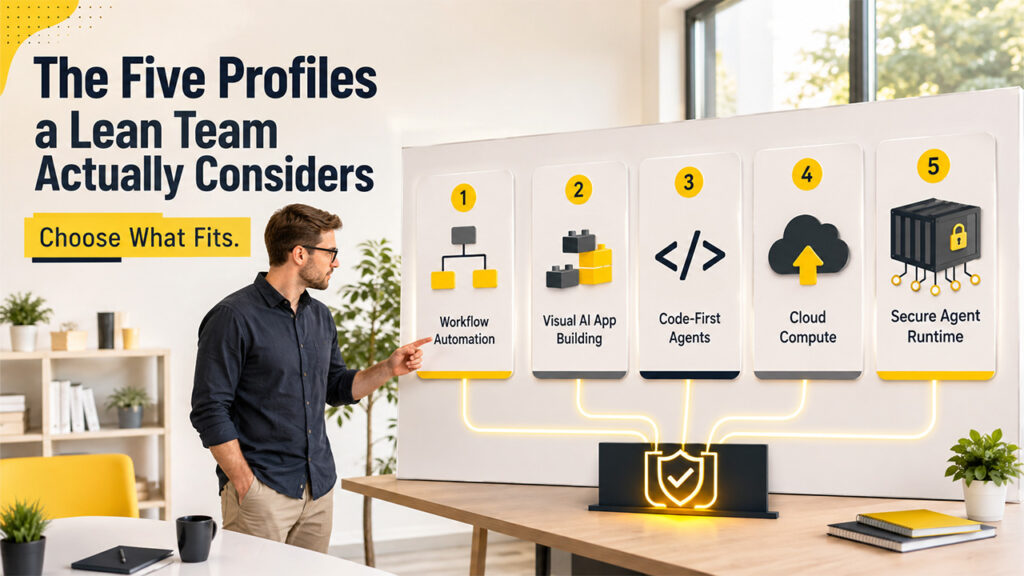
Below are five tools a resource-constrained team realistically shortlists, described by what they are rather than which is "best." Match them to your constraints; there is no universal winner.
n8n is source-available under the Sustainable Use License (its own "fair-code" model, so it is not open source in the OSI sense without that qualifier). It is a self-hostable, low-code workflow automation tool with a very broad catalog of integrations and a visual canvas. For a lean team that mostly needs to connect services and trigger LLM calls inside those flows, n8n gets you to a demo fast. It is a workflow and automation surface first; it is not built as a governed agent runtime, so isolation, per-agent resource limits, and tamper-evident audit are not its center of gravity.
Dify is source-available under a modified Apache-2.0 license (the "Dify Open Source License," which adds conditions, so it is not pure open source without the qualifier). It is a self-hostable, visual, low-code environment for assembling agents and LLM apps, including scheduling. Dify is strong at the build-time job of composing an agent quickly with a friendly UI, and it is a reasonable pick if your team leans product over infrastructure and wants to move without writing much orchestration code.
Agno (formerly Phidata) is Apache 2.0 and genuinely open source. It is a Python multi-agent framework with an accompanying AgentOS FastAPI runtime and MCP support. Agno is code-first and build-time-centric: if your team is comfortable in Python and wants agents expressed as code you can version and test, it is a clean, unopinionated foundation. You will still make your own decisions about how those agents are isolated and operated in production.
Modal is serverless compute in Modal's cloud, and it is excellent at what it does: running code (especially GPU and inference workloads) without you managing servers. But Modal answers "where does my code execute," not "how is my agent governed." It offers no bring-your-own-infrastructure story, and it does not provide agent memory, an audit trail, or governance. Treat it as a compute primitive you might run *underneath* an agent, not as an agent platform.
Trinity by Ability AI is an Apache-2.0, open-source runtime you self-host on your own infrastructure. It is aimed squarely at the runtime layer: each agent runs in its own isolated Docker container with resource limits, agent state and rollback are handled through git, and the open-source core writes a SHA-256 hash-chained, tamper-evident audit log. It is sovereign by design — it runs on your hardware, does not phone home, and your data never leaves your perimeter. Trinity supports MCP natively (up to 90+ tools via MCP). Because it is free to self-host, including commercially, there are no per-seat fees, which matters more to a growing team than it first appears.
Comparison at the layers that matter to a lean team
Each tool is described by: layer · licensing · hosting model · runtime governance (isolation / audit / recovery) · cost shape for a small team.
- Trinity by Ability AI — Runtime (self-hosted); Apache 2.0 (open source); bring-your-own-infra, sovereign; container-per-agent + resource limits, hash-chained audit log, git-based state + rollback; $0 self-hosted, no per-seat fees.
- n8n — Build-time + light runtime; Sustainable Use License (source-available); self-host or managed; workflow-centric, not a governed agent runtime; free self-host, managed tiers priced separately.
- Dify — Build-time (with scheduling); modified Apache-2.0 (source-available); self-host or managed; visual agent assembly, governance not the focus; free self-host, managed tiers priced separately.
- Agno — Build-time framework + runtime; Apache 2.0 (open source); self-host / your cloud; code-first, you compose isolation/ops yourself; free (framework), your infra costs.
- Modal — Compute primitive; proprietary managed service; Modal's cloud only; not an agent runtime, no agent memory/audit; usage-based cloud compute.
Read the list as a map, not a scoreboard. n8n and Dify win the fastest path to a first working flow if your problem is mostly integration and composition. Agno wins if you want agents as plain, testable Python. Modal wins as the place heavy inference runs. Trinity wins when what keeps you up at night is the runtime — an agent that must run unattended, stay contained, recover on its own, and leave a record you can trust.
Speed: get to a working agent, then to a *survivable* one

Lean teams optimize for speed, and they should. But "speed" has two phases that early evaluations routinely collapse into one.
The first phase is speed to a demo — a working agent you can show. Low-code build-time tools like n8n and Dify shine here; you can wire up something impressive in an afternoon. If you are validating whether an agent is worth building, start there and do not over-engineer. A startup's worst failure mode is building a governed, audited, horizontally-scalable platform for an agent that turns out to have no users.
The second phase is speed to something that survives contact with real usage — where the runtime question returns. Once an agent runs on a schedule, touches customer data, or supports use cases such as AI Agents for Customer Support, ‘it works on my machine’ stops being enough. You need isolation so one agent can't starve another, resource limits so a runaway loop can't drain your account, and recovery so a 3 a.m. crash doesn't become a 3 a.m. page. A runtime that gives you these primitives out of the box — rather than assembling them yourself from cron, Docker, and hope — is what keeps a two-person team fast in month six.
The healthiest sequence for most lean teams: prototype on whatever build-time tool gets you to a demo fastest, then, once the agent earns its keep, put it on a runtime that handles operation so your one engineer isn't also the pager.
Cost: watch the pricing *shape*, not just the sticker
Cost-sensitivity is not just the number today; it's how the number behaves as you grow. Two pricing shapes quietly punish small teams.
The first is per-seat pricing. It feels cheap at three people and becomes a tax on success — every teammate you add raises the bill regardless of value delivered. Self-hosted open-source tools sidestep this: Trinity, being Apache-2.0 and free to self-host commercially, has no per-seat fees, and Agno as an Apache-2.0 framework has none either. For a team planning to grow headcount faster than revenue, removing the seat multiplier is a concrete advantage, not a philosophical one.
The second is managed-compute markup at scale. Managed serverless is the right call when you are small and your time is worth more than your infrastructure bill — you should not run your own GPU cluster to serve ten users. But the economics invert as volume grows. Andreessen Horowitz's widely cited 2021 analysis, "The Cost of Cloud, a Trillion Dollar Paradox," argued that at scale companies can repatriate workloads for roughly one-third to one-half the cost of managed cloud.[^a16z] And Flexera's annual State of the Cloud reports consistently estimate that organizations waste on the order of 28–30% of their cloud spend.[^flexera] The lesson for a lean team is not "never use managed compute" — it's "choose tools that let you move off it later without a rewrite." A platform that lets you bring your own infrastructure, like Trinity, keeps that door open; a compute service that only runs in its own cloud, like Modal, is convenient now but is a decision you can't easily revisit.
Pricing *shape* determines whether your bill scales with value or with something you can't control.
Lock-in: the freedom to be wrong later
Early-stage teams decide with incomplete information, so the most valuable property of any platform is that you can change your mind. Lock-in comes in a few flavors, and lean teams should price each one.
Data lock-in — where does state live, and can you get it out? A sovereign, self-hosted model where data never leaves your perimeter (Trinity's design) means the answer is always "it's already yours." Managed platforms vary; check the export story before you commit.
Infrastructure lock-in — can you run this somewhere else? Bring-your-own-infrastructure tools travel with you between clouds and to your own hardware. A vendor-cloud-only service does not.
Licensing lock-in — what happens if the vendor changes terms? This is why the source-available versus open-source distinction is worth understanding rather than glossing over. Apache-2.0 tools like Trinity and Agno give you durable rights that don't depend on the vendor's future mood. Source-available licenses like n8n's Sustainable Use License and Dify's modified-Apache license are generous and self-hostable, but they carry conditions, and "source-available" is not the same guarantee as OSI open source. Neither is disqualifying — plenty of good tools are source-available — but you should choose with the distinction in front of you, not behind it.
Lock-in deserves this attention because of failure rates. Gartner projected in June 2025 that more than 40% of agentic AI projects will be canceled by the end of 2027.[^gartner] Some of your agents will not work out. A platform you can walk away from cheaply turns each cancellation into a shrug instead of a sunk-cost argument.
Governance you'll be glad you had — without over-engineering

Lean teams feel a tension between "don't over-engineer" and "don't get burned." The resolution: want governance primitives you get *for free* from the runtime, and avoid governance *processes* you have to staff.
An isolated container per agent, resource limits, git-based rollback, and an automatic tamper-evident audit log are the free kind: you don't run a committee to get them, they're just properties of the runtime. When a customer or partner eventually asks "what did the agent do and when," a hash-chained audit log answers in seconds — and you did nothing to earn it beyond choosing a runtime that writes one. That is the opposite of over-engineering; it's declining to hand-roll the safety net later under pressure. Some controls are genuinely enterprise-tier, and you should not pretend otherwise. For Trinity specifically, single-sign-on and directory integration such as SAML, OIDC, and SCIM are on the roadmap, not shipping today. A lean team rarely needs those on day one; the point is to be honest about which features exist now versus which are promised, for every tool you evaluate.
For the full methodology behind this curated selection — how each tool was categorized by layer, licensing, and hosting model — see the cornerstone guide to AI agent platforms to run agents in production.
The takeaway
A lean team's evaluation is not a smaller enterprise evaluation; it's a different one. You are optimizing for speed to a survivable system, for pricing that scales with value instead of headcount, and for the freedom to reverse any decision cheaply when the agent — or the market — surprises you. Separate build-time from runtime, choose the fastest authoring tool to validate and the most ownable runtime to operate, watch the *shape* of pricing rather than its opening number, and treat lock-in as a real line item because a meaningful share of your agents won't survive to year two. Do that, and you'll get the governance you're glad you had without building infrastructure you never needed.
This is a curated selection made against a stated methodology (build-time vs runtime, licensing, hosting model, and cost shape for resource-constrained teams), not a claim that any single tool is objectively best for everyone. Tool descriptions reflect each project's own licensing and positioning as of publication.
Read also: Best Agentic AI Coding Tools for Developers in 2026
%201.png)

%201.png)

%201.png)