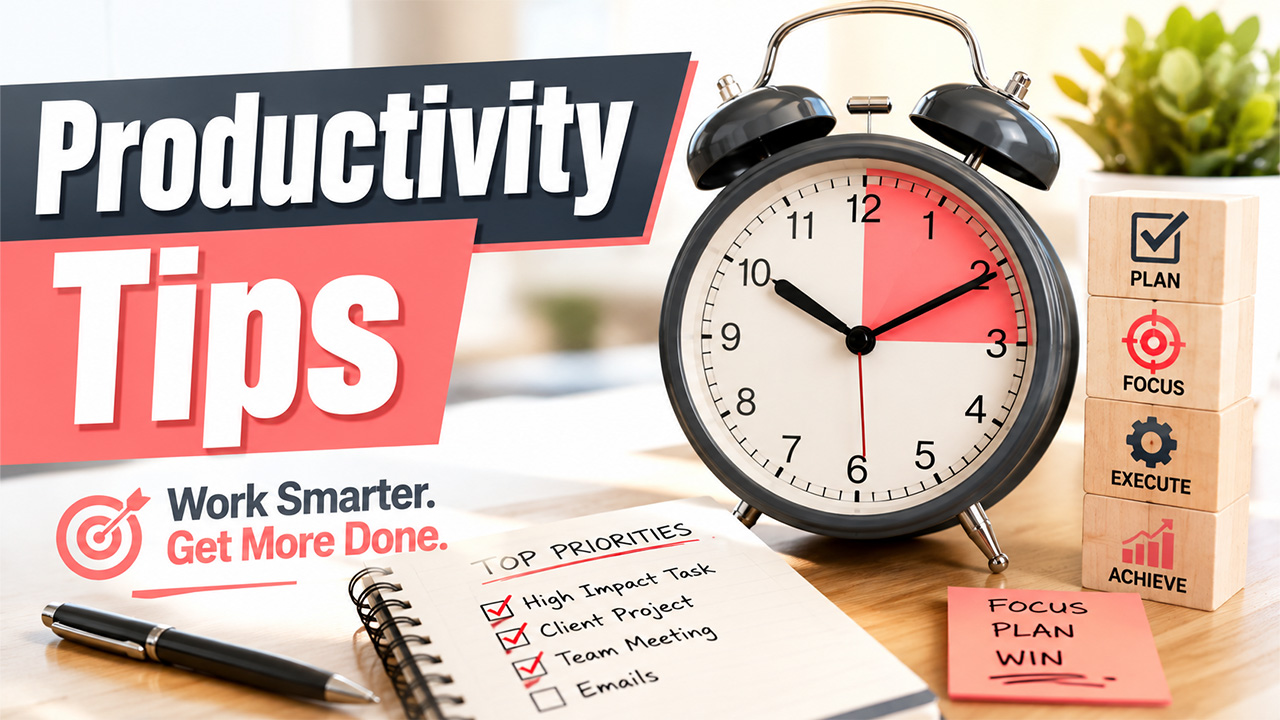

Everyone gets 24 hours a day, so time really is not an issue. The issue most professionals face is related to focus. Calendars get booked, notifications keep coming, and at the end of the day, the most significant task on the list remains untouched. Working longer hours typically does not fix this; it often just makes the burnout delayed and adds to the overall mental load that you carry to the next day. What really moves the needle is a set of repeatable and practical habits that enable you to direct your energy where it can have the most impact, instead of spreading it thin across everything that shows up on your desk. In this article, let us discuss a few productivity tips that freelancers, professionals, and teams can begin to apply almost instantly, without needing their systems overnight.
What Is Productivity?
Productivity is not just about how many hours you spend on your desk or the number of tasks you complete from your to-do list. It is the overall ratio of meaningful output to the effort and time you give. A person completes three high-impact tasks in around four hours with an unwavering focus should be considered more productive than a professional who switches back-and-forth between different tasks.
Having a clear idea about this distinction is important since most productivity tips fail when people apply them to the wrong issue. The focus remains on busyness instead of impact. Genuine productivity stems from effective prioritization, saving your attention, and incorporating AI-powered platforms that minimize decision fatigue, so that the energy you do have is directed toward work that is important than tasks that just feel urgent.
Focus on Energy Management, Not Just Time Management

Conventional tips to manage time assume that every hour of the day is equal. It is not. Most people get a window, generally mid-morning, when decision-making and focus are sharpest, and slump later when straightforward tasks feel more complex than they should.
- Fix the work that demands maximum energy during your natural peak-energy time, which can be morning or evening.
- Save repetitive tasks such as data entry or email replies for periods when you have lower energy.
- Avoid pushing through the fatigue and smartly use short breaks between deep-work sessions.
- Keep track of your energy patterns for a week before reorganizing your calendar.
- Avoid fixing meetings back-to-back during your most productive sessions.
People overlook these productivity tips, mainly since it needs close observation of your own patterns instead of following a generic schedule that you have been following for years. Once you know when your focus naturally peaks, the rest of your day can be built around protecting that window.
Create a Workflow That Is Distraction-Free
Context switching on a consistent basis is one of the greatest factors that drain your output silently. Each unplanned meeting, notification, or "quick session" resets your focus and drains your productivity. It wastes time since you have to re-engage with various tasks throughout the day.
- Batch the same tasks together instead of jumping between different types of work.
- Turn off non-critical notifications during blocks of deep work.
- Establish clear boundaries in your high-productivity hours and keep them meeting-free.
- Utilize a single dashboard to keep track of tasks instead of making them scattered across applications.
- Let your team know about your focus hours, so interruptions are minimized.
Teams that work together from across different time zones generally struggle with this most. Thus, having a platform that streamlines their meetings and makes it easy to share ideas is important. Choosing the best online meeting apps can minimize unnecessary back-to-back scheduling and ensure that the meetings are fixed in the set windows instead of scattering them throughout the whole day. When you allot a fixed time window for meetings, you declutter your day and allow yourself to focus on uninterrupted work.
Prioritize Your Work with the Help of a Clear System

Not every task needs equal attention. However, many people strategize their day via a single flat to-do list where a five-minute email is given the same importance as the task that can take a couple of hours. Without a system for prioritizing, urgency always dictates your schedule and always keeps you behind your tasks.
- Segment the tasks into what is important, what is urgent, and what is neither.
- Recognize the one task every day that would make the day productive even if nothing else gets completed.
- Segment large projects into shorter milestones that have their own deadlines.
- If you get a request that does not fit into your priorities, choose to decline or delegate your tasks.
Using the above-mentioned productivity tips continuously changes the feeling around a workday. Instead of reacting to whatever comes in front of you, you work with a plan that showcase what really matters, which minimizes the low-grade stress that comes from an overflowing and unranked list.
Also Read: workplace productivity hacks
Strategically Use Automation and Technology
Technology must minimize manual effort; not include another tool you need to handle. The objective must be to automate low-judgement and repetitive work, so your attention remains on tasks that really require your attention.
- Automate repetitive follow-ups, reports, and reminders wherever necessary.
- Leverage templates for routine proposals, emails, or documentation.
- Trust a unified tool for keeping track of deadlines and ongoing work.
- Periodically go through your tool stack, and delete anything that is not urgent or important.
Marketing and sales teams see this come to life daily with AI in sales, where automation manages outreach and lead scoring so representatives can concentrate on building relationships instead of manual entry of data. The same shift is occurring across customer-facing functions more widely, as AI and machine learning reshape CRM systems to manage data entry, scheduling, and repetitive follow-ups automation. The same principle is applied to almost any kind of role: allow software to absorb the routine parts of your job so your time goes toward decisions you can make.
Create Habits That You Can Sustain Over Time

Productivity platforms that depend on willpower alone typically collapse within a few weeks. Habits that you can keep up over time are more effective because it does not rely on motivation to remain in place.
- Plan your day a day before so that you can start your work in the morning with total clarity.
- Set specific and realistic objectives.
- Set up weekly meetings to find out what worked and what did not work during the week.
- Set boundaries with your downtime and rest time in the same way as you do it for your work time.
- Make your system adjust to workload changes, instead of pushing through that can lead to inefficiencies and errors.
For hybrid or remote teams, gaining visibility into how much time you are spending can be valuable for identifying where these habits become ineffective. Reliable employee time tracking apps can let you know where hours are disappearing quietly, which makes it simpler to adjust before burnout happens instead of doing it afterwards. What you need to keep in mind is that you do not have to keep track of your time and work just for the sake of it but detect patterns early enough to fix them.
How Can AI-enabled CRM Assist in Improving Sales Teams' Productivity?
Sales teams manage follow-ups, outreach, pipeline tracking, and data entry. Juggling through these tasks reduces their productivity and affects their actual selling time. An AI-driven customer relationship management software removes this manual workload by automating routine tasks and offering insights that help sales reps boost their performance and productivity.
- Automatically logs emails, meeting notes, and calls, minimizing manual entry of data.
- Scores as well as prioritize leads as per the buying and engaging signals, so representatives emphasize prospects that can be converted easily.
- Sends automated follow-up sequences and reminders, avoiding deals from going cold.
- Reveals predictive insights on next-best actions and deal likelihood.
- Manages customer data across calls, emails, and social touchpoints in a centralized and single dashboard.
- Create fast summaries of prior interactions before every call, saving you time.
By managing the low-judgement and repetitive parts of your sales process, an AI-driven CRM frees up the sales teams to spend considerable amount of time strengthening relationships and closing deals, instead of handling status updates and spreadsheets. Over time, this shift also enhances prediction accuracy, since the customer relationship management consistently gets insights from real interaction data instead of managing manual pipeline updates alone.
Conclusion
None of these productivity tips need a complete overhaul of your workflow and tech-stack. All you have to do is ensure small and consistent changes, Minimize your distractions, protect your energy, automate repetitive work, prioritize with a clear platform, and inculcate habits that serve you for a long time. Slowly and steadily, you will establish a productive routine that can make things easier for you regardless of the complexity of the project.
Being productive does not mean that you have to do more; it is about doing the right things with minimum friction, and developing a workday that holds up under real-world pressure instead of breaking down the moment something does not go according to plan. Begin with one or two such productivity tips, give them some time to settle in, and then start from there.
Frequently Asked Questions
What is the easiest way to enhance productivity?
Avoid making too many changes at once. Just choose one habit, like dedicating the time where your productivity is highest to only strategic tasks and being consistent with it for a week.
Are time management and energy management different?
Time management considers each hour as equal, while energy management emphasizes aligning demanding tasks with your time window where your focus is at highest and saving low-effort work for lower-productivity periods.
Can automation help sales teams save crucial time?
Yes. Automating lead scoring, follow-ups, and data entry can save a lot of hours for sales representatives, time that can then be dedicated toward direct selling activities.
How frequently do I need to review as well as update my productivity system?
A short review every week is quite effective for most teams and professionals, enabling you to identify what is working and adjust before small inefficiencies become your habits.
Are productivity strategies the same for in-office or remote teams?
The core principles remain the same for both teams. However, hybrid or remote teams generally benefit more from advanced visibility tools such as shared dashboards and time-tracking to remain aligned across different time zones.
%201.png)

%201.png)

%201.png)