
Translate Website Using AI Without Losing SEO
If your website is only available in one language, you are likely losing customers from whom you never hear back. With the time and cost it has saved, more brands today are opting to translate website using AI tools rather than waiting for months to complete a manual localization job. AI website translation makes it possible to preview a project in minutes and launch in days, rather than months.
Translation of your website by hand meant hiring an agency, exporting all your strings of text, waiting several weeks before you get a draft back, and then giving it to the developer to wire into your CMS. By the time a new language was available, source pages had been changed twice. With AI translation, that's all turned upside down; you can preview a project in minutes and launch in days, rather than months.
Why So Many Businesses Are Moving to AI Website Translation
A company will typically have a specific reason (and not simply an interest) for choosing to translate their website through AI. These triggers tend to be in one of three categories.
The Cost Problem
- With traditional translation services, the charges are word-based, language-based, and may increase by revision round, making it expensiveat thea site level.
- When the homepage or product pages change, a manual process results in paying for the same parts to be translated again.
- Each new locale requires new templates to be rebuilt, as well as new routing, and this is an additional hidden cost that does not typically appear in the initial quote.
- Some smaller teams may even stop considering multilingual plans altogether because the initial agency expense seems too great to justify.
The Speed Problem
- A typical agency handoff involves exporting content, waiting for translators, then re-importing everything by hand.
- By the time a translated version ships, the original English pages have usually already been updated.
- Marketing campaigns tied to a launch date often miss their window because localization was still in progress.
- Manual QA on translated pages can take just as long as the translation itself.
The Technical and SEO Problem
- Many teams still rely on browser-based translation widgets that render text for visitors but are never indexed by Google.
- Missing or broken hreflang tags mean search engines cannot tell which language version to show which visitor.
- Meta titles, descriptions, and Open Graph tags often get left in the original language even after the page content is translated.
- Rebuilding a site's routing to support subdirectories or subdomains for each language can turn into its own engineering project.
For this reason, effective AI website translation needs to address both the language experience and the technical SEO requirements of multilingual websites.
What a Good AI Website Translation Tool Should Actually Offer
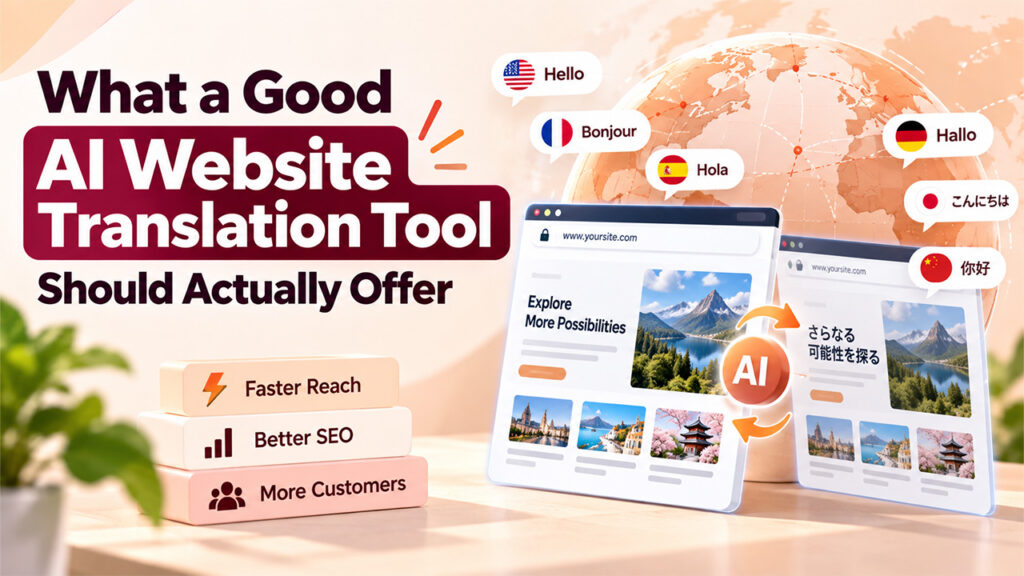
Before choosing a solution, it's always nice to know what you're solving, as there is a problem you are trying to solve. In addition to cost and/or speed savings, there are other reasons to consider a new approach, including visibility in search engines or ongoing maintenance over the long-term. The right AI-powered website translation tool should make multilingual content easier to manage without sacrificing SEO performance.
Match the Tool to Your Technical Setup
- Some tools work through a single script tag, so you can preview a translated site without touching your codebase or your DNS settings.
- Teams that care about organic traffic in new markets need a setup that makes translated pages crawlable and indexable, not just visible to visitors.
- Existing websites built on a CMS will find that a content connector will prove useful, since translations will remain current whenever the source page changes.
- When the business has strict terminology, business terminology needs to be applied automatically, and a glossary and translation memory need to be applied automatically instead of translating the same product name in different ways on every page.
Match the Tool to Your Growth Plans
- A single exported and imported page might suffice, but with increasingly dynamic sites, it is important to automatically update the translated versions as the content updates.
- Brands that enter multiple markets at once can take advantage of a system that can support hundreds of languages, and not just a few.
- If a team is interested in having a human review process in addition to the AI draft, an in-context review step would be a good idea before going live.
Where the Options Differ
Having an understanding of the various methods allows you to determine which configuration is the correct one, rather than making an assumption that all AI translation tools are created equal.
Script Tag and Browser Rendering
Some tools translate pages directly in the visitor's browser using a lightweight script, which is the fastest way to get a multilingual preview live without any backend changes.
SEO Proxy Delivery
A separate layer can serve translated pages to search engine crawlers at their own language-specific URLs, complete with translated titles and metadata, so those pages can actually rank.
CMS Connectors
If a team uses a platform to manage content, such as WordPress, Webflow, or Contentful, there can be a direct integration that pushes new content out for translation automatically and brings in approved translations back into the native locale pages.
Rolling Out AI Translation Without the Headache

If you are concerned about handing over your site content to an automated process, particularly one with a brand voice and terminology that is important to you, then you are not alone.
Audit Before You Commit
- There’s no need to translate the entire site at once. Look at your traffic and sales first. Which pages are actually bringing people in? Start with those. You can deal with the less important pages once the main ones are done.
- Check whether your current site already has any hreflang tags or partial translations that could conflict with a new setup.
- Identify any content that lives behind a login or inside images, since standard page translation tools usually cannot reach either.
Test Before You Scale
- Do a trial run first on a few key pages to determine if it is the right choice before going all in on a rollout.
- Be sure to have a native speaker on your staff proofread a sample of the AI draft before pages go live, particularly for customer-facing material.
- Ensure how the tool will manage future content changes, as it is not beneficial to manually re-translate all changes to start with automation.
- As your website expands, inquire about pricing as well: some tools impose their charges based on the number of words on each page, while others only charge for new or modified content.
Conclusion
The optimal AI website translation setup will vary by CMS, SEO objectives, and content change frequency; there is no single right or wrong approach. For a small site, where the only requirement is a quick multilingual preview, it could be acceptable to use a simple script tag. If you are a brand targeting organic search in new countries, you will need an SEO proxy delivery that includes translated metadata and hreflang. Any company using the content for multiple languages in a content management system will be best served by a direct connector that automates keeping all language versions in sync.
AI-assisted translation of websites is no longer a revolutionary approach; it's now the norm for expanding brands to cater for customers who aren't reading English. If it's not already multilingual, and you're considering moving your site to a multilingual future, it's a good idea to test a live preview to see how fast that transition can occur.
%201.png)

%201.png)

%201.png)