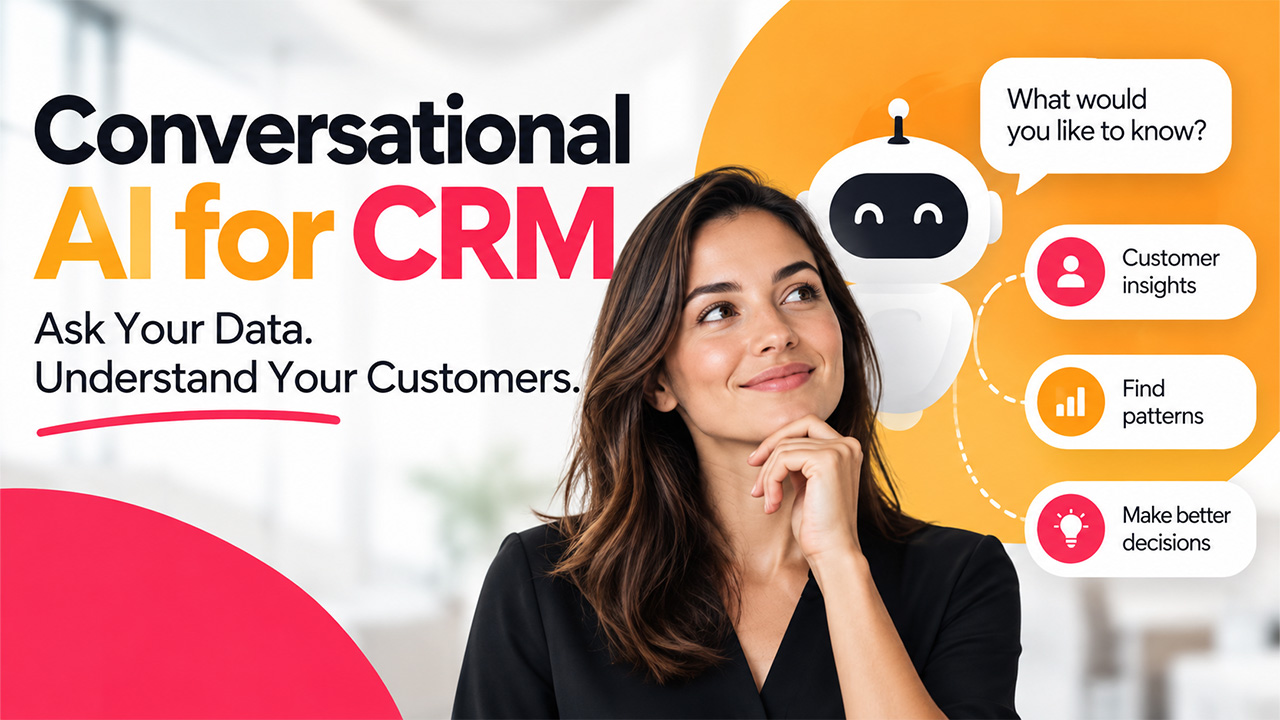

For decades, customer relationship management has revolved around dashboards.
Sales representatives open a CRM to check opportunities. Managers examine pipelines. Marketing teams study customer segments. Support teams review tickets and interaction histories.
These systems have become essential infrastructure for modern businesses.
But there is a strange contradiction at the heart of CRM software: companies collect enormous amounts of customer information, yet employees still spend considerable time figuring out what that information actually means.
The next evolution of business automation may therefore be less about adding another dashboard and more about creating a conversational layer that helps people navigate the complexity underneath it.
The Problem With Knowing Too Much
A growing company can accumulate thousands of customer interactions.
Emails, support conversations, purchase histories, website behavior, campaign responses, meeting notes, and sales activities can all become data points.
The problem is no longer simply collecting information.
It is turning information into useful context.
A sales manager might know that a customer has opened five emails, contacted support twice, and postponed a purchase. But understanding what those signals mean may require examining several systems and reconstructing the customer's journey manually.
This is where conversational AI and AI CRM become interesting, particularly when businesses need to interpret customer data rather than simply retrieve it.
From Searching for Data to Asking About It
Traditional CRM software expects users to know what they are looking for.
A conversational interface allows users to begin with a question.
For example:
“Which customers appear to be disengaging, and what patterns do they have in common?”
That question is fundamentally different from clicking through several reports.
The interface moves from data retrieval toward problem exploration.
The CRM as a Business Memory
One of the most powerful ways to think about CRM is not as a database, but as organizational memory.
Every customer interaction contains fragments of information about the relationship between a company and its market.
Yet raw memory is not particularly useful unless someone can interpret it.
AI could potentially act as a layer between business employees and that accumulated memory.
Instead of asking:
“Where is the information?”
employees can increasingly ask:
“What does the information suggest?”
That does not mean AI should make decisions autonomously. It means businesses can use conversational systems to make large volumes of information easier to explore.
Use AI and the Rise of the Conversational Business Layer
This broader shift is one reason UseAI is an interesting example of the movement toward chat-based AI.
Use AI is positioned as a chat-based AI platform, emphasizing conversation as the primary method of interacting with artificial intelligence.
For businesses, this model is potentially relevant because not every problem arrives in the form of a predefined software command.
A manager may want to understand why conversions have fallen. A sales representative may want to brainstorm ways to re-engage a dormant account. A founder may want to explore several explanations for a change in customer behavior.
These are questions, not buttons.
The “Question Before Automation” Principle

Modern business automation often starts with a rule:
When X happens, automatically do Y.
Conversational AI introduces another possibility:
Something unusual happened. Help me understand why.
That distinction is important.
Rules are excellent for predictable processes. Questions are more useful when circumstances are ambiguous.
A mature business may therefore need both.
Where Conversational AI Could Complement CRM
| CRM challenge | Potential conversational AI role |
| Large amounts of customer data | Summarize relevant patterns |
| Complex customer journeys | Explain relationships between events |
| Repetitive research | Organize information quickly |
| Sales preparation | Generate context and questions |
| Customer segmentation | Explore possible groupings |
| Strategy discussions | Compare alternative scenarios |
| Process documentation | Turn conversations into structured notes |
The key word is potential.
AI-generated interpretations can be incomplete or incorrect. Customer data can itself be messy, outdated, or misleading.
Human review remains essential before important commercial decisions are made.
The End of the “One Dashboard Fits All” Idea?
There is another possibility hiding behind conversational interfaces.
Perhaps future business software will become less dependent on fixed dashboards.
Instead of forcing every employee into the same interface, AI could provide different views depending on the question.
A CEO might ask:
“What changed in customer behavior this quarter?”
A sales manager might ask:
“Which opportunities need attention this week?”
A support leader might ask:
“What problems are appearing repeatedly in customer conversations?”
The underlying data may be the same.
The interface is different because the question is different.
From Software Navigation to Intent Recognition
This could represent a fundamental change in enterprise software design.
For years, employees had to learn the structure of software.
The emerging model suggests software may increasingly learn to interpret the structure of human requests.
That is a subtle but significant shift.
Why This Could Matter for Small Businesses

Large organizations can afford teams of analysts, operations specialists, and data professionals.
Small businesses usually cannot.
For a small company, a conversational AI layer could potentially make sophisticated information exploration more accessible without requiring every employee to become a data specialist.
A founder could ask questions about customer retention.
A salesperson could explore an account before a meeting.
A support manager could look for recurring complaints.
The technology does not eliminate expertise. Instead, it can potentially lower the barrier to accessing and organizing information.
The Risk of Automating Interpretation
There is an important warning.
Automating data entry is relatively straightforward.
Automating interpretation is much more complicated.
An AI may identify a correlation that looks meaningful but has no causal relationship. It may misunderstand a customer's message. It may summarize a conversation while omitting the detail that actually matters.
For this reason, businesses should distinguish between:
AI-generated insight and verified business knowledge.
The former can be a starting point.
The latter requires evidence.
The CRM of the Future May Feel More Like a Conversation
The evolution of CRM may ultimately move beyond increasingly sophisticated dashboards.
The next interface could be conversational.
Instead of learning where every report lives, employees could describe the business problem they are trying to solve and use AI to explore the relevant information.
Chat-based platforms such as Use AI illustrate the broader movement toward making artificial intelligence accessible through natural dialogue.
The most valuable development may not be automation for its own sake. It may be the reduction of the distance between having data and being able to reason about it.
CRM systems have spent decades becoming better at remembering customers.
The next generation of business technology may focus on helping companies think with that memory.
%201.png)

%201.png)

%201.png)