
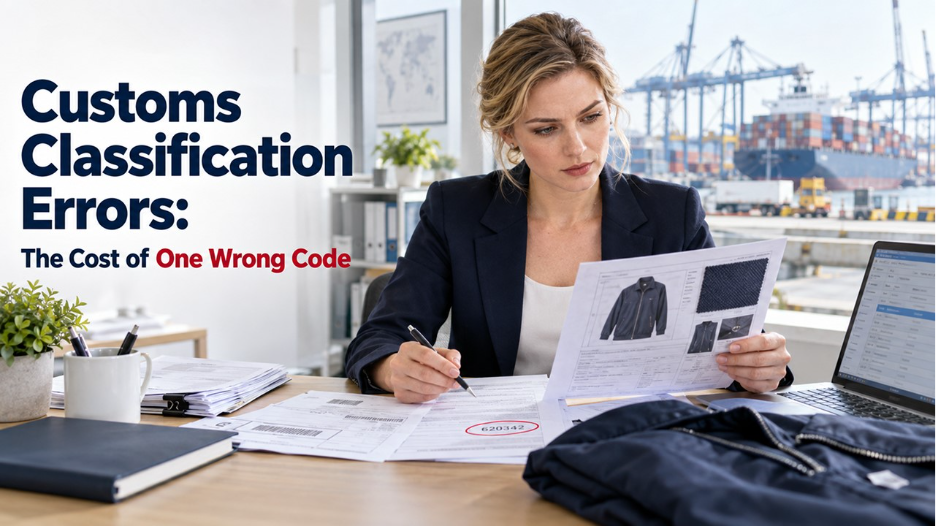

Most customs classification errors are not exotic. They are ordinary, repeatable and boring, and that is exactly why they survive long enough to cause damage. Nobody notices a code that clears the customs delays. It clears again next month, and the month after, and by the time anyone looks at it there are two years of entries built on the same wrong number.
You can usually spot some common customs classification errors, like the shape of the problem before you find the specific error that can cause customs delays. An operation where product descriptions come from the sales catalogue, where codes get inherited, and where nobody has written down why a heading was chosen is an operation carrying errors it has not found yet.
Descriptions written for a catalogue
The single most common root cause of customs classification errors has nothing to do with tariff knowledge. It is input.
A product description written to sell says "lightweight all-season jacket, water resistant, unisex". A description written to classify says what the shell is made of, whether it is knitted or woven, whether the water resistance comes from a coating or a laminate, and how the garment is constructed. Those are different documents produced by different people for different reasons, and when the first one is the only one that reaches the classifier, the determination is built on nothing.
The tell is that the error is not correctable by reviewing the code. You have to go back to the product, which is why these errors sit undiscovered so long.
Codes inherited rather than determined
Copying a code from a similar item is the fastest way to classify and the fastest way to be wrong at scale. Someone finds a comparable SKU, takes its number, and the new product inherits both the code and any error already in it.
The variants show up constantly:
- A supplier's export code accepted as the destination country's classification
- A code carried across from a previous product generation after the specification changed
- A code copied within a product family where one attribute genuinely differs
- A code brought over from a legacy system nobody has reviewed since migration
- A code taken from a competitor's public filing or a freight forwarder's suggestion
None of these are determinations. They are borrowed answers, and the liability of an incorrect entry sits with the importer of record regardless of who supplied the number.
These practices are a common source of customs classification errors, particularly when the same inherited code is applied across large product volumes.
The note that reroutes the heading
Section and chapter notes decide more classifications than most people expect, and they are the easiest thing to skip because they sit above the heading rather than inside it. A heading can describe your goods precisely and still be wrong because a note excludes them, or defines a term in a way that does not match ordinary usage, or sends parts of a particular kind somewhere else entirely.
Parts and accessories are the classic trap. Whether an item classifies as a part of a machine, as an article in its own right, or under a heading a note directs it to, is rarely obvious from the product itself. The same goes for retail sets, where components that would each classify separately have to be assessed for essential character before anything else happens.
Applying the General Rules of Interpretation in order catches most of it. Skipping to the heading that sounds right is what produces the errors, and under volume that is exactly what people do. Systems built around AI customs classification software that reads the notes alongside the headings tend to surface the exclusion that a fast manual pass reads straight past.
What a wrong code does after it clears
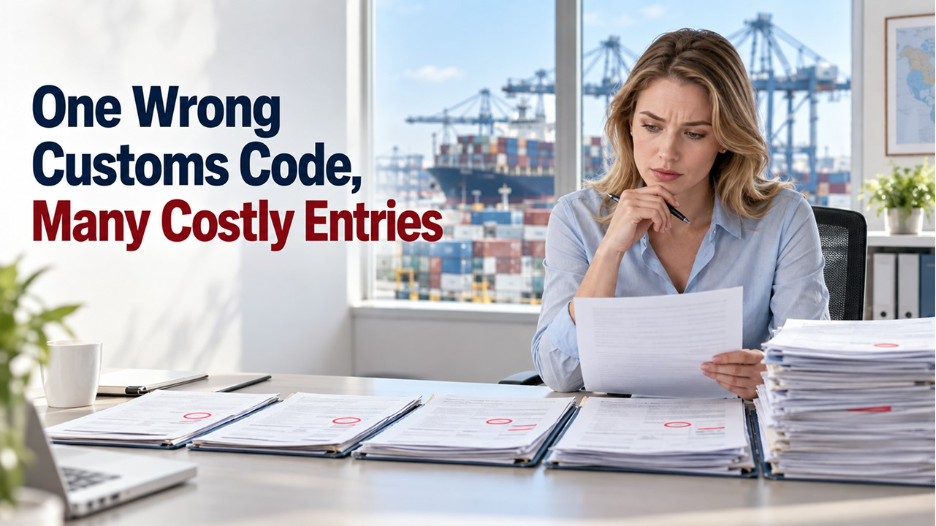
An error at the border is inconvenient. An error that clears is worse, because it becomes a pattern.
Downstream, a wrong classification does several things at once. It can put you in the wrong duty position in either direction, underpaying or quietly overpaying for years. It can attach or detach an additional duty programme you should or should not have been subject to. It can break a preference claim, because origin rules are written against tariff classifications and a wrong code means the wrong rule of origin was tested. It can affect admissibility where another agency's requirements key off the classification, which is how a classification problem turns into a hold that has nothing to do with duty.
And it compounds. Every entry using the code inherits the error, so the exposure grows with volume rather than staying fixed at the moment of the mistake.
Reasonable care is a standard, not a feeling
CBP's expectation is that an importer exercises reasonable care. It is not a promise of perfection, and the difference between an honest error and something treated more seriously usually comes down to what your file shows about how the determination was made.
A file demonstrating care looks like: a specification the code was based on, the alternatives considered, the note or rule that decided it, a search of prior rulings for comparable goods, and a record of who signed off. A file demonstrating nothing looks like a code in a field.
Finding errors while they are still corrections
The distinction that matters most is who finds the error. An importer who identifies a problem and corrects it through the available channels is in a fundamentally different conversation from one whose problem surfaces during an examination.
That is an argument for reviewing your own book on a schedule rather than waiting. Regular reviews can help identify customs classification errors before they become repeated entry problems, duty exposure, or compliance issues. Periodic sweeps against your entry history, focused on high-volume codes, products whose specifications have changed, and headings affected by recent schedule revisions, tend to surface both the overpayments and the exposures. Running an AI tariff compliance audit tool across entry data makes that sweep something you can actually complete, instead of a project that gets scoped every year and never started.
The errors are already in there. The only real question is whether you go looking before somebody else does.
Conclusion
Customs classification errors rarely come from complicated cases alone. More often, they result from incomplete product information, inherited codes, overlooked tariff rules, or inconsistent review processes. Identifying and correcting these issues early can help businesses reduce customs delays, avoid unnecessary duty exposure, and maintain stronger compliance. Regular classification reviews, well-documented decisions, and AI-assisted tools can make that process more consistent and manageable as trade volumes grow.
%201.png)

%201.png)

%201.png)