


Done-for-you email automation promises you a growth without the hardwork. However, what you actually get depends on the provider and tier. One provider gives you a full team to write, design, and test each send; another one just installs a single welcome flow and leaves. Go for a wrong tier and the 2024 bulk-sender rule of Gmail (domains sending close to 5,000 messages per day must pass DKIM, SPF, and DMARC) can affect deliverability. Make the right choice and per statistics roundup of Omnisend’s email marketing still returns $36 to $40 for each dollar spent. In this detailed guide, let us break down six service models so you can safeguard both reputation and revenue.
What are done-for-you email automation services?
A done-for-you (DFY) email automation service is an outside team that plans, writes, designs, codes, tests, and sends your lifecycle emails, while also monitoring deliverability so Gmail, Yahoo, and Outlook keep placing them in the inbox.
In today’s market, that promise comes in five formats:
- Embedded full-service team: an agency crew that runs strategy, campaigns, and flows inside your existing tools.
- Specialist managed agency: a retained partner focused on revenue yet removed from day-to-day communications.
- Project build-and-handoff: consultants who audit, launch, and exit once key automations perform.
- Platform onboarding package: your ESP’s professional-services arm that migrates data and builds starter flows.
- SaaS-plus-service hybrid: software bundled with limited human help for copy, design, or optimization.
Cold-outreach providers (rented domains, pre-warmed mailboxes) operate under separate consent rules and are not comparable to the opt-in lifecycle models above.
Pick the lane that matches whether you need total channel ownership, ongoing execution, or a quick, one-off implementation.
How We Selected and Ranked the Six Services?
First, every contender had to clear five objective criteria:
- Active as of September 10, 2026
- Sells to U.S. buyers
- Offers more than software features alone
- Publishes enough detail to judge scope and outcomes
- Operates only in permission-based email (cold-outreach tools were excluded)
Twelve providers passed. We then scored them on a six-part rubric:
| Criterion | Weight |
| Strategy and lifecycle depth | 25 percent |
| ROI proof (named, time-bound cases) | 20 percent |
| Tech-stack flexibility | 15 percent |
| Commercial transparency | 15 percent |
| Deliverability and compliance | 15 percent |
| Team continuity | 10 percent |
Public evidence such as case studies, pricing pages, and policy documents earned points; missing or unverifiable data lost them. The six providers you’ll meet next rose to the top by documenting repeatable impact, not just writing a persuasive sales copy.
Quick comparison: The Six Stand-out Providers
Scan the table below to see which lane (embedded team, specialist agency, or project build) fits your goals and tech stack.
| Provider | Best for | Service model | Platform flexibility | Public pricing signal |
| InboxArmy | Embedded team across 40+ ESPs | Full-service agency | High | Custom quote |
| Rejoiner | White-glove ecommerce ownership | Platform + managed service | Low | Sales-led |
| Chronos Agency | High-growth DTC retention | Specialist agency | Medium | Custom quote |
| Bay Leaf Digital | B2B SaaS lifecycle & pipeline | Specialist agency | High (HubSpot-leaning) | From $3,999 per month |
| Flowium | Klaviyo-first dedicated pod | Specialist agency | Low | Custom; Flowium’s own guide cites $2,000 to $15,000 |
| SmartMail | Fast-start builds without a retainer | Production billed per output | High | Per-output billing, quote on call |
1. InboxArmy: best overall embedded, ESP-agnostic team
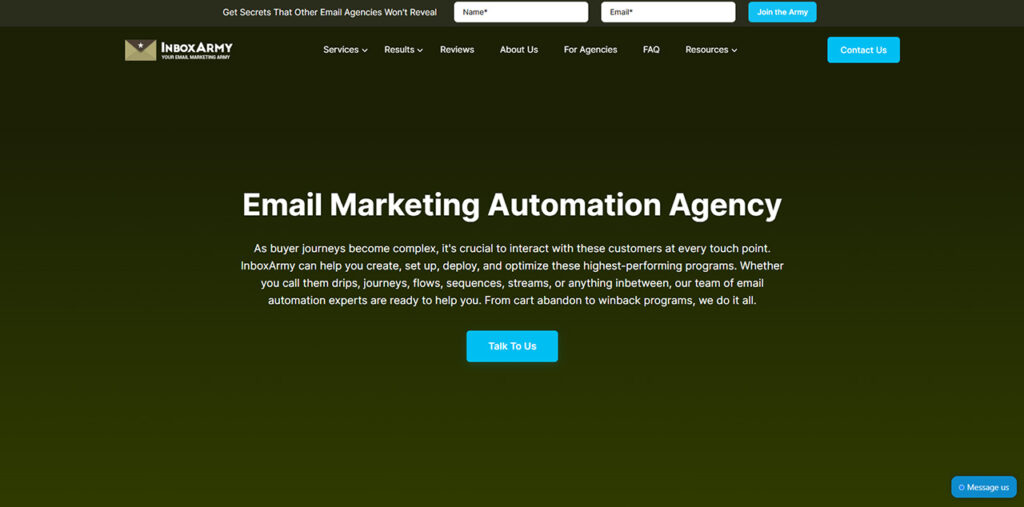
Need an email department fast? InboxArmy delivers strategists, designers, developers, and deliverability specialists as one unit. Founded in 2016, the agency works across 40+ ESPs, so you keep your stack rather than migrate.
Onboarding moves quickly. A four-week sprint secures data access, brand voice, and authentication. From week-five, the team moves into regular production, with weekly check-ins to review revenue, tests, and next steps.
Results speak for themselves.
- Bicycle retailer Sixthreezero saw a 335 percent increase in revenue in three months, compared to the same period the previous year.
- RC Juice’s new cart-abandonment automation lifted monthly revenue 400 percent.
- Maven Lane generated $700K+ in revenue within six months.
Deliverability stays front and centre: the work covers authentication (SPF, DKIM, DMARC), reputation, list hygiene, and inbox placement monitoring.
Contracts stay light: InboxArmy states no hidden fees and no long-term lock-ins, and the work happens inside your own ESP account. Pricing is quoted per engagement, so scope volumes and channels before you ask for a number.
Choose InboxArmy if you want an outsourced team that feels in-house, serves both ecommerce and B2B, and works inside the platform you already trust.
2. Rejoiner: best for white-glove ecommerce channel management
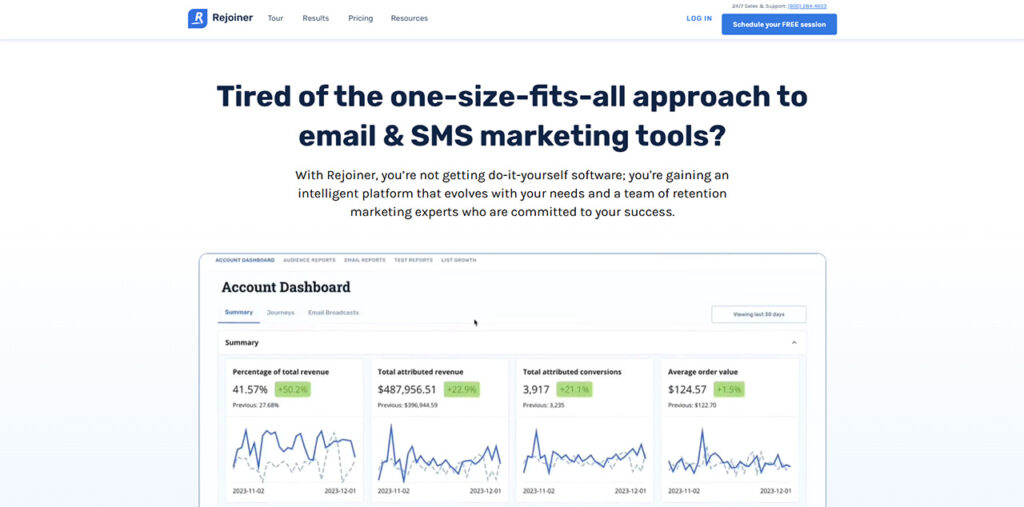
Rejoiner pairs its own ecommerce email platform with a hands-on team that manages strategy, design, deployment, testing, and deliverability while you approve offers and creative.
The results are tangible:
Luxury-pen brand A.T. Cross sent 76 percent fewer emails yet lifted last-click email revenue 35 percent year over year.
Process begins with a data and segmentation audit, then moves into cart recovery, browse abandonment, post-purchase, win-back, and VIP nurturing. Weekly broadcasts layer on top, each tied to revenue per send and margin impact.
Because Rejoiner owns the full stack, the team pre-configures SPF, DKIM, and DMARC and surfaces complaint rates in real time, so issues are fixed before Gmail or Yahoo throttle your domain.
Pricing is custom and inseparable from the software, so confirm data portability and exit terms before you sign. Choose Rejoiner if you want reliable inbox revenue without juggling multiple vendors or tools.
3. Chronos Agency: best for high-growth DTC retention
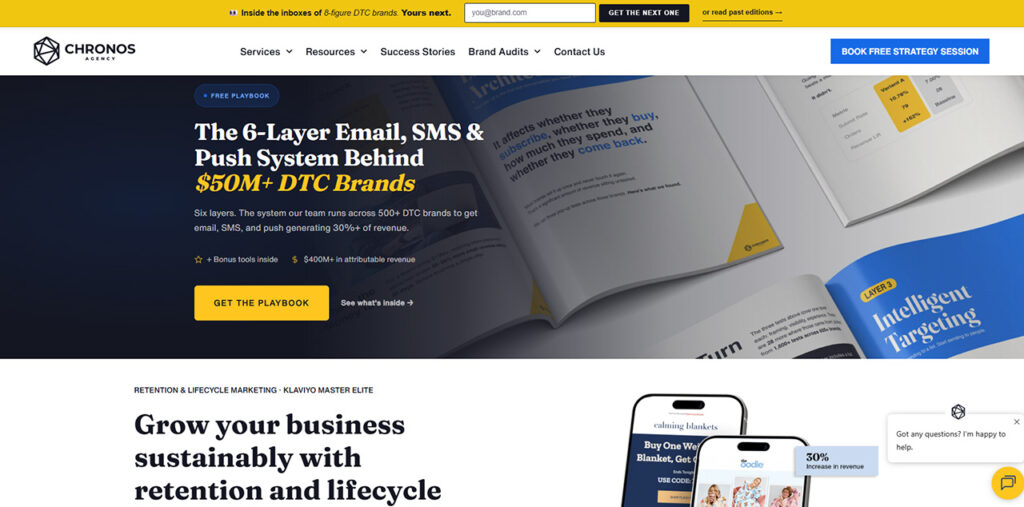
When welcome and cart flows stall, Chronos turns one-time shoppers into repeat buyers. This Klaviyo-focused agency builds deep lifecycle sequences, runs disciplined A/B tests, and has refined its playbook across hundreds of DTC stores.
How it works
- Maps every post-purchase milestone (order received, delivery, first use, replenishment window) and schedules timely nudges.
- Keeps lists warm with a parallel campaign calendar while automations do the heavy lifting.
- Operates as a dedicated pod: strategist, copywriter, designer, and analyst inside your Slack and dashboards.
Results
- Streetwear label CISE grew email revenue to 30 percent of total store revenue and achieved an 800 percent overall email revenue increase.
Platform & pricing
Chronos is a Klaviyo Master Elite partner and also works in Braze, HubSpot, Mailchimp, ActiveCampaign, Omnisend, and Dotdigital, with Attentive and Postscript for SMS. Salesforce Marketing Cloud is not on its list. Chronos does not publish pricing; retainers are scoped to list size and creative volume.
Choose Chronos if you have product-market fit, need lifecycle depth beyond abandoned carts, and can commit to the weekly testing cycles that sustain retention growth.
4. Bay Leaf Digital: Best for B2B SaaS Lifecycle & Pipeline
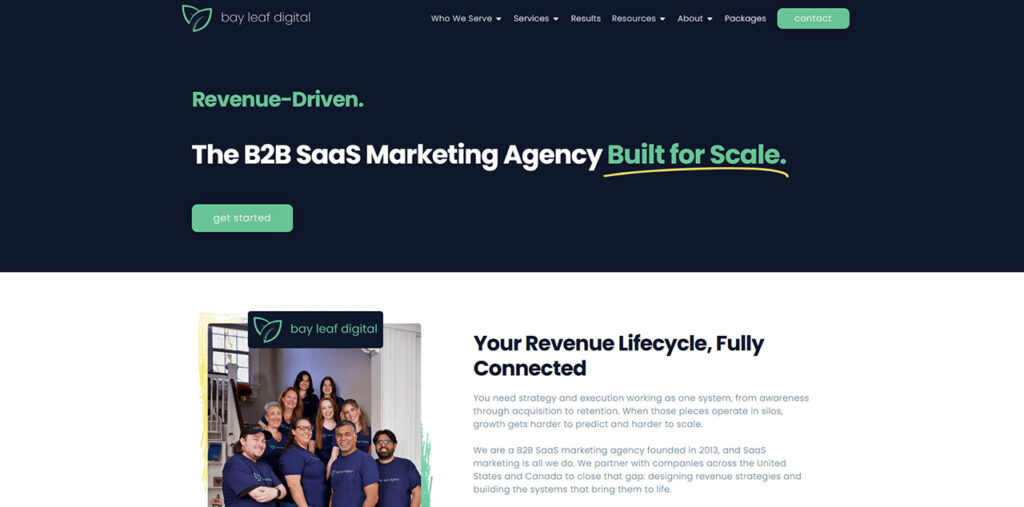
SaaS email isn’t about cart recovery; it’s about turning sign-ups into power users and accounts into expansions. Bay Leaf Digital connects every nurture touch to CRM events such as trial start, feature activation, deal stage, and account at-risk, so revenue teams see impact inside HubSpot rather than a vanity dashboard.
During discovery, strategists audit funnel metrics, flag leaks, and design automations that guide users from sign-up to paid to champion. Copy stays tight and benefit-led for time-starved decision makers.
Proof in practice
A RevTech platform enlisted Bay Leaf to revive a stagnant free-trial pipeline. It rebuilt the trial experience with a guided nurture flow so that prospects reached the buying decision faster; the agency publishes it as a win brief rather than a numbered case.
Platform scope
HubSpot is home base (Bay Leaf is a HubSpot Gold partner) and the agency also manages HighLevel.
Engagement model
A core pod (strategist, copywriter, marketing-ops specialist) handles day-to-day work, with developer hours added for complex data wiring. Published packages start at $3,999 a month for Authority Builder and $5,000 a month for Growth Partner, so arrive with targets like MQL lift, activation rate, or net revenue retention.
Choose Bay Leaf Digital if board conversations revolve around expansion and churn, not abandoned carts.
5. Flowium: best Klaviyo-first dedicated pod
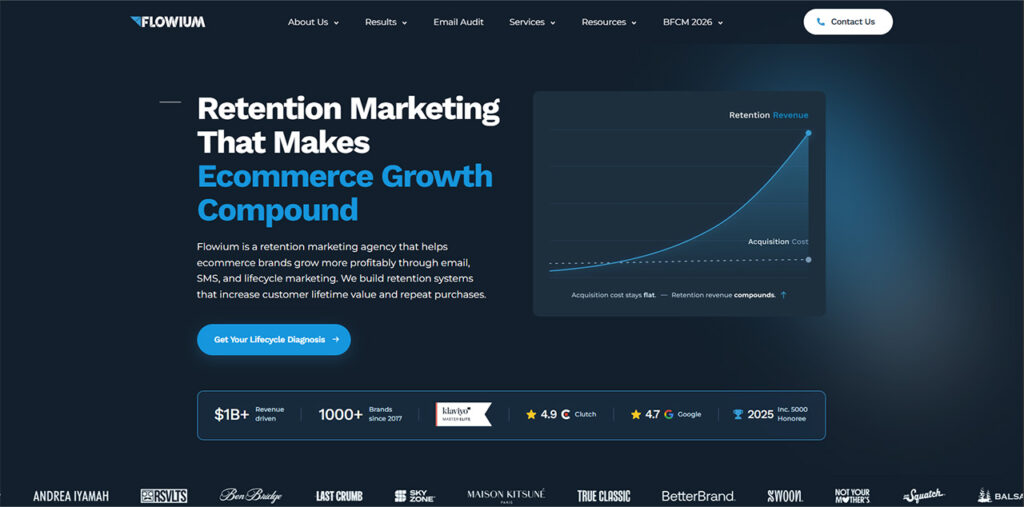
If Klaviyo powers your store, Flowium assigns six email marketing experts to each project who work in the platform every day. The team pulls extra value from features many merchants skip, such as dynamic product blocks, predictive analytics, and event-level splits for VIPs or at-risk buyers.
Engagement roadmap
- Technical audit: SPF, DKIM, and DMARC live to meet Gmail’s bulk-sender rules
- Foundational flows: welcome, cart, browse, and post-purchase
- Optimization phase: advanced segments, weekly campaigns, and ongoing A/B tests surfaced by your strategist
Proof & pricing
Flowium shares case studies across boutique fashion and high-volume electronics; one sporting goods client reports a 214.9 percent increase in repeat-customer revenue, and a beauty brand reached 35 percent of online revenue from email (provider-reported). Flowium quotes per scope; its own pricing guide places agency retainers at $2,000 to $3,000 a month for a light program and up to $10,000 to $15,000 for a fully outsourced one.
Know the limits
Flowium focuses on Klaviyo. If you need Salesforce Marketing Cloud or Cordial, choose another provider. When Klaviyo is your growth engine and you want a pod that already knows every lever, Flowium provides momentum without platform ramp-up.
6. SmartMail: best ESP-flexible automation builds
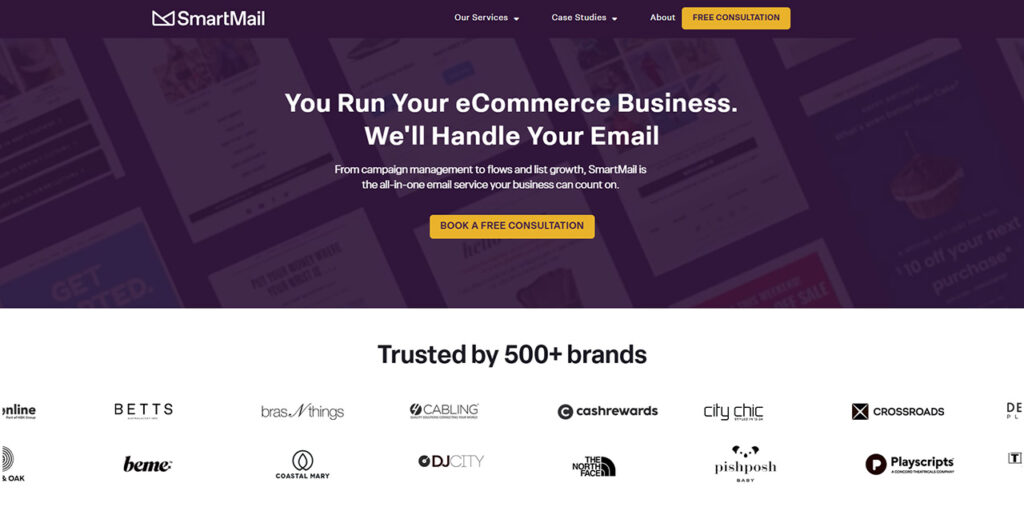
When you don’t need a full-time agency and just want a revenue-ready automation built fast, SmartMail fits the brief. SmartMail runs a seven-day start: a kickoff call on day one, a customised strategy by day three, and the first designed emails sent by day seven. It bills for what it produces rather than a fixed retainer, so confirm scope and monthly volume before you sign.
Why it fits
SmartMail names Klaviyo, Mailchimp, Campaign Monitor, Omnisend, HubSpot, Salesforce Marketing Cloud, Emarsys, and Oracle Responsys among the ESPs it works in, so you keep native integrations intact.
Proof of scale
The team has delivered 11 billion emails for more than 150 ecommerce brands, demonstrating a repeatable process even if individual ROI figures remain private.
Choose SmartMail when strategy lives in-house, bandwidth is tight, and you want a fast start without platform lock-in.
Good alternatives when the six aren’t quite right
Below are lighter-weight or platform-bound options that may suit niche needs or tighter budgets.
| Provider | Best for | Pricing & contract | Key limitation |
| Recapture | Self-serve cart recovery and email for Shopify, WooCommerce, Magento | From $39 per month, no contract, no setup fee | Software only; no managed service |
| AWeber Done For You | Building a basic list + welcome flow in under a week | $79 promotional setup (normally $599) plus AWeber subscription | One-time build; ongoing optimisation is DIY |
| Omnisend Kickstart | Free migration and starter flows for new Omnisend users | Included with Omnisend plan | Implementation only; ongoing campaigns handled by you or a partner agency |
| Klaviyo onboarding and partner services | Klaviyo accounts that need implementation help | Custom, project-based | Klaviyo-only; not a long-term outsourced team |
| Instantly DFY domains/mailboxes | High-volume cold outreach infrastructure | Custom; quoted with the VIP setup tier | Outbound only; not comparable to opt-in lifecycle email |
| Directive | Full-funnel B2B SaaS growth with email as one channel | Custom retainer | Broader scope; not an email-only specialist |
Pick an alternative if budget, platform migration, or quick technical setup is your main barrier; otherwise the six primary providers offer deeper, ongoing channel ownership.
Recapture: best transparent-price self-serve option
Running Shopify, WooCommerce, Magento 2, or BigCommerce and want clear, fixed pricing? Recapture is a self-serve cart-recovery and email platform for those stores. Plans start at $39 a month, with no contracts and no setup fees, and Recapture reports recovering more than USD 225 million for merchants.
Limitations
All flows live inside Recapture, and nobody runs the channel for you. Switching ESPs later means rebuilding. Choose it when price certainty and speed matter more than having someone else run the channel.
Dedicated email team vs supplemental outsourced team
Outsourcing isn’t binary; think of it as a spectrum of responsibility.
| Model | When it makes sense | Typical scope | Internal time required |
| Embedded team (e.g., InboxArmy, Rejoiner, Chronos, Flowium) | Strategy, copy, and coding all bottleneck, and you need repeatable execution | Calendars, copy, design, segmentation, testing, deliverability, weekly reporting | Low (approve direction and share business context) |
| Project / onboarding service (e.g., Klaviyo onboarding services, Omnisend Kickstart) | Ideas are ready but bandwidth is thin, or a migration looms | Audits, migrations, new flows, template overhauls | Medium (brief, review, and iterate during build) |
Ask yourself: Who will own results 12 months from now?
- Choose an embedded crew to keep the channel running week after week.
- Choose a project specialist for a one-off fix when your in-house team can run it thereafter.
Even supplemental help needs an internal anchor. Without someone to brief and review, the most polished build will gather dust.
What a truly done-for-you automation service should include
Before you sign, match every promise to a deliverable you can inspect. A genuine done-for-you partner provides:
- Lifecycle strategy: maps each stage, prioritises flows, and ties every idea to revenue or retention upside through email marketing campaigns.
- Persuasive copy & responsive design: brand-approved visuals, accessibility checks, and mobile-first HTML.
- Technical build & QA: event wiring, logic tests, exit conditions, and link checks so no customer reaches a dead page.
- Deliverability safeguards: SPF, DKIM, and DMARC alignment plus live monitoring to keep spam complaints below Gmail’s 0.3 percent ceiling.
- Performance reporting: tracks revenue per recipient, repeat-purchase lift, and activation rate rather than vanity opens.
- Asset ownership & documentation: ensures the ESP account, domains, templates, and suppression lists stay in your name, with flow logic fully documented for easy hand-off.
If any box above is missing from the proposal, push back; done-for-you should leave no loose ends.
How much do done-for-you email automation services cost?
Costs run from a few hundred dollars for a basic setup to five figures for a fully embedded team. The jump reflects how much work lives with the provider versus your in-house staff.
| Monthly spend (USD) | What you’re buying | Typical deliverables | Example providers* |
| < 1,000 (often one-time) | Productised setup | Welcome flow, list import, quick training | AWeber Launch Kit, Omnisend Kickstart |
| 1,000 | Lean managed service | Abandoned cart, post-purchase, win-back, light campaign calendar | Ask vendors for a scoped quote |
| 3,000-6,000 | Specialist agency pod | Weekly campaigns, flow tuning, data-driven tests | Flowium, Chronos Agency |
| 6,000-12,000 | Embedded email team | Strategy, design, development, deliverability, reporting | Chronos Agency (mid-market scope) |
| 12,000+ (custom) | Enterprise or multi-brand | Compliance, multi-language, data engineering | Any provider at enterprise scale |
Grounding questions to ask every vendor:
- What will launch in the first 30, 60, and 90 days?
- Who owns the ESP account, domains, templates, and data when the engagement ends?
Clear answers show whether the quoted fee funds lasting revenue work or a short-term fix.
Contract, ownership, and offboarding questions
Your contract shapes reality once the honeymoon ends. Verify each clause before you sign:
- Term and termination: Month-to-month can still trap you if a 30-day notice extends the bill. Confirm in writing whether notice is calendar or billing days.
- Setup and hidden fees: Ask for an itemised quote; fees that “disappear” during sales calls often return on the invoice.
- Asset ownership: Your company should hold the ESP account, sending domains, DNS records, templates, copy, data, and suppression lists. If the agency uses its master licence, require a written hand-back plan.
- Data portability: Suppression lists and engagement data must export in CSV or via API so you stay compliant with CAN-SPAM and Gmail’s 0.3 percent complaint ceiling.
- Revision limits and out-of-scope rates: “Unlimited changes” often shrinks to two rounds. Clarify turnaround times for small tweaks.
- Offboarding and documentation: Flow logic, segmentation rules, test results, and creative files should land in your drive without an extra fee.
Spend 15 minutes on a legal review now to avoid weeks of chaos when priorities or budgets shift later.
Deliverability and compliance: non-negotiables you must confirm
Mailbox providers have tightened rules for bulk senders:
| Requirement | Gmail & Yahoo* | Outlook* |
| Daily threshold that triggers “bulk sender” status | 5 000+ messages | 5 000+ messages |
| Auth records | SPF, DKIM, DMARC alignment | SPF, DKIM, DMARC |
| Spam-complaint ceiling | < 0.3 percent | Not published; lower is safer |
| One-click unsubscribe | Required | Recommended |
Sources: Google Email Sender Guidelines; Microsoft SNDS policy.
A credible DFY partner should:
- Monitor reputation: Google Postmaster Tools, Yahoo FBL, Outlook SNDS.
- Warm domains: throttle volume until reputation stabilises.
- Segment unengaged contacts: protect the complaint rate.
- Sync suppressions across email and SMS: prevent accidental sends.
- Keep an incident plan: name roles, pause authority, delist steps, and copy rewrite.
Legal layer
Ask how the provider records consent and stores data for CAN-SPAM, CASL, GDPR, and state privacy acts. Suppression lists should export on request in encrypted CSV or via API.
AI governance
AI-generated code can look perfect in a preview yet break in Outlook or the Gmail app. Require human review for all AI outputs: copy, links, and HTML.
If a provider can’t answer these points in writing, keep searching; compliant delivery is table stakes for revenue.
Fifteen questions to ask on a sales call
A slide deck can dazzle, but direct questions reveal the truth. Copy this list before you talk to any provider.
- Which flows and campaigns will be live at 30, 60, and 90 days?
- How many emails per flow and campaigns per month are included in the base price?
- Who are the named people on my account, and how much senior time is guaranteed each week?
- Is any work subcontracted, and how is quality checked?
- Can you work inside my current email service provider (ESP), or must I migrate?
- If migration is required, who pays for extra platform or integration costs?
- Who owns the ESP account, domains, templates, data, and suppression lists?
- How do you measure incremental revenue or activation, and what attribution window or report will you use?
- How often do you review deliverability dashboards, and which tools support that work?
- How do you warm new domains and handle complaint spikes above 0.3 percent?
- Where, if anywhere, do you use AI-generated copy or code, and who approves it?
- What are the minimum term, notice period, and any setup or off-boarding fees?
- How many creative-revision rounds are included, and what is the turnaround time?
- Will you document automation logic and segmentation rules for future internal use?
- Can you share a recent comparable case study and provide a client reference?
Listen for concrete answers, not vague promises. Detail beats a polished slide every time.
Red flags when buying a DFY email partner
If you spot even two of the warning signs below, move on.
- Open-rate promises: Apple MPP skews opens; ask for revenue per recipient or activation instead.
- “Unlimited emails” with no optimisation plan: often signals template churn, not strategy or testing.
- Forced ESP migration without a technical or financial case: benefits the agency’s workflow, not yours.
- No written ownership clause: if the agency controls domains or data, you’ll pay to reclaim them.
- Junior-only delivery team after a senior-led sales call: you bought the pitch, not the expertise.
- AI-generated copy with no human QA: live sends may carry brand-damaging errors.
- Revenue guarantees without baselines or time frames: vague maths equals vague accountability.
- Missing deliverability plan: no SPF, DKIM, DMARC, warm-up, or < 0.3 percent complaint target means walk away.
Conclusion
Opting for a done-for-you email automation partner begins with understanding your objectives, budget, and technical constraints. Leverage the cost benchmarks, evaluations, and due-diligence questions above to find the providers and secure a solution that secures both reputation as well as revenue over the long term.
Frequently asked questions
Q1. What is a done-for-you email automation service?
An external team builds and often runs your email strategy, copy, design, automations, testing, optimisation, and deliverability. You approve direction while they handle day-to-day execution.
Q2. How much should I budget?
- Productised setup: < USD 1 000 (one-time)
- Lean managed service: USD 1 000-3 000 / month
- Specialist agency: USD 3 000-6 000 / month
- Embedded team: USD 6 000+ / month (multi-brand or complex)
Q3. Is this the same as hiring an email agency?
A full-service DFY offer behaves like an agency retainer. A productised setup is a one-off build you manage afterward.
Q4. Will the provider work in my current email service provider (ESP)?
ESP-flexible providers such as InboxArmy and SmartMail do. Platform-native hybrids like Rejoiner, AWeber, and Omnisend use their own software.
Q5. How long does onboarding take?
- Setup kits: < 1 week
- Full-service agencies: 3-4 weeks to first live flow.
Q6. Does a DFY partner handle deliverability?
Reputable ones configure SPF, DKIM, and DMARC, monitor complaint dashboards, warm domains, and fix issues before inbox placement drops.
Q7. Who owns my list and automations?
You should. Make sure the contract states that the ESP account, domains, templates, and data stay in your name, with a clean export on exit.
Q8. What metrics prove success?
Ecommerce: revenue per recipient, share of total sales, repeat-purchase lift.
Q9. B2B SaaS: activation rate, qualified pipeline, expansion revenue.
Can AI replace a DFY email team?
AI speeds up drafts and code but still requires human strategy, brand-voice checks, segmentation logic, and quality assurance.
10. Is done-for-you cold outreach the same thing?
No. Outbound mailbox provisioning targets unverified leads under different consent rules; lifecycle automation nurtures opted-in subscribers and customers.
Q11. What should I ask on the sales call?
Confirm deliverables, timelines, team members, ownership, authentication plan, attribution method, revision limits, and exit terms.
%201.png)

%201.png)

%201.png)