
Each business operates on processes, starting from onboarding a new employee to completing a customer order. When such processes are inconsistent or unclear, costs scale, and work slows down. Business process management provides teams with an organized way to give order to this complexity. Instead of resolving issues with one task at a time, this approach considers how work flows across systems, people, and data. In this guide, we will study what BPM involves, how the lifecycle really works, the advantages it delivers, and how you can put into practice-
Why Is BPM Important for Daily Operations?
Most issues of workflow have the same roots: inconsistent steps, unclear ownership, and no way to assess results. BPM focuses on such gaps by providing each repeatable process with a clear owner, a defined design, and measurable targets.
Common issues it assists in resolving:
- Tasks get stalled repeatedly at the same step.
- The same process operates distinctly according to who manages it.
- Nobody will have a clear responsibility for a step in this process.
- Small changes in the workflow require the support of developers.
Defining Business Process Management
Business process management (BPM) uses methods to discover, model, assess, measure, enhance, and optimize business strategy and processes. It is generally confused with project and task management, but the scope of it is wider:
- Task management emphasizes individual tasks.
- Project management emphasizes a one-time work scope.
- BPM sees the whole end-to-end process, with a greater focus on processes that are quite repeatable.
In BPM business process management, the practice is often observed as a discipline, while Lean and Six Sigma are consistent improvement methodologies that can be used within it. The discipline develops process thinking, where employees can see that they work in the context of what the customers emphasize most.
Types of BPM
There are main types of Business Process Management:
- Integration-centric BPM: Helps processes that need little human involvement. These rely extensively on platforms and APIs that integrate data across tools such as ERP, HRM, and Customer Relationship Management.
- Human-centric BPM: This is used for processes that need human input, such approvals. Innovative interfaces enable teams to assign tasks and roles.
- Document-centric BPM: Emphasizes specific documents, like a contract that passes through distinct rounds of reviews along with approval.
BPM Lifecycle Stages
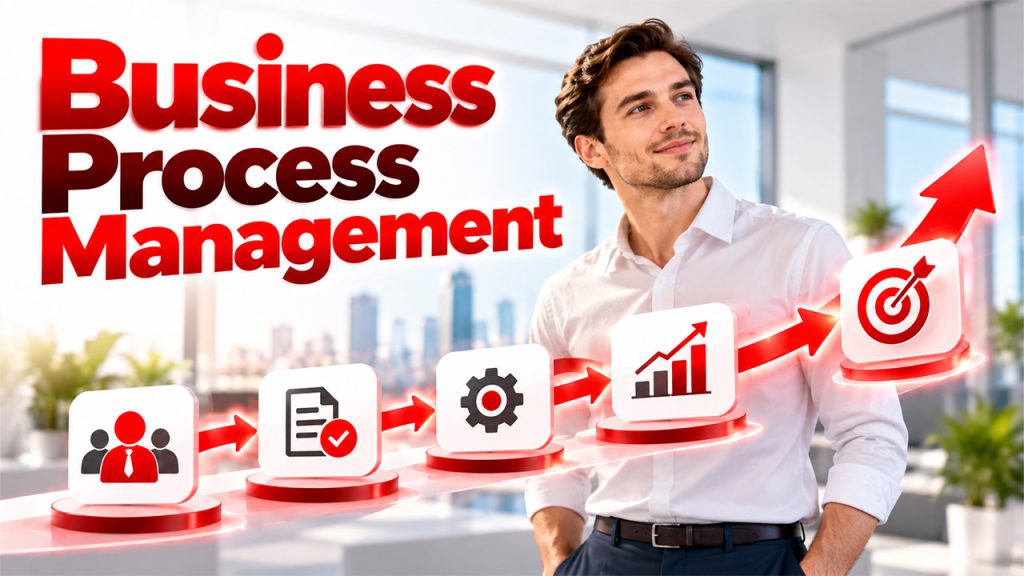
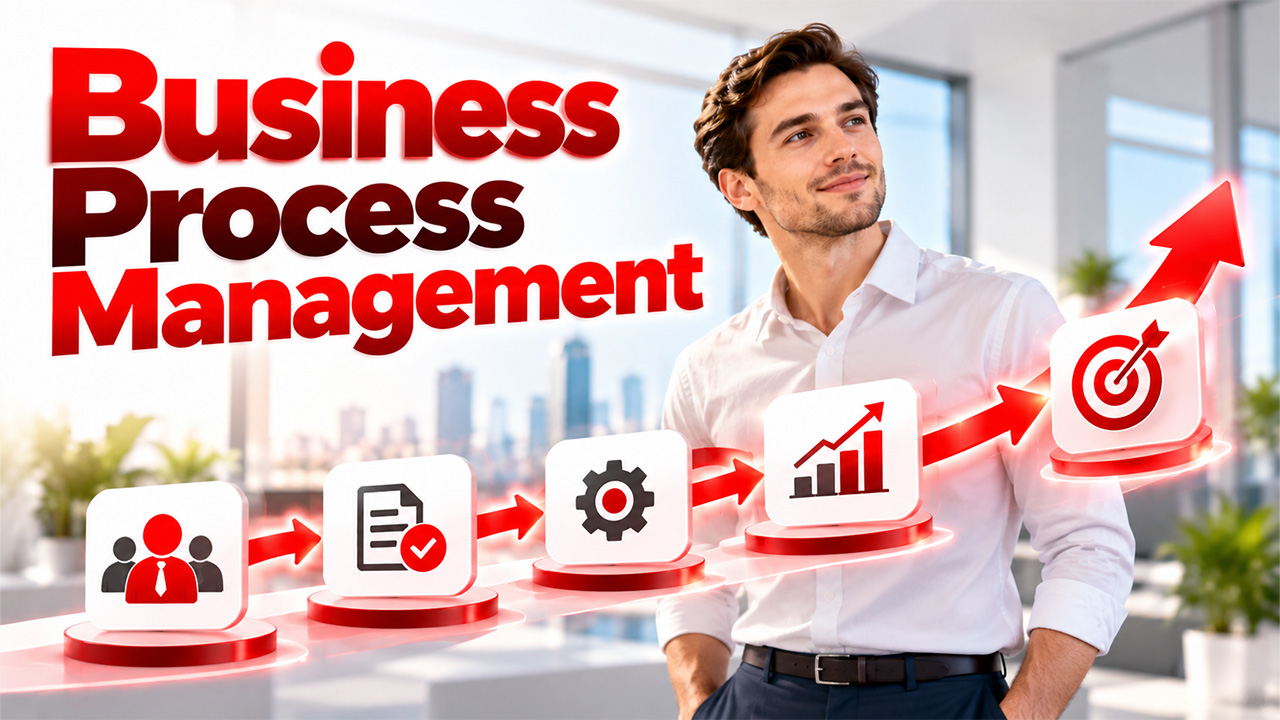
Successful BPM initiative follows a detailed cycle of repetition that has five separate stages:
- Design: Outline the milestones, individual tasks, and task owners, and define the metrics that can monitor progress.
- Model: Develop a visual representation of the process, which involves timelines, task descriptions, and data flow.
- Execute: Use this process with restricted groups, leverage feedback, and roll it across the entire organization.
- Track: Evaluate improvements in terms of efficiency and identify the remaining bottlenecks.
- Optimize: Make last adjustments to improve the activities of businesses.
Metrics are key at every stage. Defect cycle and rate time are prime examples of measures that reveal whether a redesigned process showcase more effective performance than before.
What Are the Benefits and Real-World Applications?

A BPM program that is run effectively gives you value across the entire business:
- Efficiency and Cost Savings: Eliminate bottlenecks and redundancies frees your resources for work with greater priority.
- Higher Employee and Customer Experience: Less repetitive work and clearer workflows that enable teams to focus on customers.
- Scalability: Consistent execution and particular roles make it straightforward to extend processes to the latest regions.
- Transparency: Clear task ownership improves accountability and communication.
- Less Reliance on Developers: Low-code features allow business users to adjust automation fast.
Such benefits apply across distinct functions:
- Human Resources: Organized management of timesheet approvals, onboarding management, and performance assessments.
- Finance: Straightforward templates for purchase order submissions.
- Banking: Fast decisions on eligibility of loads through a few errors in documentation as well as lesser errors.
- Fullfilment of Orders: Smooth capture of orders and delivery.
Customer-based teams benefit as well. Connecting BPM with CRM process automation connects end-to-end operational logic with company data, so handoffs between sales, service, and operations remain consistent.
Choosing Software and Enhancing Business Process Improvement
Business process management software gathers modeling, automation, and monitoring in one environment. A BPM suite can include different complementary technologies:
- Process mining tools to find and assess tasks.
- Diagramming platforms to visualize distinct processes.
- Workflow engines automate diverse tasks.
- Business rules engines that enable users to change rules without the assistance from the developers.
- Simulation and testing tools.
When assessing business process management software, you can look for specific features:
- Low-code or no-code interfaces with drag-and-drop functionality and visual dashboards.
- Integrating apps and APIs, including ERP, CRM, and legacy tools.
- Capabilities of AI to secure investment to secure investment with the evolution of technology.
Platforms do not guarantee results on their own. Long-term business process improvement depends on a few effective practices:
- Set up clear goals and different ways to evaluate them.
- Start small, in properly defined steps, and utilize early successes to guide projects later.
- Make your implementable advocate secure, since BPM delivers only when the management is on board.
- Define clear roles for process governance.
Automated workflows transform a redesigned process into repetitive practice. A CRM workflow generated multi-stage step, rule-driven triggers, and reminders is quite practical to use for customer-based work. Teams that also evaluate their wider set of business tools can recognize overlaps and gaps before they can slow down the process.
Conclusion
Business process management replaces scattered and inconsistent with a clear and measurable way to executable processes. Its five-stage lifecycle, process types, and focus on repeatable end-to-end flows to render businesses with a dependable framework for consistent process enhancement.
Choosing the right business process management software, setting up measurable goals, and starting with a small and well-defined process are crucial first steps. With executive backing and clear governance, BPM becomes a lasting way to improve efficiency, transparency, and customer satisfaction.
FAQs About Business Process Management
A- BPM is a discipline that leverages methods to look for, model, evaluate, and improve end-to-end and repeatable processes. Contrary to task or project management, it looks as if work flows across people, systems, and data.
A- There are three main types: human-centric (approvals and role-based tasks), integration-centric (system-to-system with human input), human-centric (role-based and approvals) and document-centric (documents going through reviews and approvals).
A- The lifecycle has five specific stages: design, model, implement, monitor, and optimize. Metrics such as defect rate and cycle time are utilized at each stage to check whether the redesigned process performs effectively.
A- BPM minimizes costs by removing redundancies and bottlenecks, enhancing employee and customer experience, and making processes simpler to scale. It also includes transparency through clear ownership and minimizes dependency on developers via low-code tools.
A- Check out low-code or no-code interfaces with visual dashboards and integration with apps and APIs like CRM and ERP. AI capabilities aid in future-proofing the investment as your technology evolves.