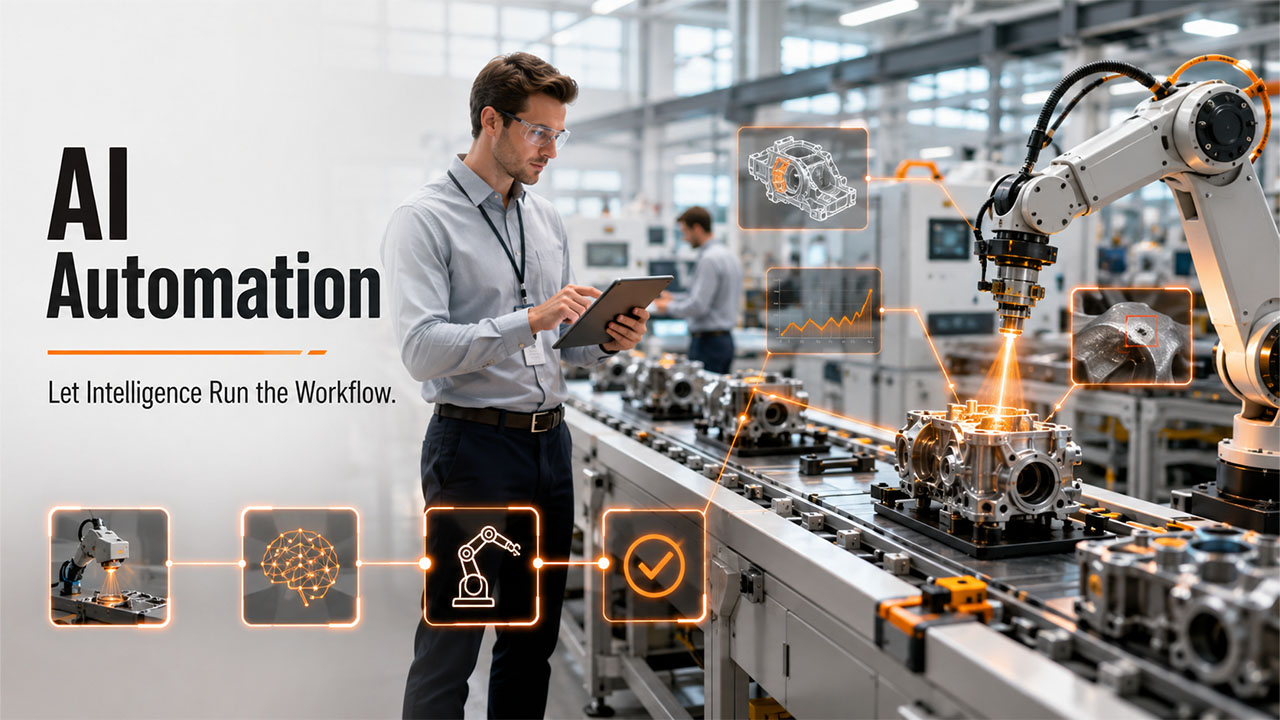

Suppose you set up an automation at work for sending an email every time someone fills out a form on your site. As long as people are filling out forms in a standard way, it works fine. However, the moment someone fills the form a bit differently, they might miss a field or use a weird symbol; the whole thing breaks. Now, you have to do everything by hand, wondering why you still have to babysit “automation”. This is exactly the problem with old-school automation. It only knows what you tell it to know.
The solution is AI automation. Instead of just following fixed steps, it can look at something new, understand it, and still get the job done.
What Is AI Automation?
AI automation is the result of combining artificial intelligence with automation software to make machines not just complete tasks but also make sensible decisions about how to complete them in the best possible way. Traditional automation could only follow instructions that someone feeds them prior to assigning tasks. However, AI automation goes a step further. It can easily analyze new information it’s never seen before, understand it, and figure out what to do next, much like a person would.
Simply put, automation does what it’s been told, while AI automation figures out what to do. The difference might sound small, but it changes almost everything about how businesses use it in 2026.
AI Automation vs Traditional Automation: What's the Difference?
Automation” and “AI” get used all the time interchangeably; however, they are not at all the same. Before exploring AI automation in depth, it's important to understand how it differs from traditional automation.
| Traditional Automation | AI Automation | |
| How it works | Follows fixed, pre-written rules | Learns from data and adapts |
| Handles new situations? | No, breaks or needs reprogramming | Yes; adjusts based on patterns |
| Best suited for | Repetitive, predictable tasks | Complex, changing, judgment-based tasks |
| Human involvement | High, rules need constant updating | Lower, system adapts on its own |
| Example | Auto-sending a receipt after a purchase | Detecting a fraudulent transaction it's never seen before |
The comparison makes one thing clear: AI automation goes beyond following rules by adapting to changing situations and making intelligent decisions. Once you understand how AI actually works at a basic level, this distinction starts to make a lot more sense
Core Technologies That Power AI Automation
AI automation relies on several technologies working together, each contributing a unique capability to help systems learn, understand, and make decisions.
Machine Learning (ML)
Machine learning is the ability of AI models to study large volumes of historical data and identify patterns that a human eye might overlook or would just take too long to recognize manually. After analyzing the patterns thoroughly, it can predict probable outcomes, such as knowing a machine part is about to fail before it breaks down completely.
Natural Language Processing (NLP)
NLP allows software to understand human language and respond in the same language that humans would understand. This technology powers chatbots that can read your question and respond with something that makes sense. A few examples include virtual assistants, customer service bots, and tools that prepare summaries of long documents in seconds. Without natural language processing, a machine can only read your words, not understand what you mean by them.
Optical Character Recognition (OCR)
Optical character recognition turns printed or handwritten text into digital, editable, and searchable content. For instance, when you feed a system with a stack of paper invoices, OCR scans them to extract all numbers and details useful to a business. You don’t have to type a thing; it handles everything on its own. Even PDF files that are already digital become far more useful once OCR makes them searchable.
Computer Vision
With computer vision, machines can “see” images and make sense of them. This ability allows software to analyze and understand visual information. A factory camera uses computer vision to spot a defective product on an assembly line in a split second. This technology also plays a big role in things like automated quality control and self-driving vehicles. In a lot of ways, it's the eyes of AI automation.
Robotics
When you pair AI with physical robots, you get machines that are flexible enough to handle tasks better than old, rigid assembly-line motion. This is used a lot in manufacturing where robots are required to adjust to slight variations. It has become increasingly common in healthcare, where surgeons use robotic-assisted surgery to perform more precise procedures. They can quickly adapt their movements depending on what they sense in real-time.
Key Benefits of AI Automation for Businesses
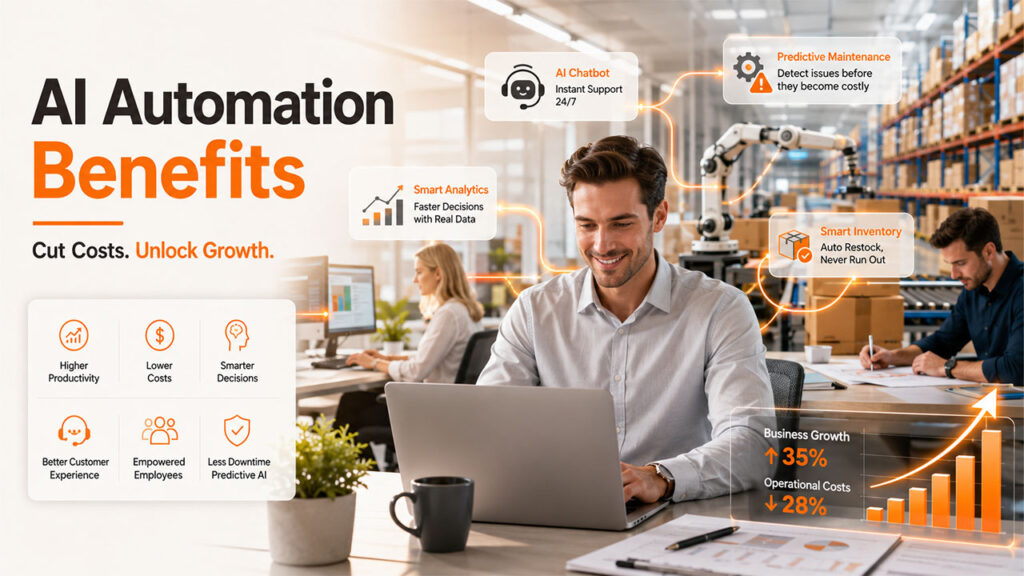
Businesses across industries are adopting AI automation because it improves efficiency, reduces costs, and enables smarter decision-making.
Increased Productivity with AI Automation
AI automation handles everyday tedious tasks automatically. It frees people for more creative and complex tasks that actually need a human brain. You can think of it like a tireless assistant who never asks for a coffee break and can work around the clock, so your actual team can focus on the work that matters.
Smarter Business Decisions
As compared to humans, AI can process huge amounts of data faster and more accurately. This allows businesses to make smart and faster decisions based on accurate information. This means you can make inventory restocking decisions based on real numbers or patterns, instead of just guesswork. Similarly, AI and machine learning are reshaping CRM systems in the business landscape.
Improved Customer Experience
AI chatbots provide better and faster support to customers 24/7. Your customers don’t have to wait twenty minutes on hold and receive a response at 2 a.m. The system never clocks out and offers personalized, relevant customer support to resolve issues faster.
Reduce Operational Costs
The more you automate tasks, the less human labor you need. This translates to fewer manual tasks, fewer bottlenecks, and fewer errors. Additionally, systems that adapt on their own need less constant maintenance and reprogramming.
Empower Employees with More Meaningful Work
When AI automation handles more repetitive work, people get to invest their energy and time in more meaningful jobs that require human imagination, thinking, and judgment. Nobody wants to spend their entire life copying data between spreadsheets, and now they don’t have to do so.
Less Downtime with Predictive AI
AI models can easily detect unusual activity or anomalies before they become costly repairs. For instance, AI can flag equipment or machine parts that are likely to fail before they actually do. This way, you can take appropriate measures in time before they turn into emergencies.
Real-World Examples of AI Automation
AI automation is already transforming everyday business operations. Here are some of the most common real-world applications.
- Healthcare: Doctors are swamped with administrative work such as scans and paperwork, which tires them out and even a slight mistake in their practice can be costly. AI scans X-rays or MRIs to spot patterns that doctors or nurses might miss under time pressure or exhaustion. Moreover, it also speeds up the tedious admin side, such as patient registration or billing.
- Finance: Every day, banks process millions of transactions, and fraud can slip through unnoticed in that volume. AI automation studies spending habits closely to notice anything strange, suspicious, or unusual activity, such as an unknown location or an odd amount and flag it immediately.
- Manufacturing: Earlier, factories struggled to predict machine breakdowns until they did. Fixing something after it has been completely damaged costs more. However, now, sensors collect data and feed it into AI models. AI then analyzes that data to spot early warning signs like a temperature spike or a slight vibration, and schedules repair before anything actually fails.
- Retail: Nobody wants a shelf that's either empty or overflowing with stock nobody's buying. AI looks at past sales, seasons, and even local trends to predict what customers will actually want, so stores order the right amount at the right time.
- Human Resources (HR): HR professionals receive several applications and resumes every month. Sorting through them manually is slow and exhausting. AI automation does basic screening by reading through applications, matching skills and experience to what a role actually needs, and pulling out the strongest candidates in a fraction of the time.
- Marketing: Generic ads rarely land well anymore. AI automation looks at what a person has browsed, clicked, or bought before, and uses that to shape offers that actually feel relevant, instead of just being noise in someone's inbox that nobody even bothers to open.
Each example discussed above follows the same pattern: a task that needed human judgment now runs automatically, with people stepping in only when it really matters.
Common Challenges of AI Automation

Despite its advantages, AI automation comes with challenges that businesses should understand before implementation.
Data Security and Privacy
In this digital-first world, data privacy is a real concern. AI systems often need access to sensitive business or customer information to offer better solutions. However, if that data isn’t handled carefully, it opens the door to cyberattacks and compliance risks.
Job Displacement Concerns
It is probably one of the most valid concerns that’s been creating buzz among people. As AI is taking over repetitive tasks, employees whose roles involve that kind of work feel anxious or insecure. The businesses that handle this well tend to invest in retraining people for higher-value tasks, rather than treating it purely as a cost-cutting move.
System Integration and Compatibility Issues
It trips up a lot of companies too. Not every AI tool plays nicely with the systems a business already has in place, and getting everything to work together smoothly can take real time, planning, and sometimes a fair amount of trial and error. To avoid this friction, businesses are turning to unified AI automation tools. Lark solves this by embedding workflow automation directly into messaging, documents, and databases, unifying automation with everyday collaboration in one seamless workspace.
While it may be true that AI comes with its challenges, none of these challenges cancel out the benefits. This just means AI automation needs to be introduced in professional and personal lives thoughtfully, not rushed in blindly.
Conclusion
The world before AI automation used to do everything manually, following rigid rules. AI doesn’t just fix that problem; it revolutionizes the whole approach. Instead of writing rules for every possible situation, you build a system that can reason through situations you never thought of planning for.
That's really the whole idea. AI automation is what happens when software stops just following orders and starts making calls of its own; carefully, and increasingly, reliably. For businesses trying to keep up in 2026, that shift isn't optional anymore. It's just how work is starting to get done.
FAQs About AI automation
Q. Is AI automation the same as robotic process automation (RPA)?
No. RPA follows fixed rules, while AI automation can adapt and make decisions based on new data.
Q. Do small businesses actually use AI automation?
Yes, increasingly so; many tools are now affordable and don't require in-house AI expertise.
Q. Will AI automation replace human jobs entirely?
Mostly not. It tends to transform roles rather than eliminate them, taking over repetitive parts of a job.
Q. What's the easiest place to start with AI automation?
Customer service chatbots or document processing are usually the simplest entry points.
Q. Is AI automation safe for handling sensitive data?
It can be, but only with proper security measures and clear data governance in place.
%201.png)

%201.png)

%201.png)