



For recruiters, formatting candidate CVs is the kind of task that nobody puts on their CV. It happens between the interesting parts of the job (sourcing a candidate, talking to a client, closing a placement), and yet it can swallow 30 to 45 minutes per submission. Multiply that by a busy desk submitting dozens of profiles a week, and you've got a senior recruiter quietly burning a full working day on Word formatting.
That's why CV formatting tools have stopped being a "nice to have" and started showing up in serious recruitment automation stacks. The good ones don't just reformat documents. They plug into Bullhorn or JobAdder, anonymize sensitive details, translate across languages, handle messy inputs like call transcripts and scanned PDFs, and quietly remove an entire category of busywork from the day.
Picking the right one is harder than it sounds. The market is split between enterprise veterans with 20-year heritages, modern AI-first platforms, UK-focused specialists, and tools that look almost identical until you read the fine print on per-seat fees, credit rollovers, or which ATS they actually integrate with. We've put together an honest, practical comparison of the eight platforms that recruitment agencies are actively shortlisting in 2026.
Evaluation criteria
Choosing a CV formatting tool isn't really about formatting. By the time anyone is shopping for one, they've already accepted that AI can rebuild a Word doc into a branded template. What separates the tools is everything else: how they price, what inputs they accept, how deeply they sit inside an ATS, and whether they help or hurt your procurement team.
For this comparison we looked at:
- Pricing model and transparency: pay-as-you-go vs per-seat vs credits, and whether prices are even published
- AI capabilities: unlimited prompting, CV tailoring per vacancy, anonymization, translation
- Input flexibility: PDFs, DOCX, scanned docs, LinkedIn exports, call transcripts
- ATS and CRM integrations: Bullhorn, JobAdder, Vincere, RecruitCRM, Zoho and others
- Deployment options: SaaS only, whitelabel, on-premise, isolated infrastructure
- Compliance posture: ISO 27001, SOC 2, GDPR, audit logs, data residency
- Onboarding effort: same-day self-serve vs sales-led procurement cycles
Every platform on this list has its place. Our top pick was FormaCV, for combining transparent per-CV economics with the broadest input handling and AI flexibility in the category.
Here's how the eight tools stacked up.
1. FormaCV
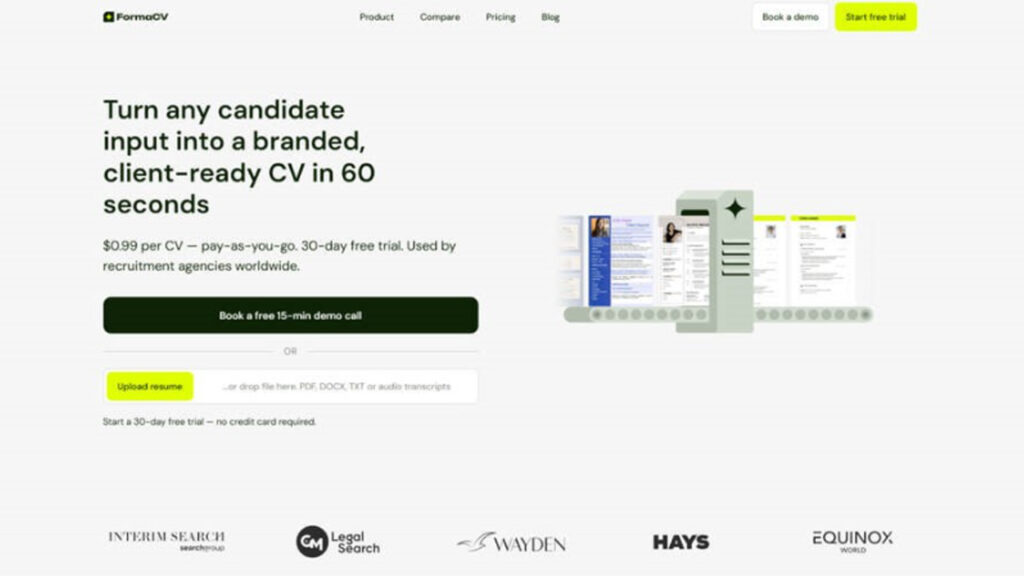
TLDR: A modern AI-first CV formatter with $0.99/CV pay-as-you-go pricing, unlimited AI prompting, and the broadest input handling in the category, including call transcripts.
FormaCV stands out as the most flexible option for recruitment teams that don't want their formatting tool to dictate their pricing structure or pipeline shape. Instead of per-seat fees or credit packs that expire at month-end, it runs on a published $0.99 per formatted CV with unlimited AI prompting included. The standout feature is input breadth. FormaCV is, as far as we can tell, the only formatter on the market that takes screening call transcripts (Otter, Fireflies, Gong) as a first-class input. The platform is already used by global enterprises including HAYS.
| Feature | Detail |
| Best for | Recruitment teams that prioritize transparent pay-as-you-go pricing, isolated data infrastructure, and the flexibility to format CVs from any input source, including call transcripts, LinkedIn exports, and messy non-standard files |
| Key strength | Transparent per-CV pricing combined with deep AI prompting and integrations |
| Biggest weakness | Does not produce candidate microsites or video intros (HireAra's specialty) |
On compliance, FormaCV offers whitelabel and on-premise deployment with isolated per-customer infrastructure, though ISO 27001 and SOC 2 Type II are still in progress. For AI flexibility, MCP support, and native ATS integrations across Bullhorn, JobAdder, Vincere, RecruitCRM, Zoho, and PeopleForce, this is the most complete AI-powered CV formatting tool in our comparison.
2. HireAra
TLDR: A polished candidate-presentation platform with branded microsites and engagement analytics, priced for mid-large agencies on per-seat tiers.
HireAra has the largest verified user base in CV formatting (10,000+ recruiters) and goes beyond plain CVs with spec documents, candidate landing pages, branded microsites, and video intros, plus engagement analytics that track how clients interact with each profile. If your pitch to clients is built around presenting candidates better than competitors, HireAra is purpose-built for it.
| Feature | Detail |
| Best for | Mid-large agencies competing on candidate-presentation quality |
| Key strength | Spec documents, microsites, and client-engagement analytics |
| Biggest weakness | Tiered per-seat pricing pre-loads cost regardless of volume |
The trade-off is pricing. HireAra runs tiered per-seat plans starting at £180/mo and scaling to £950/mo, which suits agencies with predictable steady volume but feels heavy for variable workloads. The platform is ISO 27001 certified, which is a real procurement advantage, but doesn't currently support unlimited AI prompting, on-premise deployment, or call transcript handling.
3. Allsorter
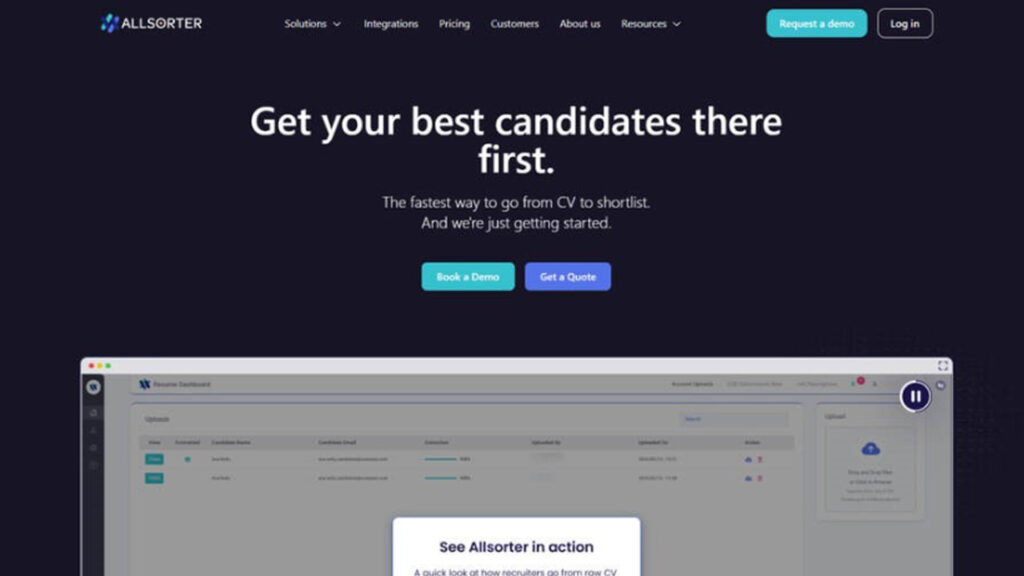
TLDR: The enterprise veteran with ISO 27001 and deep Bullhorn integration, priced through demo-led custom quotes.
Allsorter is the established enterprise option. It's long-tenured, ISO 27001 certified, and built around formal procurement cycles. Its standout product feature is a one-click formatting mode that preserves the original document layout while applying branding, which is genuinely useful in compliance-heavy workflows.
| Feature | Detail |
| Best for | Large enterprises and RPOs with Bullhorn-deep workflows |
| Key strength | ISO 27001 certification and one-click "preserve original" formatting |
| Biggest weakness | No published pricing; demo-led procurement only |
The downside is no published pricing. Everything runs through sales conversations sized for teams of five users or more. There's no MCP support, no call transcript handling, and the AI prompting layer is more limited than modern alternatives. For ISO-required procurement and Bullhorn loyalty, Allsorter is a safe shortlist pick. For most other operations, it asks more in procurement effort than it returns.
4. Daxtra Styler
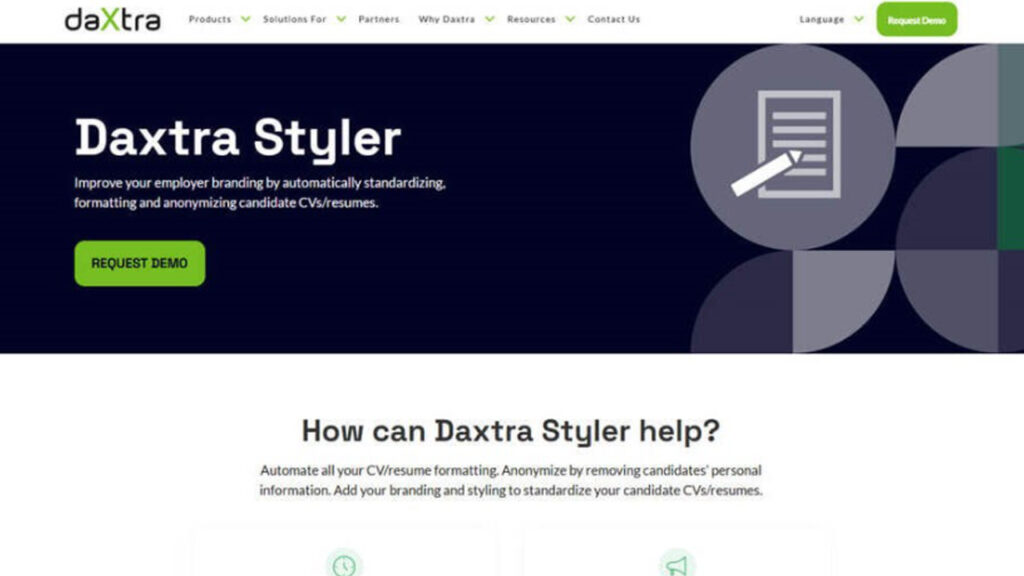
TLDR: A 20-year veteran with the deepest CV parser in the market, best for agencies already in the Daxtra ecosystem.
Daxtra is the longest-tenured name on this list. Its parser has been embedded inside multiple ATS platforms for over two decades, supports 40+ languages, and extracts more than 150 structured fields from a CV. Daxtra Styler is the formatting layer that sits on top of that parser.
| Feature | Detail |
| Best for | Existing Daxtra Capture customers and large enterprises with multi-year vendor contracts |
| Key strength | The deepest CV parser in the market with a 20+ year heritage |
| Biggest weakness | Sales-led procurement, undisclosed pricing, weeks-long onboarding |
For everyone outside the Daxtra ecosystem, this is a heavier lift than the capabilities require. Pricing isn't disclosed publicly but customer reports put entry around $500/mo and full Capture + Styler bundles often above $1,500/mo. Onboarding runs 2 to 6 weeks. If your downstream automation depends on those 150+ structured fields, Daxtra is unmatched. For formatting alone, modern alternatives deliver more flexibility for less effort.
5. CVFormatter
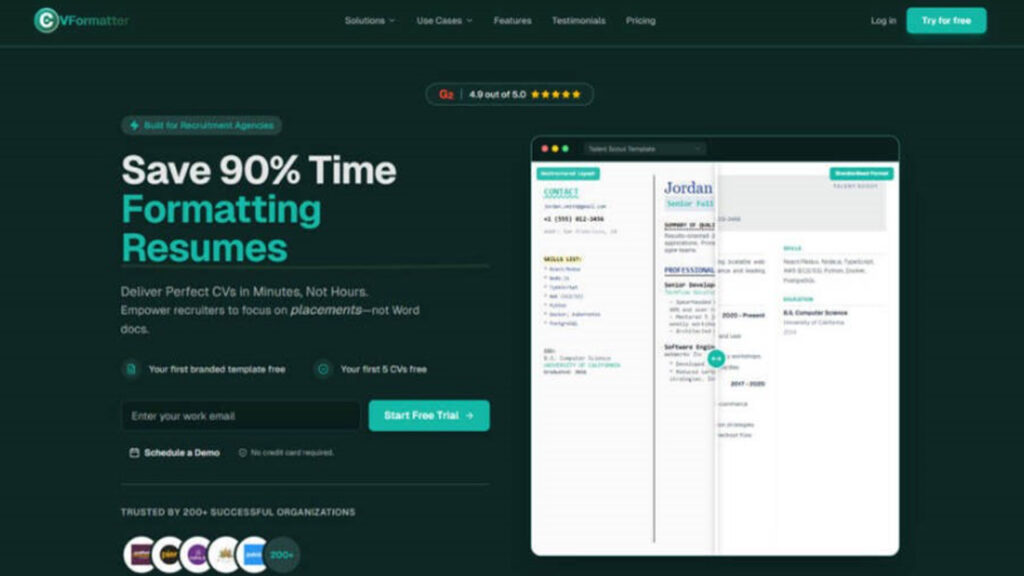
TLDR: A JobAdder-deep formatter with translation as a headline feature and a strong G2 review base.
CVFormatter (cvformatter.co, not to be confused with FormaCV) is built around two things: deep JobAdder integration and translation as a core capability. Its 4.9/5 G2 rating with a substantial review base is a real social-proof advantage. Pricing is published and predictable: $79/mo on Standard, $299/mo on Enterprise.
| Feature | Detail |
| Best for | JobAdder-focused agencies with translation-heavy multilingual workflows |
| Key strength | Established JobAdder depth and translation specialization |
| Biggest weakness | Limited API access and no support for non-CV inputs |
The trade-off is breadth. CVFormatter doesn't ship MCP support, doesn't offer whitelabel or on-premise deployment, and doesn't handle call transcripts. For JobAdder-only agencies with steady volume, it earns its niche. For multi-ATS stacks or messier pipelines, you'll outgrow it.
6. Quibench
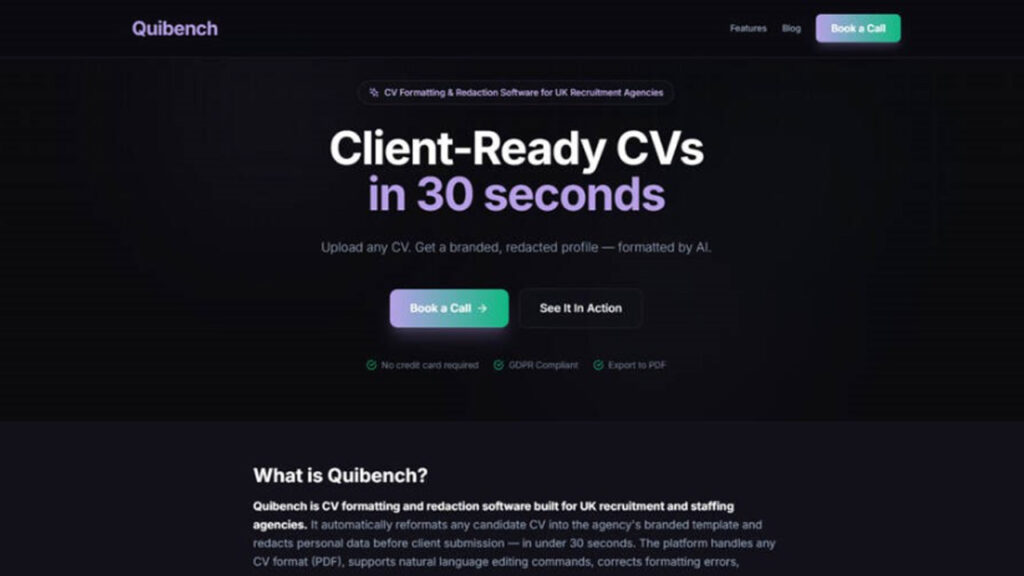
TLDR: A UK-focused, GDPR-led formatter with anonymization as the core product and a free starter tier.
Quibench is positioned squarely around the UK recruitment market and the compliance pressures that come with it. Anonymization and GDPR redaction are the headline product, built for blind hiring workflows where names, photos, contact details, and education origins are stripped before client submission. The free $0/month Starter plan is the lowest barrier to entry in this category.
| Feature | Detail |
| Best for | UK agencies focused on blind hiring and GDPR compliance |
| Key strength | Anonymization as a core feature plus a free starter plan |
| Biggest weakness | UK-centric focus and undisclosed paid-tier pricing |
The catch is that paid pricing tiers aren't published. You'll need a quote once you outgrow Starter. There's also no documented support for MCP, call transcripts, or deep API access. For UK desks where blind hiring is the primary pitch, Quibench is purpose-built. For global agencies, the geographic and feature focus starts to constrain.
7. RapidRecruit
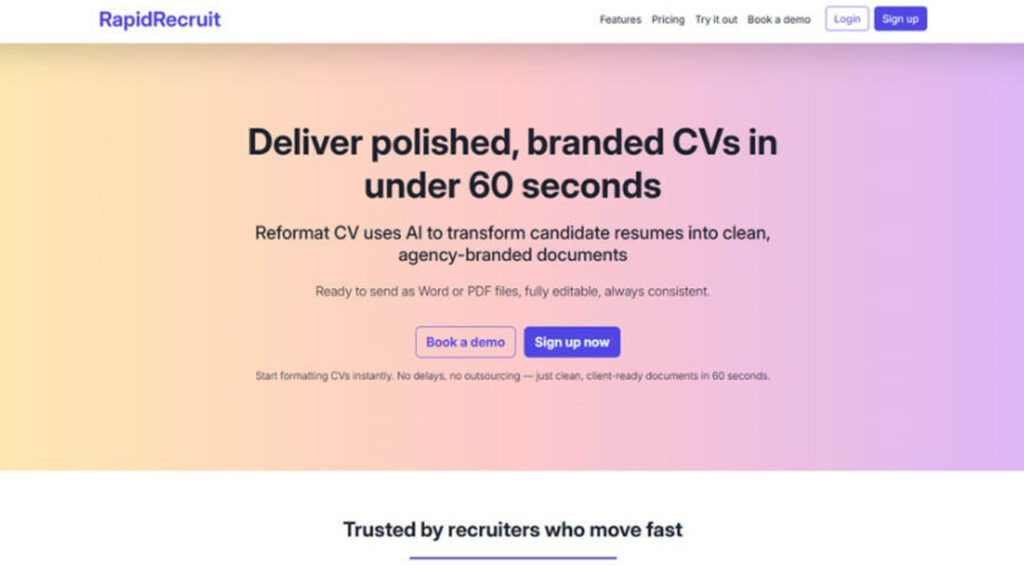
TLDR: A UK credit-based formatter built for scanned and photographed CVs at predictable monthly volume.
RapidRecruit's specialty is scanned and photographed CVs as a first-class input, not an afterthought OCR feature. For UK agencies that work with high-street walk-ins, mailed applications, or industries where digital-only CV submission isn't the norm, that capability is genuinely useful. The platform also markets a built-in AI grammar pass as part of formatting.
| Feature | Detail |
| Best for | UK agencies with steady volume of scanned or photographed CVs |
| Key strength | Scanned-document handling and a built-in AI grammar pass |
| Biggest weakness | Credit-based pricing with no monthly rollover |
Pricing runs on credit-based monthly tiers from £299/mo (150 credits) to £999/mo (1,000 credits), with no rollover for unused credits. ATS integration is limited compared to platforms with native Bullhorn, JobAdder, and Vincere connectors. For agencies in RapidRecruit's niche, it's a strong specialist. For everyone else, pay-as-you-go alternatives come out ahead on cost flexibility.
8. RemakeCV
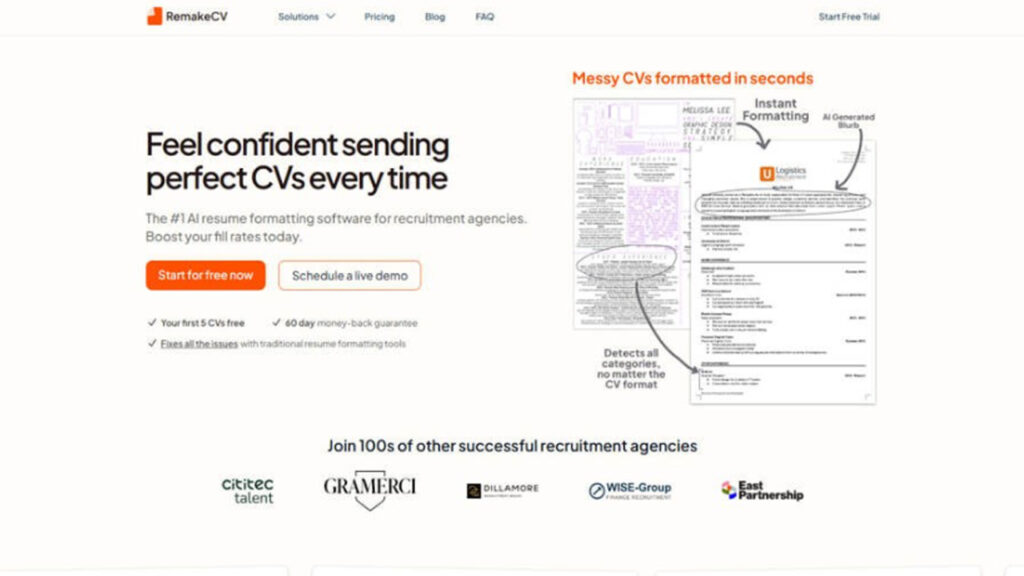
TLDR: An entry-level AI formatter with credit-based per-user pricing, solid for small agencies needing basic capabilities.
RemakeCV is the simplest option for agencies that want AI formatting without complications. It supports PDF and DOCX inputs, ships with custom branded templates and auto-anonymization, and handles bulk formatting at $25 per user per month with 30 credits included. The first 5 CVs are free.
| Feature | Detail |
| Best for | Small agencies needing basic CV formatting at low entry cost |
| Key strength | Simple per-user pricing and auto-anonymization out of the box |
| Biggest weakness | Limited input formats, no call transcripts, no advanced AI prompting |
What you don't get is breadth. RemakeCV doesn't handle TXT files, LinkedIn exports, or call transcripts. There's no smart candidate matching, no per-vacancy CV tailoring, and no on-premise deployment. For a small agency with simple needs, it's fine. For anything more complex, the ceiling arrives fast.
Summary: choosing the right CV formatting tool for your agency
For recruitment teams scaling beyond a couple of recruiters, the right CV formatting tool is an operational decision that touches pricing predictability, ATS depth, compliance posture, and the inputs your pipeline can absorb without breaking. The eight platforms above all have legitimate use cases, but they fit different shapes of operation.
For agencies with variable workload, multi-ATS environments, AI-heavy workflows, or pipelines that include non-CV inputs like screening call transcripts, FormaCV came out as the most operationally complete pick. For mid-large agencies competing on candidate presentation, HireAra's microsites and engagement analytics are differentiated. For Bullhorn-deep enterprises with formal procurement, Allsorter's ISO 27001 status and one-click preserve mode earn their place. And for niche use cases like Daxtra's parsing depth, Quibench's UK anonymization, RapidRecruit's scanned-document handling, CVFormatter's JobAdder specialty, or RemakeCV's entry-level simplicity, there are real reasons to choose them when the fit is right.
The best approach is the same one that works for any recruitment automation purchase. Map your actual workflow first, identify which inputs and integrations you genuinely need, run a free trial where one is offered, and review a CV for Success Review before picking the platform whose pricing model fits how your volume actually behaves rather than how the vendor wishes it would.
FAQs about AI CV formatting tools
Q1. What is the difference between CV parsing and CV formatting?
CV parsing extracts structured data from a resume (name, email, work history, skills) and feeds it into an ATS. CV formatting takes that data, or the raw document, and rebuilds it into a branded, client-ready presentation. Some tools focus on one; the better recruitment platforms do both. Daxtra is the deepest parser; FormaCV combines parsing with full formatting plus AI prompting on top.
Q2. How long should AI-powered CV formatting take?
For most modern AI formatters, 30 to 60 seconds per CV is realistic. Manual formatting in Word typically runs 25 to 45 minutes per submission, depending on the complexity of the agency's branded template and the messiness of the source document. The biggest time savings show up when the tool handles non-CV inputs like transcripts, scanned docs, or LinkedIn exports without requiring conversion first.
Q3. Can these tools integrate with my existing CRM and ATS?
The depth of integration varies significantly. Tools like FormaCV publish native connectors for Bullhorn, JobAdder, Vincere, RecruitCRM, Zoho, and PeopleForce, plus REST API and webhook support on every plan. Others (RemakeCV, RapidRecruit) operate primarily as Word/PDF in-out tools with limited ATS depth. If your CV formatter has to talk to your CRM, integration depth should be on your shortlist before pricing.
Q4. Do I need ISO 27001 certification from my CV formatting vendor?
It depends on your clients. Enterprise clients and procurement-heavy industries (financial services, government, healthcare) often require ISO 27001 or SOC 2 Type II as a supplier baseline. HireAra and Allsorter currently hold ISO 27001; FormaCV lists both as in progress while offering on-premise deployment with isolated per-customer infrastructure as an alternative path for security-conscious teams. For agencies without enterprise clients pushing the question, the certification is less critical than the deployment options behind it.
Q5. Are pay-as-you-go or subscription models better for CV formatting?
Neither is universally better. It depends on your volume profile. Pay-as-you-go (FormaCV at $0.99/CV) wins for variable workload, smaller desks, and agencies that don't want to gamble on monthly volume. Per-seat (HireAra) and credit-based (RapidRecruit) tiers can work out cheaper at very high steady volume but waste money on light months. Run your actual monthly numbers through both pricing models before committing. Most agencies overestimate their volume consistency.
%201.png)

%201.png)

%201.png)