
The shift of artificial intelligence from an optional advantage to a business priority is now seen more than ever. However, many AI initiatives struggle to deliver measurable value, and the problem isn’t often the technology itself. Companies just happen to lack strong data and processes needed to support them.
According to McKinsey’s 2025 State of AI report, 78% of organizations use AI in at least one business function, yet only 39% mention an EBIT impact at the enterprise level. Success tends to depend less on adopting new models. Companies experiencing the greatest returns share the one trait: they strengthen their data foundation and redesign business processes before scaling AI.
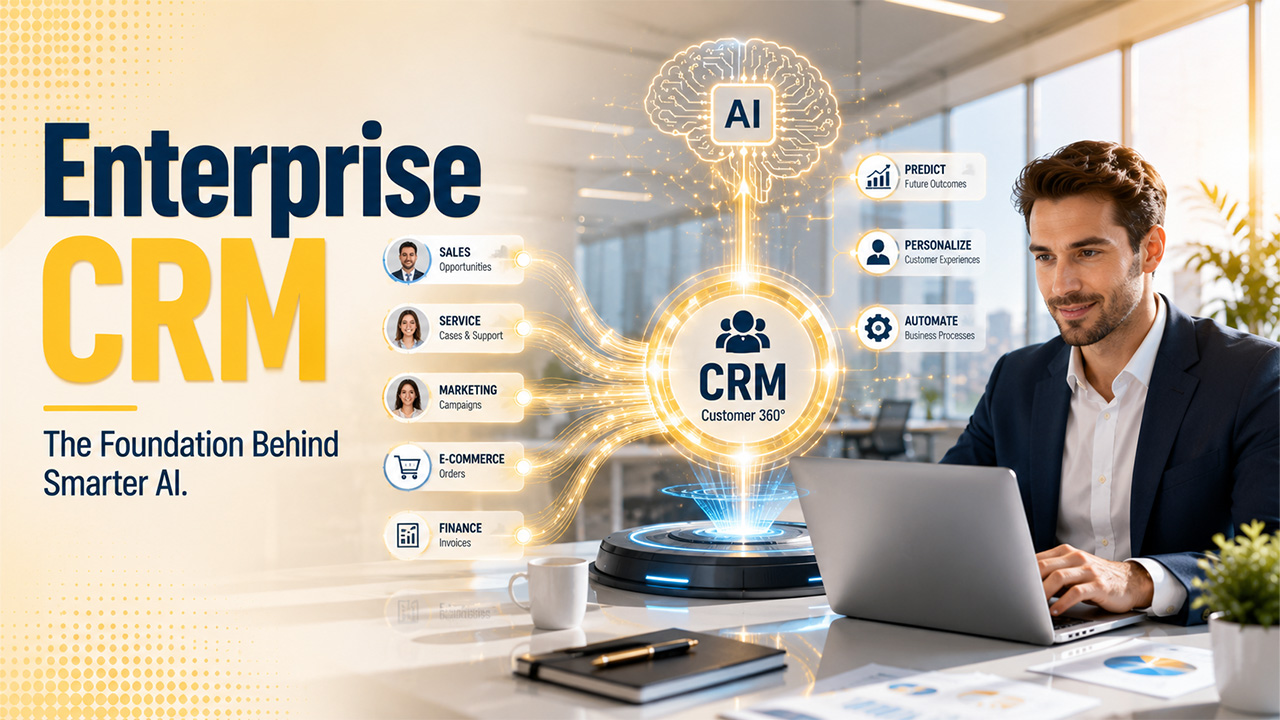
That foundation often begins with Enterprise CRM. AI performs best when customer information is accurate, connected, and easy to access. A trusted Salesforce implementation partner helps organizations create that environment where AI relies on proven insights.
Why AI Starts with CRM
Imagine asking AI to identify your highest-value customers when sales, marketing, and support each store different versions of the same account. The results won’t inspire much confidence. AI needs context, and CRM provides it.
Salesforce addresses this challenge through Customer 360, which is designed to bring interactions customers leave throughout various channels into one complete profile. AI analyzes the entire customer journey, not just works with isolated records. This data quality allows you to notice patterns that would otherwise remain hidden and make relevant upgrades. A strong CRM implementation also improves the processes behind the data. You can enjoy:
- Integrations connecting Salesforce with ERP, finance, and support platforms.
- Automated workflows resulting in reduced manual mistakes.
- Governance that keeps information consistent, secure, and compliant.
Together, these capabilities define CRM maturity. Organizations with standardized data and connected systems are far better positioned to scale AI than those still gathering fragmented information from multiple systems.
Building an AI-Ready Salesforce Ecosystem
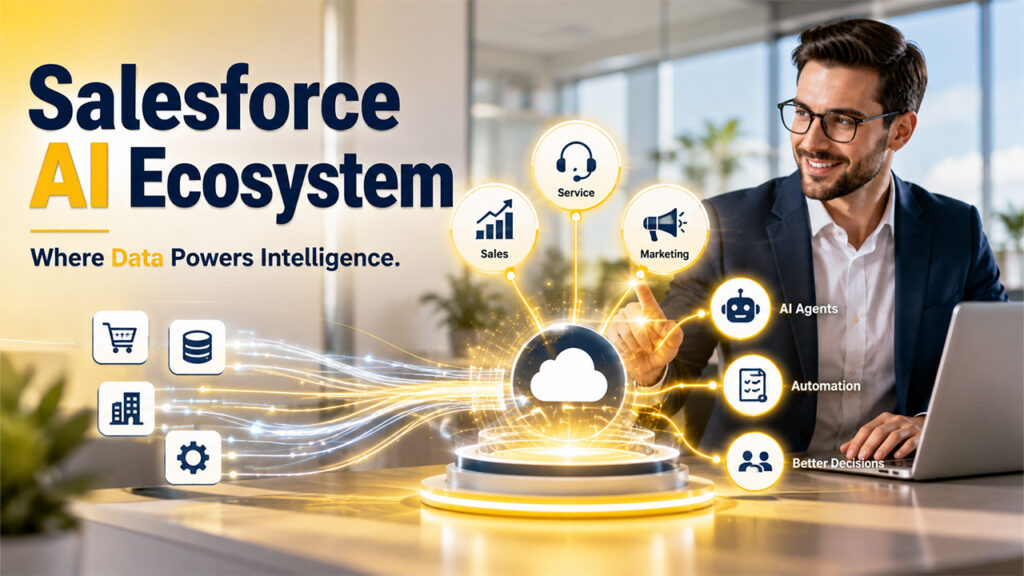
An AI-ready Salesforce environment is much more than a CRM database. It bridges a few clouds so customer information flows across the business.
Sales Cloud provides AI with opportunity history, forecasts, and customer behaviors, helping sales teams get a vision of which leads they need to prioritize and predict revenue more accurately.
Service Cloud captures support cases, resolutions, and customer feedback. AI scrutinizes them to recommend knowledge articles and route requests to the right teams.
Marketing Cloud adds engagement intelligence. It lets AI personalize campaigns based on how customers actually interact with the brand instead of targeting audience segments.
The real game changer, however, is Salesforce Data Cloud. It unifies information from Salesforce, ERP platforms, eCommerce systems, and other business applications into real-time customer profiles. It means no scattered records anymore because AI has one consistent source of truth.
That foundation powers Salesforce Agentforce, which extends beyond answering questions. AI agents may qualify leads, draft customer responses, summarize meetings, and automate repetitive business processes, yet how effectively they’ll do it depends only on data quality. Even the most advanced AI can’t compensate for incomplete or variable customer information.
Finally, integrations tie everything together. Modern Salesforce implementation services focus on connecting operational systems and actionable insights flowing from data. With secure APIs, information moves freely across departments, while real-time dashboards assist leaders in monitoring performance and revealing new opportunities. All features together turn Salesforce into a platform that supports smarter automation and business decisions.
Common AI Implementation Challenges
An AI strategy can look impressive on paper and still fall short in production. The usual obstacles are already sitting inside the organization.
- Poor Data Quality. Duplicate accounts, outdated contact details, and missing fields all can undermine AI suggestions. Deloitte research states that data-related problems caused 55% of surveyed organizations to avoid certain generative AI use cases.
- Siloed Systems. Sales may have one customer record; finance, marketing, and service may hold different versions. AI fails to build a reliable customer picture from disconnected sources.
- Legacy Architecture. Older applications often lack modern APIs or require more advanced integrations. Replacing everything at once can drain much of the budget, so companies need a practical modernization roadmap.
- Low Adoption. Employees may ignore AI tools that require extra steps to take or produce unreliable answers. Successful deployments fit naturally into existing workflows, showing users a clear benefit.
- Weak Governance. AI introduces questions around permissions, privacy, accuracy, and accountability. In reference to Gartner, only 29% of surveyed companies confirm having a formal GenAI governance policy, while 67% still lack it.
- Limited Implementation Expertise. Connecting Salesforce, external data sources, automation, and AI comes with architecture skills that go beyond standard CRM configuration.Experienced Salesforce consulting can help organizations plan the right architecture and implementation approach.
Enterprise AI Readiness Checklist
Before launching an AI initiative, assess the CRM environment against seven practical areas:
| Area | What to check |
| CRM maturity | Sales, service, and marketing processes should be standardized |
| Data quality | Duplicate, incomplete, and outdated records are regularly addressed |
| Automation | Have repetitive workflows already been streamlined? |
| Security | The clear definition of permissions, privacy controls, and access policies |
| Integrations | The ability for Salesforce to exchange data with ERP, finance, eCommerce, and other core systems |
| Reporting | Consistency of dashboards and trustworthiness of metrics teams work from |
| AI governance | Are AI outputs monitored, tested, and reviewed against business rules? |
The checklist can also pinpoint areas companies should invest first. If customer data remains fragmented, deploying an AI agent may create more operational work rather than reduce it.
Choosing the Right Salesforce Implementation Partner
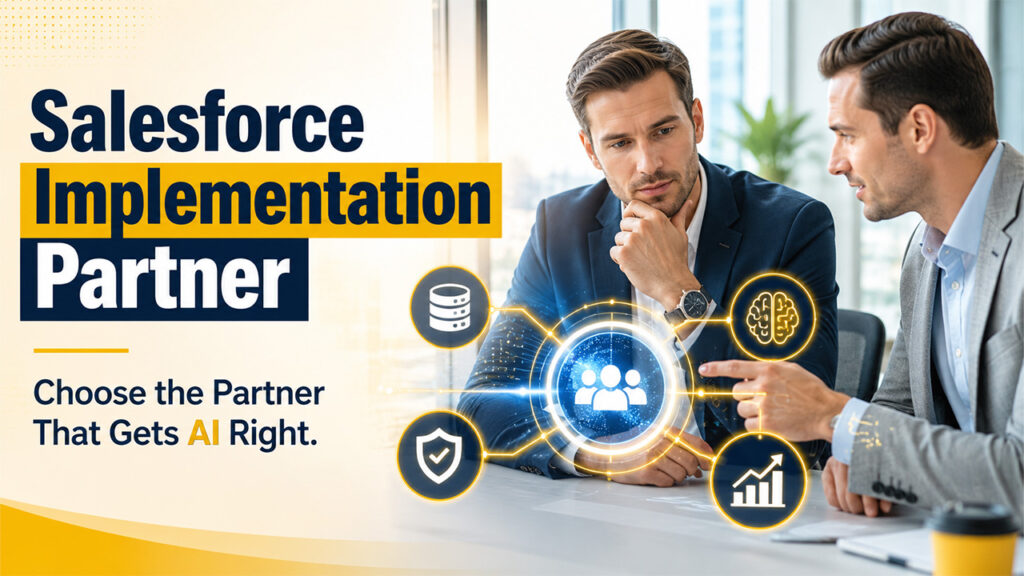
The choice of a Salesforce implementation partner requires looking beyond certification counts. The strongest candidates have to demonstrate relevant experience with your industry, data architecture, integrations, and AI use cases.
Ask prospective partners to show how they approach Data Cloud, Agentforce, security, testing, and post-launch support. Their methodology matters too. A good Salesforce consulting engagement begins with business goals and data readiness; then outlines the technology required to achieve them.
Customer reviews and case studies can highlight another important detail – what is going to happen after implementation. AI systems need monitoring, optimization, and user adoption work long after the initial launch.
Top Salesforce Implementation Partners for AI-Ready CRM Projects
The companies below represent different approaches to Salesforce transformation rather than a strict ranking.
| Company | Headquarters | Epertise | Industries | Key Strengths |
| Accenture | Dublin, Ireland | Salesforce, Data Cloud, AI | Cross-industry | Large-scale transformation and personalized experiences |
| Deloitte Digital | New York, USA | Salesforce, Data Cloud, CX | Financial services, healthcare, retail | Strategy, data, and customer experience |
| IBM Consulting | Armonk, USA | Salesforce, AI, integration | Enterprise, financial services, manufacturing | Connecting CRM with complex legacy environments |
| Slalom | Seattle, USA | Salesforce, Data Cloud, Agentforce | Healthcare, retail, public sector | Collaborative delivery and AI accelerators |
| Cognizant | Teaneck, USA | CRM, cloud, AI | Healthcare, banking, retail | Enterprise modernization |
| TCS | Mumbai, India | Salesforce, AI, cloud | Cross-industry | Global delivery and Salesforce transformation |
| Noltic | Kyiv, Ukraine | Salesforce, Data Cloud, Agentforce | Finance, telecom, logistics, SaaS, nonprofit | Salesforce Summit Partner with strong data and integration expertise |
Accenture has developed Salesforce solutions combining Data Cloud and AI for personalized customer experiences. Deloitte focuses on Data Cloud, data unification, and customer experience, while IBM combines Salesforce with enterprise AI and integration capabilities.
Slalom holds an Agentforce Foundations Accelerator built around Salesforce Data Cloud and is a founding member of the Agentforce Partner Network. IBM has been named a Leader in the 2025–2026 IDC MarketScape for Worldwide Salesforce Implementation Services.
Noltic fits the specialized-partner category. Its published capabilities include Data Cloud, Agentforce, MuleSoft, Sales Cloud, Service Cloud, Marketing Cloud, CRM Analytics, and custom API development. The company includes 90 Salesforce-certified professionals and over 400 certifications.
There’s no ultimate right choice because each company involves different project complexity, industry requirements, internal resources, and the level of long-term support required.
Future Trends & Conclusion
The next stage of CRM is moving from prediction toward action. McKinsey’s 2025 research found that almost all organizations are investing in AI, yet only 1% of surveyed leaders considered their organizations’ generative AI rollouts mature.
Agentic AI will increasingly handle workflows such as lead qualification and service resolution. Predictive CRM will spot buying signals earlier; customer data platforms will continue bringing information into unified profiles. Real-time analytics is expected to help teams with responses to changing customer needs.
Salesforce is already linking Data Cloud and Agentforce more closely. Salesforce reported $900 million in Data Cloud and AI annual recurring revenue for FY2025. Since October, the company has closed 5,000 Agentforce deals, including more than 3,000 paid deals.
The message is clear: clean data, connected systems, automation, and governance are things that determine how effectively companies can scale AI. A mature Enterprise CRM provides that foundation, making CRM implementation and Salesforce implementation services strategic investments for the next generation of customer operations.
%201.png)

%201.png)

%201.png)