
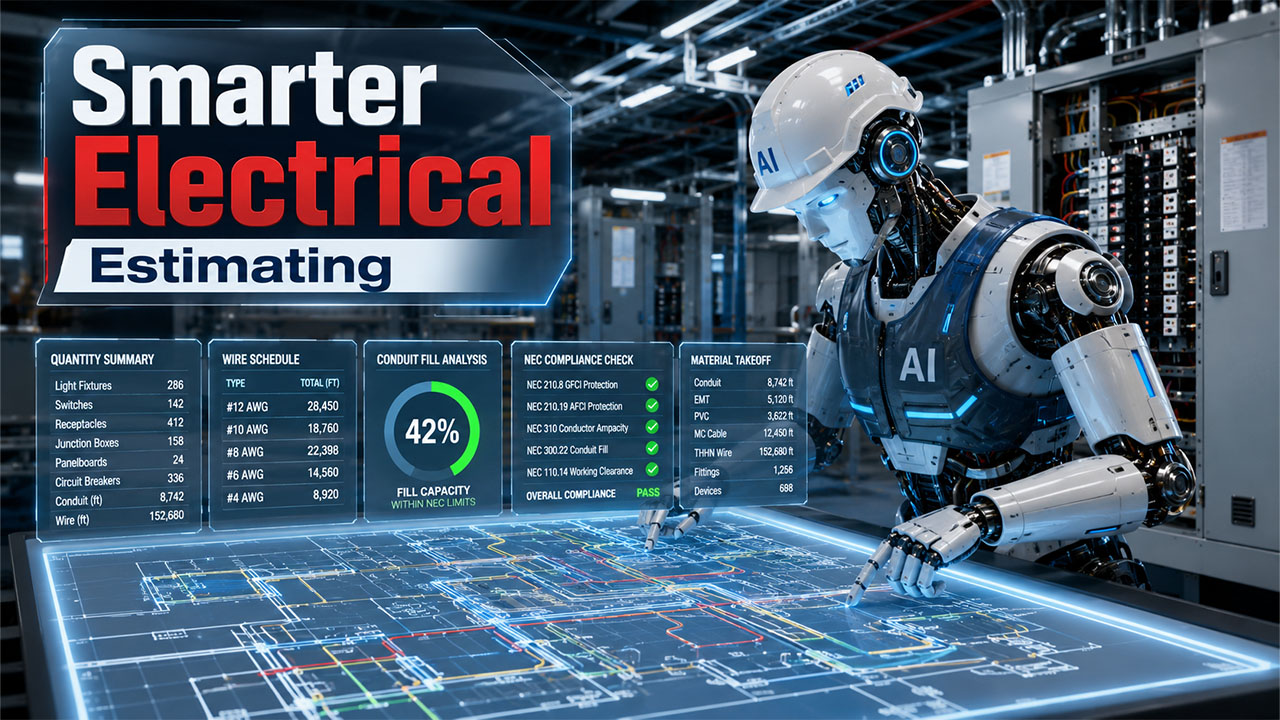

The electrical contracting industry has always demanded precision — in material counts, in circuit design, and in code adherence. Today, more estimators and project managers are discovering Drawer AI online as a practical solution and are adopting AI electrical takeoff software to streamline NEC-compliant project planning, improve estimating accuracy, and connect takeoff data directly to billing workflows.
The Hidden Cost of Manual Workflows
A typical electrical project moves through at least three distinct phases before a single invoice goes out: takeoff, estimating, and billing. In most firms, each phase lives in a different tool — a spreadsheet, an ERP platform, QuickBooks — and each handoff requires someone to re-enter data by hand. That manual transfer is where errors compound. Quantities get mistyped, material markups are omitted, and change orders made during construction fail to reach the billing system. The result is margin leakage that quietly reduces profitability across every job.
The same problem shows up on the compliance side. Electrical estimators routinely cross-reference a dozen NEC articles — Article 210 for branch circuit sizing, Article 310 and Table 310.16 for conductor ampacity, Chapter 9 tables for conduit fill — and each lookup takes time and introduces risk. With complex projects running hundreds of circuits across multiple panel schedules, the likelihood of missing a code requirement grows with every page turned.
What AI Electrical Takeoff Software Actually Changes
Modern AI electrical takeoff software addresses both problems at once by automating blueprint analysis, NEC code checks, and quantity extraction, similar to how AI in software development is transforming complex business processes. When project drawings are uploaded, the software automatically scans blueprints, counts devices, routes branch circuits, and sizes wire — applying NEC rules from Article 210, Article 310, and Chapter 9 without requiring the estimator to open the codebook. Voltage drop calculations, conduit fill checks, and panel schedule interpretation happen in the background, flagging issues before they become field problems.
The output is a structured quantity report: a clean, labeled spreadsheet listing every device, material, and wire size along with specifications. That document isn't just takeoff data — it's the foundation for the entire billing pipeline. Because the quantities are organized and consistent from the start, they can be imported directly into estimating or ERP software, priced with labor rates and material costs, and converted into progress billings or final invoices without re-entering a single line item.
How AI Electrical Takeoff Software Helps Contractors Keep Up with NEC Changes

The 2023 NEC introduced several updates that affect estimating directly: expanded GFCI protection requirements mean more devices per project; new EV charging infrastructure rules alter conduit layouts and load calculations; enhanced arc-flash labeling standards add documentation requirements to every job. Each change shifts material counts and compliance checkpoints — and not all jurisdictions have adopted the 2023 edition yet, with many still enforcing 2020 or 2017 standards.
For estimators working across multiple regions, tracking which code version applies to each project is itself a time-consuming task. AI tools that integrate NEC compliance into the takeoff workflow reduce that burden, applying the relevant standards automatically based on project parameters and flagging where jurisdiction-specific rules may differ.
From Estimate to Invoice: How AI Electrical Takeoff Software Connects the Entire Workflow
The firms seeing the most benefit from AI-assisted takeoff are those that have connected it directly to their billing software. When the same dataset drives the estimate and the invoice, discrepancies between what was scoped and what gets billed effectively disappear. Invoices reflect actual quantities, change orders are captured in real time, and payment cycles shorten because clients have fewer grounds to dispute line items.
For electrical contractors managing multiple concurrent projects, that compounding efficiency represents a genuine competitive advantage — not just faster invoicing, but more accurate financial data across the entire business.
Conclusion
As the electrical projects become more complex, code requirements continue to evolve. For this, the contractors need tools that help improve both accuracy and efficiency. This is where AI electrical takeoff software comes into play. The software helps in bridging the gap between estimating, NEC compliance, and billing, simply by automating time-consuming tasks and reducing the risk of costly errors. From blueprint analysis to material takeoff and code verification, the software helps reduce the risk of costly errors. Especially for firms looking to stay competitive in rapid changing industry, adopting AI electrical takeoff software has become a necessity.
%201.png)

%201.png)

%201.png)